Your pay arrives in one account. Bills leave from it. Groceries, subscriptions, transfers, and debit-card purchases may all pass through the same balance.
Then an unexpected expense appears—or you realize that money intended for an emergency, a vacation, or next year’s insurance bill has gradually disappeared into ordinary spending.
The problem may not be that you failed to save. It may be that money with different purposes was kept in the same place.
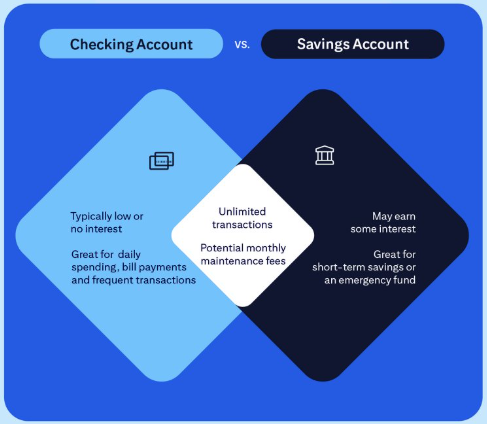
Checking and savings accounts are both places to hold deposits, but they are designed around different jobs. A checking account is generally built for frequent access and everyday transactions. A savings account is generally built for money that should remain available without being used routinely.
Understanding that distinction can help you decide whether one account is enough, whether you need both, and how to organize them without making your finances unnecessarily complicated.
Terminology note: This article uses the American term checking account. Similar everyday transaction accounts may be called current accounts, transaction accounts, or other names in different countries. Product rules, fees, protections, and withdrawal terms vary by country and financial institution.

Quick Answer
A checking account is usually the best place for money you expect to use soon, including:
- income deposits;
- recurring bills;
- debit-card purchases;
- ATM withdrawals;
- transfers;
- and ordinary monthly spending.
A savings account is generally better for money you want to keep available but separate from routine spending, including:
- an emergency fund;
- upcoming annual expenses;
- a vacation;
- a home or car repair;
- a short-term goal;
- or extra cash that does not need to remain in checking.
For many households, the most practical structure is not choosing one account instead of the other. It is using:
Checking for movement and savings for separation.
The right setup still depends on account fees, minimum-balance requirements, interest rates, withdrawal rules, deposit access, and how frequently you need the money. Those details matter, but they should support the account’s purpose rather than replace it.
Reader Navigation
| Your situation | Focus on |
|---|---|
| You use one account for everything | Why separating money can help |
| You are opening your first bank account | What checking and savings are each designed to do |
| You want to build an emergency fund | Why savings can create a useful boundary |
| You are unsure whether you need both | When one account may be enough |
| You already have both accounts | Whether each account has a clear job |
| You tend to spend from the displayed balance | How separation can make available money easier to understand |
The Basic Difference
Checking and savings accounts can both hold money at a bank or credit union.
The difference is primarily how the account is intended to be used.
A checking account is usually designed for transactions. It commonly supports direct deposit, bill payments, debit-card purchases, electronic transfers, ATM withdrawals, and other frequent activity.
A savings account is generally designed for holding money rather than continuously moving it. It may pay interest and may place more distance between reserved money and everyday purchases.
A simple way to think about the distinction is:
| Account | Primary job |
| Checking | Receive, spend, pay, and transfer |
| Savings | Separate, preserve, and prepare |
This does not mean money in savings can never be withdrawn. Savings exists to be used when its intended purpose arrives.
The difference is that checking normally supports activity happening now, while savings supports needs that are important but not part of ordinary daily spending.
What Is a Checking Account?
A checking account is an account used to manage money that regularly enters and leaves your financial life.
It may receive:
- wages;
- pension payments;
- benefit payments;
- transfers;
- refunds;
- or other deposits.
It may then be used to pay:
- rent or a mortgage;
- utilities;
- credit-card bills;
- groceries;
- transportation;
- subscriptions;
- insurance;
- and other routine expenses.
Checking accounts commonly provide:
- a debit card;
- ATM access;
- online and mobile banking;
- electronic transfers;
- bill-payment tools;
- direct deposit;
- cheque-writing capability;
- and transaction records.
These features make checking the working centre of many households’ short-term cash flow.
Checking Works Best for Money With a Near-Term Job
Suppose your income is deposited on the first day of the month.
Over the next several weeks, that money may need to cover housing, food, utilities, transportation, insurance, debt payments, subscriptions, and flexible spending.
That money needs to remain accessible.
Moving all of it into savings simply because savings pays more interest may create unnecessary transfers or make upcoming bills harder to manage. The value of checking is usually not that it produces the highest return. Its value is that it allows money to move through ordinary life.
This is why a checking balance should not automatically be treated as available spending money.
Part of the balance may already be committed to:
- bills that have not posted yet;
- pending debit-card purchases;
- upcoming automatic payments;
- or necessary spending before the next deposit.
Checking is a working balance. Understanding what is already committed is as important as knowing the number displayed in the app.
What Is a Savings Account?
A savings account is generally intended for money that you do not expect to use through everyday transactions.
It may be used for:
- an emergency fund;
- an annual insurance premium;
- a home repair;
- a future trip;
- education costs;
- a planned purchase;
- a tax reserve;
- or another short-term goal.
Savings accounts often pay interest, although the rate can vary widely. Some checking accounts also pay interest, and some savings products may offer only a modest rate.
For many people, however, the most important benefit of savings is not interest. It is separation.
Separation Makes the Balance Easier to Understand
Imagine that your bank app shows a total balance of $6,000.
That may look like a comfortable amount. But perhaps:
- $2,000 is reserved for emergencies;
- $1,200 is for an insurance bill due later;
- $800 is for travel;
- $1,000 must cover bills before the next paycheque;
- and only $1,000 is available for flexible use.
The total is still $6,000, but the purposes are different.
When all of that money sits in checking, you must mentally subtract every reserved amount before deciding what is safe to spend.
Moving future-purpose money into savings does not create more money. It makes the purpose of existing money clearer.
Account separation does not increase your cash. It reduces the chance of mistaking reserved money for spendable money.
Why One Account Can Become Difficult to Manage
Using one account for everything can work.
It may be reasonable when:
- the balance is small;
- expenses are simple;
- the account holder tracks obligations carefully;
- and creating another account would add fees or unnecessary complexity.
The problem appears when one balance begins to represent too many different things.
A single account may contain:
- money for today;
- money already committed to bills;
- money for a future expense;
- emergency reserves;
- and money for a personal goal.
Without clear separation, every spending decision requires an internal calculation.
You must ask:
- Which payments have not posted yet?
- How much belongs to the emergency fund?
- What amount is needed for the annual bill?
- How much is truly uncommitted?
- Will another deposit arrive before the next major expense?
The more obligations you have, the harder that calculation becomes.
A savings account can reduce the mental work by creating a boundary between:
money for current life
and
money for later use
That boundary does not need to be complicated. For many people, one checking account and one savings account are enough.
Do You Always Need Both?
No.
One account may be enough when:
- you are just beginning and hold only a small balance;
- your spending and bills are simple;
- you already use a reliable budgeting method;
- the account pays a competitive rate;
- there are no meaningful transaction restrictions;
- and you are unlikely to spend reserved money accidentally.
For example, a student with limited income and only a few recurring expenses may reasonably begin with one low-fee checking account.
A person who carefully tracks every category in a budgeting system may also be able to keep several purposes inside one account without confusion.
Both accounts may become more useful when:
- you receive regular income;
- you manage several recurring bills;
- you are building an emergency fund;
- you save for annual or irregular expenses;
- you tend to spend according to the displayed balance;
- or you want to reduce the chance of using reserved money unintentionally.
The purpose is not to open more accounts simply because banks offer them.
The purpose is to make your available, committed, and reserved money easier to distinguish.
Access and Interest: The Two Main Practical Differences
Checking usually offers easier transaction access. Savings usually offers stronger separation and is more likely to pay interest.
Those differences matter, but neither should be evaluated alone.
Access
Checking commonly supports:
- debit-card purchases;
- recurring payments;
- bill payments;
- ATM withdrawals;
- person-to-person transfers;
- and everyday deposits.
Savings may support transfers and withdrawals, but the exact tools vary. Some savings accounts include ATM access. Others require money to be moved into checking before it can be spent.
Financial institutions may also establish savings withdrawal limits or charge fees under their account agreements. The former federal rule commonly associated with a six-transfer limit is no longer imposed in the same universal way, but an institution may still apply its own terms.
That makes one question especially useful:
Will I need to spend this money directly, or only move it occasionally?
Money used regularly usually belongs in checking.
Money that should remain available but untouched most of the time usually fits savings better.
Interest
Savings accounts are more likely to pay interest than basic checking accounts.
That makes savings a reasonable home for cash that does not need to move immediately.
But interest should not become the only decision factor.
A higher rate may be less valuable when the account also requires:
- a monthly fee;
- a large minimum balance;
- qualifying deposits;
- a linked account;
- or transaction conditions that do not fit your needs.
The detailed comparison of fees, minimum-balance rules, and account-switching costs belongs later in this Banking Basics cluster. For this foundation article, the essential point is simpler:
The account should perform its job well after its real conditions are considered.
A Simple Two-Account System
For many households, a basic two-account system is enough.
Checking
Use checking for:
- income;
- regular bills;
- ordinary spending;
- debit-card purchases;
- scheduled payments;
- and money needed before the next deposit.
Savings
Use savings for:
- emergencies;
- annual or irregular expenses;
- short-term goals;
- planned purchases;
- and cash that does not need to remain in everyday circulation.
This structure helps answer two separate questions:
- What money needs to move soon?
- What money should remain available for later?
The exact dollar amount to keep in checking is a separate decision. It depends on income timing, payment schedules, irregular expenses, and the buffer needed to avoid routine shortfalls. That question will be addressed in detail in the later article, How Much Cash Should You Keep in Your Checking Account?
How the Basic Structure Changes by Situation
The same checking-and-savings distinction can serve different households, but the emphasis may change.
First-Time Account Holder
A first-time account holder may begin with:
- one checking account for deposits, payments, and debit-card use;
- and one savings account for a first emergency reserve or short-term goal.
The initial priority is usually simplicity.
Useful features may include:
- low or no monthly fees;
- a convenient ATM network;
- clear account alerts;
- easy transfers;
- and an overdraft setup the account holder understands.
The goal is not to create a sophisticated system immediately. It is to learn that money for ordinary use and money being preserved can have different homes.
Regular-Income Household
A household with predictable income may use checking for current cash flow and savings for reserves and upcoming irregular expenses.
Income may arrive in checking, after which a planned amount moves to savings.
The important principle is that saving should not leave checking so underfunded that the household must repeatedly reverse the transfer.
A sustainable separation is more useful than an aggressive transfer that fails every month.
Irregular-Income Household
A freelancer, contractor, seasonal worker, or commission-based employee may still use checking and savings, but their balances can serve more than one purpose.
Checking may need to hold a larger operating reserve because the next deposit is less predictable.
Savings may contain:
- emergency reserves;
- money for slow-income periods;
- taxes;
- and planned expenses.
In this situation, a high bank balance after a strong month does not necessarily mean the full amount is available to spend.
The detailed target-balance calculation belongs in the later checking-balance article. The foundation principle remains the same: separate money according to when and why it will be needed.
When One Savings Account Is Enough
A single savings account can hold money for several goals.
For example:
| Savings purpose | Amount |
| Emergency reserve | $4,000 |
| Car repair | $1,000 |
| Travel | $1,200 |
| Annual insurance bill | $800 |
| Total savings | $7,000 |
The money can remain in one account while the categories are tracked through:
- a spreadsheet;
- a budgeting app;
- labelled savings buckets;
- or a simple written record.
Separate accounts may help when the categories are difficult to preserve inside one balance. They are not automatically necessary.
A useful rule is:
Use the smallest number of accounts that still makes the purpose of your money clear.
Too few accounts can blur important boundaries. Too many can create forgotten balances, extra fees, and unnecessary transfers.
Common Mistakes
Treating Checking and Savings as Competing Choices
The question is often framed as:
Should I use checking or savings?
For many people, the better answer is both—each for a different purpose.
Treating the Entire Checking Balance as Spendable
A checking balance may include money already committed to bills or necessary spending.
The displayed number should not be mistaken for a discretionary budget.
Leaving All Reserved Money in Checking
Keeping everything in checking can feel simple, but it may cause emergency or goal money to appear available for ordinary spending.
Savings can create a useful boundary.
Moving Every Extra Dollar Out of Checking
Separation should not make current cash flow fragile.
Checking still needs enough money for near-term expenses and a reasonable margin for timing differences. The exact amount will be covered in Topic 6 of this cluster.
Opening Too Many Accounts
An account should solve a clear problem.
Opening separate accounts for every small goal may create more administration than clarity.
Choosing by Interest Rate Alone
A higher rate may be attractive, but an account must also fit your access needs, fee conditions, and normal transaction pattern.
The highest advertised yield is not automatically the best account.
Assuming “Savings” Means the Money Will Remain Saved
An account label does not create discipline by itself.
Savings works best when the money has a defined purpose and the household understands when it may be used.
Decision Summary
| Your situation | Practical starting point |
| You need an account for income and daily transactions | Start with checking |
| You are building an emergency fund or short-term reserve | Add savings |
| You use one balance for bills, emergencies, and goals | Separate current and future-purpose money |
| You already track every category reliably | One account may be workable, depending on its terms |
| You repeatedly spend reserved money | Create stronger separation |
| You repeatedly transfer savings back for normal bills | Reconsider how much belongs in checking |
| You have several savings goals | Track categories within one account before opening many accounts |
| You are comparing products | Match fees, access, and interest to the account’s intended job |
The EverydayWise Question
Before opening an account or moving money between accounts, ask:
What job does this money need to perform?
Money expected to move soon generally belongs in checking.
Money being preserved for later generally benefits from savings.
The goal is not to create the perfect number of accounts. It is to make current, committed, and future-purpose money easier to distinguish.
Final Thoughts
Checking and savings accounts are not competing products.
They are complementary tools for different parts of everyday financial life.
Checking is generally best for:
- receiving income;
- paying bills;
- making purchases;
- withdrawing cash;
- and managing ordinary transactions.
Savings is generally best for:
- emergencies;
- planned expenses;
- short-term goals;
- and cash that should remain available without sitting in the path of daily spending.
Some people can manage those purposes inside one account. Many households gain clarity from using both.
The best setup is not determined by the number of accounts, the largest advertised interest rate, or the most features.
It is determined by whether the structure helps you answer three questions:
- What money is available for current use?
- What money is already committed?
- What money should remain available for later?
When those answers are clear, checking and savings can work together without making banking more complicated than it needs to be.
FAQ
Is a checking account or savings account better?
Neither is universally better. Checking is generally more useful for everyday transactions, while savings is generally better for reserves and short-term goals. Many people benefit from using both.
Can I use a savings account instead of checking?
Possibly, but it may be inconvenient for regular bills, debit-card purchases, ATM access, and frequent transfers. Review the account’s transaction features and withdrawal terms before using savings as your primary account.
Can I use checking as a savings account?
Yes. However, reserved money may be easier to spend accidentally when it remains in the same account used for daily transactions. A separate savings account can create a clearer boundary.
Do I need both accounts if I have only a small amount of money?
Not necessarily. One low-cost account may be enough when your finances are simple. A second account becomes more useful when you need to separate emergency money, planned expenses, or other reserves.
Do savings accounts still limit withdrawals?
A federal six-transfer limit is no longer imposed in the same universal manner, but a bank or credit union may still apply withdrawal limits or fees under its own account agreement. Check the current terms.
Should I open a separate savings account for every goal?
Not automatically. One savings account with labelled categories may be easier to manage. Open another account when the additional separation solves a clear problem.
Is it bad to transfer money from savings back to checking?
No. Savings exists to be used for its intended purpose. Frequent unplanned transfers for ordinary spending may indicate that checking is underfunded or that the savings goal was not clearly defined.
Sources
- CFPB – What Is the Difference Between a Checking Account, a Demand Deposit Account, and a NOW Account?
- CFPB – Why Am I Being Charged for Transactions in My Savings Account?
- CFPB – Should I Get a Checking Account That Pays Interest?
- CFPB – Bank Accounts and Services
- FDIC – Deposit Accounts
- FDIC – Deposit Insurance
More in This Cluster: Banking Basics
- Checking vs Savings Accounts: What Each Is For and Why You May Need Both (you are here)
- Online Bank vs. Traditional Bank: Which Fits Your Needs?
- Joint vs Individual Bank Accounts: Which Should You Choose?
- How to Compare Bank Fees Before Switching Accounts
- Debit Cards, ATM Cards, and Bank Cards Explained
- How Much Cash Should You Keep in Your Checking Account?
- What Deposit Insurance Does—and Does Not—Protect