Quick Summary
The FDA approved Moderna’s MFLUSIVA on August 5, 2026, making it the first mRNA seasonal influenza vaccine approved in the United States. It is a single-dose injection for adults 50 and older and is formulated for the 2026–2027 flu season.
Approval does not establish that MFLUSIVA is the best choice for every adult over 50. It also does not mean every pharmacy already has it, every health plan covers it on the same terms, or CDC has given it preference over established flu vaccines.
Reader Decision
Do not delay a suitable seasonal flu vaccination solely to wait for the new product. Ask whether MFLUSIVA is available, appropriate for your age and health history, covered by your plan, and preferable to the other vaccines offered at that appointment—especially if you are 65 or older.

What FDA Approval Means
MFLUSIVA uses messenger RNA instructions to prompt an immune response to influenza antigens represented in the vaccine. It does not contain influenza virus and cannot cause influenza from the vaccine itself.
The approved 2026–2027 formula is a trivalent vaccine, meaning it targets three influenza components selected for the season. That is not unique to MFLUSIVA: U.S. seasonal flu vaccines are now trivalent.
The product is given as one 0.38 mL intramuscular dose. Its approval covers prevention of influenza disease caused by the influenza A subtypes and influenza B type represented in the vaccine. Like other flu vaccines, it may not protect every recipient or cover influenza viruses not represented in that season’s formulation.
The Approval Is Different at 50–64 and 65+
FDA’s label covers everyone age 50 and older, but the evidence pathway is not identical across that whole range.
For adults 50 through 64, the approval is supported by clinical efficacy data. For adults 65 and older, the indication received accelerated approval based on immune responses. Continued approval in that older group may depend on a confirmatory trial verifying and describing clinical benefit.
FDA required a randomized study comparing MFLUSIVA with a high-dose influenza vaccine in U.S. adults 65 and older. The approval letter lists study completion in 2029 and a final report due in 2030.
Accelerated approval is a legal FDA approval pathway—not an experimental-use designation. The practical limitation is narrower: the clinical benefit in adults 65 and older still requires confirmation. The current label therefore does not support claiming that MFLUSIVA works better than high-dose, adjuvanted, recombinant, or other age-appropriate vaccines.
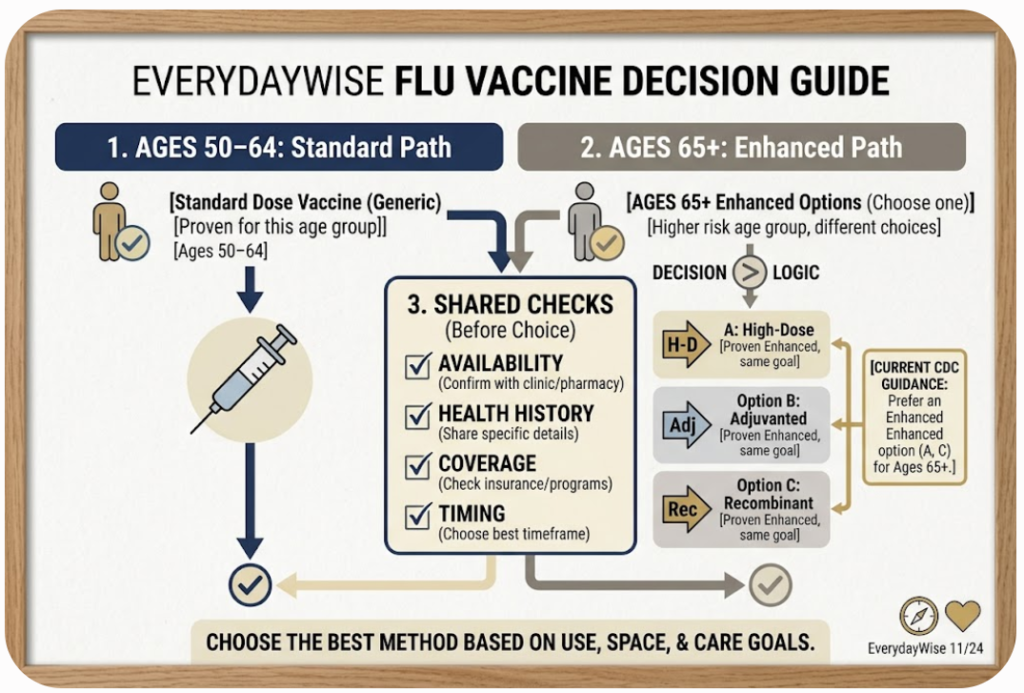
If You Are 50–64
Adults in this age range now have another approved option. Under recent CDC guidance, adults younger than 65 generally do not have one specific age-appropriate flu vaccine preferred over another, outside limited clinical exceptions.
Your useful questions are straightforward:
- Is MFLUSIVA stocked at this location for the 2026–2027 season?
- Is it covered under my pharmacy or medical benefit?
- Do my allergy history, prior vaccine reactions, immune condition, or current illness change the choice?
- If it is unavailable, what other age-appropriate vaccine can I receive today?
Novel technology may be personally appealing, but receiving an appropriate vaccine at the right time can matter more than securing one brand.
If You Are 65 or Older
This group needs an extra comparison. CDC has historically preferred three enhanced options for people 65 and older: high-dose inactivated, adjuvanted inactivated, or recombinant flu vaccine. If none is available at the vaccination opportunity, CDC guidance has allowed another age-appropriate vaccine.
MFLUSIVA’s approval arrived after the most recently posted detailed CDC selection summary available during this review. Do not assume its FDA approval automatically changed CDC’s product preference. Before choosing it, ask the vaccinator to check the current 2026–2027 CDC recommendation and explain how MFLUSIVA compares with the enhanced vaccine available locally.
What Side Effects Were Common in Trials?
In the FDA label, the most commonly reported reactions in both age groups included:
- pain at the injection site;
- fatigue;
- headache;
- muscle or joint pain;
- chills; and
- underarm swelling or tenderness.
These solicited reactions were reported more often with MFLUSIVA than with the standard-dose comparator in the main trial. Their median onset was about two days after vaccination and median duration was about two days; most were mild or moderate.
The vaccine should not be given to someone with a history of a severe allergic reaction to MFLUSIVA or one of its components. The label also calls for individual benefit–risk consideration if Guillain-Barré syndrome occurred within six weeks of a previous influenza vaccination. Discuss those histories with the vaccinator rather than trying to resolve them from a retail booking screen.
Seek emergency care for signs of a severe allergic reaction or another medical emergency after vaccination. Report concerning or persistent symptoms to a healthcare professional.
Approval Is Not the Same as Availability
Moderna says it expects MFLUSIVA to be available to eligible U.S. adults during the 2026–2027 respiratory-virus season. That is a manufacturer expectation, not proof that a particular pharmacy, clinic, employer event, or physician’s office has received doses.
Before traveling for it, call or use the provider’s current booking system and ask:
- Do you have the 2026–2027 MFLUSIVA formula in stock?
- Is it offered to my age group at this location?
- Will you bill my insurance, and what might I owe?
- If it is out of stock, which age-appropriate flu vaccines are available now?
Verify coverage directly with the insurer when an unexpected charge would affect your decision. “FDA approved” and “in network at no cost to me” answer different questions.
Timing Still Matters
CDC recommends annual flu vaccination for most people age six months and older who do not have a contraindication. For most adults, September or October has generally been the preferred vaccination window, with vaccination continuing while influenza viruses circulate. Individual timing can differ when someone may not be able to return later or has other clinical considerations.
The arrival of an mRNA option does not change the basic planning question: which suitable vaccine can you receive at an appropriate time? If waiting for MFLUSIVA could mean missing vaccination entirely, ask a clinician or pharmacist whether an available alternative is the better choice.
The Practical Takeaway
MFLUSIVA expands choice for adults 50 and older and marks a significant technology milestone. Its first-season value to an individual still depends on ordinary questions: age, health history, current recommendations, local stock, insurance coverage, and timing.
Adults 50–64 can compare it with other age-appropriate products without assuming the newest platform is automatically superior. Adults 65 and older should add one more step—ask how the new vaccine fits with CDC’s current preference for enhanced flu vaccines and with FDA’s confirmatory-study requirement for the older indication.
This newsletter provides general U.S. health information and is not medical advice. Vaccine recommendations, availability, coverage, and product labeling can change. Discuss your age, allergies, prior reactions, medical conditions, pregnancy status, medications, and vaccination history with a qualified healthcare professional. Seek urgent medical help for signs of a severe allergic reaction or another emergency.
FAQ
Is MFLUSIVA approved for people younger than 50?
No. The current FDA approval is for people age 50 and older. Studies for younger adults and children do not make the product approved for those groups.
Is MFLUSIVA better than a high-dose flu vaccine?
The FDA label does not establish superiority. A required confirmatory study will compare MFLUSIVA with a high-dose vaccine in adults 65 and older.
Can an mRNA flu vaccine give me the flu?
MFLUSIVA does not contain influenza virus, so it cannot cause influenza from the vaccine. Temporary reactions such as injection-site pain, fatigue, headache, muscle aches, joint aches, chills, or underarm tenderness can occur.
Will my pharmacy have MFLUSIVA this fall?
Approval allows marketing, but local inventory is separate. Confirm the 2026–2027 product and insurance billing with the pharmacy or clinic before traveling.
Sources
- FDA — MFLUSIVA Product Page
- FDA — MFLUSIVA Approval Letter, August 5, 2026
- FDA — MFLUSIVA Prescribing Information and Patient Information
- CDC — 2026–2027 Flu Season
- CDC — ACIP Influenza Recommendations Summary
- Moderna — MFLUSIVA Availability Statement