Cleaning can look divided on paper while still feeling concentrated in practice. One person wipes the counters, but another notices they need attention, finds the time, asks for help, explains what “done” means, and checks whether the work happened. The visible task is shared; much of the responsibility is not.
A workable division does not require every person to complete the same number of chores. It requires the household to see the full workload, assign clear responsibility, account for real differences in capacity, and adjust when the arrangement stops working.
This article provides a practical way to create that agreement. It applies to couples, roommates, multigenerational homes, and families with children old enough to participate safely. It does not decide how often each task should be done, build a weekly cleaning calendar, or prescribe a room-by-room cleaning order.
The practical rule: Divide responsibility, not just individual cleaning actions.
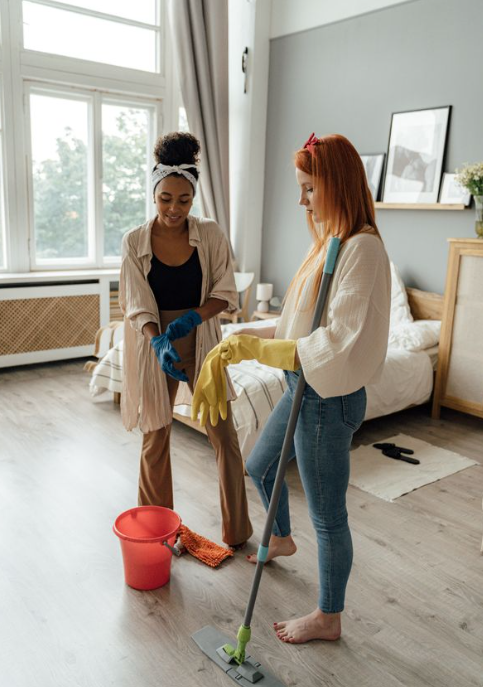
Begin With the Work That Actually Exists
Many household discussions start with a short list: vacuum, bathrooms, kitchen, laundry. That list misses the small and irregular work that often causes frustration.
For one ordinary cycle—usually a week—write down cleaning-related work as it occurs. Keep the inventory practical rather than exhaustive. Include four kinds of responsibility:
- Routine work: wiping counters, loading the dishwasher, taking out waste, cleaning toilets, vacuuming, or changing linens.
- Trigger-based work: cleaning a spill, dealing with muddy entryways, emptying an unexpectedly full bin, or responding to a pet accident.
- Occasional work: cleaning the refrigerator, washing windows, laundering shower curtains, or preparing a guest room.
- Coordination work: noticing supplies are low, remembering a task, deciding when it needs attention, asking others to act, and checking that the area is usable afterward.
The goal is not to document every crumb. It is to make categories of work visible enough that the household can assign them. If the inventory becomes a minute-by-minute record used to prove who worked harder, it is likely to create defensiveness instead of clarity.
National time-use data can show why looking beyond a few visible chores matters, although it cannot diagnose any particular home. In the U.S. Bureau of Labor Statistics’ 2025 averages, women were more likely than men to report household activities on an average day and spent more time on them. Household structures differ, and averages do not determine what is fair for an individual family. They do show that domestic work can be distributed unevenly even when it is treated as ordinary background activity.
Research also distinguishes physical work from cognitive household labor: anticipating needs, identifying options, making decisions, and monitoring results. A fair conversation therefore needs to include both doing and managing.
Consider Nina and Eric, who say they split cleaning because each handles several chores. Nina later realizes that she also decides when towels need washing, notices when detergent is low, clears the family calendar for a cleaning block, and reminds Eric about the bathroom. Their task counts are similar, but their responsibility is not. They do not need a longer chore list; they need the planning and follow-through work assigned as clearly as the scrubbing.
Define “Fair” Before Assigning Tasks
Equal and fair are not always the same.
An equal division might mean the same number of tasks or the same number of minutes. A fair division considers the total burden each person can reasonably carry. That can include:
- paid-work hours and commute time;
- childcare, eldercare, or other household responsibilities;
- physical ability, pain, fatigue, allergies, or sensory limits;
- how frequent, unpleasant, interruptive, or time-sensitive a task is;
- skill and the effort required to learn;
- personal preference;
- access to the home at the time the work must occur; and
- the planning and monitoring attached to the task.
These factors are not a formula that produces one correct percentage. They are prompts for an explicit agreement.
A person with more available time may reasonably do more cleaning during one season. That does not automatically make that person the permanent household manager. Someone who cannot lift a full laundry basket may still own lighter work, supply tracking, or another complete area. Someone working fewer paid hours may carry more domestic work, but the arrangement should still preserve rest and personal time rather than treating every unscheduled hour as available labor.
Fairness is easier to evaluate using three questions:
- Does everyone understand what they own?
- Does each person have a manageable total burden, including invisible work?
- Can the arrangement change when circumstances change?
If the answer to any is no, counting tasks more precisely may not solve the real problem.

Assign Ownership, Not “Help”
“Just tell me what to do” can sound cooperative, but it leaves one person responsible for noticing, assigning, and following up. A stronger model gives one person ownership of a task or zone.
Ownership usually includes:
- recognizing when the work is due or triggered;
- making sure the needed tools or products are available;
- choosing a reasonable time;
- completing the work or arranging an agreed handoff;
- returning the area to the household’s agreed condition; and
- communicating early if the task cannot be completed.
The owner does not have to perform every motion personally. A parent may own kitchen cleanup while a child clears the table. Roommates may exchange parts of a job during an unusually busy week. The important point is that responsibility does not silently return to someone else.
Avoid assigning two people jointly to every task. Shared ownership often becomes uncertain ownership: each person assumes the other will notice. Instead, give the task one default owner and identify any supporting role.
For example:
- Owner: notices the bathroom needs its agreed cleaning, completes it, and replaces the used towel.
- Support: empties the bathroom bin on the same day.
This is clearer than “both people are responsible for the bathroom.”
Ownership should also include permission to perform the task competently without being micromanaged. Household members may use different movements or order while reaching the same agreed result. Requiring one person to reproduce another person’s exact preferred method can turn ownership back into supervised assistance.
There are exceptions. Product labels, surface-care directions, hygiene boundaries, and safety rules are not personal preferences. A different technique is acceptable only when it remains safe and suitable for the material.
Group Work Into Clear, Complete Units
Assignments work better when they describe a usable result rather than a vague action.
“Do the dishes” might mean loading the dishwasher but leaving pans, food scraps, and a wet counter. “Own evening kitchen close” is clearer if the household has agreed that it includes:
- food put away;
- dishes loaded or washed;
- sink left usable;
- counters cleared and wiped as needed; and
- waste handled if it is full or causing odor.
That does not mean every task needs a long checklist. Define the boundary once where misunderstandings repeatedly occur.
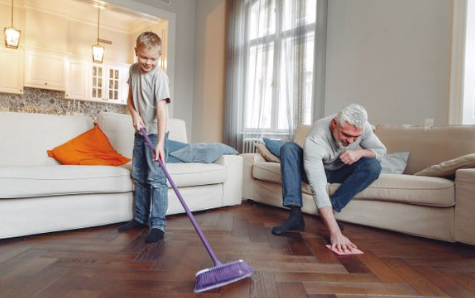
Assign by task
One person owns vacuuming, another owns bathrooms, and another owns linens.
This works when tasks are easy to identify and occur throughout the home. It can also build efficiency because the owner learns one job well. The risk is imbalance: “bathrooms” may be more demanding than “take out recycling,” even if each counts as one assignment.
Assign by zone
One person owns the kitchen, another owns bathrooms, and each person owns their private space.
This reduces ambiguity because the boundary is visible. It works well for roommates and homes where people use different areas. It can fail when shared zones differ greatly in size, traffic, or urgency.
Assign by complete routine
One person owns the evening kitchen close, another owns the weekend shared-space reset, and another owns the linen cycle.
This bundles physical work with noticing and follow-through. It is often the clearest approach for recurring work, but routines must remain small enough for one owner’s capacity.
Households can combine these models. The right structure is the one that creates the fewest handoff gaps without concentrating all coordination in one person.
Omar and Luis initially divide work by room, but Omar travels frequently and cannot reliably own a room that needs midweek attention. They switch to complete routines: Luis owns the weekday kitchen close, while Omar owns laundry and a larger shared-space clean when he is home. The division is not identical each day, but the responsibilities match their availability and remain visible.
Match Assignments to Capacity Without Freezing Roles
Preference and skill can make a division easier. One person may dislike bathroom work but be comfortable with floors. Another may prefer a predictable weekly job over daily interruptions. Using those differences is practical.
However, preference should not become a permanent escape from every undesirable task, and skill should not punish the person who already knows how to do something. “You are better at it” can trap one household member in the same role indefinitely.
Use preference in this order:
- Let people claim tasks they genuinely do not mind.
- Compare the burden of the remaining tasks.
- Rotate, trade, or balance work that nobody wants.
- Teach skills where lack of experience is the only barrier.
- Keep safety and physical capacity as firm constraints.
When teaching is needed, explain the outcome and any safety-critical method, demonstrate once if useful, and allow practice. Do not immediately redo acceptable work in front of the person. If the result misses the agreed standard, describe the specific gap: “The food was put away, but the counter still has raw-meat residue,” not “You never clean properly.”
Standards can differ, especially among roommates or partners who grew up in different homes. Agree on a functional minimum for shared areas rather than treating one person’s preference as self-evident. The standard may cover sanitation, odor, blocked access, pest prevention, damage prevention, and whether the space is ready for its next normal use. Optional polishing can remain optional unless everyone agrees to include it.
Include Children Without Making Them Responsible for Adult Safety
Children can participate in household work, but age alone does not determine readiness. Consider the child’s development, ability to follow directions, motor control, judgment, supervision needs, and the specific hazards in the task.
Safer contributions may include:
- putting toys or personal items away;
- placing dirty clothes in a hamper;
- matching socks or folding simple linens;
- wiping a table with a safe method chosen by the caregiver;
- sweeping a small clear area;
- making a bed with help; or
- carrying lightweight, nonbreakable items.
<!– IMAGE 4: Insert here. See Admin File, Image 4. –>
The American Academy of Pediatrics provides examples of chores that increase with age, but its lists should be treated as possibilities, not deadlines. A child who can vacuum one open room may not be ready to maneuver around stairs, cords, pets, or fragile objects.
Cleaning chemicals require a firmer boundary. The CDC and U.S. Consumer Product Safety Commission advise keeping household cleaners out of children’s reach, with CPSC recommending locked storage. Keep products in their original containers and follow their labels. Do not make a young child responsible for selecting, mixing, diluting, spraying, or storing cleaning chemicals.
An adult remains responsible for judging safety and verifying that a child’s assignment is appropriate. Participation should build competence, not transfer adult risk.
Priya’s eight-year-old clears personal items from the living room and matches clean socks. Her teenager vacuums the open main floor after receiving instruction on cords and equipment. Priya still controls cleaning products and handles a bathroom task involving chemicals. The children contribute meaningfully, but the assignments reflect different readiness and hazards.
Make Handoffs Visible
Even a clear division needs a simple way to communicate exceptions. Work schedules change. Illness, travel, deadlines, caregiving, and low-energy periods can make an ordinary assignment unrealistic.
A useful handoff contains three parts:
- what cannot be completed;
- what matters before the next normal opportunity; and
- who has agreed to take it or whether it will wait.
“I cannot do my full bathroom task tonight. Can you empty the bin, and I will finish the rest tomorrow?” is more actionable than leaving the task untouched and hoping someone notices.
Choose the lightest tracking method the household will actually use:
- a short list on the refrigerator;
- a shared note;
- recurring calendar assignments;
- labeled ownership by room or routine; or
- a brief household check-in.
The tracker should reduce reminders, not become another system maintained by one person. If someone must repeatedly update it, prompt everyone, and translate each item into instructions, the coordination work is still concentrated.
Do not use a board to publicly score family members or document every minor miss. It should answer “Who owns this?” and “Has an exception been agreed?” rather than create constant surveillance.
Review the Arrangement, Not Every Imperfect Day
A division should be tested long enough to reveal patterns. One missed task does not prove the system is unfair; repeated reminders, hidden planning, or chronic overload may.
After one or two ordinary weeks, ask:
- Which assignments were unclear?
- Who had to notice or remind?
- Which jobs took more effort than expected?
- Did any person lose most of their rest time?
- Were standards specific enough?
- Did a task repeatedly depend on a handoff?
- Has work, health, school, or caregiving changed?
Then change the smallest part that addresses the problem. Split an oversized routine, transfer full ownership, rotate an undesirable job, lower a nonessential standard, or replace a joint assignment with one owner and one support role.
Avoid reopening every historical disagreement during a routine review. The purpose is to improve the next version of the arrangement. Serious patterns of disrespect, coercion, intimidation, or deliberate refusal are not merely cleaning-system problems and may require a different kind of support.
Mei and Jordan review their arrangement after two weeks. Jordan’s three assigned tasks look light by count, but one is a lengthy weekend floor job. Mei has more daily tasks and is still tracking supplies. They transfer supply monitoring with the bathroom routine to Jordan and reduce one low-priority polishing task. The revision addresses both visible time and invisible responsibility without trying to make every day identical.
A Simple Household Agreement
A workable agreement can fit on one page or in one shared note. For each recurring responsibility, record:
- the task, zone, or routine;
- the default owner;
- what “complete” means if it has been disputed;
- any safety or physical constraint;
- the support person, if one is genuinely needed;
- how to communicate an exception; and
- when the arrangement will be reviewed.
Start with the work that most affects daily function. Do not assign every seasonal or obscure task in the first meeting. Once routine ownership works, occasional tasks can be added without rebuilding the entire system.
The agreement is successful when household members do not have to renegotiate ordinary cleaning every day. It will not eliminate all reminders or uneven weeks. It should make responsibility clear enough that one person is not automatically carrying the noticing, asking, and checking for everyone else.
Decision Summary
A fair cleaning division is not determined by chore count alone.
- Make routine, occasional, trigger-based, and coordination work visible.
- Consider time, care obligations, physical capacity, difficulty, and personal preference.
- Give one person ownership from noticing through completion, with support roles defined separately.
- Group work into clear tasks, zones, or complete routines.
- Agree on a functional standard for shared spaces without micromanaging method.
- Give children meaningful but developmentally appropriate work while adults retain responsibility for hazardous products and conditions.
- Use a simple handoff method and review the arrangement when patterns or circumstances change.
The best system is not the one that looks perfectly equal on a chart. It is the one the household understands, can sustain, and can revise without placing all management back on one person.
FAQ
Should cleaning always be divided 50/50?
Not necessarily. A fair division may change with paid work, caregiving, health, physical ability, and availability. The important questions are whether the total burdens are manageable, responsibility is visible, and the arrangement can be reviewed.
Is it better to assign rooms or individual tasks?
Either can work. Rooms create visible boundaries, while task assignments can build efficiency across the home. Complete routines are often useful when planning and follow-through need one clear owner.
What if one person has much higher cleaning standards?
Agree on a functional minimum for shared areas, including safety, sanitation, access, odor, and damage prevention. Work beyond that minimum can be discussed separately rather than silently becoming everyone’s obligation.
How can we divide chores without one person constantly reminding everyone?
Assign full ownership, including noticing and timing, and use a simple shared tracker only if needed. If one person still has to prompt and interpret every task, the planning work has not actually been divided.
Should disliked tasks be rotated?
Rotation is one option. Households can also trade disliked work, balance it against other burdens, or keep stable assignments when everyone considers the total arrangement fair.
What cleaning jobs can children do?
Choose by the child’s development, judgment, and the hazards involved. Simple organizing, linens, or supervised dry tasks may be appropriate. Adults should retain control of hazardous products and follow official storage and label guidance.
How often should a household revisit the division?
Review it after an initial one- or two-week test and whenever work, school, health, caregiving, or household membership changes. Stable arrangements do not need constant renegotiation.
Sources
- BLS – American Time Use Survey Summary: 2025 Results
- Archives of Women’s Mental Health – Cognitive Household Labor: Gender Disparities and Consequences for Maternal Mental Health and Wellbeing
- AAP / HealthyChildren.org – Age-Appropriate Chores for Children
- CDC – When and How to Clean and Disinfect Your Home
- CPSC – Poison Prevention Information Center
More in This Cluster: Home Cleaning Systems
- How to Build a Weekly Cleaning Schedule That Fits Your Life
- Daily, Weekly, and Monthly Cleaning Tasks Explained
- How to Clean Your Home When You Are Short on Time
- A Practical Room-by-Room Deep Cleaning Order
- How to Divide Cleaning Work in a Household (you are here)
- Essential Cleaning Supplies: What You Actually Need
- How to Restart Cleaning After Falling Behind