Quick Summary
Meta and a multistate coalition filed a proposed settlement on August 26, 2026, covering claims that Facebook and Instagram harmed children and teens through compulsive-use features and other practices. Meta does not admit the states’ allegations.
The agreement could bring default daily time limits, overnight access restrictions, school-hour notification limits, hidden like counts, stronger age checks, and expanded parental controls. But it still requires court approval. Most of the changes would apply to users identified as under 18 in participating U.S. states and territories—not automatically to every teen worldwide.
The deal has often been reported as an $18 billion settlement. The filed agreement and state attorney-general announcements describe guaranteed state payments totaling at least $12.1 billion, potentially increasing to $17.1 billion if specified industry conditions are met. This is state funding, not a general claims fund that parents can apply to today.
Reader Decision
Do not wait for the proposed settlement to set household expectations. Review the teen account’s birth date, supervision link, current time controls, privacy and content settings now. Treat the new two-hour limit and other settlement terms as pending until the court approves the agreement and Meta announces the applicable rollout for the account.
What Has—and Has Not—Happened
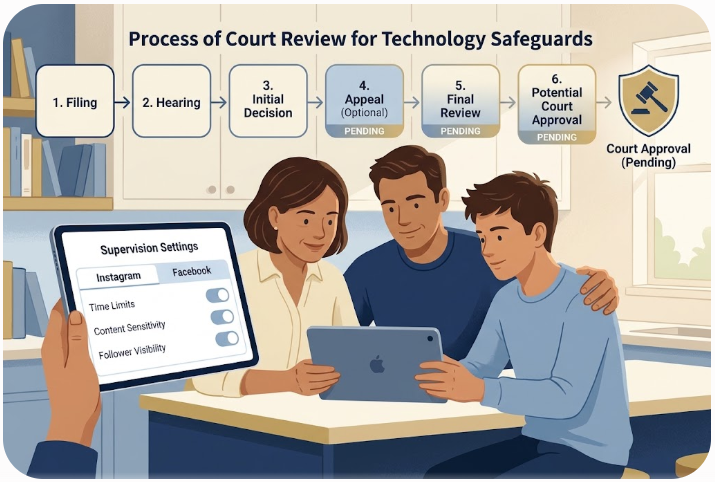
The parties signed and filed a settlement agreement in federal court. California’s attorney general described it as a proposed settlement subject to court approval through entry of a consent judgment. Until that happens, the agreement is not the same as a final nationwide rule already operating on every account.
The settlement would resolve participating states’ claims against Meta. It does not resolve every private, school-district, or nonparticipating-state case, and it is not a congressional law applying identical rules to every social platform.
The complaints alleged that Meta encouraged compulsive use and harmed young people while misleading families. Those remain allegations; Meta does not admit wrongdoing.
The Main Changes Parents Could See
If approved, the following defaults would apply to teen users covered by the agreement. Exact interfaces and timing may change during implementation.
A two-hour cumulative daily limit
Meta says the default would allow up to two hours per day across Facebook and Instagram combined. A supervising parent would have to approve a less restrictive setting. Teens or parents could choose a stricter limit.
The filed agreement excludes messaging, settings, and qualifying long-form content from parts of the calculation. Not every minute with either app open will necessarily count identically.
If specified industry-wide conditions are later met, the limit could move to 60 minutes on each Meta platform while remaining no more than 120 minutes cumulatively. That phase is conditional.
Overnight access restrictions
The initial default would block broader Facebook and Instagram access from midnight to 6 a.m. Messaging and settings would remain available in limited form. Push notifications would generally be disabled from 10 p.m. to 7 a.m., with specified exceptions and parental modification.
The broader restriction could expand to 10 p.m.–7 a.m. if the industry condition is met. A supervising parent could approve something less restrictive or choose something stricter.
School-hour notification limits
School mode would mute most push notifications from 8 a.m. to 3 p.m. during the specified school-year period. Direct messages and security or safety alerts have exceptions. It would not block opening the apps.
Hidden engagement counts and feature limits
The terms also include hidden like and reaction numbers, restrictions on cosmetic-procedure image filters, time-use prompts, a non-personalized feed option, and an autoplay control.
A non-personalized feed option does not promise that every algorithmic system disappears from the services.
Age assurance and parent supervision
The agreement requires age assurance and an appeal process for people identified incorrectly. New or unassessed accounts can receive teen protections while age is evaluated.
A “supervising parent” must be formally linked through Meta’s controls. Sharing a household, paying for the phone, or following the account does not create that link.
What Parents Can Check Today
Meta already offers Teen Accounts and supervision tools, including limits, scheduled breaks, privacy and contact restrictions, and content settings. Availability depends on the app, country, account age, and supervision link.
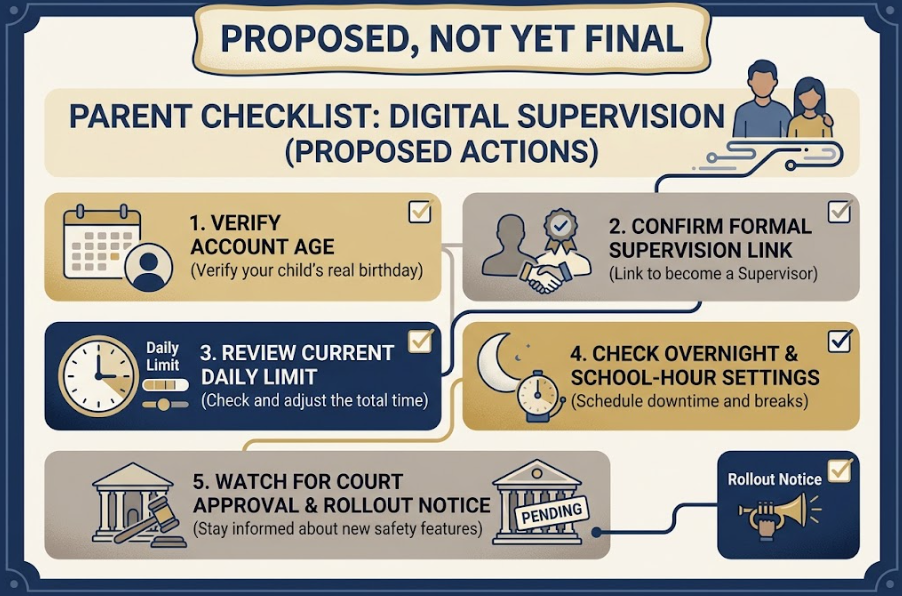
Use this five-step check:
- Open the teen’s account information and confirm the birth date is accurate.
- Confirm that the parent and teen accounts are formally connected through supervision—not simply following one another.
- Review the current daily limit, scheduled break, privacy, messaging, content, and reporting settings.
- Agree on what happens when a limit is reached, including homework, sleep, transportation, and emergency communication.
- Save the official settlement or state-attorney-general page and wait for a court or Meta rollout notice before assuming a pending default is active.
Ask the teen what works and what creates friction. Agree on how to report harmful content or ask for help.
The Money Is Not a Parent Claim Form
Payments would go to participating states over ten years for purposes such as youth mental-health services, education, prevention, and remediation.
The $17.1 billion maximum is conditional; $12.1 billion is guaranteed under the described structure. Do not give personal information or pay a fee for an individual claim unless an official court or state notice later creates a verified process.
What This Settlement Cannot Decide for a Family
A two-hour default is not a medical finding that two hours is appropriate for every teen. Nor does the agreement guarantee that harmful content, contact, bullying, compulsive use, or distress will disappear.
Families may still need device controls, school rules, nighttime arrangements, privacy conversations, and professional support when online experiences affect health or safety.
The Practical Takeaway
The proposal could create stronger defaults on many U.S. teen accounts, but it has not created an automatic two-hour rule on every account. Approval, rollout, jurisdiction, age identification, supervision, and exceptions matter.
Parents can act now without pretending the settlement is final: verify the account age, connect supervision if appropriate, review current controls, and agree on a household plan. Then watch official notices for what changes, when, and for whom.
This newsletter provides general U.S. legal, technology, and family information. It is not legal, medical, or mental-health advice. Platform features, court status, state participation, and account eligibility may change. Use official court, attorney-general, and Meta notices for current implementation details. Seek qualified help when a young person’s online experience raises immediate health or safety concerns.
FAQ
Does every U.S. teen now have a two-hour Facebook and Instagram limit?
No. The settlement still requires court approval and implementation. If approved, the initial default would generally be two cumulative hours across covered Facebook and Instagram use for identified teen users in participating U.S. jurisdictions, with stated exceptions.
Can a teen turn off the limit alone?
Under the proposed terms, a less restrictive setting would require approval from a formally linked supervising parent. A teen or parent could choose a stricter setting.
Does school mode block app access from 8 a.m. to 3 p.m.?
No. The described school mode primarily mutes push notifications during specified school hours, with exceptions. It is not a complete school-day access block.
Can parents apply for part of the settlement money?
No general parent claims process was announced in the proposed agreement. Payments go to participating states for designated public purposes. Treat unsolicited claim-registration messages as unverified unless an official court or state source announces a process.
Sources
- Proposed Meta Multistate Settlement Agreement, filed August 26, 2026
- California Attorney General — Proposed Meta Settlement and Teen Protections
- New York Attorney General — Up to $17.1 Billion and Reforms
- Meta — Agreement With Bipartisan Attorneys General
- Meta — Instagram Teen Accounts and Parent Controls
- Associated Press — Meta Teen Safety Settlement