Your baby finally falls asleep.
Maybe it happened in a lounger after a long feeding. Maybe the swing was the only thing that stopped the crying. Maybe you are visiting family and the portable product in the corner looks close enough to a crib.
The baby looks peaceful, and moving them may mean starting the entire settling process again.
That is the moment when many careful parents face the same question:
Can I let my baby keep sleeping here, or should I move them?
This is not a question about whether parents care about safety. It is a question created by products that often look similar while serving very different purposes. A lounger may have raised sides like a bassinet. A play yard may be marketed as a portable nursery. A swing may recline far enough to look almost flat. Soft padding can make a product seem more suitable for sleep, even though safe-sleep guidance generally points in the opposite direction.
The useful distinction is not whether a product looks comfortable. It is whether the product was designed, regulated, and instructed for infant sleep in the place where you live.
Quick answer: For routine naps and overnight sleep, use a crib, cradle, bassinet, or another sleep product specifically permitted for infant sleep under local rules and the manufacturer’s instructions. Baby loungers, swings, bouncers, positioners, and other sitting or support products should not replace a dedicated sleep space.

The decision in 30 seconds
| Situation | Best starting choice |
|---|---|
| Everyday naps and overnight sleep | A compliant crib, cradle, or bassinet |
| Newborn sleeping beside the parents’ bed | A compliant bassinet or cradle used within its limits |
| Travel in the United States | A compliant play yard that the manufacturer identifies for sleep |
| Travel in Canada | A crib, cradle, or bassinet; do not assume the playpen floor is approved for unsupervised sleep |
| Baby is awake and closely supervised | A lounger, bouncer, or swing may have a limited awake-time role |
| Baby falls asleep in a lounger, swing, bouncer, stroller, or car seat outside travel | Move the baby to an appropriate firm, flat sleep surface as soon as it is safe and practical |
The travel answer deserves attention because “play yard,” “playpen,” and “portable crib” do not mean exactly the same thing in every country. In the United States, a compliant play yard may be intended for sleep. In Canada, federal guidance says playpens are not recommended for unsupervised sleep, although an approved bassinet attachment may be used within its stated limits. The product name alone is therefore not enough.
What a safe sleep space has in common
The U.S. Consumer Product Safety Commission, the American Academy of Pediatrics, Health Canada, and the Public Health Agency of Canada use somewhat different regulatory language, but their practical guidance overlaps.
A baby’s sleep space should generally be:
- firm, rather than cushioned or deeply padded;
- flat and level, rather than inclined or seated;
- clear, with no pillows, loose blankets, bumper pads, positioners, stuffed toys, or added padding;
- separate, rather than an adult bed, couch, armchair, or soft shared surface;
- used as instructed, including all weight, height, mobility, assembly, and accessory limits.
Babies should be placed on their backs for every sleep. Once a baby can roll independently in both directions, parents generally do not need to keep turning the baby back, but the sleep space should remain bare and appropriate.
These recommendations can feel counterintuitive because adults often associate softness with comfort and comfort with better sleep. Infant sleep safety is different. A soft or shaped surface may allow a baby’s face to press into material, may make it harder to reposition the head, or may create spaces where the baby can become trapped.
The goal is not to build the coziest-looking nest. It is to create a predictable sleep environment that does not introduce avoidable hazards.
Crib: the strongest long-term default
For most families, a compliant crib is the clearest long-term choice for routine sleep.
A crib is designed around sleep rather than soothing, carrying, feeding, or supervised play. It provides a firm mattress fitted to a fixed enclosure and can usually be used longer than a bassinet. A full-size crib takes more room and may be less convenient during the earliest weeks, but it avoids an early second transition if the family is comfortable using it from birth.
A crib is usually best for
- everyday naps;
- overnight sleep;
- families who want one primary sleep space;
- babies who have outgrown a bassinet;
- parents who have enough room for a permanent setup.
What to check
Use the mattress supplied or specified for that crib. The mattress should fit tightly, and the fitted sheet should be made for that mattress. Do not add a second mattress, foam topper, pillow, wedge, bumper, or sleep positioner.
For a used crib, check current safety requirements, assembly instructions, missing hardware, damage, and recalls. Older cribs may not meet current standards even when they appear sturdy. In Canada, drop-side cribs are prohibited. In the United States, traditional drop-side cribs have also been banned for years.
A crib is not automatically safe simply because it is called a crib. Its condition, age, assembly, mattress fit, and compliance still matter.
Bassinet or cradle: convenient for the early months
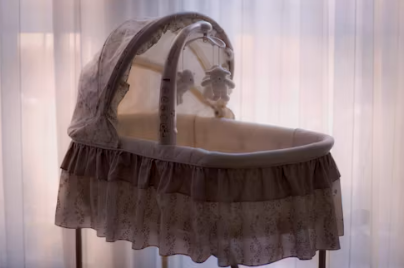
A bassinet or cradle can make the newborn stage more manageable because it usually fits beside the parents’ bed. That can reduce the practical burden of nighttime feeding and checking while preserving a separate sleep surface.
Room sharing is not the same as bed sharing. The baby sleeps in their own bassinet, cradle, or crib near the caregiver rather than on the adult mattress.
A bassinet is usually best for
- newborns and young infants;
- parents who want the baby close at night;
- small bedrooms;
- families planning to move to a crib later.
The main trade-off
A bassinet has a shorter useful life than a crib. The transition point is not determined only by whether the baby still appears to fit.
Stop using it when the baby reaches any limit stated by the manufacturer, which may involve:
- maximum weight;
- maximum length or height;
- ability to roll;
- ability to push up on hands and knees;
- another developmental milestone specified in the manual.
A baby who becomes mobile may be able to shift against the side or create a fall risk even while remaining below the weight limit.
A bassinet attachment supplied with a play yard or playpen should be treated as its own product component. Use only the attachment approved for that model and follow its separate limits.
Play yard, playpen, portable crib, or travel crib: check the jurisdiction
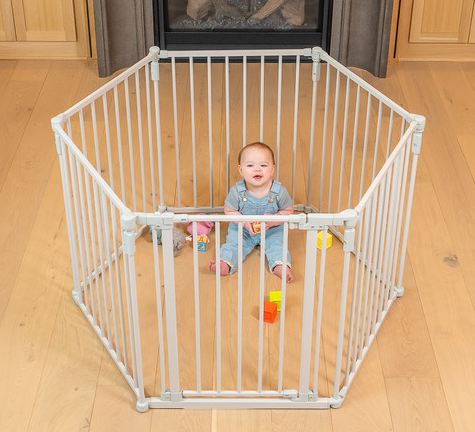
This category causes more confusion than any other because similar-looking products may be regulated or described differently.
In the United States
The CPSC identifies a firm, flat surface in a crib, bassinet, or play yard as an appropriate infant sleep environment when the product meets applicable standards and is used as directed.
A compliant U.S. play yard can therefore be a practical travel or secondary sleep option. Use only the original mattress or pad specified by the manufacturer. Do not add an aftermarket mattress to make the surface feel softer.
In Canada
Health Canada distinguishes playpens from cribs, cradles, and bassinets. Its safe-sleep guidance says playpens are not recommended for unsupervised sleep. A bassinet attachment for a playpen may be an appropriate sleep space when it meets Canadian requirements and is used within its limits, but parents should not assume the lower playpen floor is a routine overnight sleep surface.
For travel in Canada, the official recommendation is to plan for a crib, cradle, or bassinet that meets current Canadian safety regulations.
Why the difference matters
A statement such as “play yards are safe for sleep” may be accurate in one regulatory context and misleading in another. Product categories, test standards, and public-health recommendations are not perfectly interchangeable across borders.
When travelling or buying online:
- Identify the country where the product will be used.
- Read the manufacturer’s sleep instructions for that exact model.
- Confirm that the product is permitted for infant sleep under local guidance.
- Check recalls and safety alerts.
- Use only the supplied or approved sleep surface and accessories.
The safest travel choice is not the product with the most portable appearance. It is the one whose sleep use is clearly supported where you are using it.
Baby lounger: useful awake-time support, not a sleep replacement
A baby lounger is typically a padded support cushion with raised or contoured sides. It may provide a convenient place to set an awake baby down on the floor while a caregiver remains close.
The design can also create the wrong impression. Because the baby appears nestled and calm, the product may look more sleep-ready than a firm bassinet. Yet padding, side bolsters, indentations, and flexible materials are precisely the features that can create breathing, entrapment, or fall hazards.
The CPSC advises that infant support cushions and loungers should not be used for sleep or naps. If a baby falls asleep, the baby should be moved to a crib, bassinet, or—where permitted—a play yard. The CPSC also advises using support cushions only on the floor, staying nearby, and not placing them on beds, sofas, tables, or other elevated or soft surfaces.
A lounger may fit when
- the baby is awake;
- an adult is nearby and actively supervising;
- the product is on the floor;
- the product is used exactly as directed.
A lounger does not fit when
- the baby is sleeping or likely to be left sleeping;
- it is placed inside a crib or bassinet;
- it is used on a couch, bed, counter, or table;
- extra blankets or cushions are added;
- the caregiver assumes supervision can make an unsafe sleep surface safe.
“Supervised sleep” in a lounger is not equivalent to sleep in a product designed for infant sleep. A caregiver may become distracted, tired, or unable to recognize a breathing problem immediately.
Swings, bouncers, car seats, and other sitting devices
Swings and bouncers can calm a baby, and a properly installed car seat is essential for travel. Their usefulness does not make them routine sleep spaces.
The AAP advises that sitting devices—including car seats, strollers, swings, infant carriers, and slings—should not be used for routine sleep, especially for young infants. When a baby falls asleep in one, the baby should be moved to a crib or another appropriate flat surface as soon as it is safe and practical.
This does not mean parents should remove a baby from a properly used car seat while the vehicle is moving. The practical distinction is between necessary travel and allowing the device to become the baby’s continuing sleep space after travel has ended.
At home:
- move a sleeping baby out of a swing or bouncer;
- do not place the device inside a crib;
- do not add head supports or cushions unless supplied and permitted by the manufacturer;
- do not loosen or change restraint use because the baby is sleeping.
Side-by-side comparison
| Product | Intended role | Routine infant sleep? | Main limit or caution | Best fit |
| Crib | Dedicated long-term sleep space | Yes, when compliant and correctly set up | Requires room; check mattress fit, condition, and recalls | Everyday naps and nights |
| Bassinet or cradle | Dedicated early-infant sleep space | Yes, within limits | Short use period; stop at stated weight or mobility limits | Bedside room sharing |
| U.S. compliant play yard | Portable enclosed space that may be designed for sleep | Often yes, if the manufacturer permits it | Use original pad; no added mattress | U.S. travel or secondary sleep |
| Canadian playpen floor | Play and containment space | Not recommended for unsupervised sleep by Health Canada | Do not treat the name as approval for sleep | Supervised play |
| Approved bassinet attachment | Elevated newborn sleep component for a specific model | Yes, if compliant and within limits | Must match the model; short developmental window | Travel or compact newborn setup |
| Baby lounger or support cushion | Supervised awake-time support | No | Soft padding, side bolsters, fall and entrapment concerns | Awake baby on the floor with caregiver nearby |
| Swing or bouncer | Soothing and supervised awake time | No | Seated or inclined position; transfer after sleep begins | Brief calming while awake |
| Car seat | Crash protection during travel | Not a routine sleep space outside travel | Keep properly restrained in transit; move after arrival when practical | Vehicle travel |
Common decisions parents face
“My baby sleeps longer in the lounger. Does that change the answer?”
No. The length or apparent quality of sleep does not change the product’s intended use. Babies may fall asleep deeply in many places that are not appropriate for continued sleep.
The decision is about the environment, not whether the baby seems peaceful.
“The lounger is completely flat. Is it basically a bassinet?”
Not necessarily. Flatness is only one factor. A sleep product also needs appropriate firmness, side construction, mattress dimensions, stability, labeling, testing, and compliance. A padded cushion does not become a bassinet because its centre appears level.
“Can I put the lounger inside the crib so the crib contains it?”
No. Adding a lounger, nest, positioner, pillow, or other insert changes the crib’s sleep surface and introduces soft material. A bare crib with its approved mattress and fitted sheet is the safer setup.
“Can I add a thicker mattress to a play yard?”
Do not add a mattress unless the manufacturer explicitly supplies or approves it for that exact model. An aftermarket mattress can create a gap at the sides, change the enclosure geometry, or make the surface softer than intended.
“What if the baby falls asleep while I am watching?”
Move the baby to an appropriate sleep space as soon as it is safe and practical. The instruction is not a judgment about how the baby fell asleep. It is a simple correction once sleep begins.
“Do I need both a bassinet and a crib?”
No. A compliant crib can be used from birth when set up correctly. A bassinet is mainly a convenience choice: it is smaller, easier to position beside the bed, and often easier for nighttime access. The trade-off is that it will be outgrown sooner.
A practical buying and setup checklist
Before buying or accepting a sleep product, ask:
- Is this exact product identified for infant sleep?
- Does that sleep use align with the rules and guidance where I live?
- What are the weight, height, and developmental limits?
- Is the original mattress or pad present and undamaged?
- Are all hardware and instructions available?
- Has the product been recalled or named in a safety warning?
- Will I be tempted to add padding because the surface looks firm?
- Can I place it on a stable, level surface away from cords, blinds, heaters, and other hazards?
For a secondhand product, also consider whether its history is known. Damage, missing pieces, an incorrect replacement mattress, or an old model can be difficult to identify from a quick visual inspection.
The EverydayWise perspective
Parents do not need to treat every baby product as dangerous. Loungers, swings, bouncers, carriers, strollers, and playpens can solve real problems when they are used for the purpose they were designed to serve.
The mistake is allowing usefulness in one situation to become assumed safety in another.
A swing can be helpful for soothing without becoming a bed. A lounger can support supervised awake time without becoming a nap space. A playpen can be valuable for play without automatically qualifying for overnight sleep in every country.
That distinction respects both sides of the decision: parents need practical tools, and babies need a sleep environment designed for sleep.
Final takeaway
When your baby falls asleep somewhere unexpected, you do not need to evaluate the product by softness, price, popularity, or how peaceful the baby looks.
Ask three questions:
- Was this exact product designed and permitted for infant sleep?
- Am I using it exactly as instructed, within every stated limit?
- Does its sleep use match the guidance where I live?
For most routine sleep decisions, a compliant crib, cradle, or bassinet provides the clearest answer. In the United States, a compliant play yard may also be appropriate. In Canada, do not assume the floor of a playpen is approved for unsupervised sleep; use a compliant crib, cradle, bassinet, or an approved bassinet attachment within its limits.
Loungers, swings, bouncers, and sitting devices have other roles. When sleep begins, move the baby to the appropriate firm, flat, bare sleep space as soon as it is safe and practical.
The product does not need to do everything. It only needs to be used for the job it was designed to do.
FAQ
Is a baby lounger safe for supervised naps?
Major safety guidance does not recommend baby loungers or infant support cushions for sleep, including naps. Active supervision does not turn a padded support product into a regulated sleep space. Move a sleeping baby to an appropriate crib, bassinet, or locally permitted sleep product.
Is a bassinet safer than a crib for a newborn?
A compliant bassinet and a compliant crib can both provide appropriate sleep spaces from birth when used correctly. A bassinet is usually more convenient beside the bed, while a crib lasts longer. The better choice depends on space and routine, not a general rule that one is inherently safer.
Can a newborn sleep in a crib right away?
Yes. A newborn can sleep in a compliant crib from birth when placed on the back on the approved firm mattress with only a fitted sheet and no soft objects or added padding.
Can a baby sleep overnight in a play yard?
In the United States, a compliant play yard may be used for sleep if the manufacturer identifies it for that purpose and all instructions are followed. In Canada, Health Canada does not recommend playpens for unsupervised sleep, although a compliant bassinet attachment may be used within its limits. Check local guidance and the exact model.
What should I do if my baby falls asleep in a swing?
Move the baby to an appropriate firm, flat sleep surface as soon as it is safe and practical. Swings and other sitting devices are not recommended for routine sleep.
Can I use an aftermarket mattress in a play yard?
Do not use an added mattress unless it is explicitly supplied or approved by the manufacturer for that exact model. Extra mattresses can create gaps, increase softness, and change how the product performs.
When should a baby stop using a bassinet?
Stop at the first limit reached in the manufacturer’s instructions. That may be a weight, length, or developmental limit such as rolling, pushing up, or sitting. Do not rely only on whether the baby still appears to fit.
Are bedside sleepers the same as bassinets?
Not always. Product categories and standards vary by jurisdiction. Confirm that the exact bedside product is legally sold for infant sleep where you live, meets the relevant standard, and is used precisely as instructed. Do not improvise attachment to an adult bed.
References
- U.S. Consumer Product Safety Commission. “Safe Sleep – Cribs and Infant Products.”
https://www.cpsc.gov/SafeSleep - U.S. Consumer Product Safety Commission. “Infant Sleep Products.”
https://www.cpsc.gov/FAQ/Infant-Sleep-Products - U.S. Consumer Product Safety Commission. “CPSC’s New Federal Infant Sleep Products Safety Standard Takes Effect.”
https://www.cpsc.gov/Newsroom/News-Releases/2022/CPSCs-New-Federal-Infant-Sleep-Products-Safety-Standard-Takes-Effect - U.S. Consumer Product Safety Commission. “CPSC Approves New Federal Safety Standard for Infant Support Cushions to Prevent Infant Deaths and Serious Injuries.”
https://www.cpsc.gov/Newsroom/News-Releases/2025/CPSC-Approves-New-Federal-Safety-Standard-for-Infant-Support-Cushions-to-Prevent-Infant-Deaths-and-Serious-Injuries - American Academy of Pediatrics. “Sleep-Related Infant Deaths: Updated 2022 Recommendations for Reducing Infant Deaths in the Sleep Environment.” Pediatrics.
https://publications.aap.org/pediatrics/article/150/1/e2022057990/188304/Sleep-Related-Infant-Deaths-Updated-2022 - Health Canada. “Safe Sleep Tips.”
https://www.canada.ca/en/health-canada/services/safe-sleep/safe-sleep-tips.html - Health Canada. “Cribs, Cradles and Bassinets.”
https://www.canada.ca/en/health-canada/services/safe-sleep/cribs-cradles-bassinets.html - Public Health Agency of Canada. “Safe Sleep on the Go.”
https://www.canada.ca/en/public-health/services/safe-sleep/on-the-go.html - Public Health Agency of Canada. “Setting Up a Safe Nursery.”
https://www.canada.ca/en/public-health/services/safe-sleep/setting-up-nursery.html
Medical note: This article provides general decision support and does not replace advice from your baby’s health-care professional. Ask a qualified clinician about medical conditions or care plans that may require individualized sleep guidance.