A medicine routine that works at home can fail during travel for reasons that have little to do with the medicine itself. A delayed bag can separate you from every dose. A border rule can apply to a product that is legal at home. Heat, freezing, a time-zone change, or a missing device part can turn a familiar routine into a series of guesses.
The safest approach is to plan for continuity before you pack. That means checking the whole route, preparing enough identifiable medicine and supporting information, protecting access and storage conditions, and knowing whom to contact if the plan breaks.
Quick answer: Several weeks before travel, review every medicine and supply against the destination, transit points, carrier, security process, trip length, and likely delays. Arrange an adequate supply, keep medicines in original labeled containers, carry a current medication list and required documents, and keep essential medicines and supplies accessible rather than relying on checked baggage. Ask a pharmacist or prescriber for a written plan when time zones, refrigeration, devices, needles, or missed doses create uncertainty. Verify controlled-medicine and import rules with official authorities for every country on the route. If medicine is lost, damaged, exposed to unsafe conditions, or held at a border, do not improvise a replacement or dosing plan.
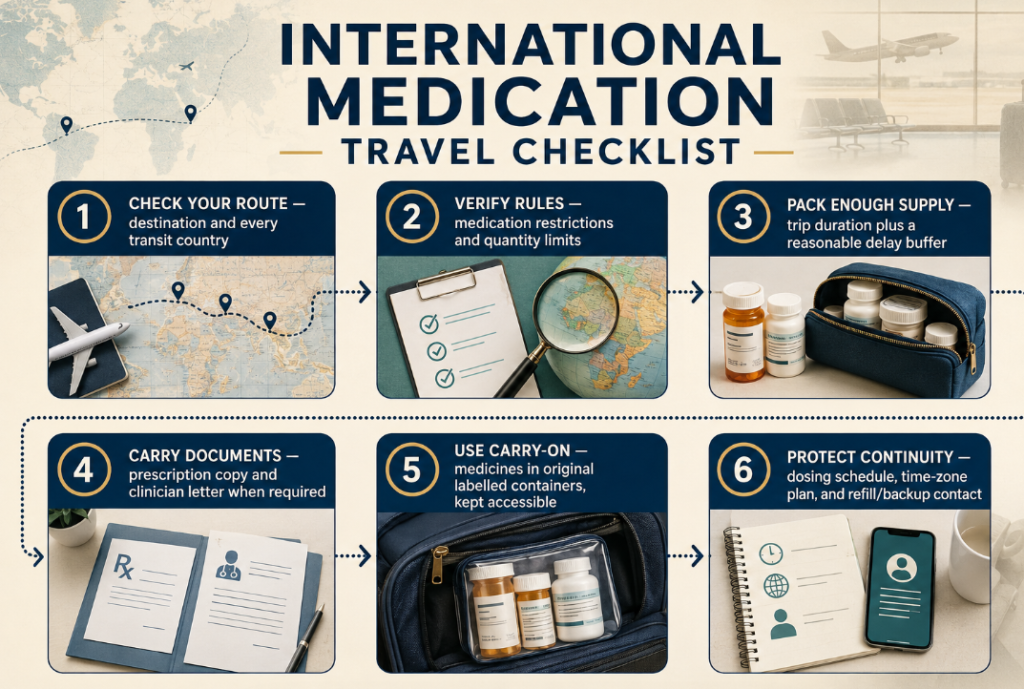
Start with the route, not the suitcase
Write down the departure country, every transit country, destination, return route, modes of transport, trip length, and places where the medicine will be stored. A direct domestic flight, an international connection, a road trip through extreme heat, and a cruise with multiple ports create different questions.
Then list what must travel with you:
- prescription medicines, including products used only when needed;
- over-the-counter medicines and supplements you intend to carry;
- administration supplies such as measuring devices, needles, syringes, swabs, or sharps containers;
- medical devices, chargers, spare parts, batteries, and manufacturer instructions; and
- information needed to identify the product and explain why it is carried.
Use a current medication list as the inventory. The travel plan should not rebuild that record; it should test whether every listed product has enough supply, correct identification, appropriate storage, necessary equipment, and a route-specific legal check.
International rules can apply even when you never leave the airport during a connection. A medicine may be legal at home but prohibited, quantity-limited, or subject to a certificate or advance approval elsewhere. This can include some controlled medicines, sedatives, stimulants, pain medicines, injectable products, and products that a traveler may not think of as drugs. Check each destination and transit point through its official embassy, consulate, health authority, customs authority, or other designated agency. The International Narcotics Control Board’s country information can help identify questions about internationally controlled substances, but it is not a substitute for current confirmation from the country concerned.
Do this early. A refill, prescriber letter, permit, translated document, carrier approval, or replacement device can take time.
Secure the supply before departure
Count the doses and consumable supplies required for the full journey, including travel days. Then consider realistic disruption: a canceled flight, weather delay, quarantine, missed connection, or later return.
“Bring extra” is not permission to obtain or carry an arbitrary amount. Refill timing, insurer limits, dispensing rules, product shelf life, controlled-substance limits, and destination law can all affect what is possible. Ask the pharmacy or prescriber early what supply can lawfully be dispensed and carried for the itinerary. If an early refill or vacation override may be needed, leave enough time to resolve it.
Do not assume that the same brand, strength, formulation, or prescription can be replaced easily abroad. Product names differ, familiar medicines may be unavailable, and buying from an unverified seller creates quality and counterfeit risk. Before departure, identify a legitimate contact route for the dispensing pharmacy, prescriber, insurer or assistance service, and—when the medicine is important to ongoing treatment—a reputable healthcare option at the destination.
Split risk without losing control. Essential medicine should remain with the traveler or responsible caregiver in accessible hand luggage when the applicable carrier and security rules allow it. A backup supply may sometimes be useful, but dividing a controlled medicine, temperature-sensitive product, or essential device across bags or travelers can create identification, security, stability, or legal problems. Confirm the plan instead of treating “two bags” as a universal rule.
Keep the medicine identifiable and the documents separate
Original pharmacy- or manufacturer-labeled containers help connect a medicine to the traveler, its strength, and its directions. Avoid combining different products in one bottle to save space. A pill organizer may still be useful during the trip if the pharmacist has confirmed it is appropriate for those products, but it should not replace the labeled supply needed for identification, environmental protection, or border inspection.
Carry supporting information separately from the medicine so that a lost bag does not erase both. Depending on the product and route, useful documents may include:
- a current medication list using both generic and brand names where known;
- a copy of the prescription;
- a clinician’s letter describing the medicine, dose directions, medical need, allergies, and required equipment;
- permits, certificates, translations, or customs declarations required by a country;
- device documentation and carrier approval; and
- pharmacy, prescriber, insurer, assistance-service, and emergency contact details.
A clinician’s letter does not override a country’s law or guarantee carrier acceptance. Likewise, a prescription that proves lawful use at home may not satisfy the destination’s documentation standard. Match each document to an official requirement and check whether an original, signature, letterhead, translation, or issue date is specified.
Protect privacy proportionately. Keep a paper copy accessible and a secure backup available to the traveler or authorized caregiver, but do not expose a full health record when a focused medicine document is sufficient.
Pack for access, screening, and storage
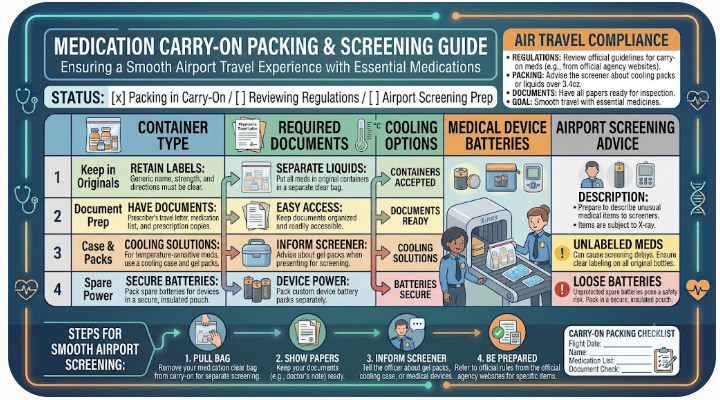
Checked baggage can be delayed, lost, exposed to temperature extremes, or inaccessible during the journey. Government travel guidance commonly recommends keeping medicines and necessary supplies in carry-on baggage. That is a strong default for continuity, but it does not erase security, dangerous-goods, carrier, or customs rules.
Before departure, verify the rules for:
- medically necessary liquids, gels, aerosols, and cooling materials;
- needles, syringes, lancets, and sharps containers;
- inhalers, pumps, monitors, CPAP equipment, oxygen, and other devices;
- spare batteries, power banks, chargers, and battery-powered equipment;
- ice packs or insulated containers; and
- extra medical baggage or advance assistance.
For example, U.S. Transportation Security Administration rules allow medically necessary liquids above the ordinary cabin-liquid limit in reasonable quantities, but travelers must declare them for screening. That is a U.S. screening rule, not a global promise. Another airport, airline, train operator, cruise line, or border agency may use a different process.
Keep enough time for screening. Place documents where they can be shown without unpacking every dose. Keep sharp items safely contained and device parts organized. If a bag must unexpectedly be checked at the gate, remove essential medicine and any item that the relevant aviation rules require to remain in the cabin, such as certain spare lithium batteries.
Protect temperature-sensitive medicine without inventing a cold chain
Travel does not change the product’s labeled storage conditions. Review the pharmacy label, manufacturer information, and any instructions provided by the pharmacist. If those directions are hard to locate or reconcile, use the method in how to read a medication label before deciding how to pack.
Ask product-specific questions:
- What temperature range applies before opening and after opening?
- Must the medicine be refrigerated, and must it be protected from freezing?
- How long may it remain outside its usual storage conditions, if at all?
- What cooling method and container are appropriate?
- Should the medicine touch an ice pack directly?
- How should it be handled during a long connection, power outage, or hotel transfer?
- What information should be recorded if a temperature excursion occurs?
Do not assume that colder is safer. Direct contact with frozen packs can damage some products, while a warm vehicle, sunny window, or unconditioned baggage area can expose others to excessive heat. A hotel minibar may not maintain a suitable, stable temperature and can freeze items placed near a cooling element.
If a product becomes too warm, freezes, leaks, breaks, or changes appearance, separate it from usable supplies and note what happened. Contact the pharmacist or manufacturer for a product-specific stability decision and ask how to protect continuity of treatment while the product is assessed. Appearance alone cannot prove that it remains usable. For the underlying storage principles, see safe medication storage at home; this travel plan adds transport, transfers, and temporary accommodations.
Make a medicine-specific time-zone plan
A changed clock can alter the interval between doses. The importance of that change depends on the medicine, the schedule, the number of time zones, and the length and direction of travel. There is no single rule such as “switch immediately to local time” or “stay on home time” that is safe for every medicine.
Before leaving, show the pharmacist or prescriber the itinerary and ask for a written plan. Clarify:
- which time zone governs each dose during the journey;
- when to transition to destination time;
- what minimum or maximum interval must be protected;
- how meals, sleep, fasting, monitoring, or device settings affect the schedule;
- what to do after a delay, missed connection, vomiting, or uncertain dose; and
- how to reverse the plan for the return trip.
Record the plan in actual dates and local times rather than relying on mental conversion while tired. Keep the phone’s automatic time-zone setting in mind, and use an alarm label that identifies the dose rather than a bare clock time. Do not crowd doses together, double a dose, or skip one merely to make the schedule look tidy.
This article does not calculate an individualized schedule. The safe decision is to obtain the medicine-specific plan before departure and carry it with the directions.
Prepare for loss, delay, damage, or border problems
A useful travel checklist includes the moment when the plan fails.
If medicine is lost or stolen, contact the local healthcare pathway, dispensing pharmacy, prescriber, and insurer or travel-assistance service as appropriate. Use the medication list, prescription copy, and labeled-container information to identify the exact medicine, strength, dosage form, and directions. Report theft when local rules or an insurer require it.
If a dose may be delayed, do not borrow another traveler’s medicine or buy a look-alike product from an unverified source. Ask a qualified local professional how to maintain continuity. A familiar brand name can contain a different ingredient or strength in another country.
If border or security officials question a product, stay factual and present the required documentation. Do not conceal, relabel, transfer, or mail the medicine as a workaround. If the product is refused or confiscated, ask for the reason and any available documentation, then contact the relevant health professional, official authority, or consular service. Consular staff may provide information or assistance, but they cannot cancel another country’s laws.
If a medicine has been exposed to heat, freezing, moisture, contamination, or physical damage, set it aside and seek a product-specific assessment. If essential treatment may be interrupted, say that clearly when requesting help. The continuity question is urgent even when the product’s appearance seems normal.
Final pre-departure checklist
Before leaving, confirm that you have:
- checked every destination and transit point for medicine, controlled-substance, quantity, permit, and declaration rules;
- arranged enough lawfully dispensed medicine and supplies for the trip and plausible delays;
- kept products in original labeled containers and prepared an appropriate organizer only when confirmed suitable;
- packed a current medication list, prescriptions, letters, permits, translations, and contact information required for the route;
- placed essential medicine and supplies in accessible carry-on baggage, subject to verified security and carrier rules;
- confirmed the transport plan for liquids, needles, devices, cooling materials, and batteries;
- obtained product-specific temperature instructions and a written time-zone schedule where needed;
- identified legitimate pharmacy, healthcare, insurance, and assistance contacts at the destination; and
- written a response plan for loss, delay, damage, confiscation, or an uncertain dose.
The goal is not to predict every travel disruption. It is to keep one disruption from forcing an unsafe guess.
FAQ
Should medication go in carry-on or checked baggage?
Essential medicines and supplies are generally safer in accessible carry-on baggage because checked bags can be delayed, lost, inaccessible, or exposed to temperature extremes. Verify the carrier, security, customs, liquid, device, battery, and sharps rules for the full route.
Do medicines have to stay in their original containers when travelling?
Original labeled containers are the strongest practical default for identification, directions, and border questions. Destination rules may specifically require pharmacy or hospital packaging. If you use an organizer, keep the labeled supply and confirm that removing the product from its original packaging is appropriate.
How much extra medication should I bring?
Prepare for plausible delays, but do not choose an arbitrary quantity. Ask the pharmacy or prescriber what can be dispensed and carried under refill, insurer, controlled-substance, shelf-life, and destination rules.
Can I travel internationally with a controlled medicine?
Possibly, but legality, quantity limits, documentation, permits, and declaration rules vary by country and may apply at transit points. Verify current requirements with the official authorities for every country on the route before departure.
What should I do about medication times when crossing time zones?
Ask a pharmacist or prescriber for a medicine-specific written schedule based on the itinerary. Do not automatically switch to local time, stay on home time, double, skip, or crowd doses without confirmed instructions.
How do I keep refrigerated medicine cold while travelling?
Follow product-specific instructions from the label, pharmacist, or manufacturer. Confirm the suitable container, cooling method, freezing risk, allowed excursion, and hotel-storage plan. Do not place medicine directly against ice unless instructed.
What if my medication is lost or damaged abroad?
Use your medication list, prescription copy, and container information to contact a legitimate local healthcare professional, your pharmacy or prescriber, and the insurer or assistance service. Do not borrow medicine, use an unverified seller, or guess about a damaged product or replacement dose.
Health Information Notice
This article provides general medication-travel planning information. It does not determine whether a medicine is legal in a particular jurisdiction, create an individualized dosing or time-zone schedule, confirm product stability after an excursion, or replace a pharmacist, prescriber, manufacturer, carrier, security agency, customs authority, insurer, consular service, or emergency professional. Rules and healthcare access vary by route and can change. Verify current official requirements before each trip and seek prompt local help when essential treatment may be interrupted or a medication error, serious reaction, poisoning, or emergency is possible.
Sources
- CDC Yellow Book 2026 – Travelers With Chronic Illnesses
- CDC Yellow Book 2026 – Traveling With Prohibited or Restricted Medications
- Government of Canada – Travelling With Medication
- International Narcotics Control Board – Country Regulations for Travellers
- TSA – Medically Necessary Liquids
- FAA – Lithium Batteries in Baggage
More in This Cluster: Medication Safety
- How to Keep an Accurate Medication List
- Prescription and OTC Medicines: How to Check for Interactions
- How to Read a Medication Label Without Missing Key Directions
- What to Ask a Pharmacist About a New Medicine
- Safe Medication Storage at Home
- Travelling With Medication: A Practical Safety Checklist (you are here)
- How to Dispose of Unused or Expired Medication Safely