Quick Summary
The U.S. Department of Education approved the nation’s second Workforce Pell Grant program on August 19. Eligible students at Ivy Tech Community College may now use Pell Grant funds for its eight-week Clinical Medical Assistant program. The first approval, announced earlier in August, covered an emergency medical technician program at Iowa Central Community College.
These approvals show that federal aid can now reach some career programs shorter than a traditional semester. They do not make every eight-week course, certificate, bootcamp, or trade program Pell-eligible.
Two separate conditions must line up: the program must have specific Workforce Pell approval, and the student must qualify for federal aid. Even then, the grant may not cover the full cost.
Reader Decision
Do not enroll because a course is merely described as “Pell eligible” or “Workforce Pell ready.” Ask the school’s financial aid office to confirm—in writing—the exact program, location, start term, federal approval status, your estimated grant, and the remaining amount you would have to pay.
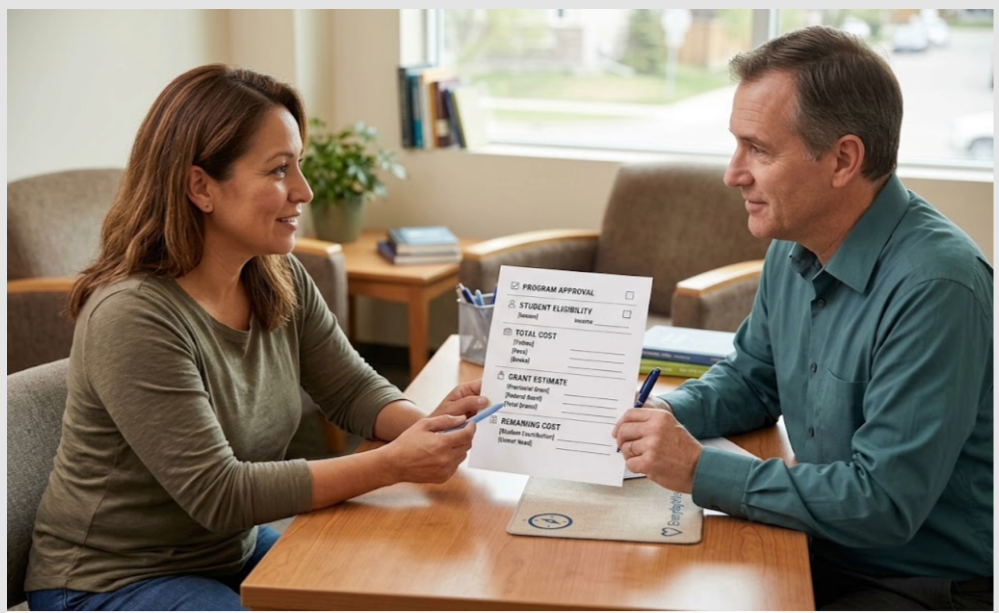
Two Approvals Must Line Up
Workforce Pell expands what federal Pell Grants can support, but it does not create automatic aid for all short-term training.
1. The program must qualify
An eligible workforce program generally must run for at least eight weeks but less than 15 weeks and include 150 to 599 clock hours, or the credit-hour equivalent. It must lead to a recognized credential for a high-skill, high-wage, or in-demand occupation and satisfy federal requirements involving completion, employment, and graduate earnings.
The approval process is program-specific. A governor identifies and approves a candidate through the state process, and the U.S. Secretary of Education conducts a separate review. Approval of one program at a college does not make every short course at that college eligible.
2. The student must qualify
The student must still meet the applicable federal Pell requirements. That generally means completing the Free Application for Federal Student Aid, or FAFSA, and allowing the school to determine eligibility and the award amount.
There is no special Workforce Pell box on the FAFSA. The school’s financial aid administrator identifies whether a student is enrolled in an approved workforce program and records the appropriate eligibility information.
Prior use of Pell Grants can also matter because lifetime limits still apply. A student cannot receive concurrent Pell awards for more than one program.
How to Find an Eligible Program
The approved list is still small and developing. A search result, advertisement, or school webpage may be outdated or may describe a program that is only seeking approval.
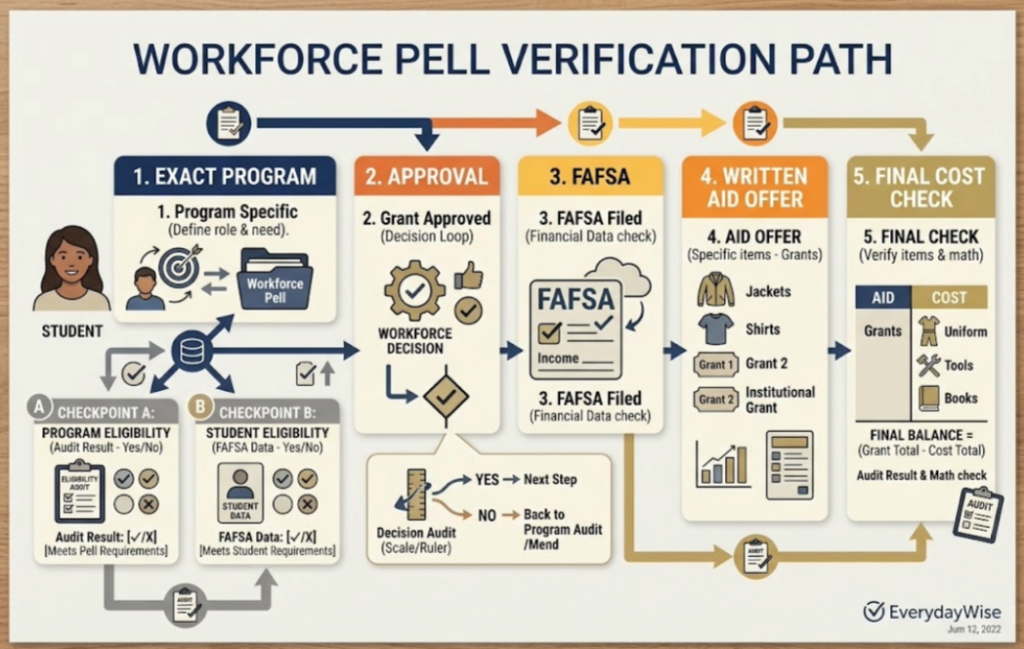
Use this sequence before committing money:
- Find the exact program. Record its official name, credential, campus or delivery format, start date, and program code if one exists.
- Verify approval with the financial aid office. Ask whether that exact program is approved for Workforce Pell for your intended term—not whether the institution participates in federal aid generally.
- Complete the FAFSA. The application supplies the information the school uses to determine federal student-aid eligibility.
- Request a written aid estimate. It should show the Pell amount, other grants or scholarships, and any amount left for you to pay or borrow.
- Confirm before the refund deadline. If approval, aid, or enrollment conditions are still uncertain, ask what you can cancel and by what date without owing tuition or fees.
Ask for the Full Price, Not Just the Tuition
A Pell Grant is aid, not a promise that training will be free. The actual award depends on the student’s eligibility and the program’s circumstances. Short programs may also carry costs that are easy to miss in the advertised tuition.
Ask the school to itemize:
- tuition and mandatory fees;
- books, software, uniforms, tools, and equipment;
- certification or licensing examinations;
- background checks, immunizations, drug screening, or clinical requirements;
- transportation, parking, and unpaid clinical or practicum time;
- the amount of Pell and other gift aid applied; and
- the balance due, including any proposed loans or payment plan fees.
Compare the total with the wages and hiring conditions for the occupation in your area. A short completion time can reduce some living costs, but it does not by itself make a program affordable.
Request Four Outcomes in Writing
Federal approval includes accountability standards, yet a prospective student still needs program-level information. Ask for these four items:
| What to request | Why it matters |
|---|---|
| Completion rate | Shows how many students finish within the measured period. Ask which cohort and definition the school used. |
| Employment rate | Ask whether it measures any job or work in the trained occupation, and when graduates were counted. |
| Credential and licensing result | Confirm what credential you receive and whether it meets the requirements for the job in the state where you plan to work. |
| Credit transfer or stacking | Find out whether the coursework counts toward a later certificate or degree and which institution has agreed to accept it. |
Do not treat a high percentage as a personal guarantee. Outcomes can vary with local hiring, prior experience, scheduling, transportation, licensing requirements, and the needs of individual students.
Check the Credential Before You Enroll
Workforce Pell rules are designed to support recognized credentials that can be portable or build toward further education. Still, federal financial-aid approval does not automatically establish that a credential satisfies every state licensing rule or that another college will accept the credits.
For a regulated occupation, contact the relevant state licensing or certification body and ask whether the program meets its education requirements. For transfer credit, ask both the training school and the receiving college for a written articulation or transfer policy. “May transfer” is weaker than an agreement naming the courses and credits accepted.
A Note for Students Who Already Have a Degree
Workforce Pell has an unusual exception: a student who already holds a bachelor’s degree may be eligible for Pell while enrolled in an approved workforce program. That does not override every other requirement. Federal guidance excludes students who already hold a graduate credential or who are accepted into or enrolled in a graduate credential program, and the school must still determine individual eligibility.
If you already have a degree, ask the financial aid office to review your situation rather than assuming that ordinary Pell rules either approve or disqualify you.
The Practical Takeaway
Workforce Pell can make carefully vetted short-term training more accessible. Its value depends on a three-part match: an approved program, an eligible student, and a total cost that still makes sense after the grant.
Start with the exact program rather than the school’s general marketing. Complete the FAFSA, obtain written confirmation from financial aid, and compare the remaining price with completion, employment, credential, and credit information. That turns a promising new benefit into a decision you can evaluate before signing an enrollment agreement.
This newsletter provides general educational and financial information, not individualized financial, legal, licensing, or career advice. Program approval, student eligibility, award amounts, costs, and occupational requirements can change. Verify the exact program and term with the school’s financial aid office and confirm licensing requirements with the appropriate state authority before enrolling.
FAQ
Does every program lasting eight weeks qualify for Workforce Pell?
No. Length is only one requirement. The exact program must complete state and federal approval and meet additional credential, outcome, and value requirements.
Is there a separate Workforce Pell application?
There is no special selection on the FAFSA. Complete the FAFSA and ask the school’s financial aid office to determine whether you and the exact program qualify.
Can someone who already has a bachelor’s degree receive Workforce Pell?
Possibly. Federal guidance permits some bachelor’s degree holders to qualify for an approved workforce program. Restrictions apply to students with, or enrolled in, graduate credential programs, and the school must determine individual eligibility.
Will a Pell Grant cover the entire program cost?
Not necessarily. The award depends on the student and program, and supplies, examinations, transportation, clinical requirements, or other costs may remain. Request a written estimate of all costs and aid before enrolling.
Sources
- U.S. Department of Education — Second Workforce Pell Program Approved in Indiana
- U.S. Department of Education — Final Rule Creating the Workforce Pell Grant Program
- U.S. Department of Education — Workforce Pell Grant Final Rule Fact Sheet
- Federal Student Aid Handbook 2026–2027 — Student Eligibility for Pell Grants
- Federal Student Aid — Federal Pell Grants