What Different Disclosure Rules Could Mean for You
Artificial intelligence is quietly becoming part of everyday content. A customer-service reply, product image, school presentation, company report, social-media post, or news article may now involve AI somewhere in the creative process.
For many people, the question is no longer whether AI is being used. It is:
Should people always be told when AI helped create something?
The answer is less straightforward than it first appears.
Some people support a clear label on every piece of AI-generated material. Others argue that universal labeling could create more confusion than clarity, especially when AI only corrected grammar, improved formatting, or supported routine editing.
Governments, publishers, technology companies, educators, and creators are therefore experimenting with different forms of transparency. Some approaches rely on visible labels. Others use technical provenance records, invisible signals, or contextual explanations.
Understanding those differences matters because an “AI-generated” badge does not automatically tell you whether content is accurate, deceptive, useful, or trustworthy. It only tells you something about how the content may have been produced.
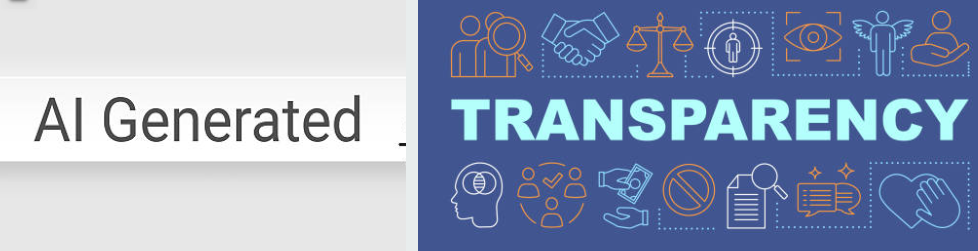
[IMAGE 1: Hero image — a reader viewing the same piece of digital content with several possible transparency signals: a visible AI label, a provenance icon, and a contextual disclosure.]
AI Is Already Part of Everyday Content
Many discussions treat content as either “made by AI” or “made by a person.”
Real-world production rarely fits that binary.
Consider a few common situations:
- A writer uses AI to correct grammar.
- A photographer removes an unwanted object with an AI editing tool.
- A business uses AI to summarize a long internal report.
- A designer generates an initial illustration and then substantially reworks it.
- A student uses AI to organize research notes before writing independently.
- A publisher uses AI to draft a headline but has an editor verify and approve the article.
Should all of these receive exactly the same label?
Probably not.
AI can assist with brainstorming, editing, translation, organization, generation, verification, or personalization. Its contribution may be minor, substantial, or difficult to separate from the rest of the workflow.
That makes the practical question more useful than the binary one:
Did AI materially affect what the audience sees, understands, or may act upon?
This idea of materiality is not one universal legal rule. It is a practical way to think about when disclosure becomes more valuable.
Different Countries Are Taking Different Approaches
There is no single global standard for labeling AI-generated content.
The European Union’s AI Act creates transparency obligations for certain AI systems and outputs. It includes machine-readable marking requirements for generative AI outputs and visible disclosure requirements in specific situations, including certain deepfakes and some AI-generated or manipulated text published to inform the public about matters of public interest.
Canada has taken a developing, consultation-based approach. In July 2026, the federal government launched a public consultation focused on detecting AI-generated content, helping people know when they are interacting with AI, improving access to understandable system information, tracking serious incidents, and increasing transparency around AI agents. The consultation asks Canadians and residents of Canada where transparency matters most and what information people actually need.
The United States does not currently have one comprehensive federal AI-labeling law that applies uniformly to all sectors and uses. Federal policy continues to develop alongside state laws, sector-specific rules, agency actions, voluntary standards, and proposed national frameworks.
These summaries are only snapshots. AI regulation is changing quickly, and the details may evolve as new laws, standards, and enforcement practices emerge.
Despite their differences, these approaches share a broad purpose: helping people recognize when AI involvement could affect how they interpret or act on information.
Four Practical Types of AI Transparency
The word label is often used to describe several different systems.
For practical purposes, EverydayWise groups AI transparency into four broad categories. This is an analytical framework for readers, not an official legal taxonomy.
1. Visible Labels
Visible labels are the notices most people immediately recognize.
Examples include:
- “Created with AI”
- “AI-generated image”
- “This article was assisted by AI”
- “This video contains digitally altered media”
Their main advantage is accessibility. A reader does not need special software or technical knowledge to see the disclosure.
The weakness is that a short label may oversimplify the process.
An article written almost entirely by AI with little review could carry the same basic label as an article independently researched and verified by a human who used AI only to create an outline. The label communicates that AI was involved, but not how much, where, or with what level of oversight.
2. Content Credentials and Provenance Information
Content Credentials are designed to record information about the history of a digital asset. Depending on the implementation, they may include how the content was created, which tools or processes were used, when changes occurred, and whether AI participated in the workflow.
This is different from a simple visible badge. Provenance information can provide a more detailed creation history rather than only a yes-or-no statement.
When compatible software supports the system and the data is preserved, the information can travel with the asset and help viewers inspect its history.
However, this system has limits:
- not every creation tool supports it;
- not every publishing platform preserves it;
- the information may become detached from the file;
- and readers need compatible software or interfaces to view it.
Content Credentials can help verify a recorded production history. They do not prove that the content’s claims are true.
3. Invisible Watermarks and Fingerprints
Some systems use signals that viewers do not normally see.
An invisible watermark may be embedded into the content itself. A fingerprint may be calculated from characteristics of the asset. Detection systems may then use those signals to identify content or reconnect it to stored provenance records.
These technologies are related to, but not identical with, Content Credentials. For example, the C2PA specification describes “soft bindings” that can use invisible watermarks or fingerprints to recover provenance records after embedded metadata has been removed or separated from an asset.
That overlap matters. Watermarking and provenance are not always completely independent systems. A watermark may serve as a bridge back to a provenance record.
Still, invisible techniques are generally less useful for direct reader communication unless a platform or browser detects the signal and presents the result in a visible way.
They also have practical limitations. Cropping, compression, re-encoding, screenshots, or other transformations may affect whether a signal remains detectable, depending on the technology.
4. Contextual Disclosure
Sometimes the most useful disclosure is not a permanent badge or embedded technical record. It is an explanation of how AI was used in that particular situation.
Examples include:
- a publisher describing its editorial review process;
- a company explaining that a customer-service chatbot is automated;
- a school stating which forms of AI assistance are allowed;
- a researcher documenting AI use in a methodology section;
- a photographer explaining that an image was substantially altered;
- or a business disclosing that a recommendation was generated from automated profiling.
Contextual disclosure can answer questions that a generic label cannot:
- What did AI do?
- What did a person do?
- Was the work reviewed?
- Were important claims independently checked?
- Did AI create the substance or only assist with presentation?
[IMAGE 2: Four-part infographic showing visible labels, Content Credentials, invisible watermark/fingerprint systems, and contextual disclosure.]

When Does Disclosure Matter Most?
Disclosure becomes more useful when AI involvement could reasonably change how someone interprets, trusts, or acts on content.
Depending on the sector and applicable rules, that may include AI-generated or substantially altered:
- news and public-interest information;
- political communication;
- medical information;
- financial guidance;
- legal information;
- educational assessment;
- identity-related images, audio, or video;
- product representations;
- evidence used in employment, insurance, or eligibility decisions.
In these situations, people may reasonably care whether a statement, image, or recommendation came from direct observation, professional judgment, automated generation, or some combination of the three.
By contrast, routine grammar correction or formatting may have little effect on meaning. A universal rule that treats every minor automated edit as equivalent to full generation could overwhelm readers with notices that provide little practical value.
The difficult part is deciding where the threshold lies.
A useful test is to ask:
- Did AI create or substantially alter the core message?
- Could the audience mistake synthetic material for direct evidence or human testimony?
- Could disclosure change a reasonable person’s decision?
- Is the content being used in a high-consequence setting?
- Would the absence of disclosure create a misleading impression about authorship, authenticity, or review?
The more often the answer is yes, the stronger the case for meaningful disclosure.
[IMAGE 3: Decision flow for judging when AI disclosure is most important.]
Can AI Labels Be Misleading?
Transparency is valuable, but labels are not perfect.
Imagine two articles.
The first is generated almost entirely by AI and published with little fact-checking.
The second is researched, sourced, reviewed, and approved by an experienced journalist who used AI only to organize an early outline.
If both display the same “AI-assisted” label, readers may assume their production processes were similar when they were not.
The reverse problem also exists. False, manipulative, or low-quality content can be created entirely by humans and carry no AI label at all.
An AI disclosure therefore tells you something about the production process. It does not automatically establish:
- truth;
- accuracy;
- fairness;
- expertise;
- independence;
- or editorial quality.
A label should be treated as one piece of evidence, not as a substitute for evaluating the source and its claims.
What Happens to Provenance in Screenshots and Shared Files?
A common misunderstanding is that provenance information follows content permanently.
Taking a screenshot normally creates a new image file representing what appeared on the screen. It does not simply preserve the original file in a different form. Unless the device or application deliberately carries provenance information into the new asset, the screenshot will generally not contain the original embedded metadata.
However, that does not mean all provenance recovery becomes impossible. A sufficiently robust invisible watermark or fingerprint may survive some transformations and allow compatible software to reconnect the new image to a stored provenance record.
The correct conclusion is therefore not “screenshots always erase proof” or “provenance always survives.”
It is:
A screenshot creates a new asset, and whether any provenance signal remains recoverable depends on the technology, software, and workflow involved.
Exporting, compressing, re-encoding, or posting through a platform can create similar problems. Some systems preserve provenance. Some remove it. Others may support recovery through external records.
This is why no single technical method can carry the entire burden of trust.
[IMAGE 4: Diagram showing original embedded provenance, screenshot creation, and optional recovery through a watermark or fingerprint.]

Building Trust Requires More Than Technology
People usually want answers to broader questions:
- Who created this?
- What evidence supports it?
- Was it independently reviewed?
- Can important claims be checked?
- Has relevant context been omitted?
- Does the publisher correct mistakes?
- Is there a financial, political, or personal conflict of interest?
These questions existed before generative AI.
AI creates new ways to produce and alter content, but it does not replace the basic foundations of credibility: evidence, accountability, transparency, and a traceable process.
A technically authenticated image can still be misleadingly captioned. A clearly labeled AI summary can still contain errors. A human-written article can still omit important facts. Conversely, carefully reviewed AI-assisted work may be accurate and useful.
The goal should not be to make readers automatically trust or reject content because AI was involved.
The goal should be to give them enough relevant information to judge it more intelligently.
What This Means for Everyday Readers
As AI becomes integrated into ordinary software, you will encounter more AI-assisted content than you can easily identify.
Some content will have visible disclosures. Some will offer Content Credentials. Some platforms may detect invisible signals. Others will rely on contextual explanations. Many items will provide no disclosure at all.
A practical reader response is not to assume that every unlabeled item is human-made or that every labeled item is unreliable.
Instead, ask:
- What exactly is being disclosed?
- Does the label explain the degree of AI involvement?
- Is there evidence beyond the label?
- Does the source have a credible review process?
- Would AI involvement matter for the decision I am making?
- Is this a situation where authenticity, identity, or direct observation is important?
For a low-stakes decorative image, the production method may matter little.
For a video presented as evidence of a public event, it may matter enormously.
For a grammar-corrected email, disclosure may add little.
For medical, financial, legal, political, or employment-related information, knowing how the content was produced and reviewed may be much more important.
The EverydayWise Perspective
The AI-labeling debate is often framed as a choice between complete disclosure and no disclosure.
That framing is too narrow.
Visible labels, Content Credentials, invisible signals, and contextual explanations solve different parts of the transparency problem. None is sufficient in every setting.
A more useful question is:
Does knowing about the AI involvement help someone make a better-informed decision?
That question keeps the focus on the reader rather than the technology.
It recognizes that disclosure should be meaningful, not merely performative. It should clarify the origin, alteration, or review of content when those facts could reasonably affect interpretation or action.
Specific legal requirements will continue to change. Technical standards will improve. Platforms will adopt different systems. New forms of manipulation will appear.
The durable principle is simpler:
People should receive clear, relevant information when AI involvement could materially affect how they understand or use content.
An AI label can support that goal. It cannot replace evidence, judgment, or trustworthiness.
FAQ
Does all AI-generated content have to be labeled?
No. Requirements vary by country, sector, platform, and type of content. Some rules apply only to particular uses, such as deepfakes, public-interest information, automated interactions, or high-risk settings. Many forms of disclosure remain voluntary.
Is AI-assisted content the same as AI-generated content?
Not necessarily. “AI-assisted” may describe limited support such as editing, summarizing, or organizing. “AI-generated” often suggests that AI produced a substantial part of the final output. Because these terms are not used consistently, a specific explanation is more useful than the label alone.
Do Content Credentials prove that an image is real?
No. They can help record and verify information about an asset’s provenance and editing history. They do not prove that the scene depicted is truthful, that the caption is accurate, or that the creator is unbiased.
Can screenshots remove Content Credentials?
A screenshot normally creates a new image file, so original embedded provenance data may not carry over. Some invisible watermarks or fingerprint-based systems may still allow compatible tools to reconnect the screenshot to an external provenance record.
Are invisible watermarks the same as Content Credentials?
No. They are different technologies, although they can work together. An invisible watermark may help identify an asset or recover a detached Content Credentials record.
Does an AI label mean the content is unreliable?
No. AI-generated content may be accurate or inaccurate, just as human-created content may be accurate or inaccurate. Reliability depends on evidence, review, accountability, and the quality of the source.
When should I care most about AI disclosure?
Disclosure matters most when authenticity, identity, direct observation, professional judgment, or high-consequence decisions are involved. Examples include news, politics, health, finance, legal matters, education, employment, and evidence presented through images, audio, or video.