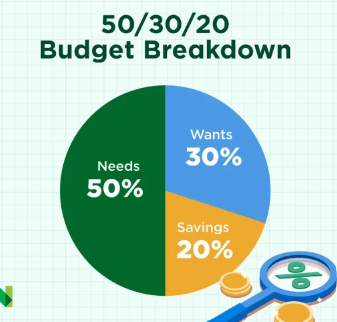
The 50/30/20 budget is appealing because it turns an entire household budget into three numbers:
- 50% of take-home income for needs;
- 30% for wants; and
- 20% for savings and debt repayment.
For someone facing a long list of transactions, those percentages can create a useful first view. They show whether essential costs are consuming most of the household’s income and whether any meaningful room remains for the future.
But a simple framework can become misleading when it is treated as a test of financial virtue. Housing may already use much of the needs category. Childcare, medication, transportation, or family support may be necessary in one household and absent in another. A person may also need to prioritize high-interest debt over discretionary spending or accept a smaller savings rate while income is temporarily constrained.
The practical question: Does the 50/30/20 framework reveal a useful adjustment, or does it mainly describe a ratio your household cannot reasonably reach?
The answer depends less on whether the percentages look balanced and more on what is inside them.
Treat 50/30/20 as a Diagnostic, Not a Verdict
The U.S. Consumer Financial Protection Bureau presents a version of the framework as a common rule of thumb: 50% of take-home pay for needs, 20% for savings and debt payments, and no more than 30% for wants.[1] The order is often written as 50/30/20, but the three allocations are the same.
The CFPB also acknowledges that people can find common financial rules difficult to apply and encourages them to create a personal rule that fits their situation.[1] That qualification is essential. The framework is a lane marker, not a law.
Used well, it can answer three useful questions:
- How much of take-home income is required to keep the household functioning?
- How much is supporting present-day choices and enjoyment?
- How much is improving future resilience or reducing past obligations?
It cannot, by itself, tell you:
- whether your rent is locally avoidable;
- whether your savings target matches your goals;
- which debt should be repaid first;
- whether income arrives before bills are due;
- whether an irregular expense has been omitted; or
- whether a household with unstable income can safely use an average month.
Those questions require a fuller budget. The ratio becomes useful only after the underlying numbers are credible.
Calculate the Ratio From Take-Home Income
Begin with monthly take-home income: the amount available after payroll deductions and other amounts withheld before the money reaches you. If pay is weekly or every two weeks, convert the annual net total to a monthly average rather than assuming every month contains the same number of paydays.
Then calculate:
| Category | Standard share | Monthly take-home income of $5,000 |
|---|---|---|
| Needs | 50% | $2,500 |
| Wants | 30% | $1,500 |
| Savings and debt repayment | 20% | $1,000 |
The arithmetic is straightforward:
monthly take-home income × category percentage
The classification is not.
Before comparing your spending with the targets, total a complete month of actual expenses. The CFPB worksheet instructs users to track everything they spend for a month before calculating the shares.[1] The Financial Consumer Agency of Canada similarly recommends using recent pay records, bills, and account statements so the budget represents current circumstances.[2]
Do not reduce a category on paper merely to make the ratio fit. If needs are currently 68%, record 68%. The first result is a description, not yet a prescription.

Define Needs Before You Defend Them
FCAC defines a need as something necessary, required, or essential, and a want as something desirable but not essential. It also emphasizes that the boundary differs among people and changes over time.[2]
A car illustrates the problem. It may be a want for someone with safe, reliable transit and a short commute. It may be necessary for a worker with no practical transportation alternative, a parent managing childcare schedules, or a person with mobility needs.
- basic housing and utilities;
- groceries and essential household supplies;
- necessary transportation;
- childcare required for work;
- insurance that is legally required or needed to protect a major risk;
- medication and necessary health costs;
- minimum required debt payments;
- basic communication needed for work or family responsibilities; and
- essential support obligations.
A required expense is not automatically efficient. An expensive vehicle payment may be contractually committed today even if a different transportation decision would be possible later. For the current calculation, hiding it in “wants” will not free the cash. Mark it as a present need or obligation, then identify whether it can be changed over a longer horizon.
This distinction prevents two opposite errors:
- calling every current expense a need so that nothing remains open to review; and
- calling an unavoidable cost a want because it exceeds the target.
Ask three questions when the classification is unclear:
- What practical consequence follows if this spending stops now?
- Is a realistic lower-cost substitute currently available?
- Is the expense essential, or is only part of it essential?
Internet service may be necessary, while a premium speed tier is a choice. Basic groceries are needs, while convenience upgrades may contain both need and want components. Housing is essential, but some features of a particular home may reflect preference as well as necessity.
You do not need to split every mixed purchase precisely. Separate the parts only when doing so could change a decision.
Decide What Belongs in the 20%
The third category is often described as savings, debt payments, or both. That variation can create misleading comparisons.
Use a consistent rule:
- count required minimum debt payments among current obligations when testing whether essential cash commitments are affordable; and
- count additional principal repayment in the 20% future-building category.
This treatment avoids implying that a household can skip required minimums when the 20% target is unavailable. It also makes extra debt reduction visible as progress rather than ordinary consumption.
The 20% category may support:
- emergency savings;
- retirement contributions made from take-home income;
- other long-term savings or investments;
- sinking funds for future goals; and
- debt payments above the required minimum.
Employer retirement contributions or pension deductions that never enter take-home pay require separate treatment. You may note them when evaluating overall progress, but do not add them to the numerator while leaving them out of take-home income. Use the same income boundary on both sides of the ratio.
The correct mix inside the 20% is not universal. Someone without a basic cash buffer may prioritize emergency savings. Someone carrying costly debt may direct more toward repayment. Someone with stable reserves and no high-cost debt may emphasize retirement or another long-term goal. The formula does not choose among them.
When the Framework Works Well
The 50/30/20 framework is most useful when the household has:
- reasonably stable take-home income;
- complete enough records to classify actual spending;
- essential costs near a level that leaves genuine choice;
- no immediate crisis requiring a different payment priority;
- a desire for broad boundaries rather than detailed category limits; and
- enough flexibility to redirect money among wants, savings, and debt reduction.
It can be especially helpful as a quick diagnostic after a first full budget. Article 1 in this cluster showed how several understandable housing, transportation, insurance, and family commitments can narrow the income still open to choice. A percentage view can make that concentration visible without repeating every line item.
Suppose a household with $6,000 in monthly take-home income records:
- $3,150 in needs: 52.5%;
- $1,650 in wants: 27.5%; and
- $1,200 in savings and extra debt repayment: 20%.
This budget does not match 50/30/20 exactly, but the framework reveals no obvious structural conflict. Needs are close to the guide, future progress is funded, and wants remain below 30%. Forcing a $150 reclassification or reduction merely to display 50% would add precision without adding much value.
In this situation, a practical personal rule might be:
Keep needs near 55% or lower, direct at least 20% toward savings and extra debt repayment, and allow wants to use what remains.
The rule is still simple, but it reflects the household’s actual structure.

When 50/30/20 Does Not Fit
Essential costs already exceed 50%
If rent, utilities, food, childcare, necessary transportation, insurance, and minimum payments consume 65% or 75% of take-home income, the formula does not identify an easy cut. It identifies a structural constraint.
Reviewing wants may still help, but reducing a 12% wants category cannot make needs fall to 50%. The meaningful options may involve housing, transportation, benefits, debt terms, childcare arrangements, or income. Some can change only slowly; some may not be available at all.
Do not respond by relabeling necessities as wants or by treating the difference as a discipline failure.
Income is low relative to local essentials
Percentages can make households with very different incomes look comparable when their actual room for choice is not. Fifty percent of $3,000 is $1,500; 50% of $10,000 is $5,000. Essential costs do not scale neatly with income, and basic housing or childcare may consume a much larger share at the lower amount.
When income is insufficient for current essentials, the first priority is not preserving a 30% wants allowance. It is protecting safety, required payments, and access to credible local support while evaluating the underlying gap.
Income changes substantially
A monthly average can overstate what is safely available in a low-income month. Commission workers, seasonal workers, business owners, contractors, and people with changing shifts may need a cautious income baseline and allocation rules for better months.
The 50/30/20 ratio can still be calculated over a longer period, but it should not replace a variable-income budget. That method belongs to Article 4 in this cluster.
Debt or a near-term goal needs temporary priority
A household may deliberately direct 30% toward high-cost debt and only 10% toward wants. Another may save intensively for an imminent move, parental leave, or essential purchase. Those departures can be rational if essentials remain covered and the trade-off is sustainable.
The framework should not force useful progress back down to 20% merely to preserve 30% for wants.
The categories create repeated arguments
If every grocery receipt, family activity, or transportation cost becomes a debate over whether it is a need or want, the framework is consuming more attention than it saves. Broader household rules may work better:
- a maximum amount for open-choice spending;
- a minimum transfer toward the future;
- a cap on committed costs before taking on a new obligation; or
- separate personal spending amounts after shared needs and goals are funded.
The point is to clarify decisions, not win classification disputes.
Adapt the Ratio Without Hiding the Trade-Off
A useful adaptation preserves the three jobs—current essentials, present choices, and future progress—even when the percentages change.
Use your current ratio first
Calculate the actual shares before selecting targets. A household at 68/17/15 has a different problem from one at 48/42/10:
- 68/17/15: needs dominate; the question is whether any major commitment can change and whether 15% of progress is currently credible.
- 48/42/10: essential costs leave room, but present choices may be crowding out future goals.
The same formula should not produce the same advice for both.
Set a direction, not a fictional destination
If needs are 68%, a first target of 65% may be more useful than insisting on 50%. If the current future-building rate is 4%, moving to 7% may establish progress without making the rest of the budget impossible.
FCAC notes that average budgeting guidelines do not apply to everyone and are best treated as a starting point.[2] A target should create a credible next decision, not a permanent excuse or an unreachable standard.
Use ranges when monthly life varies
A household might choose:
- needs: 50%–60%;
- wants: no more than 25%;
- savings and extra debt repayment: at least 15%.
Ranges acknowledge variation while preserving boundaries. They are particularly useful when utility, transportation, or family costs move modestly from month to month.
Protect a minimum future contribution
When 20% is not currently realistic, choose an amount or percentage that can continue through ordinary months. FCAC’s emergency-fund guidance emphasizes that small regular amounts can accumulate and that savings goals should be reviewed as family, work, or household circumstances change.[3]
This is not an argument for keeping the target permanently low. It is a way to maintain visible progress while the household works on larger constraints.
A Five-Step Fit Test
Before adopting 50/30/20, run this test:
- Use actual take-home income. Keep payroll-based and take-home amounts from being mixed.
- Classify a complete month. Include irregular provisions and required minimum payments, not only visible monthly purchases.
- Calculate the current ratio. Do not edit the numbers to reach the target.
- Identify the movable share. Separate costs that can change this month from commitments that require a longer decision.
- Choose the next rule. Keep 50/30/20, use a modified ratio, or move to a different budgeting method.
Keep the framework if it creates a clear boundary with little maintenance. Modify it if the three categories remain useful but the percentages do not reflect your constraints. Reject it if unstable income, tight cash flow, urgent debt, or complex variable spending requires a more detailed method.
Decision Summary
The 50/30/20 budget works best as a diagnostic framework for households with stable income and meaningful flexibility. It helps show whether income is supporting needs, wants, and future progress in a broadly balanced way.
It works poorly when:
- essential costs are structurally above 50%;
- income is too low or unstable for a fixed monthly ratio;
- debt or a near-term goal deserves a temporary priority;
- category boundaries hide mixed expenses; or
- the formula creates shame or argument without revealing an actionable change.
Start with the real ratio. Decide which costs are genuinely movable. Then use the familiar percentages only if they help you choose what happens next.
A budget should not be adjusted to make the framework look successful. The framework should be adjusted—or set aside—to make the budget more useful.
FAQ
What is the 50/30/20 budget rule?
It is a budgeting rule of thumb that divides take-home income into three broad shares: 50% for needs, 30% for wants, and 20% for savings and debt payments. The percentages are a starting point, not a universal requirement.
Should I use gross income or take-home income for the 50/30/20 budget?
Use take-home income—the amount available after payroll deductions—for the calculation. Mixing gross income with expenses paid from take-home pay makes the three percentages misleading.
Is rent or a mortgage always a need?
Housing is a need, but the full cost of a particular housing choice is not automatically beyond review. Classify the current required payment honestly, then separately consider whether that commitment can change over time.
Where do debt payments fit in the 50/30/20 budget?
For this article’s operational convention, required minimum payments are current obligations, while payments above the minimum belong in the future-building share with savings. Published versions differ, so consistency matters more than relabeling payments to improve the ratio.
What if my needs are more than 50% of my income?
Treat the result as information, not failure. Check whether the calculation is complete, identify which major commitments could realistically change, protect a credible amount for future progress, and use a personalized ratio or another budgeting method if 50% is not currently workable.
Can I change the 50/30/20 percentages?
Yes. A modified ratio or range can be more useful when housing, childcare, income, debt, or a near-term goal makes the standard split unrealistic. Keep the three purposes visible so the adaptation does not hide the trade-off between present choices and future progress.
References
- My Spending Rule to Live By, U.S. Consumer Financial Protection Bureau.
- Making a Budget, Financial Consumer Agency of Canada.
- Setting Up an Emergency Fund, Financial Consumer Agency of Canada.
- How to Do a Budget, Moneysmart, Australian Securities and Investments Commission.
This article provides general educational information and does not constitute individualized financial, tax, legal, or debt advice. Budget categories, debt obligations, support systems, and appropriate priorities differ by country and personal circumstances. Consider qualified local assistance if income does not cover essential expenses or required payments.
More in This Cluster: Budgeting Foundations
- How to Build a Monthly Budget That Reflects Real Life
- 50/30/20 Budget: When It Works and When It Does Not (you are here)
- Zero-Based Budgeting for Variable Expenses
- How to Budget When Your Income Changes Each Month
- Fixed vs Variable Expenses: What to Track First
- How to Review a Budget Without Starting Over
- The Most Common Budgeting Mistakes and How to Correct Them