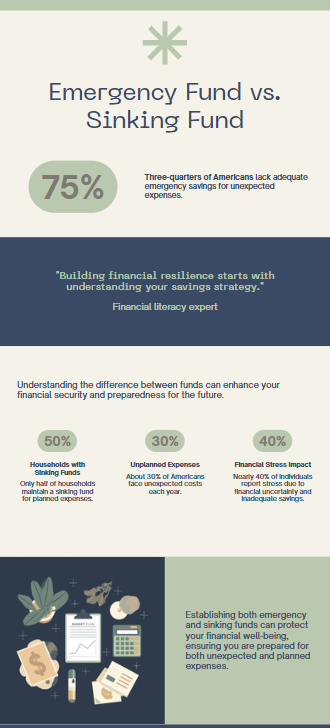
A car repair, annual insurance premium, school expense, veterinary bill, and broken furnace can all create the same immediate problem: money is due. But they do not all belong in the same savings category.
An emergency fund protects you from financial shocks you could not reasonably schedule or fully plan. A sinking fund prepares you for a cost you know—or should reasonably expect—is coming, even if its exact amount or date is uncertain.
The difference matters because using one balance for everything can create false security. A household may appear to have $12,000 in emergency savings, but if $4,000 is already needed for property tax, winter tires, and an annual insurance bill, only $8,000 is actually available for a job loss or urgent repair.
The practical question: Is this cost an unexpected disruption, or is it a predictable obligation that should have its own plan?
This is not a moral test. A cost does not become an emergency because someone failed, and a sinking fund does not require perfect foresight. The purpose is to give each dollar a clear job before several needs arrive at once.
The Shortest Useful Distinction
Official guidance draws a clear boundary even when it does not always use the term sinking fund. The U.S. Consumer Financial Protection Bureau defines an emergency fund as cash set aside for unplanned expenses or financial emergencies.[1] The Financial Consumer Agency of Canada similarly describes it as money for unexpected expenses and specifically distinguishes those from occasional costs such as school supplies, winter tires, and holiday spending, which should be planned in a budget.[2]
A sinking fund is one way to do that planning. You choose a known or reasonably foreseeable expense, estimate how much will be needed and when, and set aside part of the cost over time. The balance is expected to be spent for its named purpose.
| Emergency fund | Sinking fund |
|---|---|
| Covers an unplanned financial shock | Covers a known or reasonably foreseeable cost |
| Usually has no scheduled spending date | Usually has a target date, season, or usage cycle |
| Preserves broad household resilience | Protects one defined category or obligation |
| Is replenished after a qualifying emergency | Is repeatedly built and intentionally spent |
| Requires judgment before withdrawal | Has permission to be used for its stated purpose |
The most important distinction is not whether the bill is large. A $2,000 annual premium may belong in a sinking fund because it is known. A $400 emergency trip to care for a family member may belong in an emergency fund because it was urgent and unforeseeable.
Use Four Questions to Classify the Cost
Real expenses do not always arrive with a label. Use four questions together rather than relying on one example list.
1. Could you reasonably foresee it?
Foreseeable does not mean you know the exact invoice. Vehicle maintenance, home upkeep, school-year expenses, professional renewals, gifts, and many insurance deductibles are part of ordinary life even though timing and amount vary.
An event is more likely to be an emergency when its occurrence, timing, or scale could not reasonably have been incorporated into the household plan. Sudden income loss, urgent travel after a family crisis, or damage not adequately covered by insurance may meet that description.
Do not demand impossible prediction. A first-time homeowner may not know when a particular appliance will fail. But as the home and its systems age, replacement becomes increasingly foreseeable even if the exact month remains unknown.
2. Is there a date, season, mileage point, or replacement cycle?
A fixed date strongly supports a sinking fund: annual fees, tuition instalments, holiday travel, property tax, licence renewal, or an insurance premium.
Some costs have a range rather than a date. Tires wear with distance. Appliances have uncertain useful lives. A pet may need routine dental care after a future assessment. These can still be planned because there is a recognizable cycle or growing probability.
Uncertainty about timing does not automatically make a cost an emergency.
3. Can you estimate a credible range?
A sinking-fund target does not require a perfect quote. Prior invoices, service intervals, current prices, deductibles, and replacement ranges may provide enough information to begin.
Suppose a household expects a $1,200 annual insurance bill in ten months. Dividing the remaining cost by ten gives a starting monthly contribution of $120. If the final bill changes, the contribution can change. The category remains planned.
By contrast, the purpose of an emergency fund is broad because the specific event and amount may not be known in advance.
4. What happens if you delay the expense?
Some predictable costs are flexible. A vacation or optional renovation can be postponed if the sinking fund is short. Others are predictable but essential: property tax, necessary vehicle maintenance, annual medication costs, or a professional licence required to keep working.
The consequence of delay affects priority, but not classification. A predictable essential bill is still predictable. Calling it an emergency does not create more money; it merely hides the obligation inside a general reserve.
Common Sinking-Fund Categories
A sinking fund works best for irregular expenses that are too large or too infrequent to absorb comfortably from one month’s cash flow. Common categories include:
- annual or semiannual insurance premiums;
- property tax or other known periodic charges;
- vehicle registration, scheduled maintenance, tires, and expected replacement;
- routine home maintenance and aging-appliance replacement;
- school supplies, activity fees, and planned education costs;
- holidays, gifts, celebrations, and planned travel;
- professional dues, licences, equipment, and continuing education;
- routine veterinary care and expected pet costs;
- recurring medical, dental, vision, or accessibility expenses not fully covered; and
- technology or equipment with a foreseeable replacement cycle.
These are examples, not mandatory categories. Too many separate funds can make a system harder to maintain. A household might group several small annual bills into one “yearly expenses” fund while keeping a large home-repair target separate.
The category should be specific enough that you can tell whether the balance is already committed. It does not have to be so narrow that the system becomes administrative work for its own sake.
Common Emergency-Fund Uses
Emergency savings is generally reserved for unplanned bills or income disruptions outside routine monthly spending.[1] Depending on the household, examples may include:
- an unexpected loss or interruption of income;
- an urgent medical, dental, or veterinary cost that could not reasonably wait;
- immediate travel or temporary accommodation after a family crisis;
- sudden damage requiring action to keep a home safe or habitable;
- an essential vehicle repair that was not part of known maintenance; or
- a necessary expense created by an event that insurance or another resource does not cover in time.
An example is not automatic permission. The fifth article in this cluster, EW-M-0019, will examine the full withdrawal decision—including urgency, necessity, unpredictability, and consequences of delay. Here, the narrower point is that emergency money remains broadly available because the household does not know which legitimate shock will arrive.
Borderline Costs: When Both Funds May Have a Role
Some expenses contain a predictable layer and an unexpected layer. Treating them as all-or-nothing categories is often less useful than separating the layers.
Car repairs and replacement
Oil changes, scheduled service, tires, registration, and replacement of an aging vehicle are foreseeable. They fit sinking funds. A collision deductible, sudden breakdown between scheduled services, or repair caused by an unforeseen event may call for emergency savings if other coverage is unavailable.
But age matters. Repeatedly calling repairs on a visibly deteriorating vehicle “unexpected” may conceal a replacement need that has become predictable.
Home repairs
Routine maintenance, appliance replacement, and the gradual aging of a roof or heating system should inform planned reserves. Storm damage, a sudden leak, or an immediate safety problem may create an emergency.
The boundary can shift. The first failure of an appliance may be surprising; after warnings, service reports, or repeated temporary fixes, future replacement is no longer equally unexpected.
Medical and dental costs
Regular prescriptions, recurring therapy, scheduled dental work, known deductibles, and expected accessibility supplies can be planned. A new urgent condition or an unexpectedly large uncovered cost may require emergency savings.
Health costs deserve care in classification. “Predictable” does not mean optional, affordable, or the reader’s fault. It only means the budget can recognize some portion before the due date.
Pet expenses
Food, routine examinations, vaccinations, licences, grooming, and known treatment are ordinary or foreseeable costs. An urgent illness or injury may be an emergency. An aging pet or chronic diagnosis, however, may justify a larger planned medical reserve alongside emergency savings.
Income interruptions
A sudden layoff may be a classic emergency. A known seasonal shutdown, scheduled unpaid leave, planned parental leave, or a predictable gap between contracts is different: the expected portion should be planned before it begins.
Variable income can include both. A freelancer may use planned cash-flow reserves for ordinary low months and preserve the emergency fund for an unusual loss of clients, illness, or disruption beyond the normal range.
This layered approach prevents the emergency fund from carrying every irregularity while acknowledging that planning cannot eliminate genuine shocks.
What to Do When One Event Exceeds the Sinking Fund
Suppose you saved $1,500 toward vehicle maintenance, but an urgent and unforeseeable repair costs $2,300. The fact that a vehicle fund exists does not make the additional $800 automatically planned.
A practical sequence is:
- Use the sinking fund for the portion it was designed to cover.
- Decide whether the remaining amount meets your household’s emergency-use standard.
- If it does, use emergency savings for the unexpected gap rather than relabeling the entire cost.
- Later, reassess whether the sinking-fund target was unrealistic or whether the event was genuinely outside the normal range.
This preserves an honest record. If similar gaps recur, the issue may be an underfunded category rather than repeated bad luck. If the event was exceptional, changing the regular target may be unnecessary.
The same logic works in reverse. If a $2,000 home reserve covers a $1,400 repair, the unused $600 remains assigned to future home costs. It does not have to return to emergency savings unless the household intentionally changes the category.
When to Move Money Between the Funds
Savings categories should reflect current reality, not preserve an old plan forever.
Moving money from an emergency fund to a sinking fund may make sense when a previously vague risk becomes a known obligation. After a mechanic says a vehicle will probably need tires within six months, for example, that cost can move from general concern to a dated target.
Moving money from a sinking fund back to general emergency savings may make sense when:
- the planned purchase is cancelled rather than postponed;
- an obligation disappears;
- the target was materially overestimated;
- insurance or another reliable arrangement now covers the exposure; or
- the household deliberately changes priorities after reviewing essential needs.
Do not move the same dollars back and forth to make each balance look complete. A transfer is useful only when the purpose genuinely changes.
Also distinguish a transfer from a temporary borrowing habit. If the household repeatedly empties annual-bill funds for current spending and then uses emergency savings when the bills arrive, the labels are not protecting the plan. The problem is no longer classification alone; the budget and cash-flow structure need attention.
Avoid Double Counting
Double counting occurs when the same money is presented as available for two commitments.
Imagine these balances:
| Savings purpose | Balance |
| Emergency fund | $10,000 |
| Annual insurance | $1,200 |
| Vehicle maintenance | $1,000 |
| School and holidays | $800 |
| Total cash savings | $13,000 |
This household has $13,000 in total cash savings, but it does not have a $13,000 emergency fund. Three thousand dollars is already assigned to foreseeable costs. If all balances sit in one account, the accounting distinction still matters.
The opposite error is also possible. If annual insurance and vehicle maintenance are already fully reserved, do not add them again to the emergency-fund target merely because they are essential. EW-M-0015’s sizing calculation should include unavoidable monthly operating needs without duplicating costs that another funded category already covers.
Clear labels do not create more cash, but they reveal how much flexibility actually exists.
You Do Not Need a Separate Bank Account for Every Category
A fund is a purpose before it is a product. You can track several sinking funds in one account using a spreadsheet, budgeting app, account “buckets,” or a simple written ledger. You can also use separate accounts when that makes the boundaries easier to respect.
The emergency fund may benefit from visible separation because it serves a different job, but this article does not decide which account, institution, or structure is best. EW-M-0017 will compare safety, access, deposit protection, fees, yield, and the trade-offs of one-account and multi-account arrangements.
For classification, the test is simpler: can you see the balance assigned to each purpose and avoid spending committed money twice?
When Money Is Tight, Protect the Distinction Without Demanding Perfection
A household may not be able to fund every goal at once. That does not make classification pointless. It makes the information more important.
If $75 is available this month, you might record that $50 is building a starter emergency buffer while $25 is reserved for a known annual bill. Another household may need to direct the full $75 to an essential bill due soon. The allocation depends on urgency, consequences, current reserves, debt, and income stability.
This article does not prescribe the contribution order. EW-M-0018 will address how to build emergency savings on a tight budget and how to work with small milestones and competing priorities.
For now, avoid two misleading statements:
- “I have no emergency savings,” when some flexible cash truly is available for a shock.
- “I have a fully funded emergency reserve,” when much of the balance is already committed to known bills.
Honest labels let a household see the shortfall without turning it into a judgment about character.
A Simple Classification Review
For each irregular expense, write down:
- What is the expense? Use a clear category rather than “miscellaneous.”
- What makes it foreseeable or unforeseeable? Note dates, cycles, warning signs, or past frequency.
- Can the amount be estimated? Use a range if necessary.
- When might it be needed? Record a date, season, or trigger.
- Can it safely be delayed? Separate optional timing from essential obligations.
- Is money already assigned elsewhere? Check for double counting.
- Which layer belongs where? Split routine, predictable, and genuinely unexpected portions when needed.
- What would change the classification? Review after a diagnosis, inspection, job notice, quote, or other new information.
The result may be one emergency fund plus a few practical sinking categories—not a complicated web of accounts.
Decision Summary
An emergency fund and a sinking fund are both savings, but they solve different problems.
Use emergency savings to preserve flexibility against unplanned financial shocks. Use sinking funds to spread known or reasonably foreseeable costs across the months before they arrive. The size of the bill does not determine the category; predictability and purpose do.
When a cost contains both elements, split the layers. Routine vehicle maintenance can come from a sinking fund, while an exceptional urgent repair may justify emergency savings. As new information makes a vague risk more specific, move the planned amount into an appropriate category.
Most importantly, do not count the same money twice. Total savings and available emergency savings are not necessarily the same number. Clear assignments help you see what is protected, what is committed, and what still needs attention.
FAQ
Is a sinking fund the same as a savings account?
No. A sinking fund describes the purpose assigned to money, while a savings account is a financial product. You may keep several sinking categories in one account or separate them, provided you can track each balance accurately.
Is car repair an emergency or a sinking-fund expense?
Scheduled maintenance, tires, and foreseeable age-related work generally belong in a sinking fund. A sudden essential repair outside the normal plan may qualify for emergency savings. Warning signs and repeated failures can make a future repair increasingly predictable.
Should annual bills come from an emergency fund?
Usually not. If the bill and approximate due date are known, it should generally be included in the budget or a sinking fund. Using emergency savings for a known annual bill can leave less protection for a genuine disruption.
What if I cannot afford both funds yet?
Keep the distinction even if the balances are small. Identify known bills and your available emergency cushion honestly, then allocate according to urgency and consequences. The next cluster articles address storage and building strategies in more detail.
Can one expense use both funds?
Yes. A sinking fund may cover the expected portion, while emergency savings covers a genuinely unexpected and necessary gap. Review afterward to determine whether the planned target was too low or the event was exceptional.
How many sinking funds should I have?
Use enough categories to see meaningful commitments without creating unnecessary administration. Several small annual expenses can be grouped, while a large or high-priority obligation may deserve its own category.
Should I include insurance deductibles in a sinking fund?
It depends on how likely, recurring, and predictable the exposure is. A known deductible can inform a planned reserve, while the event triggering it may still be unexpected. Avoid counting the same deductible in both a dedicated balance and the emergency-fund target.
References
- An Essential Guide to Building an Emergency Fund, U.S. Consumer Financial Protection Bureau.
- Setting Up an Emergency Fund, Financial Consumer Agency of Canada.
- Savings Plan, U.S. Consumer Financial Protection Bureau.
- Sinking Funds Explained: How to Save for Known Upcoming Costs, MoneyHelper, United Kingdom.
- Simple Ways to Save Money, Moneysmart, Australian Securities and Investments Commission.
This article provides general educational information and does not constitute individualized financial, tax, legal, credit, debt, insurance, or investment advice. Savings priorities, protections, account rules, taxes, and appropriate reserves differ by country and personal circumstances. Consider qualified local assistance when income does not cover essential expenses or required payments.
More in This Cluster: Emergency Funds
- How Much Should You Keep in an Emergency Fund?
- Emergency Fund vs. Sinking Fund: What Is the Difference? (you are here)
- Where Should You Keep Emergency Savings?
- How to Build an Emergency Fund on a Tight Budget
- What Counts as a Real Financial Emergency?
- Should You Invest Your Emergency Fund?
- How to Rebuild Savings After Using Your Emergency Fund