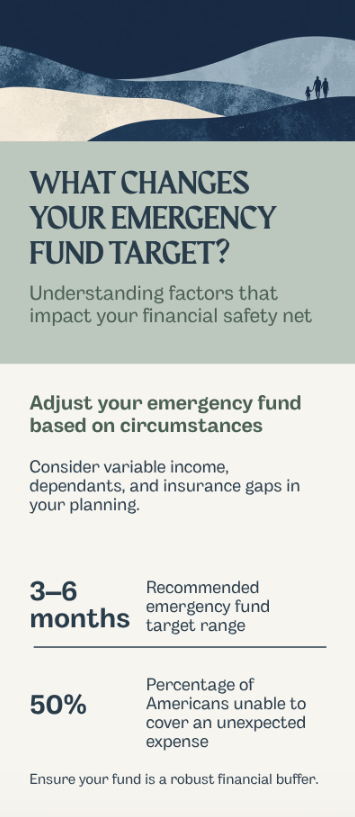
The familiar advice is to keep three to six months of expenses in an emergency fund. It sounds precise until you try to use it.
Which expenses count? Should a household with two stable incomes use the same target as a self-employed worker? What if insurance would cover most of a major loss, but only after a large deductible? And what if even one month of expenses feels far away?
The practical question: How much cash would give your household enough time and flexibility to recover from a financial shock without creating a second problem?
There is no single amount that answers that question for everyone. A useful target begins with essential monthly expenses, then adjusts for the risks your household actually carries and the resources that would still be available during a disruption.

Start With a Range, Not a Magic Number
Official guidance in several countries converges around a similar starting point. The Financial Consumer Agency of Canada suggests aiming for three to six months of regular expenses or income.[1] The United Kingdom’s government-backed MoneyHelper uses three to six months of essential outgoings as a rule of thumb.[2] The U.S. Consumer Financial Protection Bureau is less prescriptive: it says the amount depends on your situation and recommends considering the unexpected expenses you have experienced and what they cost.[3]
These positions are compatible. Three to six months is a planning range, not a universal rule or pass-fail test.
For most readers, essential expenses provide the more useful calculation base. Income can substantially overstate the amount needed to keep a household functioning if part of normal income goes to taxes, discretionary spending, long-term investing, or goals that could temporarily pause. But using income may be simpler for someone who does not yet have reliable expense records. If you use income as a shortcut, revisit the target once you know your essential monthly cost.
The starting formula is:
Core emergency-fund target = essential monthly expenses × target number of months
If essential expenses are $4,200 per month, the basic range is:
| Coverage period | Calculation | Target |
|---|---|---|
| 3 months | $4,200 × 3 | $12,600 |
| 4 months | $4,200 × 4 | $16,800 |
| 6 months | $4,200 × 6 | $25,200 |
The currency does not change the method. The important decisions are what belongs in the monthly base and where within—or beyond—the range your circumstances point.
Calculate the Monthly Amount You Would Actually Need
Do not automatically multiply your current total spending. An emergency budget is not necessarily your ordinary lifestyle continued without change. It is the amount required to protect housing, health, work capacity, dependants, legal obligations, and basic daily life while you recover.
Include expenses such as:
- rent or mortgage payments;
- basic utilities and communications;
- groceries and essential household supplies;
- necessary transportation;
- insurance premiums that must continue;
- minimum required debt payments;
- medications, medical supplies, and essential care;
- childcare or other care needed to work or manage the disruption;
- taxes or required contributions not already withheld; and
- unavoidable support for dependants.
Some expenses may continue at a reduced level rather than disappear. A household may spend less on commuting after a job loss but more on health coverage, job searching, training, or local travel. A self-employed person may need to preserve software, licensing, storage, or other minimum business costs to restore income.
Exclude or reduce expenses that could realistically pause without causing material harm, such as optional travel, extra debt payments above the required minimum, entertainment subscriptions, nonessential shopping, and some long-term savings contributions.
Be conservative about cuts that sound possible on paper but would be difficult to sustain. A family may reduce restaurant meals quickly; it cannot instantly leave a lease, eliminate a financed vehicle, or stop care responsibilities. Use a credible emergency budget, not an austerity fantasy.
Use records rather than memory
Review several representative months of bank and card activity, along with bills that may not appear monthly. Convert unavoidable quarterly or annual costs into monthly amounts. If an essential insurance premium of $1,200 is paid annually, include $100 per month in the calculation.
Do not include predictable upcoming costs twice. The portion of an annual bill that belongs to ordinary planning is not automatically an emergency. If money has already been reserved for that bill, it should not also inflate the emergency-fund target.
That boundary matters, but the full distinction between an emergency fund and a sinking fund belongs to the next article in this cluster.
Choose the Number of Months by Measuring Recovery Risk
Once you have the monthly base, decide how long the reserve may need to carry the household. The question is not simply, “How likely is something bad to happen?” It is also, “If it happens, how long would recovery take, and how much of the cost would remain ours?”
Factors that may support the lower end of the range
A target near three months may be more defensible when several protections are genuinely independent:
- two earners work in different industries or for unrelated employers;
- either income could cover most essential expenses;
- work is stable and comparable employment is usually available quickly;
- paid leave, severance, unemployment benefits, or other support is likely and understood;
- insurance coverage is strong and deductibles are manageable;
- housing, transportation, and health costs are predictable;
- the household has no dependants or unusual care obligations; and
- other reliable resources could be used without major tax, penalty, or market-loss consequences.
One favourable factor alone is not enough. Two people employed by the same business, sector, or local economy may have two paycheques but one underlying risk.
Factors that may support the higher end—or more
Six months or a deliberately larger reserve may be reasonable when:
- income is variable, seasonal, commission-based, contract-based, or self-employed;
- one income supports the household;
- the worker has specialized skills and a job search may take longer;
- both earners are exposed to the same employer, industry, or economic cycle;
- health needs could interrupt work or create uninsured costs;
- several people depend on the same income;
- immigration, licensing, location, caregiving, or accessibility constraints limit job mobility;
- insurance has high deductibles, exclusions, waiting periods, or reimbursement delays;
- the home, vehicle, or essential equipment has a concentrated repair risk; or
- the household has recently experienced an unstable transition.
The purpose is not to assign a score to hardship. It is to identify how many protections could fail at the same time and how long replacement income or reimbursement might take.
Do Not Count Every Backup at Full Value
An emergency fund does not operate alone. Insurance, paid leave, public benefits, severance, family support, and a partner’s income can reduce the amount of cash needed. But each resource must be discounted for delay, uncertainty, limits, and conditions.
Ask four questions about any backup:
- Is it available for this type of event? Disability coverage does not pay for a broken furnace. Unemployment benefits may not apply to every work separation.
- When would money arrive? A valid claim may still involve a waiting or processing period.
- How much would remain after tax, deductibles, exclusions, or reduced replacement rates? Gross benefit figures may not equal spendable cash.
- Is it independent of the same shock? Family support may be less reliable during a regional disaster or industry-wide downturn.
Credit is also not equivalent to savings. A credit line can be reduced, repriced, frozen, or difficult to repay precisely when income has fallen. Retirement funds or invested assets may be accessible, but taxes, penalties, settlement delays, or a market decline can make them poor substitutes for a planned cash reserve.
You do not have to ignore these resources. Treat them as layers with different reliability rather than adding their face values as though they were cash already available.
Test the Target Against Likely Single-Event Costs
The months-of-expenses method is designed mainly for an income interruption or a disruption that lasts. It may still be too low if one plausible, urgent event would exceed it.
Review the financial shocks your household has experienced or could reasonably face, without trying to predict every disaster. Examples might involve an insurance deductible, essential travel, urgent care not fully covered, a major repair needed to keep working, or temporary relocation.
The CFPB specifically recommends looking at common unexpected expenses from your own past and how much they cost when setting a goal.[3] That history can reveal a useful second test:
Final target should be high enough for the chosen recovery period and should not be obviously inadequate for a plausible major cash need.
Suppose a household calculates three months of essential expenses at $10,500, but its largest relevant insurance deductible plus temporary living costs could reasonably require $13,000 before reimbursement. A $10,500 reserve may be mathematically consistent yet operationally thin. The household might raise the target, improve the insurance arrangement, or acknowledge that another reliable funding layer is required.
Do not simply add every imaginable cost to six months of expenses. Many events overlap with the monthly calculation, cannot occur simultaneously in a meaningful planning model, or are better handled through insurance and planned maintenance. The goal is resilience, not an unlimited cash pile.
Use Three Targets When the Full Number Feels Impossible
A large target can be accurate and still be discouraging. The answer is not to pretend that a small round number fully solves the risk. Divide the goal into stages.
1. Starter buffer
Choose an initial amount capable of absorbing a common small disruption without immediate borrowing. This may be based on a typical urgent bill, a deductible, or the first portion of one month’s essential expenses. It is a milestone, not a universal amount and not the finished fund.
2. Core reserve
Build toward the calculated three-to-six-month range using essential expenses and your recovery-risk assessment.
3. Extended reserve
Add coverage when your circumstances justify more time or when a concentrated cost is not adequately handled by insurance or other reliable resources.
This staged approach preserves two truths: even a small amount can improve financial security, as the CFPB emphasizes,[3] and a starter balance should not be confused with the reserve needed for a long income interruption.
The fourth article in this cluster will address how to build the fund when the budget is tight. For now, the task is to set honest milestones rather than lower the final target until it loses meaning.
Example: Two Households With the Same Expenses
Consider two illustrative households, each with essential expenses of $4,000 per month.
Household A has two earners in unrelated industries. Either income covers most essentials. Both have paid leave, manageable deductibles, and broad employment options. After reviewing likely delays and costs, the household chooses a three-month core target of $12,000 and confirms that this exceeds its largest plausible immediate cash gap.
Household B relies primarily on one self-employed income. Revenue varies by season, health coverage has substantial out-of-pocket exposure, and specialized work may take time to replace. The household chooses six months as its core target, or $24,000, then adds a limited amount for a clearly identified cost not captured in monthly expenses.
Neither household is more responsible. The same monthly spending produces different targets because the paths back to stable cash flow are different.
When a Larger Fund Is Not Automatically Better
More cash creates flexibility, but emergency savings has an opportunity cost. Money held for immediate resilience is not being used to reduce costly debt, meet a required payment, fund a near-term obligation, or pursue a long-term goal.
That does not mean the reserve should be minimized. It means the final number should have a reason.
Reconsider an unusually large target when:
- it is based on total income even though essential expenses are much lower;
- the same cost is already covered by a dedicated reserve or reliable insurance;
- every remote possibility has been added as though all would happen together;
- expensive debt or an overdue essential obligation is worsening while cash continues to accumulate; or
- the target has grown from anxiety without a defined risk or coverage period.
This article does not decide whether emergency savings should be invested or exactly where it should be held. Those decisions belong to later articles. The sizing principle is narrower: keep enough accessible value to absorb the risks you intend the fund to cover, but know what those risks are.
Recalculate After Meaningful Changes
An emergency-fund target should change when the household changes.
Review it after:
- a job change, layoff risk, or move into self-employment;
- a major increase or decrease in essential expenses;
- marriage, separation, a new dependant, or changed care responsibilities;
- a move or major housing change;
- a change in insurance, benefits, deductibles, or paid leave;
- new debt obligations or the repayment of an old one;
- a health change affecting income or costs; or
- use of the fund itself.
Inflation can also make an old target quietly inadequate. Recalculate the monthly base from current essential expenses rather than increasing the old number by guesswork.
A Practical Sizing Worksheet
Use this sequence:
- Calculate essential monthly expenses. Use current records and include unavoidable non-monthly costs on a monthly basis.
- Choose a starting coverage period. Use three to six months as a reference range, not an automatic answer.
- Assess recovery time. Consider employment options, income concentration, health, dependants, location, and mobility.
- Discount backup resources. Account for waiting periods, taxes, deductibles, exclusions, limits, and uncertainty.
- Test a plausible major cash need. Make sure one foreseeable shock would not make the months-based number obviously inadequate.
- Set starter, core, and extended milestones. Keep the first step attainable without disguising the final need.
- Name the reason for any amount beyond the range. Avoid accumulating cash against undefined fear.
- Set a review trigger. Recalculate when income, expenses, responsibilities, or protection changes.

Decision Summary
Three to six months of essential expenses is a useful starting range, but it is not the decision itself.
First calculate what your household would truly need to keep functioning during a disruption. Then adjust the coverage period for the time it may take to restore income, the number and independence of your earners, health and care responsibilities, insurance gaps, and the reliability of benefits or other support. Test the result against a plausible large cash need, but do not add every imaginable emergency together.
If the final number feels distant, establish a starter buffer, a core reserve, and—only when the risks justify it—an extended reserve. A small first milestone can provide real protection without being mislabeled as complete.
The right target is not the largest number you can defend or the smallest number you can tolerate. It is the amount that gives your household a realistic path through a financial shock without requiring perfect timing, immediate borrowing, or the sacrifice of something even more essential.
FAQ
Is three months of expenses enough for an emergency fund?
It may be enough when income is stable, risks are well diversified, benefits and insurance are reliable, and replacement work would likely be found quickly. A single-income, variable-income, highly specialized, or medically vulnerable household may need closer to six months or more.
Should an emergency fund be based on income or expenses?
Essential expenses usually provide the more direct measure of what the household needs during a disruption. Income can be a simpler starting shortcut, and FCAC accepts either method, but it may overstate the target when normal income funds discretionary spending and long-term goals.
What expenses should I include in an emergency-fund calculation?
Include costs required to protect housing, food, utilities, necessary transportation, insurance, minimum debt payments, health, care, taxes, and dependants. Reduce costs that could credibly pause, but do not assume immediate lifestyle changes that would be impractical.
Is $1,000 enough for an emergency fund?
$1,000 may be a useful starter buffer for some households and an important improvement over having no reserve. It is not a universal complete target. Compare it with your essential monthly expenses, deductibles, likely urgent costs, and recovery time.
Should a self-employed person keep a larger emergency fund?
Often, but not automatically. A larger target may be justified when revenue is variable, benefits are limited, personal and business risks overlap, or replacing income could take longer. Stable contracts, diversified clients, insurance, and other reliable income can reduce the required cushion.
Can I count available credit as part of my emergency fund?
Credit can be a secondary backup, but it is not equivalent to savings. Limits, interest rates, and access can change, and repayment becomes harder after an income loss. Do not count its full face value as guaranteed cash.
How often should I recalculate my emergency-fund target?
Review it after a meaningful change in income, essential expenses, household responsibilities, insurance, health, housing, debt, or employment risk. Otherwise, a periodic check using current expenses can catch inflation and gradual changes.
References
- Setting Up an Emergency Fund, Financial Consumer Agency of Canada.
- Emergency Savings—How Much Is Enough?, MoneyHelper, United Kingdom.
- An Essential Guide to Building an Emergency Fund, U.S. Consumer Financial Protection Bureau.
- Save for an Emergency Fund, Moneysmart, Australian Securities and Investments Commission.
- Setting Savings and Investment Goals, Financial Consumer Agency of Canada.
This article provides general educational information and does not constitute individualized financial, tax, legal, credit, debt, insurance, or investment advice. Benefits, protections, taxes, account rules, and appropriate priorities differ by country and personal circumstances. Consider qualified local assistance when income does not cover essential expenses or required payments.
More in This Cluster: Emergency Funds
- How Much Should You Keep in an Emergency Fund? (you are here)
- Emergency Fund vs. Sinking Fund: What Is the Difference?
- Where Should You Keep Emergency Savings?
- How to Build an Emergency Fund on a Tight Budget
- What Counts as a Real Financial Emergency?
- Should You Invest Your Emergency Fund?
- How to Rebuild Savings After Using Your Emergency Fund