When money is already tight, advice to “save three to six months of expenses” can feel less like a plan than a reminder of what you do not have. Rent, food, utilities, transport, medication, and debt payments are due now. A large emergency target may be sensible, but it does not create room in this week’s budget.
The useful starting question is smaller: What amount can leave your spending account regularly without making an essential bill fail? That may be $5, $20, or nothing during a particularly difficult pay period. A contribution does not have to look impressive to be useful. It has to be repeatable.
Building an emergency fund on a tight budget is therefore not mainly an exercise in cutting treats. It is a cash-flow design problem. You need to find when money enters, when essential bills leave, where small amounts can be protected, and how occasional extra income will be divided before it disappears into competing needs.
The strongest plan usually combines a small dependable contribution with larger, irregular boosts. It also includes permission to reduce or pause saving when doing so is necessary to protect housing, food, utilities, health, or minimum debt payments. A savings system that repeatedly causes overdraft fees or new high-cost debt is not protecting you.
Begin With a Working Milestone, Not the Entire Target
EW-M-0015 explains how to estimate a full emergency-fund range using essential expenses, income stability, recovery time, insurance, benefits, and household responsibilities. Keep that longer-term figure, but do not require yourself to reach it in one uninterrupted push.
Use milestones that change what the household can handle:
- First interruption: enough for a common small disruption without immediately borrowing—for example, a prescription, transport problem, utility shortfall, or insurance deductible contribution.
- One essential bill: enough to cover one important recurring obligation.
- One week of essential expenses: a short bridge when income or reimbursement is delayed.
- One month of essential expenses: meaningful protection against a longer interruption.
- The calculated reserve range: the core or extended target appropriate to the household.
These are stages, not universal amounts. A fixed $1,000 milestone can be helpful for some people, but it may be too large to feel reachable, too small for the risks they face, or denominated in the wrong currency. The existing EverydayWise article How to Build a $1,000 Emergency Fund Fast owns that particular sprint. Here, the goal is a system that can continue beyond any one number.
Give the current milestone a real function. “Save $250” is abstract; “hold enough to cover the medication deductible and two trips to work” explains what the money changes. Once the milestone is reached, choose the next one rather than treating the first buffer as a completed emergency fund.
Find the Amount That Is Actually Available
A budget does not create money, but it can reveal timing problems, forgotten commitments, and expenses that no longer reflect your priorities. Review at least one full pay cycle—and preferably two or three months if income or bills vary.
Record:
- take-home pay, benefits, support, and other reliable income;
- housing, utilities, food, transport, childcare, medication, insurance, and minimum debt payments;
- annual or irregular costs that still need monthly provision;
- bank fees, interest, subscriptions, and recurring transfers; and
- the dates on which income arrives and bills are withdrawn.
Do not call annual insurance, school costs, planned car maintenance, or holiday spending “surprises” merely because they do not occur monthly. EW-M-0016 explains how sinking funds separate known future expenses from genuine emergencies. Ignoring those costs can make an emergency contribution appear affordable until the planned bill arrives and the savings must be withdrawn.
After accounting for essentials and known obligations, look for a reliable floor, not the best month. If three recent pay periods left $8, $46, and $21, an automatic $40 transfer is not supported by the pattern. A $5 or $8 transfer may be. Extra can be added in the better periods.
Use a simple test:
Affordable contribution = the amount that can be saved after essential bills and planned obligations, without relying on overdraft, revolving credit, or next period’s income to finish this period.
If the answer is currently zero, that is information—not a moral failure. Your first task is to stop the recurring deficit or obtain support, not disguise the deficit with a savings transfer.
Separate a Tight Budget From a Structural Shortfall
There is an important difference between having little discretionary room and having income that does not cover essentials.
With a tight but balanced budget, small adjustments, automation, and irregular deposits can gradually build savings. With a structural shortfall, the household is routinely choosing which essential bill not to pay. Cancelling a subscription may help at the margin, but it will not solve a rent, childcare, health, or income gap of hundreds of dollars.
If essentials exceed reliable income:
- protect food, housing, utilities, necessary transport, health needs, and other immediate priorities;
- contact lenders, utilities, landlords, service providers, or creditors early to ask about hardship arrangements where appropriate;
- check eligibility for tax credits, income benefits, childcare support, food or energy assistance, medication coverage, and local community services;
- seek reputable nonprofit debt or financial counselling if minimum payments are unmanageable; and
- examine the larger levers—hours, benefits, wages, housing, transport, childcare, insurance, or debt structure—without pretending every one is quickly changeable.
Country and local programs differ, eligibility changes, and applying can require time and documentation. Assistance is part of the household’s available financial system; it is not evidence that someone failed to budget.
You may still save a symbolic amount if it helps preserve the habit and does not harm essential payments. But do not pay an overdraft fee to maintain a savings streak. Preventing a new expensive balance can be the more protective action.
Choose a Contribution Rhythm That Matches Your Income
Official consumer-finance agencies in the United States, Canada, the United Kingdom, and Australia consistently recommend starting with manageable amounts and using regular or automatic saving where appropriate.[1][2][3][4]
The correct rhythm depends on how you are paid.
Stable salary or wages
Schedule a small transfer shortly after each payday, not at an arbitrary month-end date. Canada’s Financial Consumer Agency specifically suggests setting an automatic transfer for the day pay is deposited.[2] Starting near payday gives the saving decision a place in the cash-flow sequence instead of asking whatever happens to remain at month-end.
Leave enough time for payroll errors or delayed deposits if those have occurred before. Automation should reduce decisions, not create overdrafts.
Variable hours, tips, commissions, or self-employment income
A fixed amount may work when there is a dependable minimum income. Otherwise, use a small floor plus a rule for stronger periods—for example, save $5 whenever paid and 10% of income above a defined base amount.
Apply percentages to money actually received after setting aside tax and near-term business obligations. Gross self-employment revenue is not the same as household income.
Benefits or monthly fixed income
Align the transfer with the benefit date and the household’s bill calendar. A very small transfer that leaves enough for the longest gap between payments is safer than a larger transfer that must be reversed every month.
Irregular or seasonal income
Build during higher-income periods with the knowledge that some of the balance may later support genuine income interruptions. Keep planned off-season expenses separate where they are predictable. Saving aggressively in the busy season and then treating normal low-season bills as emergencies does not reveal the real plan.
Make Automation Adjustable, Not Rigid
Automation is useful because it removes repeated willpower from the process. The U.S. Consumer Financial Protection Bureau describes recurring bank transfers and split direct deposit as ways to make saving consistent.[1] Australia’s Moneysmart also suggests automatic transfers or directing part of wages to the emergency account.[4]
Set the transfer below the amount that worked only in your best month. Then establish rules:
- an alert two days before the transfer;
- a low-balance threshold at which you review or cancel it;
- a calendar reminder after three pay cycles;
- a small increase after a raise or a paid-off bill; and
- a reduction or pause when income falls or essential costs rise.
Pausing is not the same as abandoning the plan. A useful system bends before it breaks.
If your employer permits split direct deposit, sending a small amount directly to savings can keep it out of the spending account. If your bank’s automatic transfer can trigger fees when income is late, manual payday transfers or low-balance controls may be safer.
EW-M-0017 covers where to hold emergency savings. Whatever account you use, verify fees, withdrawal access, and deposit protection. A maintenance fee can erase months of small contributions.
Use Two Contribution Lanes
Many tight-budget plans fail because they depend entirely on monthly surplus. A stronger structure has two lanes.
Lane 1: the small repeatable contribution
This is the amount supported by an ordinary pay period. It keeps the system active and makes progress visible.
Suppose someone is paid every two weeks and can reliably save $12 per pay. Over 26 pays, that is $312. It will not complete a multi-month reserve, but it can create the first layer without assuming a dramatic lifestyle change.
Lane 2: irregular boosts
These may include:
- a tax refund;
- overtime, tips, commission, or a bonus;
- a cash gift;
- sale of an item no longer needed;
- a rebate or reimbursement;
- a benefit adjustment or back payment; or
- money freed when a temporary expense ends.
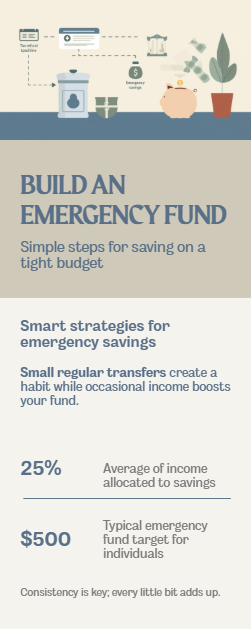
Decide the split before the money arrives. “Save 25% of every unexpected inflow” is more usable than “save whatever is left.” The percentage can vary because windfalls may also need to catch up overdue essentials, pay expensive debt, or cover a known expense.
Moneysmart recommends making ad hoc emergency-fund payments when extra money such as a tax refund becomes available.[4] CFPB likewise identifies one-time opportunities as a way to save.[1] The point is not that every windfall belongs in savings. It is that deciding in advance protects part of it from disappearing without a conscious choice.
Create Room Without Turning the Plan Into Punishment
Cost reductions are useful when they are specific, proportionate, and sustainable. Begin with expenses that provide little value or contain avoidable friction:
- duplicate or forgotten subscriptions;
- bank, overdraft, delivery, or late fees that can realistically be prevented;
- insurance, phone, internet, or utility plans that can be compared without losing needed coverage;
- food waste or purchases that repeatedly expire unused;
- services that can be paused rather than permanently cancelled; and
- a paid-off installment whose former payment can be redirected.
Do not assume every household has easy cuts. People may already share housing, use public transport, cook at home, and postpone healthcare. Repeated advice to eliminate coffee can make a structural income problem sound like a character problem.
Protect some room for ordinary life. A plan that removes every small pleasure or family choice may last for a few weeks and then rebound. The purpose of the emergency fund is to make life less fragile, not to make the present unlivable.
When negotiating a bill or cancelling an expense, move a portion of the actual saving—not the advertised saving—to the fund after the first lower bill appears. This prevents counting a reduction that never materializes.
Decide How Savings and Expensive Debt Work Together
High-interest debt can grow faster than savings interest. Yet sending every available dollar to debt while keeping no cash buffer can force a new charge when the next small disruption occurs.
The choice is rarely “save everything” or “repay everything.” A practical sequence may be:
- remain current on essential bills and required minimum payments;
- build a modest first buffer;
- direct more available cash toward the most damaging debt while continuing a small savings contribution; and
- expand the reserve as the debt burden falls.
MoneyHelper notes both sides of this trade-off: expensive borrowing commonly costs more than savings earns, while an emergency safety net still provides security.[5] The correct balance depends on interest rates, penalties, credit availability, income risk, and the consequences of another emergency.
If debt is delinquent, subject to legal action, secured against an essential asset, or impossible to service, obtain qualified local advice. This article cannot rank those consequences for an individual household.
Expect the Plan to Be Interrupted
Progress on a tight budget rarely forms a smooth upward line. A reduced workweek, school cost, medical bill, or repair may slow contributions. Some withdrawals will later prove to be planned expenses that need a sinking fund; others will be legitimate emergencies.
Do not solve the usage question in advance by declaring every urgent-feeling cost eligible. EW-M-0019 will define what counts as a real financial emergency. For now, create a short record whenever money leaves:
- amount;
- reason;
- date;
- whether the cost was unexpected or recurring; and
- what would reduce the chance of the same withdrawal next time.
This is not a guilt ledger. It is feedback. If the same annual bill drains the account, it may need its own planned-expense fund. If transfers are reversed before payday, the automatic amount or date may be wrong. If no amount remains after essentials, the underlying budget still needs structural attention.
A 30-Day Setup That Does Not Require a Perfect Budget
Days 1–7: observe
List income dates, essential bills, minimum payments, and known irregular costs. Review recent statements for fees and recurring charges. Choose one modest milestone with a clear purpose.
Days 8–14: test
Move a very small amount after payday. Leave it untouched through the next bill cycle. If the transfer causes a shortfall, reduce it or change the date rather than borrowing to protect it.
Days 15–21: automate carefully
Set a repeatable payday transfer, split deposit, or reminder. Add low-balance alerts. Write a rule for irregular income, refunds, or windfalls.
Days 22–30: review
Confirm that essential bills cleared without new fees or debt. Record the balance, decide whether the contribution is sustainable, and make only a modest increase if the evidence supports it.
Then repeat monthly. Review after any meaningful change in income, rent, childcare, insurance, debt payments, or benefits.

Common Approaches That Backfire
Setting the transfer from an aspirational budget
If the contribution depends on groceries, fuel, or utilities being lower than they normally are, it is not yet reliable. Use actual spending and improve the system gradually.
Saving at month-end only
There may never be a visible remainder. Give a small contribution a payday position, while keeping it adjustable.
Treating credit as the emergency fund
Credit can be reduced, frozen, or expensive precisely when income falls. It may be a backup resource, but borrowed capacity is not saved cash.
Raiding money meant for known bills
A balance is not fully available if part of it belongs to annual insurance, tax, school, or repair costs. Labeling and tracking prevent false progress.
Chasing income that costs more than it adds
Overtime or side work may help, but calculate childcare, transport, supplies, taxes, benefit reductions, and lost recovery time. Use net benefit, not gross revenue.
Waiting for the “right” amount
Small savings will not solve every emergency, but some cash can reduce how much must be borrowed or how many bills must be delayed. CFPB research found meaningful differences in financial difficulty between households with no emergency savings and those with some savings below one month of income, although the research does not prove that savings alone caused those differences.[6]
Decision Summary
When the budget is tight, build the emergency fund around the cash flow you actually have—not the contribution you think you should be able to make.
Keep the full target, but work through functional milestones. Find a repeatable minimum from ordinary pay periods, align it with income, and add a pre-decided share of irregular money. Automate only at a level that does not endanger essentials or trigger fees. Review the amount and timing when transfers are reversed or income changes.
If reliable income does not cover essential costs, recognize that as a structural shortfall. Benefits, hardship arrangements, reputable counselling, income changes, and major expense decisions may matter more than another round of small cuts. Saving nothing during a crisis can be the responsible choice.
The first purpose of this fund is not to prove financial discipline. It is to create one more option when life stops following the budget.
FAQ
Is it worth saving only $5 or $10 at a time?
Yes, if the contribution does not cause missed essentials, fees, or new debt. Small regular amounts can build a first buffer and establish a working system. Combine them with a rule for occasional extra income rather than expecting the small transfer to complete the entire target alone.
Should I save at the beginning or end of the month?
Match saving to your income schedule. A small transfer shortly after payday often works better than waiting for a month-end remainder, but leave enough for upcoming essentials and delayed deposits. People with variable income may need a small floor plus a percentage of stronger pay periods.
Should I stop emergency saving while paying off credit-card debt?
Not automatically. Expensive debt usually costs more than savings earns, but having no cash buffer can force new borrowing after a small shock. Many households use a modest first buffer, then emphasize high-cost debt while maintaining a small savings habit. Serious arrears require individualized advice.
What if I keep transferring the money back?
Review why. If it pays known annual or recurring costs, create a sinking fund. If it covers ordinary essentials before payday, reduce the contribution or change its date. If income cannot cover essentials, focus on the structural shortfall rather than preserving an artificial savings streak.
Should every tax refund or bonus go into the emergency fund?
No. It may also need to cover overdue essentials, planned costs, taxes, or expensive debt. Decide a reasonable percentage before the money arrives, then allocate the rest deliberately.
How often should I increase the contribution?
Review it after several successful pay cycles and after raises, benefit changes, paid-off debts, or reduced bills. Increase modestly only when the lower contribution has not caused reversals, fees, or shortfalls.
Financial Disclaimer: This article provides general educational information, not individualized financial, tax, legal, debt, or benefits advice. Products, assistance programs, creditor rights, and consequences vary by country and personal circumstances. Consider a qualified local professional or reputable nonprofit service when decisions could materially affect housing, essential services, secured assets, taxes, benefits, or debt enforcement.
References
- Consumer Financial Protection Bureau. “An Essential Guide to Building an Emergency Fund.” Updated October 29, 2025. https://www.consumerfinance.gov/an-essential-guide-to-building-an-emergency-fund/
- Financial Consumer Agency of Canada. “Setting Up an Emergency Fund.” Updated October 20, 2025. https://www.canada.ca/en/financial-consumer-agency/services/savings-investments/setting-up-emergency-funds.html
- MoneyHelper. “Saving Money to Boost Your Budget.” Accessed August 1, 2026. https://www.moneyhelper.org.uk/en/savings/types-of-savings/saving-money-to-boost-your-budget
- Australian Securities and Investments Commission, Moneysmart. “Save for an Emergency Fund.” Updated July 14, 2026. https://moneysmart.gov.au/saving/save-for-an-emergency-fund
- MoneyHelper. “Pay Off Debt, Save or Invest First?” Updated January 19, 2026. https://www.moneyhelper.org.uk/en/blog/debt-help/pay-off-debt-save-or-invest-first
- Consumer Financial Protection Bureau. “Emergency Savings and Financial Security: Insights from the Making Ends Meet Survey and Consumer Credit Panel.” March 2022. https://www.consumerfinance.gov/data-research/research-reports/emergency-savings-financial-security-insights-from-making-ends-meet-survey-and-consumer-credit-panel/
More in This Cluster: Emergency Funds
- How Much Should You Keep in an Emergency Fund?
- Emergency Fund vs. Sinking Fund: What Is the Difference?
- Where Should You Keep Emergency Savings?
- How to Build an Emergency Fund on a Tight Budget (you are here)
- What Counts as a Real Financial Emergency?
- Should You Invest Your Emergency Fund?
- How to Rebuild Savings After Using Your Emergency Fund