The expense is in front of you, the money is available, and the decision feels urgent. This is exactly when an emergency fund can become difficult to use well.
Some people protect the balance so strictly that they borrow at high interest during a genuine emergency. Others use it whenever a cost is unpleasant or arrives sooner than hoped. Neither approach reflects the fund’s purpose. Emergency savings are not a trophy balance that must never fall, nor are they an extra spending account. They are money reserved to prevent an unplanned financial shock from damaging essential parts of life.
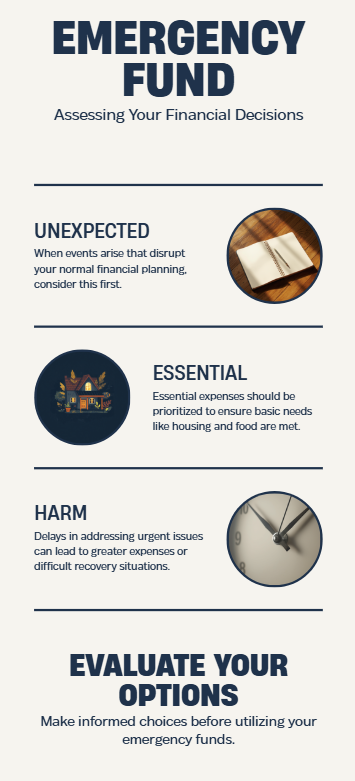
A useful decision asks four questions:
- Was the cost or income loss meaningfully unexpected?
- Does it protect an essential need, health, safety, housing, or the ability to earn income?
- Does it require action now, or would delay create material harm?
- Is there a safer or more appropriate way to cover it?
No single question is enough. A broken appliance may be unexpected but not essential. A rent payment is predictable, but using savings after a sudden job loss may be exactly what the reserve is for. A medical bill may be urgent, yet insurance, a payment plan, or public coverage may pay part of it.
The goal is not to prove that a cost deserves the word “emergency.” It is to decide whether using this money now is the least damaging reasonable choice.
Start With the Fund’s Actual Job
The U.S. Consumer Financial Protection Bureau defines an emergency fund as cash set aside for unplanned expenses or financial emergencies, including car or home repairs, medical bills, and loss of income.[1] Australia’s Moneysmart similarly describes it as money for urgent or unexpected costs.[2] MoneyHelper uses examples such as a broken washing machine or boiler.[3]
These examples are useful, but the category name does not settle the decision. “Car repair” could mean a failed transmission in the only vehicle used to reach work, cosmetic body damage, or routine brake replacement that has been delayed for months. The first may justify immediate use, the second may be postponed, and the third contains both a predictable maintenance failure and a current safety need.
Emergency savings usually have three practical jobs:
- keep essential life functioning during an unexpected expense;
- replace essential income during a disruption; and
- prevent a short-term shock from turning into missed housing, unsafe delay, service disconnection, or expensive debt.
If a withdrawal does none of these, pause before using the fund. The cost may still matter, but another savings category, a reduced purchase, or a later date may fit better.
The Four-Part Emergency Test
1. Was it meaningfully unexpected?
Unexpected does not mean unimaginable. Cars eventually need repairs, people become ill, and homes require maintenance. A cost can still be unexpected when its timing, cause, or size could not reasonably have been incorporated into the current plan.
Ask:
- Was the event known, recurring, or scheduled?
- Were there clear warnings or a reliable replacement cycle?
- Was the amount materially larger or earlier than reasonably planned?
- Did an outside event suddenly remove income or create the cost?
Annual insurance, routine school expenses, holidays, property tax, and ordinary maintenance generally belong in a budget or sinking fund. EW-M-0016 explains that distinction. However, imperfect planning does not make a present safety or housing threat disappear. If a known expense was not funded, acknowledge the planning gap without using shame as the decision rule.
2. Does it protect something essential?
An essential expense protects a basic need or prevents serious deterioration. Depending on the household, that may include:
- housing and essential utilities;
- necessary food, medication, or healthcare;
- safety-critical home or vehicle repairs;
- transport required for work, medical care, or caregiving;
- essential childcare that permits employment;
- temporary replacement of lost income; or
- urgent care for a dependent person or animal.
Essential does not mean emotionally unimportant expenses are foolish. It means the emergency fund has a narrower assignment. A family celebration, upgraded device, preferred vacation, or convenience purchase can be deeply valued without belonging to this reserve.
Context matters. A laptop may be optional in one household and the only workable tool for a self-employed person’s income in another. A car may be replaceable by transit for one week in a city, but indispensable for a rural worker or a person with limited mobility.
3. Must you act now?
Urgency concerns consequences, not pressure. Sales deadlines, social expectations, and discomfort are not the same as a threat to health, safety, housing, or income.
Ask what happens if you wait 24 hours, one week, or one month. Immediate use is easier to justify when delay could:
- make a repair substantially more dangerous or expensive;
- cause loss of housing or essential service;
- interrupt necessary treatment or medication;
- prevent someone from earning income;
- leave a dependent without safe care; or
- force more costly borrowing or penalties than the available alternatives.
When delay has limited consequences, obtain another quote, check coverage, reduce the scope, or save separately. Urgency should be verified where possible, especially when a seller benefits from an immediate decision.
4. Is there a safer or more appropriate resource?
Using the fund may still be sensible, but first check resources already meant for the event:
- insurance, warranty, roadside assistance, or employer benefits;
- a sinking fund assigned to the expense;
- a refund, reimbursement, tax credit, or public benefit;
- a no-fee payment extension or manageable payment plan;
- a less costly safe repair or temporary substitute; or
- cancellation, return, rescheduling, or help from a responsible party.
Compare the whole consequence. A payment plan with high interest is not automatically safer than using savings. An insurance claim may involve a deductible, delay, exclusions, or future premium effects. A family loan may carry relationship costs. Credit capacity can also disappear when income falls. The existence of an alternative does not make it the better one.

A Simple Decision Sequence
When time permits, write the decision in five lines:
- Event: What changed?
- Essential consequence: What important need is at risk?
- Deadline: When does real harm begin?
- Options: What other resources or reduced solutions exist?
- Withdrawal: What is the smallest amount that safely resolves the immediate problem?
This prevents the event from defining the size of the withdrawal. If a furnace fails, the emergency may justify restoring safe heat—not automatically purchasing the most expensive replacement system. If a phone breaks, the necessary response may be a basic replacement or repair, not an upgrade. If urgent travel is required, the fund may cover practical transportation and lodging rather than every expense attached to the trip.
The smallest safe solution is not always the cheapest upfront. A repair that will fail again next week or a temporary measure that creates safety risk is false economy. Compare total likely cost, reliability, and the consequences of another failure.
How the Test Applies to Common Gray Areas
Income loss or reduced hours
This is a core purpose of emergency savings. The reserve may cover essential expenses while someone searches for work, waits for benefits, recovers from illness, or adjusts after hours are cut.
Use it as an income bridge, not as automatic permission to preserve every former expense. Review the budget early, apply for eligible benefits, contact creditors or service providers where appropriate, and distinguish essential commitments from costs that can temporarily change. The balance exists to provide decision time, but spending at the old rate can shorten that time unnecessarily.
Housing and utilities
Emergency use may be justified for urgent repairs involving heat, water, electricity, weather exposure, security, sanitation, or structural safety. It may also bridge rent, mortgage, or essential utilities after a sudden income disruption.
Routine maintenance, expected renewals, cosmetic improvements, and planned renovations normally belong elsewhere. Yet a neglected maintenance item can become an immediate safety problem. At that point, protect the household first and record the lesson for future planning later.
Tenants should contact the landlord or property manager when the repair is legally or contractually their responsibility. Owners should check insurance, warranties, service plans, and multiple qualified quotes when the situation allows. Do not delay action on suspected gas leaks, electrical danger, fire risk, major water intrusion, or other immediate hazards merely to complete a financial comparison.
Vehicle repairs and transport
Ask whether the vehicle is necessary and whether the repair affects safe or lawful operation. Brakes, steering, tires, or a breakdown that prevents essential work or medical travel can make the case strong. Cosmetic damage, optional accessories, and upgrades usually do not.
Routine oil changes, scheduled servicing, registration, and replacement of predictably worn parts should be planned. But if the choice today is a necessary repair versus losing income or driving unsafely, the current decision should address that harm. Afterwards, the recurring portion can move to a vehicle sinking fund.
Medical, dental, and mental-health costs
Necessary treatment, medication, urgent dental care, mobility equipment, or required travel for care may qualify when other coverage is unavailable or delayed. Health decisions should not be based solely on a financial article. Seek appropriate clinical guidance about urgency and safe timing.
Before paying, verify insurance or public coverage, deductibles, provider billing, reimbursement procedures, and any available payment support. For non-urgent care, ask whether a lower-cost provider or staged treatment is clinically appropriate. Do not postpone emergency care while comparing prices or waiting for reimbursement certainty.
Family and caregiving emergencies
Urgent travel, temporary childcare, accessible transport, or essential support may justify a withdrawal when a child, partner, parent, or other dependent faces a serious unexpected event.
The emotional importance of the situation can make every related expense feel necessary. Separate the core response from optional additions. Ask who must travel, how quickly, what support already exists, and which costs can be shared, reimbursed, or delayed.
Pet care
Urgent veterinary assessment or treatment can be a legitimate household emergency. Check insurance, payment options, prognosis, treatment alternatives, and the animal’s welfare with the veterinarian. The decision may involve values and medical uncertainty that no universal spending rule can resolve.
Known medication, routine care, and increasingly predictable costs for an aging animal should gradually move into planned funding. That does not mean an underfunded household must ignore an animal’s urgent needs; it means the next plan should reflect information that is now more predictable.
Technology replacement
A failed device may qualify if it is required for paid work, essential communication, accessibility, education with an immediate deadline, or access to critical services. The eligible expense is the function that must be restored. Repair, borrowing equipment, using a public facility, or buying a basic replacement may be enough.
A newer model, better camera, or performance upgrade normally belongs to planned savings even when the old device breaks unexpectedly.
Helping another person
Compassion can be genuine while the use of your emergency fund remains risky. Before withdrawing, clarify whether the need is immediate and essential, whether the amount is a gift or a loan, and whether helping would endanger your own housing, dependents, or ability to work.
If you choose to help, decide the maximum you can give without counting on repayment. Your emergency reserve can support your values, but it cannot safely absorb every emergency within your wider circle.
When a Predictable Bill Becomes an Immediate Crisis
A strict “unexpected only” rule can become unrealistic. Rent is predictable. Medication refills may be predictable. Food is routine. Yet after a sudden job loss, illness, delayed benefit, separation, or family disruption, paying these ordinary expenses may become the very reason the emergency fund exists.
Classify the event, not only the bill. If income disappeared unexpectedly, using the fund for routine essentials can be appropriate. If the same ordinary bills exceed income every month without a new shock, the problem is a structural shortfall rather than a series of emergencies.
That distinction changes the response. A temporary bridge may be funded from savings. A recurring deficit requires a broader plan involving income, benefits, debt, housing, transport, childcare, or other major costs. Repeated withdrawals are information that the current system cannot sustain itself.
When Not Using the Fund Can Be More Expensive
Some people feel safer seeing the balance untouched, even while carrying a new credit-card balance, missing an essential bill, or allowing damage to worsen. That can preserve the appearance of security while increasing the underlying risk.
Compare:
- interest, fees, and penalties;
- risk of service disconnection, eviction, repossession, or loss of coverage;
- additional damage caused by delay;
- lost wages or work opportunities;
- health and safety consequences; and
- how quickly the savings could later be rebuilt.
An emergency fund has succeeded when it absorbs a shock, even if the balance falls sharply. CFPB research on emergency-savings programs notes that a person can have little or no balance after a financial shock and still be better off because the money was available when needed.[4] The balance alone does not reveal whether the fund worked.
When to Pause Before Withdrawing
Pause when:
- the decision is driven mainly by a sale, deadline created by a seller, or social comparison;
- the expense upgrades comfort but does not restore an essential function;
- the cost is annual, recurring, or already assigned to another savings goal;
- you have not checked insurance, warranty, employer, landlord, or responsible-party coverage;
- the first quote is large and the situation safely allows comparison;
- you are calling the expense an emergency to avoid changing the purchase; or
- the withdrawal would solve today’s discomfort while creating a larger essential shortfall next week.
Pausing does not mean refusing. It means obtaining enough information to use the reserve deliberately.
Record the Decision Without Putting It on Trial
For each withdrawal, note:
- what happened;
- why action was necessary;
- alternatives checked;
- amount withdrawn; and
- what, if anything, should change later.
This record is not a scorecard of discipline. It helps reveal patterns. A recurring repair may need planned replacement. A deductible may deserve its own sinking fund. A benefit repeatedly delayed may require a larger cash-flow buffer. A supposedly urgent category may turn out to be discretionary.
Do not postpone a necessary response merely to create perfect documentation. A short note after the situation is stable is enough.
EW-M-0021 will address how to rebuild savings after use. At the moment of decision, avoid promising an unrealistic repayment schedule simply to make the withdrawal feel acceptable. First determine whether the use is sound; then assess the new cash flow honestly.
Decision Summary
A real financial emergency is not defined by price, stress, or surprise alone. It is an unplanned event or income disruption that threatens an essential need and requires timely action, after reasonable alternatives have been considered.
Use four questions: Was it meaningfully unexpected? What essential function is at risk? When does delay create real harm? Is another resource safer or more appropriate? Then withdraw the smallest amount that restores the essential function safely—not automatically the full amount requested or the most desirable solution.
Predictable bills can still be valid uses when an unexpected loss of income makes ordinary essentials unaffordable. Conversely, an unexpected purchase does not qualify merely because it was not in the budget. Context and consequence matter.
The purpose of emergency savings is to be used. A lower balance after preventing unsafe delay, lost income, housing damage, or expensive borrowing is not evidence of failure. It is evidence that the household had one more option when the plan was interrupted.
FAQ
Is a car repair always an emergency-fund expense?
No. A safety-critical repair or breakdown that prevents essential work or care may qualify. Routine maintenance, cosmetic work, and upgrades normally belong in planned savings. Consider whether the vehicle is necessary, whether delay is safe, and whether a smaller reliable repair is available.
Can I use my emergency fund for rent or groceries?
Yes, when an unexpected income loss or serious disruption makes ordinary essentials temporarily unaffordable. If routine expenses exceed income every month without a new shock, savings may provide short relief but will not solve the structural shortfall.
Does an expense have to be completely unexpected?
No. The timing or size may be unexpected even when the general category was foreseeable. A known cost can also become urgent. Use predictability together with essentiality, time sensitivity, and available alternatives.
Should I use savings or a credit card for an emergency?
Compare total cost and consequences. Using savings may avoid interest and protect future income, while a no-cost payment option may preserve cash. Do not keep the savings balance untouched automatically if doing so creates expensive debt or delays an essential response.
Is urgent travel a real financial emergency?
It can be when serious illness, death, safety, or dependent care requires timely travel. Separate essential transportation and basic lodging from optional additions, and check insurance, employer support, refunds, or cost sharing.
What if I regret using the fund afterward?
Review the information available at the time, not only the final outcome. Record what happened and what can be planned differently. A decision can be reasonable even if insurance later pays, the repair costs less, or the feared consequence does not occur.
Financial Disclaimer: This article provides general educational information, not individualized financial, tax, legal, insurance, debt, benefits, medical, or veterinary advice. Coverage, assistance, creditor rights, and urgent-care options vary by jurisdiction and circumstance. Seek qualified local help when a decision could materially affect health, safety, housing, essential services, secured assets, or legal rights.
References
- Consumer Financial Protection Bureau. “An Essential Guide to Building an Emergency Fund.” Updated October 29, 2025. https://www.consumerfinance.gov/an-essential-guide-to-building-an-emergency-fund/
- Australian Securities and Investments Commission, Moneysmart. “Save for an Emergency Fund.” Updated July 14, 2026. https://moneysmart.gov.au/saving/save-for-an-emergency-fund
- MoneyHelper. “Emergency Savings—How Much Is Enough?” Accessed August 1, 2026. https://www.moneyhelper.org.uk/en/savings/types-of-savings/emergency-savings-how-much-is-enough
- Consumer Financial Protection Bureau. “Evidence-Based Strategies to Build Emergency Savings.” July 2020. https://files.consumerfinance.gov/f/documents/cfpb_evidence-based-strategies-build-emergency-savings_report_2020-07.pdf
More in This Cluster: Emergency Funds
- How Much Should You Keep in an Emergency Fund?
- Emergency Fund vs. Sinking Fund: What Is the Difference?
- Where Should You Keep Emergency Savings?
- How to Build an Emergency Fund on a Tight Budget
- What Counts as a Real Financial Emergency? (you are here)
- Should You Invest Your Emergency Fund?
- How to Rebuild Savings After Using Your Emergency Fund