The difficulty is that the return comparison leaves out the fund’s actual job. Emergency savings are not held because cash is expected to be the highest-returning asset. They are held because an essential expense or income loss may arrive without giving the household time to wait for markets to recover.
For most households, the core emergency reserve should remain in stable, readily accessible cash or covered deposit products rather than market investments. That conclusion is not based on fear of investing. It follows from a mismatch between an emergency’s uncertain timing and an investment’s uncertain short-term value.
A more useful question is therefore not, “Could this money earn more?” It is:
If the emergency and a market decline happen together, can this money still perform its full job without forcing a harmful sale, a delayed payment, or new debt?
If the answer is no, the expected return is solving the wrong problem.
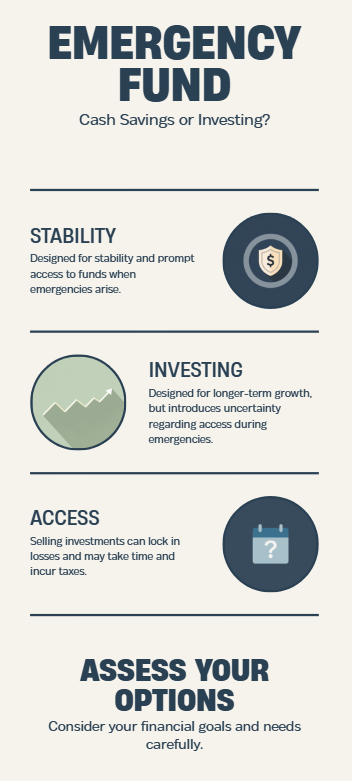
Saving and Investing Have Different Assignments
Saving protects money intended for short-term or unpredictable use. Investing accepts uncertainty in pursuit of longer-term growth. Both are valuable, but they should not be evaluated by return alone.
Investor.gov, the U.S. Securities and Exchange Commission’s investor-education site, says a savings account is a suitable choice for short-term goals or an emergency fund.[1] FINRA recommends a liquid, interest-bearing bank or credit-union account from which emergency money can be withdrawn without penalty.[2] Canada’s Financial Consumer Agency says that short-term savings, including an emergency fund, should be protected and easily accessible.[3]
The same time-horizon principle appears in other countries. MoneyHelper explains that cash deposits are the general rule for short-term goals because the stock market may be down when the money is needed.[4] Australia’s Moneysmart places cash—including bank accounts, high-interest savings and term deposits—in a very-low-risk, short-term category, while recognizing that inflation reduces its real value over time.[5]
These sources do not say that households should avoid investing. They separate two assignments:
- Emergency cash provides certainty and response capacity.
- Long-term investments pursue growth with money that can remain invested through declines.
When one pool is asked to do both jobs, the conflict appears at the worst possible time.
The Main Risk Is Needing to Sell at the Wrong Time
People often describe stocks and diversified funds as “liquid” because they can usually be sold. That is only one form of liquidity.
An emergency reserve needs three kinds of usable liquidity:
- Market liquidity: Can the asset be sold?
- Operational liquidity: How long until the proceeds can pay the bill?
- Value liquidity: Is enough of the original amount likely to be available when sold?
A publicly traded fund may satisfy the first test while failing the third. If a $15,000 reserve falls 25%, only $11,250 remains before any transaction, tax, or transfer effects. The household then faces three unattractive choices: sell at the lower value, delay the emergency response, or borrow while waiting for recovery.
Trading access also does not make proceeds instantaneous. Markets close on weekends and holidays, orders can execute at a different price than expected, securities have settlement periods, and transfers from an investment account can face verification or banking delays. Selling during a volatile session can settle the investment side of the decision without putting spendable money in the household’s bill-paying account that day. Those delays may be manageable for a long-term portfolio; they are material when housing, transport, care, or income continuity cannot wait.
The problem is not that a diversified portfolio never recovers. It is that the household does not control the emergency date. A job loss may coincide with recession, falling markets, reduced overtime, and tighter credit. A business owner may see revenue and investments weaken together. A household concentrated in one industry may experience layoffs precisely when shares in that industry are declining.
This is correlation risk: resources that look separate in ordinary conditions can fail together under stress. The reserve should reduce that dependence, not reproduce it.
FINRA warns that investors who need money sooner than expected can be forced to sell when the market is against them.[6] Emergency funds have, by definition, no dependable investment horizon. Even if no emergency has occurred for five years, the next one can arrive tomorrow.
Cash Has a Cost—but It Buys Something Real
Keeping the core reserve in cash does involve trade-offs.
- Interest may trail inflation, reducing purchasing power.
- The return may be lower than the long-run return of stocks or bonds.
- A large balance can create visible opportunity cost during strong markets.
- Poorly chosen accounts may pay very little or impose unnecessary fees.
Those costs should be managed, not denied. A competitive interest-bearing account, appropriate deposit protection, low fees, and periodic review can reduce cash drag. EW-M-0017 addresses where to keep the reserve and how to verify access and protection.
But the lower expected return is partly the price of preserving options. Cash allows a household to pay an urgent deductible, replace lost income, travel for a family emergency, or prevent damage without checking a market price first. It can also keep a temporary shock from becoming high-interest debt.
The comparison should therefore include more than “savings rate versus market return.” It should also include:
- the potential loss if assets must be sold during a decline;
- interest and fees if the household borrows instead;
- the cost of delaying an essential repair or payment;
- taxes, penalties, or lost account benefits triggered by withdrawal; and
- the value of having time to make a better decision during disruption.
Cash is not idle when it is providing resilience.
Its return is measured partly by the debt, rushed sale, and unsafe delay the household does not have to accept.

A Five-Part Test Before Investing Any Portion
Investing part of a very large reserve can be reasonable in limited circumstances, but the label “emergency fund” does not make a risky asset safe. Before considering it, test the proposal in this order.
1. Is the core cash layer already complete?
Start with the amount the household may need before an investment sale and transfer could be completed—and the amount it could not safely afford to see fall.
This is not automatically one month’s expenses or a fixed percentage of the total. A renter with stable dual incomes, strong insurance, low deductibles, and reliable paid leave may have different immediate needs from a self-employed homeowner supporting dependants with variable income.
EW-M-0015 owns the target calculation. For this decision, the important point is that an invested portion should not be used to make an incomplete cash reserve appear complete.
2. Can the money remain invested through a severe decline?
Ask a practical question, not a risk-tolerance question: if the invested portion fell substantially today, would the remaining cash still cover a plausible income disruption and urgent expense?
If selling would be required, the money does not have a genuine long-term horizon. Confidence that you would “wait it out” is not enough when rent, payroll, medication, childcare, or a home repair has a deadline.
3. Are other resources truly reliable?
Stable income from another earner, paid leave, insurance, low deductibles, and accessible non-retirement savings may reduce the cash requirement. Credit cards, home-equity lines, expected bonuses, family loans, or assets that must also be sold are weaker substitutes.
Credit limits can be reduced, borrowing rates can rise, and family resources can face the same regional or economic shock. Count a backup only after asking who controls it, how quickly it can be used, what it costs, and whether it is likely to remain available during the event being planned for.
4. What exactly is the asset?
“Conservative investment” is not a complete description.
- Stock funds can fall sharply.
- Bond funds can decline when interest rates or credit conditions change.
- Individual bonds sold before maturity can be worth less than their purchase price.
- Money market mutual funds are investments, not bank deposits, and their protections differ from deposit accounts.
- Crypto assets, single stocks, leveraged funds, and concentrated sector funds add risks that conflict strongly with emergency use.
Do not treat a low-volatility history, a familiar brand, or the word cash in a product name as a guarantee of principal or immediate access. Verify legal structure, price risk, settlement, withdrawal mechanics, fees, and applicable protection.
5. What happens when money leaves the account?
The investment and the account holding it are separate decisions. A sale may create taxable gains or losses. A withdrawal may affect contribution room, incur a charge, or permanently reduce sheltered space.
For example, Canada’s Revenue Agency states that a TFSA withdrawal is added back as contribution room on January 1 of the following calendar year—not immediately. Re-contributing in the same year without other available room can cause an overcontribution.[7] In the United Kingdom, only a flexible ISA permits certain withdrawals to be replaced in the same tax year without reducing the current year’s allowance, while unauthorized Lifetime ISA withdrawals generally face a 25% charge.[8][9] In the United States, early distributions from many retirement arrangements may be taxable and may face an additional 10% tax unless an exception applies.[10]
These examples are not a complete country guide. Rules depend on account type, age, residency, provider terms, and purpose. Emergency money should not be placed inside a wrapper whose exit rules have not been checked.
When a Tiered Structure May Be Considered
A household with an unusually large reserve may decide that not every dollar has the same likely use date. It can separate the money by assignment rather than calling the entire balance one interchangeable fund.
| Layer | Job | Appropriate risk posture |
|---|---|---|
| Immediate cash | Urgent payments and short transfer disruptions | Stable and directly accessible |
| Core reserve | Essential expenses and income replacement | Principal stability and reliable access |
| True excess or extended layer | Money beyond the protected core that can remain untouched through a decline | May be evaluated as a long-term investment |
The third layer is not automatically an “invested emergency fund.” Once money can remain invested through a serious market decline without weakening the household’s protection, it may be clearer to classify it as long-term savings or investment assets.
Consider a household with a calculated $18,000 emergency target and $28,000 available. Investing $10,000 above the completed target is different from keeping only $8,000 in cash and counting another $10,000 of volatile assets toward the $18,000 requirement. The balances may look similar on a calm day, but they do not provide the same protection.
A partial-investment approach becomes less suitable when income is variable, one earner supports the household, employment is tied to market cycles, deductibles are high, dependants rely on the income, housing or vehicles may require large repairs, or there is little unused credit that could be repaid safely. These factors can create a need for more—not less—stable cash.
Assets That Should Not Be Counted at Full Face Value
A household balance sheet may show resources without proving that they can perform as emergency savings.
Do not automatically count the following at their current statement value:
- retirement assets with withdrawal restrictions, tax, or penalties;
- employer shares whose value may fall when job security weakens;
- home equity that requires approval, appraisal, sale, or new borrowing;
- unused credit limits;
- crypto assets or concentrated investments;
- investments pledged as collateral;
- money assigned to tax, tuition, rent, payroll, or another unavoidable bill; or
- expected insurance, benefit, tax-refund, or legal payments that have not arrived.
These resources may help, but each requires a haircut for price, delay, cost, or uncertainty. An honest emergency plan distinguishes net worth from money that can protect the next essential payment.
When the Question Signals a Different Problem
Sometimes the urge to invest emergency savings is evidence that the reserve itself needs review.
If the balance has grown far beyond the current target, the household may have excess cash that should be assigned to a long-term goal. If the cash earns almost nothing, the storage account may need improvement. If the target was copied from a generic rule, it may need recalculation. If investing is the only way the household believes it can reach the target, the required amount or contribution plan may feel unrealistic.
Address the specific problem:
- recalculate the target rather than silently lowering the safe cash layer;
- improve the account rather than adding market risk solely for yield;
- name true excess money as investment capital;
- separate planned large purchases through sinking funds; and
- keep long-term goals moving with new contributions when possible.
This avoids turning one pool into an unclear compromise that is too risky for emergencies and too likely to be withdrawn for long-term investing.

A Decision Rule You Can Use
Before moving any emergency money into an investment, complete this sentence:
Even if this investment falls substantially and cannot be used promptly, our remaining protected cash can still cover ______ for ______, because ______ is independently available.
Fill the blanks with essential expenses, a realistic duration, and verified resources—not optimism about markets or future income.
Then confirm:
- the core target remains fully funded without counting volatile assets at full value;
- the invested amount has no foreseeable or emergency-dependent use date;
- the household can tolerate a simultaneous income and market shock;
- sale, settlement, transfer, tax, and account rules are understood;
- no borrowing is required merely to avoid selling; and
- both adults responsible for the household plan understand which layer can be used first.
If any answer is unclear, keeping the amount stable while reviewing the plan is reasonable. There is no need to accept a permanent risk merely to avoid a temporary feeling of inefficiency.
Decision Summary
For most households, the core emergency fund should not be invested in stocks, bond funds, or other assets whose value can decline when the money is needed. Its uncertain use date makes it a short-term obligation even when it has remained untouched for years.
Cash carries inflation and opportunity costs, but it also buys principal stability, immediate options, and protection from forced selling. Manage that cost through a suitable interest-bearing account and a regularly reviewed target—not by assuming that market liquidity is the same as emergency readiness.
If cash exceeds a well-supported emergency target, the true excess may be invested for long-term goals. If part of a large extended reserve is considered for investment, preserve a complete immediate and core cash layer first, stress-test a simultaneous market and income shock, and verify the account’s withdrawal rules.
The cleanest boundary is often the most useful: emergency cash protects the present; investments build the future. Each works better when it is not forced to do the other’s job.
FAQ
Is a money market fund safe enough for an emergency fund?
It may have low volatility and convenient access, but it is still an investment rather than an insured bank deposit. Verify whether the product is a money market mutual fund or a deposit account, along with principal risk, settlement, fees, withdrawal routes, and applicable protection.
What about short-term bonds or bond ETFs?
They can still lose value. Bond-fund prices respond to interest rates and credit conditions, and an individual bond sold before maturity may realize a loss. Do not count the core reserve at full value if a sale could be required before recovery or maturity.
Can I keep emergency savings in a TFSA or ISA?
The account label does not determine suitability. Cash may sometimes be held within these accounts, but investments can fluctuate and withdrawal or re-contribution rules differ. Check provider access, product risk, contribution room, replacement rules, and any charges before relying on the account.
Does inflation mean cash is unsafe?
Inflation reduces cash’s purchasing power over time, but market loss creates a different risk: too little money at the exact time it is needed. Use a competitive account and review the target periodically while preserving the reserve’s short-term function.
Should wealthy households invest more of their emergency fund?
Possibly only when stable cash already covers their realistic emergency requirement and the invested portion can remain untouched through a major decline. High net worth does not guarantee liquidity; assets may be volatile, pledged, illiquid, or tax-costly to sell.
Can a credit card or line of credit replace emergency cash?
It can provide a payment route, but not the same protection. Credit can be reduced, frozen, or expensive, especially after income loss. Treat it as a backup whose cost and availability must be tested, not as cash already owned.
Financial Disclaimer: This article provides general educational information, not individualized financial, investment, tax, legal, or debt advice. Product risks, settlement times, account protections, withdrawal rules, taxes, and penalties vary by jurisdiction and personal circumstances. Consider qualified local advice before changing a material emergency reserve or using a tax-advantaged or retirement account.
References
- U.S. Securities and Exchange Commission, Investor.gov. “Introduction to Investing.” Accessed August 1, 2026. https://www.investor.gov/introduction-investing
- Financial Industry Regulatory Authority. “Financial Foundations.” Accessed August 1, 2026. https://www.finra.org/investors/investing/investing-basics/financial-foundations
- Financial Consumer Agency of Canada. “Setting Savings and Investment Goals.” Updated December 15, 2025. https://www.canada.ca/en/financial-consumer-agency/services/savings-investments/savings-investment-goals.html
- MoneyHelper. “What’s the Difference Between Saving and Investing?” Accessed August 1, 2026. https://www.moneyhelper.org.uk/en/savings/how-to-save/should-i-save-or-invest
- Australian Securities and Investments Commission, Moneysmart. “Choose Your Investments.” Updated July 14, 2026. https://moneysmart.gov.au/how-to-invest/choose-your-investments
- Financial Industry Regulatory Authority. “Investing Basics.” Accessed August 1, 2026. https://www.finra.org/investors/investing/investing-basics
- Canada Revenue Agency. “Withdrawing from a TFSA.” Updated February 20, 2026. https://www.canada.ca/en/revenue-agency/services/tax/individuals/topics/tax-free-savings-account/withdraw.html
- GOV.UK. “Individual Savings Accounts (ISAs): Withdrawing Your Money.” Accessed August 1, 2026. https://www.gov.uk/individual-savings-accounts/withdrawing-your-money
- GOV.UK. “Withdrawing Money from Your Lifetime ISA.” Accessed August 1, 2026. https://www.gov.uk/lifetime-isa/withdrawing-money-from-your-lifetime-isa
- U.S. Internal Revenue Service. “Retirement Topics—Exceptions to Tax on Early Distributions.” Updated December 11, 2025. https://www.irs.gov/retirement-plans/plan-participant-employee/retirement-topics-exceptions-to-tax-on-early-distributions
More in This Cluster: Emergency Funds
- How Much Should You Keep in an Emergency Fund?
- Emergency Fund vs. Sinking Fund: What Is the Difference?
- Where Should You Keep Emergency Savings?
- How to Build an Emergency Fund on a Tight Budget
- What Counts as a Real Financial Emergency?
- Should You Invest Your Emergency Fund? (you are here)
- How to Rebuild Savings After Using Your Emergency Fund