A medication list is useful only if it reflects what is happening now.
That sounds simple, but medication information tends to scatter. A pharmacy may have your prescriptions from that pharmacy. A clinic portal may show what was prescribed. A hospital discharge sheet may show what changed at discharge. None of those records necessarily captures the cold medicine bought last week, the supplement taken most mornings, a prescription from another clinician, or the tablet you stopped taking because it was difficult to swallow.
The practical goal is not to build a perfect personal database. It is to keep one current record that you can understand, check, and share when a pharmacist, prescriber, emergency responder, or caregiver needs to know what you actually use.
Quick answer: List every prescription medicine, over-the-counter product, vitamin, herbal product, and supplement you use. For each item, record the exact name, strength and form, label directions, what you actually take, the reason if known, who prescribed or recommended it, and whether it is current, changed, or stopped. Date the list, update every copy when something changes, and compare it periodically with containers, pharmacy records, and current clinical instructions.

What a medication list is—and what it is not
A medication list is a portable snapshot of your current medication use. It helps connect information that may sit in separate healthcare systems and gives you something concrete to review when memory is unreliable, care changes, or several people are involved.
It is not a substitute for the original label, package insert, pharmacist, or prescriber. It should not become a homemade dosing instruction that silently overrides professional directions. Its purpose is to preserve accurate information and expose discrepancies that need clarification.
Official guidance from the U.S. Food and Drug Administration, the Agency for Healthcare Research and Quality, Alberta Health Services, and the World Health Organization supports patient-held medication records in paper or electronic form. These records can help people track medicines and share details across appointments, pharmacies, caregiving arrangements, and transitions of care.
The distinction matters: a list can help a healthcare professional make a safer decision, but the list does not make that decision on its own.
Start with everything you use, not only daily prescriptions
Gather the products before trying to write from memory. Look in the places where medicines are actually kept, while leaving them in their labeled containers. Check current pharmacy information, recent discharge instructions, specialist instructions, and the products you bought without a prescription.
Include:
- prescription tablets, capsules, liquids, injections, inhalers, drops, patches, creams, and ointments;
- medicines used regularly but not every day;
- medicines used only when needed;
- over-the-counter pain, cold, allergy, stomach, sleep, and other products;
- vitamins, minerals, herbal products, traditional medicines, and dietary supplements;
- samples or medicines supplied outside your usual pharmacy;
- recently changed or stopped medicines when that history is still relevant to current care; and
- known medication allergies and serious previous reactions.
“I only take it occasionally” is not a reason to omit an item. Occasional products still belong on the list because another healthcare professional may not otherwise know they are being used. The same applies to products described as natural. This article does not determine whether products interact; it makes sure the information needed for that later check is visible.
For a household, create a separate list for each person. Do not combine several family members into one medicine table. Put the person’s full name and another appropriate identifier at the top so the lists cannot be confused.
Record the details that make each entry usable
Copy identifying details from the label rather than relying on color, shape, or memory. A description such as “the small white blood pressure pill” may not identify the product or strength.
For each medicine or product, record the following.
Exact name, strength, and dosage form
Write the name shown on the label. If both generic and brand names are available, recording both can reduce uncertainty. Add the strength and form, such as a tablet, capsule, liquid, inhaler, patch, cream, or eye drop.
Strength and form are not minor details. Two containers can display the same medicine name but contain different strengths or forms. The list should preserve what the label says, not convert one unit or formulation into another.
Label directions and actual use
Record the instructions on the current label, including when, how, and how much the directions say to use. Then add a separate field for what happens in real life if it differs.
For example, a list might say:
- Label directions: one tablet twice daily.
- Actual use: usually one tablet in the morning; evening dose often missed.
This is not a confession or a test of character. It is information. Quietly changing the entry to make it look as though the directions were followed can hide an important safety question. Do not restart, stop, double, split, crush, or otherwise change a medicine simply to make the two fields match. Mark the difference and ask the appropriate pharmacist or prescriber what to do.
Reason, prescriber, and status
Add what the medicine is for if you know. If you do not know, write “not sure” instead of guessing. That turns a gap in the record into a useful question.
Record the prescriber or recommending clinician where applicable, especially when several clinicians are involved. Mark whether the item is current, newly started, changed, paused, or stopped, and add an approximate date. A stopped-medicine section can preserve recent history without making an old item look current.
Allergies and serious prior reactions
Keep medication allergies and serious previous reactions near the main list. When possible, describe what happened—such as rash, swelling, breathing difficulty, fainting, severe vomiting, or an unknown childhood reaction—rather than writing only “allergic.” Do not decide on your own whether an event was a true allergy or side effect. Record what occurred and let a qualified professional clarify it.
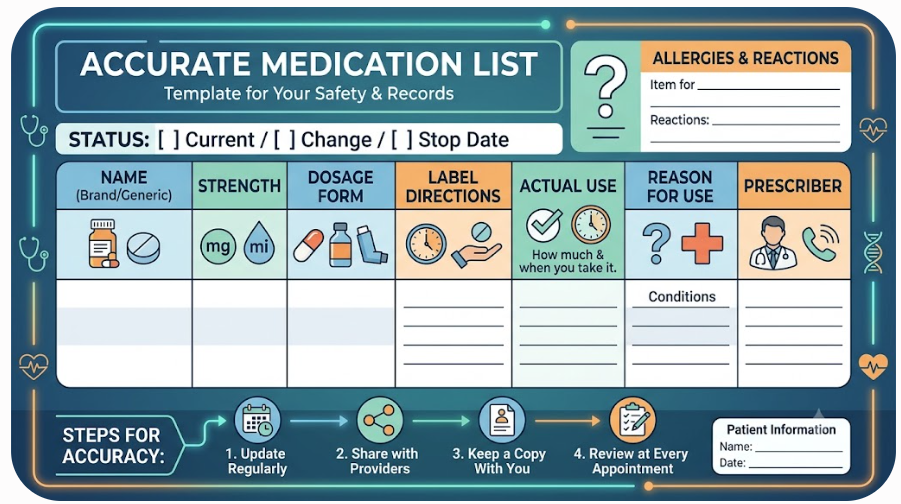
A simple medication-list template
Use a format you can maintain. The table below is intentionally compact.
| Medicine or product | Strength and form | Label directions | What I actually use | Reason | Prescriber/source | Status and date | Notes/reaction |
|---|---|---|---|---|---|---|---|
| Exact label name | As printed | Copy current instructions | Record any difference | Known reason or “not sure” | Name or source | Current/changed/stopped; date | Questions or reaction |
| Occasional OTC product | As printed | Copy package directions | How often used recently | Reason used | Self-selected/pharmacist | Current; date checked | Active ingredients to verify |
| Vitamin or supplement | Strength and form | Package directions | Actual pattern | Reason or “not sure” | Self-selected/clinician | Current; date checked | Brand if composition matters |
Add your name, the date last verified, relevant allergies or serious reactions, an emergency contact if appropriate, and the contact details of your usual pharmacy. Do not put more personal information on a wallet copy than is necessary for its purpose.
If the table becomes difficult to read, use additional pages rather than shrinking the text. A caregiver may also need a notes field for who confirmed a change and where the current instruction came from.
Reconcile the list instead of trusting a single source
Medication reconciliation means comparing available sources to create the most complete and accurate account possible. For a reader or caregiver, the useful version of that process is straightforward: compare, mark differences, and bring unresolved questions to a healthcare professional.
Check the list against:
- the labeled containers and packages currently in the home;
- records from every pharmacy used;
- the clinic or patient portal;
- recent hospital, specialist, or discharge instructions; and
- what the person actually took, including occasional products.
No source should automatically win. A portal can contain a discontinued medicine. A pharmacy list may not include products bought elsewhere. A container can carry older directions after a dose was changed. Memory can omit an as-needed product. Write down the discrepancy rather than silently choosing the version that seems most likely.
Consider a caregiver helping a parent after hospital discharge. The discharge sheet says one medicine was stopped, an older bottle remains in the kitchen, and the pharmacy profile still shows a refill. The caregiver should not infer which instruction is current or discard the medicine based on the conflict alone. The list can mark “stopped on discharge sheet—confirm,” identify the date and source, and create a focused question for the pharmacist or discharge team.
Reconciliation is especially important after a hospital stay, an urgent-care visit, a new specialist, a move between care settings, a change of pharmacy, or any period when several people have adjusted the record.
Use one master copy and control the versions
A medication list fails quietly when several copies disagree. Choose one master copy—the version you update first—and treat all other copies as controlled duplicates.
Update the master when:
- a medicine or supplement is started or stopped;
- the strength, form, directions, or prescriber changes;
- actual use changes;
- a new allergy or serious reaction is identified;
- a pharmacist or clinician corrects an entry; or
- you discover a discrepancy.
Put a “last verified” date on every version. After a change, replace or clearly mark old paper copies, update the phone copy, and send the current version to anyone who legitimately helps manage the medicines. An old list left in a wallet or caregiver’s email can be mistaken for the current one.
A routine review also helps catch drift. The right interval depends on how often the regimen changes, but event-based updates are more important than waiting for a calendar reminder. A stable list can still be checked before an appointment, refill review, trip, or handover to a new caregiver.
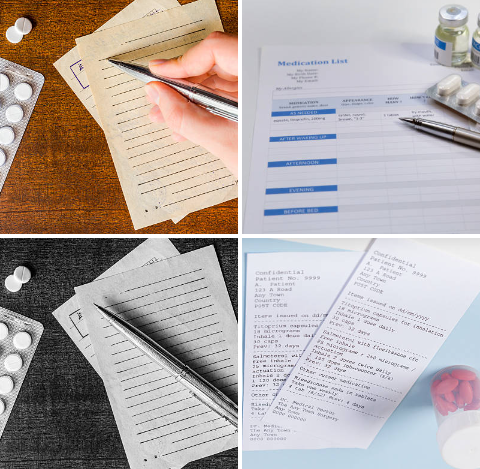
Paper or digital: choose for access, not novelty
Paper is easy to hand over, does not need power, and can work well for a short list. It can also become outdated, damaged, or unavailable when left at home.
A phone note, secure document, app, or patient portal is easier to update and copy. Digital records can be unavailable because of a dead battery, forgotten password, lost device, poor connectivity, or a system that does not show products purchased elsewhere. A portal’s medication history is valuable evidence, but it is not automatically the same as your verified current list.
Many people benefit from a small combination: one digital master plus a dated paper or locked-screen-accessible emergency copy. The best system is the one you will actually update and can reach when needed.
Share enough information without sharing it everywhere
A useful list has to be available, but medication information is private health information. Access should be deliberate.
Ask:
- Who may need the list during an appointment or emergency?
- Does a caregiver need the full record or only a current copy for a defined task?
- Is the file protected on the device or cloud service being used?
- Could a printed copy be seen by people who do not need it?
- How will an outdated shared copy be replaced?
Share the current list with the healthcare professionals who need it and with a trusted person who may speak for you or the person you care for. Avoid placing unnecessary identifying information in an unprotected note or emailing copies broadly “just in case.” Local privacy rules and healthcare-system features vary, so use the protections available in your jurisdiction and chosen service.
For emergencies, accessibility can matter more than elegance. A responder cannot use a list that no one can find or unlock. Balance that need against the sensitivity of the information rather than assuming either maximum secrecy or unrestricted sharing is always correct.
What to do when you are not sure
Do not delay creating the list until every field is certain. Use visible labels for uncertainty:
- “not sure why I take this”;
- “strength differs between bottle and portal”;
- “stopped after discharge—confirm status”;
- “reaction in childhood; details unknown”; or
- “used occasionally; frequency to confirm.”
Bring the list and, when practical and safe, the original labeled containers or clear label photographs to a pharmacist or healthcare appointment. Ask the professional to help resolve the flagged items. Then update the master copy and its date while the answer is fresh.
If a medication may have been taken incorrectly, if an unexpected reaction is occurring, or if you are considering a change because the information conflicts, seek timely advice from a pharmacist, prescriber, local poison service, or appropriate health service. Severe symptoms or a possible medical emergency require local emergency care. A list supports that conversation; it does not replace it.
Decision Summary
An accurate medication list is not the longest list or the most sophisticated app. It is the version that answers three practical questions:
- Is everything relevant included? Prescription medicines, OTC products, supplements, occasional use, changes, allergies, and serious reactions all count.
- Does it reflect reality? Preserve both the current directions and what is actually being used; mark discrepancies rather than hiding them.
- Can the right person reach the current version? Date it, control duplicate copies, and share it deliberately with healthcare professionals and trusted caregivers.
Once the record is reliable, it can support the next medication-safety decisions: checking combinations, reading directions accurately, and asking a pharmacist focused questions. The list is the starting point—not the clinical answer.
FAQ
Should I include vitamins and herbal supplements on my medication list?
Yes. Include vitamins, minerals, herbal products, traditional medicines, and dietary supplements, even when you bought them without a prescription or use them only occasionally.
Should I list medicines I have stopped taking?
Keep recently stopped medicines in a clearly labeled stopped or history section when the timing may still matter. Include the approximate stop date and who advised the change, if known. Do not leave them mixed with current medicines.
Is my pharmacy printout enough?
It is a useful source, but it may omit medicines from another pharmacy, OTC products, supplements, samples, or what you have stopped or use differently. Compare it with other records and actual use.
What if my label and patient portal show different information?
Record both versions and mark the conflict. Do not guess which is current or change how you take the medicine solely from the discrepancy. Ask the pharmacist, prescriber, or relevant care team to confirm.
Should I keep the list on paper or on my phone?
Either can work. Choose a master format you will update and a backup that remains accessible when the primary copy is unavailable. Put a last-verified date on every copy.
Can a caregiver maintain the list for someone else?
Yes, when the person has authorized that help or the caregiver has an appropriate legal or care role. Keep the person’s list separate, record who confirmed changes, protect privacy, and involve the person as much as possible.
Does a medication list tell me whether two products are safe together?
No. It supplies information for an interaction check but does not perform one. A pharmacist or prescriber can help assess a particular combination and the person-specific factors that matter.
Health Information Notice
This article provides general medication-safety information and does not diagnose a condition, recommend a medicine, interpret an individual prescription, or replace advice from a pharmacist, prescriber, or other qualified healthcare professional. Medication directions and healthcare services vary by product and jurisdiction. If you may have taken a medicine incorrectly, are experiencing a reaction, or face an urgent or emergency situation, contact the appropriate local professional, poison service, or emergency service.
Sources
- FDA – Create and Keep a Medication List for Your Health
- AHRQ – How to Create My Medicines List
- Alberta Health Services – Managing Your Medications
- ISMP Canada – Medication Reconciliation Process
- WHO – Medication Without Harm: Medication Reconciliation
- MedlinePlus – Medication Errors
More in This Cluster: Medication Safety
- How to Keep an Accurate Medication List (you are here)
- Prescription and OTC Medicines: How to Check for Interactions
- How to Read a Medication Label Without Missing Key Directions
- What to Ask a Pharmacist About a New Medicine
- Safe Medication Storage at Home
- Travelling With Medication: A Practical Safety Checklist
- How to Dispose of Unused or Expired Medication Safely