A medicine does not become harmless to combine simply because you can buy it without a prescription. Nor does a prescription automatically account for every cold remedy, pain reliever, sleep aid, vitamin, herbal product, drink, or food you may use later.
Interaction safety begins before you combine products. The useful question is not, “Have I taken each of these before?” It is, “Has this exact combination been checked against my current medicines, health circumstances, and the directions for these products?”
Quick answer: Before adding a prescription medicine, over-the-counter (OTC) product, vitamin, supplement, or herbal product, compare its active ingredients and warnings with your current medication list. Include alcohol and relevant food questions. If you find a duplicate ingredient, a warning that may apply, conflicting information, or anything you cannot confidently identify, pause and ask a pharmacist or prescriber. Do not start, stop, or change a prescribed medicine solely because an online checker reports a possible interaction.
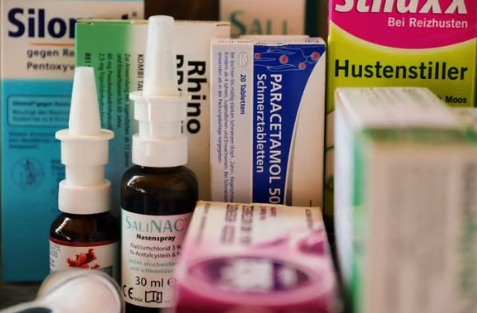
What an interaction can change
An interaction occurs when one medicine or substance changes what another medicine does in the body, or when their effects combine in an important way. At a practical level, the result may be one of three things:
- an intended effect or side effect becomes stronger;
- a medicine becomes less effective; or
- a different or unexpected effect appears.
Not every listed interaction produces harm in every person. Some combinations are deliberately prescribed because a clinician has weighed the benefits and risks and arranged monitoring or other precautions. Other combinations should be avoided. The significance can depend on the specific products, dose, timing, route, duration, health conditions, and individual characteristics.
That is why a warning is a reason to verify, not a reason to improvise. A reader can gather the right information and recognize a stop point; a pharmacist or prescriber determines what a particular interaction means for that person.
Check the whole combination, not just two prescriptions
The interaction check should begin with your current accurate medication list. If the list does not include occasional or nonprescription products, the check begins with incomplete information.
Consider all of the following:
- prescription medicines from every prescriber and pharmacy;
- OTC medicines, including products used only when needed;
- vitamins, minerals, herbal products, and dietary supplements;
- alcohol;
- foods or drinks named in the medicine’s directions or warnings; and
- recently stopped products when a pharmacist or prescriber says their effects may still matter.
The category on the package does not settle the risk. “OTC” means a product can be sold without a prescription under the rules of that jurisdiction; it does not mean the product is compatible with every prescription. “Natural” describes a marketing or source idea, not proof that an ingredient cannot change a medicine’s effects. “I have used it before” describes the past, not the current combination.
Imagine someone who has taken the same nighttime cold product on several previous occasions. This time, the person has also started a prescription that can cause drowsiness. Familiarity with the cold product does not answer whether their effects can add together. The changed prescription makes this a new question.
First check: look for duplicate active ingredients
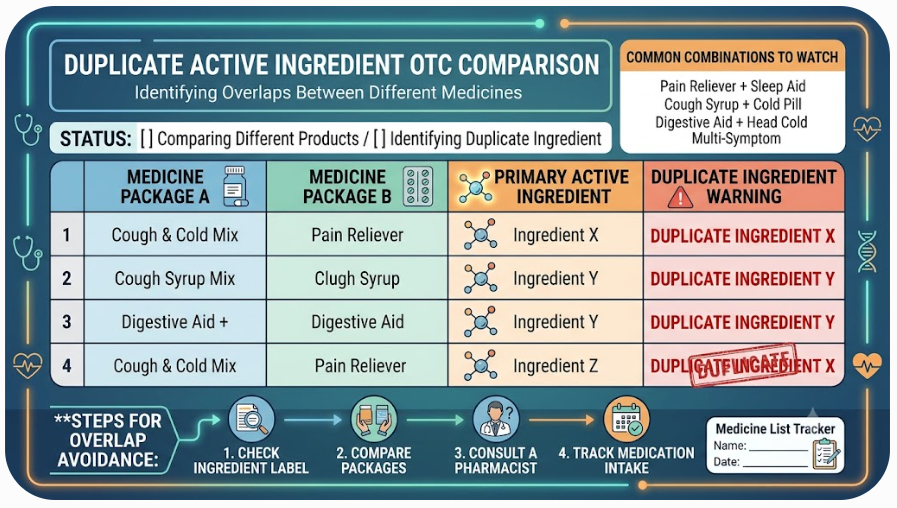
Two packages with different brand names or advertised purposes can contain the same active ingredient. A multi-symptom cold product may overlap with a separate pain reliever, allergy medicine, cough product, or sleep aid. Taking both can unintentionally increase the total amount of that ingredient.
Before using more than one OTC product:
- Find the active ingredient or ingredients on each current package.
- Compare the ingredient names, not only the brand names or front-of-package claims.
- Check whether a prescription product may contain the same ingredient or a related product by asking a pharmacist when the name is unfamiliar.
- If anything appears twice, do not assume the combination is acceptable because each package is individually available without a prescription.
This is an identity check, not a dose calculation. It does not ask you to add milligrams, convert liquid concentrations, or decide a maximum amount yourself. Those tasks depend on the exact product and directions and belong with the pharmacist, prescriber, and the label-reading process.
Food and alcohol are part of the medicine question
Some medicines have directions about taking them with food, on an empty stomach, or avoiding a particular food or drink. Food may affect absorption or metabolism, and alcohol may add to effects such as drowsiness or impaired coordination or create other product-specific risks. The correct rule is not “all food is safe” or “all alcohol is always forbidden with every medicine.” It is to check the instruction for the specific product and person.
Jerome used to treat food and alcohol as matters he could manage through general common sense. He never actually verified whether those assumptions applied to the medicine he was taking. Now, when he is ill and needs medicine, he avoids alcohol and pays more attention to what he eats. That change is safer than ignoring the question, but “liver-friendly food” is not an interaction-management method. The useful next step is to read the specific warning and ask a pharmacist or prescriber whether alcohol, a food, or a drink matters for that medicine.
This correction matters because alcohol affects more than the liver. It can also affect the brain, coordination, gastrointestinal system, and other parts of the body. A reassuring food choice cannot cancel a medicine–alcohol interaction. Nor should a general article determine a “safe number of drinks” for an unnamed medicine. If the label says to avoid alcohol—or the answer is unclear—verify before drinking.
Food questions should also be specific. A warning about one food does not justify eliminating an entire food group, and a widely shared online warning may not apply to every medicine in a class. Use the medicine’s current official information and professional advice rather than a generalized “interaction diet.”
Supplements and herbal products need the same visibility
Vitamins, minerals, concentrated extracts, herbal products, and other supplements can have biologic effects. Some can increase a medicine’s effects or side effects; others can reduce effectiveness or affect how a medicine is absorbed, metabolized, or removed from the body. Evidence is also incomplete for many possible herb–drug combinations.
That uncertainty is not proof of safety, but it is also not a reason to declare every supplement dangerous. It is a reason to identify the exact product and ask a better question.
Record the product name, ingredients, strength where shown, and actual use. If the formulation differs by brand, bring the container or a clear photograph of the label. Tell the pharmacist or prescriber about products taken only occasionally. This is especially important before surgery and when pregnancy, breastfeeding, or treatment requiring close monitoring is involved.
Do not stop a prescribed medicine to make room for a supplement. Do not stop a supplement that a clinician has specifically included in a treatment plan without discussing the change. The decision depends on why each product is being used and what the evidence means for the individual.
A practical pre-combination check
Use this process before the first dose of a newly added product, not after several days of guessing.
1. Start with one current inventory
Bring together the medication list and the exact products being considered. Include prescriptions, OTC medicines, supplements, and occasional products. If the list is out of date, correct it before relying on the comparison.
2. Identify the exact product
Confirm the active ingredient or ingredients, strength, and dosage form shown on the current package. Similar brand names can contain different ingredients, and manufacturers may change formulations or warnings. Do not rely on package color or memory.
3. Read for a reason to pause
Look for duplicate active ingredients and warnings about other medicines, health conditions, alcohol, foods, pregnancy, breastfeeding, age, or when to ask a doctor or pharmacist. This article does not replace a full label-reading guide; the immediate goal is to recognize that a warning may apply.
4. Use a reliable information source to form the question
Current official labeling, the patient information supplied with the medicine, and government or health-system medicine information can help identify a possible issue. In the United States, DailyMed provides current labeling submitted to the FDA and in use. Other countries have their own approved labeling and medicine-information systems.
Consumer interaction checkers may help surface questions, but their databases, terminology, and coverage differ. A result may be incomplete, overly broad, or unable to account for the person’s conditions, laboratory results, doses, or monitoring plan. Save the result or note the exact warning; do not treat it as a clinical decision.
5. Verify with a pharmacist or prescriber
Give the professional the exact product names and active ingredients, the medication list, how each product is actually used, and the warning or concern you found. Ask whether the combination is appropriate, what signs matter, and whether any action or monitoring is needed.
For a non-urgent question about adding an OTC product, a community pharmacist is often a practical first contact. A prescriber may be needed when the answer could affect the treatment plan or when the person’s condition and monitoring are central to the decision. Local access routes vary.

When the threshold for professional verification should be low
You do not need to memorize an exhaustive catalog of interactions. Instead, recognize situations in which incomplete information matters more.
Verify before combining products when:
- the same active ingredient appears more than once;
- a warning names another medicine, health condition, food, alcohol, age group, pregnancy, or breastfeeding that may apply;
- several medicines are involved or more than one prescriber or pharmacy supplies them;
- the person is a child, an older adult, pregnant, breastfeeding, preparing for surgery, or living with kidney or liver problems;
- a medicine requires close monitoring or has been described by the care team as especially sensitive to changes;
- a supplement or herbal product has unclear or changing ingredients;
- an online tool and the package information disagree;
- a product is new, reformulated, or difficult to identify; or
- the person develops an unexpected symptom after a product was added or changed.
These are prompts to seek the right level of help, not predictions that harm will occur.
If an interaction checker flags a problem
First, confirm that the entries are correct. A checker can produce a misleading result if the wrong strength, formulation, route, or similarly named product was selected. Then record the wording and its source.
Do not respond by abruptly stopping a prescribed medicine, crowding doses, changing the timing, or substituting another product. A flagged interaction may require avoidance, a different product, timing changes, dose changes, monitoring, or no change under a clinician’s plan—but choosing among those actions is clinical management, not a consumer checklist.
Contact a pharmacist or prescriber promptly enough for the situation. If a possible combination has already been taken, tell them what was taken, how much, when, and what symptoms are present. Contact the appropriate local poison service for a possible poisoning or medication error. Severe symptoms—such as trouble breathing, collapse, severe confusion, a seizure, or another medical emergency—require local emergency care.
Decision Summary
A useful interaction check answers three questions before a new combination is used:
- Do I know every product and active ingredient involved? Include prescriptions, OTC medicines, supplements, alcohol, and relevant foods or drinks.
- Is there a reason to pause? Look for duplicate ingredients, applicable warnings, conflicting information, or a higher-importance circumstance.
- Has the uncertainty reached the right professional? Use reliable information to form the question, then let a pharmacist or prescriber interpret the combination for the individual.
The goal is not to become your own interaction database. It is to stop treating “nonprescription,” “natural,” or “familiar” as substitutes for verification.
FAQ
Can two OTC medicines interact even if neither requires a prescription?
Yes. OTC products can contain duplicate active ingredients or have effects and warnings that matter when combined. Compare the current labels and ask a pharmacist when you are unsure.
Is a duplicate active ingredient the same as a drug interaction?
Not exactly. Duplication can unintentionally increase exposure to one ingredient, while an interaction usually refers to one substance changing or adding to another’s effects. Both are reasons to pause and verify.
Are vitamins and herbal products safer to combine because they are natural?
No. Natural origin does not guarantee compatibility. Supplements can increase or decrease medicine effects, and evidence is incomplete for many combinations. Include the exact product in the interaction check.
Can I rely on an online interaction checker?
Use it to identify questions, not to make treatment changes. Checkers may not capture every product, condition, dose, route, laboratory result, or monitoring plan. Confirm significant findings with a pharmacist or prescriber.
Should I stop a prescription if a checker reports a serious interaction?
Do not stop or change a prescribed medicine solely from an automated result. Verify the entries and contact a pharmacist or prescriber promptly. Seek urgent help when symptoms or the situation indicate an emergency.
How do I know whether alcohol is safe with my medicine?
Check the current product warning and ask a pharmacist or prescriber about that specific medicine and your circumstances. A general drink limit cannot establish safety for every medicine.
What information should I bring when asking a pharmacist?
Bring your current medication list and the exact packages or clear label photographs. Explain what you plan to combine, how you actually use each product, and the warning or checker result that raised the question.
Health Information Notice
This article provides general medication-safety information. It does not diagnose a condition, determine whether a specific combination is safe, calculate a dose, or replace advice from a pharmacist, prescriber, poison service, or other qualified healthcare professional. Product labeling, medicine databases, and care pathways vary by jurisdiction. For a possible medication error, poisoning, unexpected reaction, or emergency, contact the appropriate local service promptly.
Sources
- FDA – Drug Interactions: What You Should Know
- FDA – Mixing Medications and Dietary Supplements Can Endanger Your Health
- NIH NCCIH – How Medications and Supplements Can Interact
- MedlinePlus – Preventing Medication Errors
- NHS Specialist Pharmacy Service – Understanding Drug Interactions
- NIAAA – Alcohol’s Effects on the Body
More in This Cluster: Medication Safety
- How to Keep an Accurate Medication List
- Prescription and OTC Medicines: How to Check for Interactions (you are here)
- How to Read a Medication Label Without Missing Key Directions
- What to Ask a Pharmacist About a New Medicine
- Safe Medication Storage at Home
- Travelling With Medication: A Practical Safety Checklist
- How to Dispose of Unused or Expired Medication Safely