Medication labels can look deceptively simple. A name, a number, and a short direction may fit on a small container—but safe use can also depend on the dosage form, route, timing, maximum-use limit, warnings, and separate patient information supplied with the medicine.
Jerome once treated those details as less important than they were:
I am a large, solidly built adult, and I used to assume my body could handle medicine without my paying close attention to every direction. If I was busy or wanted to feel better quickly, the exact timing could seem less important. The result was not a specific injury that I can claim. It was a risky way of deciding: I was relying on confidence about my body instead of verifying the medicine in front of me. Watching my wife check tablet strength and measure liquid medicine in mL made the gap obvious. I now understand that my size is not permission to change a dose or crowd doses together. I try to read the directions, respect the stated timing, and use enough water when that is appropriate for the medicine. If something is unclear, the safer action is to stop and ask—not to improvise.
A larger body does not authorize self-adjustment. The correct amount and schedule can depend on the particular medicine, its formulation, the reason it is used, and patient-specific factors. Those are reflected in the prescription directions and professional advice—not in a reader’s confidence about what their body can tolerate.
Quick answer: Read the personalized pharmacy label and the patient information supplied with a prescription. For an over-the-counter (OTC) medicine, read the entire current facts panel, not only the product name or front claim. Confirm the correct person, exact medicine or active ingredient, strength, dosage form, route, amount, timing, duration or maximum limits, warnings, storage line, and expiry. If any information is missing, unreadable, unfamiliar, or inconsistent—or if you are unsure how to apply it—do not guess or change the directions. Ask a pharmacist or prescriber before using the medicine.

A medicine may come with more than one layer of information
“Read the label” does not always mean reading one sticker. Depending on the product and country, useful directions may appear in several places.
The pharmacy-applied prescription label
The pharmacy label is attached when a prescription is dispensed. It commonly identifies the patient, medicine, strength, directions, pharmacy, prescriber, quantity, refill information, and date. This is where readers usually find the personalized instruction for how the dispensed medicine is to be used.
Check the patient’s identity before anything else, especially in a household where several people use the same pharmacy. Then match the medicine name, strength, and dosage form against what you expected and against your current medication list.
The manufacturer’s container or outer package
Manufacturer packaging identifies the product and may carry important storage, handling, warning, lot, and expiry information. It may also distinguish one strength or dosage form from another. Do not assume a similar package means an equivalent product.
A pharmacy label can cover part of the manufacturer’s label, and a small container cannot hold every relevant instruction. Look at the whole package and any materials provided rather than treating the most visible sticker as the complete record.
Patient information, Medication Guides, and Instructions for Use
Some prescription medicines include a leaflet, patient information document, Medication Guide, or Instructions for Use. Names and legal requirements vary by jurisdiction. In the United States, the FDA describes Medication Guides, Patient Package Inserts, and Instructions for Use as forms of patient labeling, with each serving a different function.
These materials may explain important warnings, preparation, administration steps, side effects, monitoring, or what to do in situations the container label cannot fully describe. Read new information when the medicine is first supplied and check replacement copies, because labeling can change.
The standardized OTC information panel
In the United States, the Drug Facts label organizes OTC information under headings such as active ingredient, purpose, uses, warnings, directions, other information, and inactive ingredients. Canada uses a Canadian Drug Facts Table for many nonprescription drugs. Other countries use their own formats.
The headings differ, but the decision principle is global: use the current package for the exact product in your hand. The front panel tells you what the product is marketed to do; the full information panel tells you who should pause, how it is directed to be used, and what limits apply.
Read the identity fields before the directions
Before interpreting “take,” “apply,” “inhale,” or “use,” confirm that you have the right product.
Check:
- the correct patient, when the medicine was dispensed for a named person;
- the medicine name or OTC active ingredient;
- the strength;
- the dosage form, such as tablet, capsule, liquid, cream, patch, drops, or inhaled product;
- the route, such as by mouth, on the skin, in the eye, in the ear, or by another stated route; and
- the expiry date and whether the package appears intact and readable.
These fields work together. A name alone is not enough. The same active ingredient may be sold in different strengths, forms, or routes. A tablet is not interchangeable with a liquid merely because the medicine name looks the same. Eye and ear products, immediate- and extended-release forms, and products intended for different routes must not be treated as substitutes for one another.
If the medicine, person, strength, appearance, or form differs from what you expected, keep it separate and ask the dispensing pharmacy before using it. Do not use an online photograph, package color, or memory to resolve the mismatch.
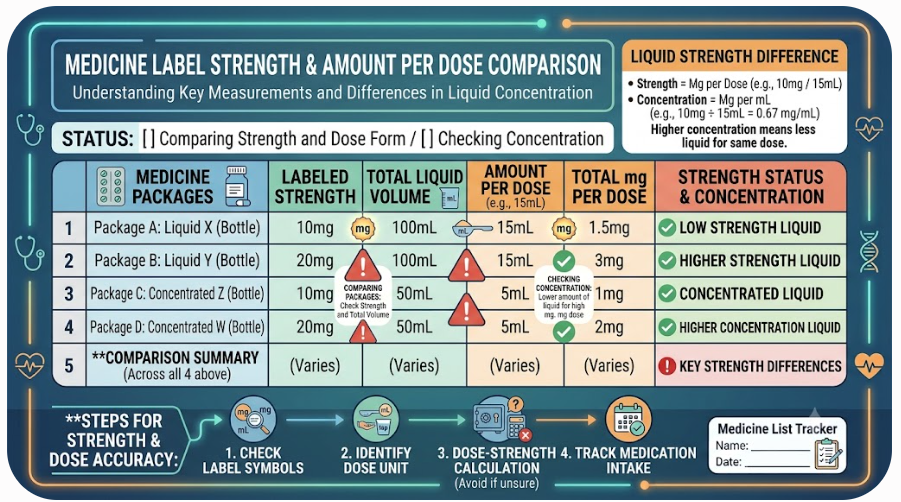
Strength, amount, and concentration are different pieces of information
Medication labels may use units such as micrograms, milligrams (mg), grams, milliliters (mL), or units. These terms do not all describe the same thing.
- Strength describes how much active medicine is present in a stated unit or form.
- Amount per dose tells the patient how many tablets, capsules, measured milliliters, sprays, drops, or other units to use at one time.
- Concentration links an amount of active medicine to a volume of liquid, such as an amount per mL or per several mL.
This distinction is why “one tablet” does not automatically mean the same dose when tablet strengths differ, and why a direction in mL cannot be replaced by a guess in mg. Two liquid bottles with the same medicine name may have different concentrations. The volume used from one concentration may therefore not be appropriate for another.
Use the measuring device recommended or supplied for an oral liquid, and make sure its markings use the same volume unit as the directions. Household spoons vary and are not reliable medication-measuring tools. If the device, unit, concentration, or direction does not match, ask the pharmacist to demonstrate the correct measurement. This article does not calculate or convert an individual dose.
Translate the directions into a complete instruction—without rewriting them
A useful reading pass answers six questions:
- What amount is used at one time?
- By which route and in what form?
- At what frequency or interval?
- Is it scheduled or only “as needed”?
- Is there a duration, stopping point, or maximum limit?
- Are there special instructions about food, preparation, measuring, or activities?
Do not fill a missing answer with habit. A previous prescription, another household member’s direction, or the usual instruction for a familiar product may not apply to the current container.
Frequency and interval language are not casual synonyms
“Every eight hours,” “three times daily,” and “as needed” communicate different kinds of instruction. An interval is anchored to elapsed time. A daily frequency states how many uses occur in a day, but the intended spacing may still require clarification. “As needed” gives a condition for use but does not erase a stated interval or maximum.
Do not create a schedule that crowds doses together simply to fit convenience, and do not assume that “more often” will make the medicine work faster. If a direction cannot be followed realistically—or you cannot tell whether nighttime dosing is intended—ask how to apply that exact wording before the first dose.
Food instructions need the exact wording
“With food,” “on an empty stomach,” and “may be taken with or without food” are not interchangeable. Food can matter for tolerability, absorption, or another product-specific reason. Follow the specific direction rather than applying a general rule to all medicines.
Questions about whether a food, drink, alcohol, supplement, or another medicine can interact with the product belong in a separate interaction check. The label may alert you to the question, but a short warning may not resolve an individual combination.
“As needed” still has boundaries
An as-needed direction should still identify the amount, the reason or symptom for use where appropriate, the minimum interval or frequency limit, and any maximum duration or amount stated. If one of those elements is absent or unclear, do not invent it.
Missed-dose instructions are medicine-specific
A missed dose can tempt someone to “catch up” by taking two doses together or shortening the next interval. That is not a safe universal response.
The appropriate action may depend on the medicine and how much time has passed. Patient information for one product may say to take the missed dose when remembered unless it is nearly time for the next dose; another medicine may have different instructions. Some medicines have especially important timing or monitoring considerations.
Look for a missed-dose section in the supplied patient information or an official medicine-information source for the exact product. If the instruction is absent, contradictory, or difficult to apply, ask a pharmacist or prescriber. Do not automatically double a dose, crowd doses together, or create a replacement schedule yourself.
If you may already have taken too much, taken the wrong product, or used a medicine by the wrong route, contact the appropriate local pharmacist, poison service, urgent-care pathway, or emergency service based on the situation and symptoms. Bring the container or a clear image of the label if you can do so safely.
Use a stop-and-verify rule for label problems
The goal of label reading is not to decode every uncertainty alone. It is to know when the written information is not usable enough for safe action.
Stop before using the medicine when:
- the label is damaged, detached, smudged, or too small to read;
- the patient, medicine, strength, form, route, or appearance is not what you expected;
- the pharmacy label conflicts with the package, leaflet, medication list, portal, or recent verbal instruction;
- the directions omit the amount, route, timing, duration, or maximum information you need;
- an abbreviation, decimal, unit, or concentration is unfamiliar;
- the supplied measuring device does not match the label’s unit;
- you cannot tell whether a warning applies to you;
- the medicine appears expired, damaged, contaminated, or improperly sealed; or
- you are considering crushing, splitting, opening, mixing, or substituting a dosage form without product-specific confirmation.
Keep the product and all its materials together. Write down the exact conflict rather than paraphrasing it from memory. Ask the dispensing pharmacist first when the issue concerns what was supplied or printed; involve the prescriber when the intended treatment direction needs confirmation. If the answer changes how the medicine should be used, ask for corrected written directions or a replacement label so the problem does not return at the next dose.

A two-pass routine for every new or changed medicine
Use the same short routine when collecting a prescription, opening a new OTC package, or receiving a refill that looks different.
Pass 1: Match the product. Confirm the person, medicine or active ingredient, strength, dosage form, route, expiry, and package integrity. Compare it with what you expected and with your medication list.
Pass 2: Build the instruction. Identify the amount, timing, duration or maximum, as-needed boundaries, food or preparation instructions, warnings, and missed-dose information. Read the separate patient material when supplied.
Then ask: Is every essential instruction readable, internally consistent, and usable in real life? If not, pause and verify. Asking for clarification is not a failure to understand medicine. It is the correct response to incomplete safety information.
Decision Summary
Reading a medication label well comes down to three tests:
- Identity: Is this the right medicine, strength, form, route, and patient?
- Instruction: Can you state the amount, timing, duration or maximum, special directions, and missed-dose rule without guessing?
- Consistency: Do the container, package, patient information, and current professional instructions agree?
If any test fails, do not use body size, prior experience, or urgency as permission to improvise. Preserve the information, identify the conflict, and ask a pharmacist or prescriber for a clear written answer.
FAQ
Which label should I follow if the pharmacy bottle and patient leaflet disagree?
Do not choose one by guesswork. Keep both materials together and ask the dispensing pharmacist to reconcile the difference. A prescriber may need to confirm the intended treatment direction.
Is one tablet always the same dose?
No. Tablets with the same medicine name can have different strengths or release characteristics. Confirm the exact strength and dosage form on the current label.
Are mg and mL interchangeable?
No. Milligrams describe an amount of medicine; milliliters describe liquid volume. A liquid’s concentration connects the two. Do not convert or substitute units without product-specific directions.
What should I do if I miss a dose?
Check the missed-dose instructions for that exact medicine. If they are missing or unclear, ask a pharmacist or prescriber. Do not automatically double the next dose or shorten the interval.
Can I use a kitchen teaspoon for liquid medicine?
No. Household spoons vary in volume. Use the recommended oral syringe, dosing cup, or other medication-measuring device with markings that match the direction’s unit.
What if my refill looks different from the previous one?
Keep it separate and check the medicine name, strength, dosage form, manufacturer information, and pharmacy label. Ask the pharmacy to confirm the change before using it.
Can I split or crush a tablet if it is hard to swallow?
Do not assume so. Some tablets must not be split, crushed, or opened. Ask a pharmacist or prescriber about that exact medicine and strength; detailed formulation questions are best resolved before the first dose.
Health Information Notice
This article provides general medication-safety information. It does not interpret an individual prescription, calculate a dose, determine a personalized schedule, or replace advice from a pharmacist, prescriber, poison service, or other qualified healthcare professional. Label formats, patient-information requirements, and care pathways vary by jurisdiction. For a possible medication error, poisoning, unexpected reaction, or emergency, contact the appropriate local service promptly.
Sources
- FDA – The Over-the-Counter Drug Facts Label
- FDA – Patient Labeling Resources
- MedlinePlus – Measuring Oral Liquid Medications
- FDA – Q&A: Compounded Oral Suspension Medications for Pain and Fever
- Health Canada – Non-Prescription Drug Labels for Industry
- NHS – Medicines
More in This Cluster: Medication Safety
- How to Keep an Accurate Medication List
- Prescription and OTC Medicines: How to Check for Interactions
- How to Read a Medication Label Without Missing Key Directions (you are here)
- What to Ask a Pharmacist About a New Medicine
- Safe Medication Storage at Home
- Travelling With Medication: A Practical Safety Checklist
- How to Dispose of Unused or Expired Medication Safely