A new medicine can leave the pharmacy with complete paperwork and still arrive home with unanswered questions. The label may say how much to take, but not whether the schedule fits meals, work, sleep, school, or caregiving. A warning may be accurate but too broad to tell you what deserves a routine call and what needs urgent help.
The pharmacist conversation is the point where written directions become a plan you can actually follow. You do not need to ask every possible question. You need to leave knowing what the medicine is for, exactly how to use it, which problems matter most, and what to do when real life does not match the plan.
Quick answer: Before the first dose, ask what the medicine is for; how, when, and how long to use it; what benefit to expect and when; which common effects can be managed routinely; which warning signs require prompt or emergency help; whether it conflicts with your medicines, supplements, food, or alcohol; and what to do about a missed dose. Explain any swallowing, measuring, schedule, language, vision, hearing, or dexterity difficulty. Then repeat the plan in your own words and ask for clear written directions. If the answer is incomplete or the medicine cannot be used as instructed, pause and contact the pharmacist or prescriber rather than improvising.

Bring the information the pharmacist cannot see
The pharmacist can see the prescription and the product being dispensed. They may not see every medicine bought elsewhere, every supplement, a recent reaction, or the practical problem that will make the directions difficult to follow.
Bring or show a current medication list that includes prescription medicines, over-the-counter products, vitamins, minerals, herbal products, and other supplements. Include what you actually take, not only what appears in one clinic’s record. If you do not yet have a dependable record, start with how to keep an accurate medication list.
Also tell the pharmacist about information relevant to this medicine, including:
- allergies and previous medication reactions, with what happened if known;
- pregnancy, breastfeeding, kidney or liver problems, or other circumstances the pharmacist or prescriber asked you to report;
- trouble swallowing tablets, opening packaging, reading small print, hearing instructions, measuring liquids, or using a device;
- food, alcohol, supplement, or timing concerns;
- a work, school, sleep, fasting, or caregiving schedule that may conflict with the directions; and
- any difference between what the prescriber said, what the pharmacy label says, and what you expected to receive.
This is not an invitation to disclose unrelated personal information. It is a way to surface the facts that can change whether the written plan is usable or needs professional clarification.
Start with four first-dose questions
If time is short, prioritize the questions that prevent the largest gaps.
1. What is this medicine for?
Ask for the medicine’s name and purpose in plain language. Confirm who it is for, especially in a household where several people use the same pharmacy. If the reason does not match what you expected, stop before the first dose and have the discrepancy checked.
Knowing the purpose also gives you a basis for the next question: what change should you reasonably watch for? A medicine may relieve a symptom, prevent a future problem, treat an infection, replace something the body lacks, or support another treatment. Those are different expectations.
2. Exactly how should it be used?
Ask about the amount, route, timing, frequency or minimum interval, duration, and any maximum stated for the product. Clarify whether it must be taken with food, on an empty stomach, at a particular time, or with a specific administration technique. If it is a liquid or device, ask for a demonstration using the supplied or recommended measuring or administration tool.
Do not leave a vague instruction in vague form. “Twice daily,” “as needed,” and “with food” may raise practical questions that depend on the medicine. Ask the pharmacist to translate the wording into a schedule you can follow without changing the prescription.
For a detailed method of checking the written information itself, learn how to read a medication label without missing key directions. The conversation should resolve what the label cannot.
3. What should I expect—and when?
Ask when the intended benefit might be noticeable and how you will know whether the medicine is doing what it is meant to do. Some effects can be noticed directly; others are assessed through follow-up, measurements, or tests. Ask whether monitoring is needed and who is responsible for arranging it.
Also ask what to do if the expected benefit does not appear. The answer may be to continue until a planned review, contact the prescriber, or seek earlier advice—but it should not be to raise the dose, take it more often, or stop it on your own.
4. Which problems matter most?
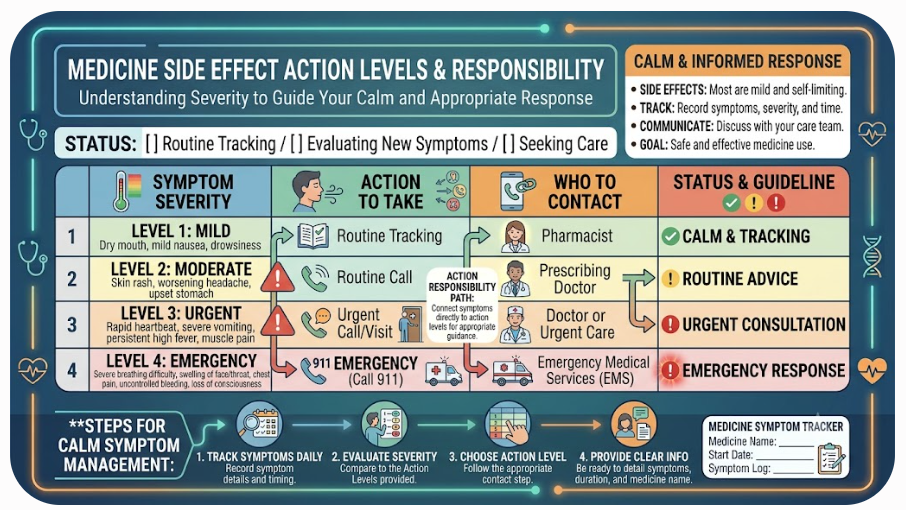
A complete list of possible side effects can be long. Ask the pharmacist to separate it into useful categories:
- effects that are common or expected and what routine response is appropriate;
- effects that should prompt a call to the pharmacy or prescriber;
- warning signs that require urgent assessment; and
- symptoms that require emergency services in your location.
Ask what action to take, not only what symptom to recognize. The pharmacist cannot predict exactly what will happen to one person, but can help you understand the product-specific instructions and escalation plan. For severe symptoms, suspected poisoning, or a possible overdose, use the appropriate local poison service or emergency pathway rather than waiting for a routine pharmacy conversation.
Ask about interactions without trying to solve them from memory
Show the pharmacist the complete list you brought and ask whether the new medicine changes how any current prescription, OTC product, vitamin, supplement, food, or alcohol should be handled. Mention products used only occasionally. A cold remedy, pain reliever, sleep aid, antacid, or supplement can be easy to omit because it does not feel like a regular medicine.
Ask a specific question: “Does anything on this list conflict with this medicine, duplicate an ingredient, or need different timing?” If the answer requires a prescriber to change the treatment plan, confirm who will contact whom and whether you should wait before starting.
This conversation does not replace a systematic check. Learn how to check prescription and OTC medicines for interactions so you can gather the relevant products and recognize when professional verification is needed.
Make formulation and administration part of the safety conversation
A direction is not usable if the person cannot take the dosage form. Say so before leaving the pharmacy. Useful questions include:
- Is this available in a different dosage form or strength?
- How large is the tablet or capsule?
- Is a suitable liquid available, and what measuring device is needed?
- Does this product have a taste, texture, preparation, or storage issue I should plan for?
- May this exact tablet be split or crushed, or this capsule be opened?
- If it may be mixed with food or liquid, exactly how should that be done?
Jerome learned why this question cannot be treated as a matter of discipline:
My son was nearly ten and would gag when he tried to swallow pills. I did not understand what he was experiencing. I scolded him and told him to swallow the pill and finish, as though the problem were unwillingness. The consequence was that I added pressure to an already difficult moment without solving how he could safely take the medicine. My wife responded differently: she checked the labeled dose and, when liquid medicine was supplied, measured the mL carefully while looking for a workable way to give it. I now understand that safe administration includes whether the child can actually take the dosage form. I try not to add stress, and I would ask about the specific medicine rather than demand that a child force it down.
Pressure treated a real administration difficulty as disobedience. That was the mistaken assumption; acknowledging it does not require blaming the parent or diagnosing the child. Gagging with a pill alone does not establish why swallowing is difficult.
Do not crush, split, chew, open, dissolve, or substitute a liquid simply because swallowing is hard. Whether alteration is safe depends on the exact medicine, strength, and formulation. A liquid can also have a different concentration and require precise measurement. Ask the pharmacist or prescriber to confirm a workable option and provide written directions for that option.
If a person also has difficulty swallowing food or drink, coughs or chokes while swallowing, or has persistent or worsening difficulty, seek appropriate clinical assessment rather than treating the problem only as a pill preference.
Cover missed doses, storage, and follow-up—but keep them product-specific
Three final questions close common gaps:
- What should I do if a dose is late, missed, vomited, or uncertain? Ask for the rule for this medicine. Do not assume that doubling, skipping, or shifting the schedule is universally correct.
- How should I store it? Confirm temperature, moisture, light, refrigeration, original-container, and child-safety requirements that apply to this product. Detailed household storage systems belong in a separate decision; here, the goal is to leave with the product-specific instruction.
- When should I call back or arrange follow-up? Ask whom to contact if the medicine is not helping, a side effect appears, the schedule is unworkable, a refill looks different, or monitoring has not been arranged.
Also ask how long the medicine is intended to be used and whether it should ever be stopped suddenly. Do not decide that a medicine is no longer needed simply because you feel better or experience a problem. Use the agreed contact route to clarify the next action.
Use teach-back to test the plan
“Do you understand?” is a weak final check. People often say yes because the explanation sounded familiar, because the pharmacy is busy, or because they do not yet know which part will become confusing at home.
Instead, restate the plan:
“Let me make sure I have this right. This medicine is for ____. I will take/use ____ at ____. I should expect ____. I will call ____ if ____, and I will seek urgent help if ____. If I miss a dose, I will ____.”
This is not a test of the patient. It is a test of whether the explanation and written directions are clear enough to use. If the pharmacist corrects your summary, repeat the corrected version once more.
Ask for written information in a format you can use: larger print, an accessible label, translated or plain-language instructions where available, a demonstrated measuring device, or a schedule written around real daily anchors. Availability and legal requirements differ by country and pharmacy, but the decision principle is stable: essential instructions should not depend on memory alone.
Know when the conversation is not finished
Do not treat the medicine as ready for use when:
- its purpose, patient, strength, form, or directions do not match what you expected;
- the pharmacist’s explanation conflicts with the container, leaflet, portal, or prescriber’s instruction;
- you cannot carry out the schedule or administration method safely;
- an interaction, allergy, pregnancy, breastfeeding, organ-function, or monitoring concern still needs review;
- you do not know which side effects require a routine call, urgent help, or emergency care;
- a child or adult cannot take the dosage form as supplied; or
- you cannot explain the essential plan in your own words.
Ask who will resolve the issue, whether you should delay the first dose, and how you will receive the final instruction. If the answer changes use of the medicine, request an updated label or written direction. A verbal correction that disappears when you reach home is not a durable safety plan.
Decision Summary
A useful pharmacist conversation produces five clear answers:
- Purpose: What is this medicine for, and what benefit should be expected?
- Use: Exactly how, when, and for how long should it be used?
- Risk: Which interactions, side effects, and warning signs require action?
- Fit: Can the person actually follow the plan, including swallowing, measuring, scheduling, and accessibility needs?
- Next step: What happens after a missed dose, a problem, lack of benefit, or a need for follow-up?
Bring a complete medication list, state practical barriers honestly, and use teach-back before leaving. The goal is not to memorize every fact about the medicine. It is to leave with a specific, written, workable plan—and to pause when professional clarification is still incomplete.
FAQ
What is the most important question to ask about a new medicine?
Start by asking what the medicine is for and exactly how it should be used. Then confirm what benefit to expect, which problems require action, and what to do if a dose is missed.
Should I bring my medicine bottles to the pharmacy?
A current medication list may be easier to review, but containers or clear label images can help when names, strengths, directions, or actual products are uncertain. Include OTC medicines and supplements. Protect personal information when storing or sharing images.
What if I remember a question after I get home?
Call the dispensing pharmacy and keep the container and written information in front of you. State the medicine name, strength, and exact question. For severe symptoms, suspected poisoning, or an emergency, use the appropriate local service instead of waiting for a routine callback.
Can a pharmacist tell me to stop a medicine?
Pharmacists’ authority and scope differ by jurisdiction and situation. Ask what action is appropriate and whether the prescriber must be involved. Do not stop or change a prescribed medicine on your own unless you are following an established urgent or emergency instruction.
Can I crush a tablet for a child who cannot swallow it?
Do not assume so. Some tablets must not be crushed or split, and capsules should not automatically be opened. Ask about the exact product and strength and obtain written administration directions or a confirmed alternative.
Is liquid medicine always easier or safer for a child?
No. A liquid may be an appropriate alternative for some medicines, but availability, concentration, taste, measurement, and storage can create different challenges. The pharmacist or prescriber should confirm the product-specific option and dose directions.
What if I feel embarrassed asking the pharmacist to repeat something?
Ask anyway. Restating the plan in your own words helps reveal unclear instructions before they become errors at home. Request slower, written, larger-print, accessible, or language-supported information when needed and available.
Health Information Notice
This article provides general medication-safety information. It does not interpret an individual prescription, recommend a medicine, calculate a dose, diagnose swallowing difficulty, or replace a pharmacist, prescriber, poison service, or emergency professional. Pharmacy services, professional authority, labeling, and emergency pathways vary by jurisdiction. Seek prompt local help for a possible medication error, poisoning, serious reaction, or emergency.
Sources
- MedlinePlus – Talking to Your Doctor About a New Medicine
- MedlinePlus – Medicine Safety
- Health Canada – Your Child’s Prescription: Important Questions to Ask
- NHS – Problems Swallowing Pills
- NHS Specialist Pharmacy Service – Checking If Tablets Can Be Crushed or Capsules Opened
- AHRQ – Teach-Back Method
More in This Cluster: Medication Safety
- How to Keep an Accurate Medication List
- Prescription and OTC Medicines: How to Check for Interactions
- How to Read a Medication Label Without Missing Key Directions
- What to Ask a Pharmacist About a New Medicine (you are here)
- Safe Medication Storage at Home
- Travelling With Medication: A Practical Safety Checklist
- How to Dispose of Unused or Expired Medication Safely