A medicine cabinet can look organized and still be unsafe. The bottles may be together, yet exposed to shower humidity. A high shelf may be out of a toddler’s sight but reachable by a climbing child—or by a pet that can knock the container down. A weekly organizer may make doses easier to remember while separating tablets from the label that identifies them.
Safe storage has two jobs: preserve the medicine under the conditions stated for that product, and prevent the wrong person or animal from reaching or confusing it. The best location is therefore not automatically the bathroom, kitchen, refrigerator, or bedside. It is the place that satisfies the specific label and still works as a secure household system.
Quick answer: Check the pharmacy label, package, and supplied patient information for temperature, moisture, light, refrigeration, and container instructions. Choose a stable location away from heat and humidity, then add access control appropriate to the people, visitors, and pets in the home. Keep each medicine identifiable and separated by person; relock caps and return products immediately after every use. If a medicine was left in heat, frozen, exposed to moisture, damaged, or changed in appearance, set it aside and ask a pharmacist or the manufacturer whether it is still usable. Do not guess from appearance or automatically replace refrigeration with freezing.
Start with the product, not the room
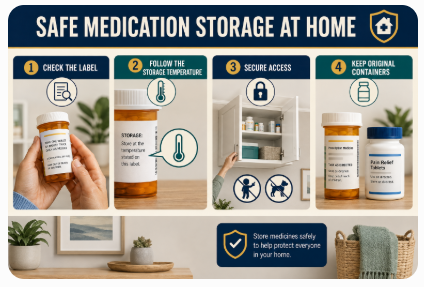
“Store at room temperature” is not permission to choose any indoor surface. Nor does “keep refrigerated” mean colder is always safer. Read the storage section on the pharmacy label, manufacturer package, and any patient leaflet supplied with the medicine. Look for:
- a stated temperature range or refrigeration requirement;
- instructions such as protect from moisture, light, or freezing;
- a requirement to keep the product tightly closed, in its original carton, or in a particular pouch;
- an after-opening or after-mixing limit; and
- any special handling direction for a device, liquid, patch, injection, or other dosage form.
If the sources do not agree, the print is unreadable, or the instruction uses a term you cannot apply confidently, ask the dispensing pharmacist. For U.S. products, the National Library of Medicine’s DailyMed database can help locate current manufacturer labeling submitted to the FDA, but the dispensed label and professional advice still matter. If you need a method for finding and comparing written directions, review how to read a medication label without missing key directions.
This order matters. A general storage tip cannot override a product-specific instruction. Most medicines may suit a cool, dry location, but some require refrigeration, some must not freeze, and some need protection from light or continued storage in their supplied packaging.
Choose a place with stable conditions
Heat, air, light, and moisture can damage medicines. Bathrooms are often convenient, but showers, baths, and sinks can make them warm and humid. A kitchen cabinet beside a stove, sink, dishwasher, kettle, or other hot appliance may have similar fluctuations. Windowsills, radiators, sunny shelves, garages, and vehicles can also expose products to conditions far outside those in the room where you normally live.
For a medicine without a special refrigeration instruction, a dresser drawer, storage box, closet shelf, or suitable cabinet away from heat and water may be a better starting point. Then test the location against the label and the household:
- Temperature: Does this area remain within the product’s stated conditions rather than becoming hot, cold, or variable?
- Moisture: Is it away from showers, sinks, steam, and frequent condensation?
- Light: If protection from light is required, does the original carton or selected location provide it?
- Physical protection: Can the container stay dry, closed, upright where needed, and protected from crushing, puncture, or spills?
- Access: Can the intended user or caregiver reach it without making it available to children, visitors, pets, or anyone for whom it was not prescribed?
A location that fails one of these tests is not made safe by looking tidy.
Treat refrigeration as a specific instruction
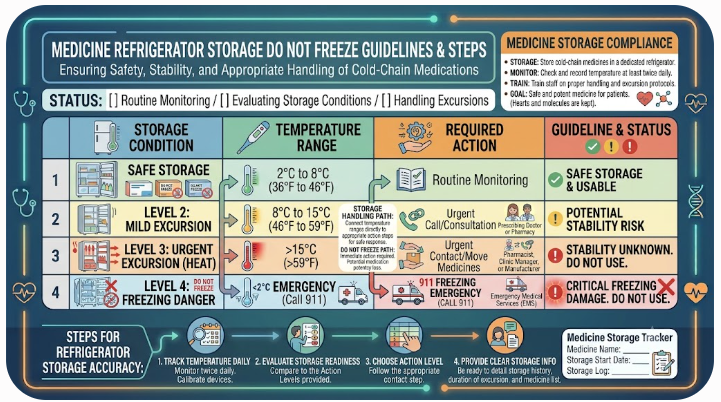
Refrigerate a medicine only when its label or pharmacist tells you to. Keep it in the part of the refrigerator recommended for that product, not automatically against a cooling element or in a place where it may freeze. Do not store it beside food in a way that invites confusion, spills, or access by children. A clearly identified secondary bin may help organize it, provided the original labeled container and required airflow or packaging are preserved.
If a refrigerator loses power, a product freezes, or a medicine is left on a counter, do not invent a universal grace period. The effect of a temperature excursion depends on the exact product, packaging, temperature, duration, and supporting stability data. Record what you know—approximately how warm or cold it became, for how long, and whether it froze—then contact the pharmacist or manufacturer. Keep the medicine separate while you wait for an answer, but do not stop an essential treatment without asking what to do next.
The same stop-and-verify rule applies after a hot vehicle, cold delivery, heater exposure, or other suspected excursion. “It looks normal” is not proof that quality was preserved, while an excursion does not automatically prove that the medicine must be discarded.
Make “out of sight” and “secure” separate checks
For young children, medicines, vitamins, and supplements—including gummies—should be put up and away, out of reach and sight, after every use. Never leave a product on a counter or at a sick child’s bedside because another dose is due soon. Relock a safety cap immediately and return the container to storage.
But height and a safety cap are not complete security. Children can climb, some caps can be opened, and a visitor’s purse may place medicine at floor level. A lock or child-resistant latch may be appropriate, especially when the household includes young children, people at risk of confusion, or medicines that could be deliberately or accidentally misused. The control should match the actual risk, not the appearance of the shelf.
Check temporary access points too:
- purses, backpacks, coat pockets, and suitcases brought by guests;
- bedside tables, countertops, dosing cups, and products left out between doses;
- dropped tablets that may roll under furniture;
- home-delivery packages waiting at the door; and
- medicines a caregiver carries from one room to another.
Tell babysitters, relatives, home-care workers, and overnight guests where medicines may and may not be placed. A short conversation before a visit is more reliable than assuming everyone uses the same storage habits.
Pets change the test again. A counter may be high enough for a child but accessible to a jumping cat or a dog that can pull down a bag. Child-resistant packaging may not withstand chewing. Keep both human and veterinary medicines in secure locations, and separate pet products from human products to reduce mix-ups.
If you think a child, adult, or pet may have accessed a medicine, do not wait for symptoms or use this article to assess the exposure. Contact the appropriate local poison service, emergency service, healthcare professional, veterinarian, or animal poison service promptly.
Keep identity attached to the medicine
The original labeled container preserves information that a loose tablet or unmarked bag does not: the person, product, strength, directions, pharmacy details, expiry, and sometimes lot or special storage instructions. Keep medicines in their original containers unless a pharmacist-supported system is being used.
That does not mean every pill organizer is wrong. An organizer can support adherence for some people, but it introduces decisions that depend on the medicine: whether removal from the original packaging is appropriate, how identification will be preserved, who will fill and verify it, and how it will be secured. Ask a pharmacist before moving moisture-sensitive, light-sensitive, specially packaged, or otherwise unfamiliar products.
Never combine new tablets with leftovers simply because the names appear to match. Do not pour different medicines into one bottle, reuse an old labeled vial for another product, or rely on color and shape as the only identifiers. If a refill looks different, compare the label and ask the pharmacist before mixing the supplies.
For a multi-person household, use clear separation rather than memory. Give each person a distinct bin, shelf area, or labeled section. Store veterinary medicines apart from human medicines. Within each section, keep look-alike packages from sitting in positions where one can be grabbed automatically. Good organization reduces choice errors; decorative uniformity is less important than readable identity.
Balance caregiver access with security
Secure storage must still allow the intended person to receive medicine correctly. A lockbox that only one absent family member can open may protect against access while creating missed doses. Leaving everything unlocked for convenience solves the wrong problem.
Build a controlled access plan:
- identify which person is responsible for routine administration;
- give authorized backup caregivers a lawful, practical way to reach the medicine;
- keep written directions and the current medication list available to them without exposing the medicine to everyone;
- return each product to its assigned location immediately after use; and
- review access when a child begins climbing, a visitor arrives, cognition changes, or caregiving responsibility shifts.
If a person needs easy-open packaging because of arthritis, weakness, vision loss, or another access barrier, tell the pharmacist. Easier opening may reduce one barrier while increasing household access risk, so the packaging and storage location should be planned together. The goal is not maximum restriction at any cost; it is reliable access for the authorized user and reliable prevention for everyone else.

Run a short routine check
A storage system can become unsafe gradually. Labels fade, caps stop closing well, refrigerator conditions change, discontinued prescriptions remain beside active ones, and family members add new products without changing the layout.
Use a brief trigger-based check whenever a medicine is started, stopped, refilled, moved, damaged, or exposed to unusual conditions—and when household access changes. Inspect:
- the product name, person, strength, and readable directions;
- the expiry date and any shorter after-opening or after-mixing limit;
- the cap, seal, carton, pouch, blister, or device for damage;
- changes in color, smell, texture, clarity, cracking, chipping, sticking, leakage, or contamination;
- whether the assigned location still meets temperature, moisture, light, and security needs; and
- whether discontinued, expired, or unidentified products have been separated from active supplies.
Do not use a medicine that has changed unexpectedly or lost reliable identification until a pharmacist advises you. Mark questionable products clearly and keep them secure so no one takes them by mistake.
This article stops at the decision to separate an expired, discontinued, damaged, or unwanted medicine. Disposal rules vary by product and jurisdiction, so do not pour it into a sink, flush it, or place it in household waste based on a generic habit. Use current local instructions or a later disposal guide.
Decision Summary
A safe home storage system answers five questions:
- Conditions: What temperature, moisture, light, refrigeration, and packaging instructions apply to this exact product?
- Place: Which location consistently meets those conditions?
- Access: Who can reach it—including children, visitors, caregivers, and pets—and who should be able to?
- Identity: Can the intended user distinguish the correct person, product, strength, and directions without relying on appearance or memory?
- Stop point: After an excursion, damage, expiry, or unexplained change, is the medicine separated until a pharmacist or manufacturer confirms the next step?
Read the label before choosing the room. Keep the medicine identifiable, close it and return it after every use, and design for the people and animals who actually enter the home. Storage does not determine whether a medicine is still clinically needed; it protects the product and reduces access and mix-up risks while that decision belongs to the patient and healthcare team.
FAQ
Is the bathroom medicine cabinet safe?
Often it is not the best location because showers, baths, and sinks can create heat and moisture. Check the product-specific label, then choose a secure, cool, dry place away from water and temperature changes unless the instructions require something different.
Should all medicines be kept in the refrigerator?
No. Refrigerate only when the label or pharmacist instructs you to. Some medicines require refrigeration, while others can be damaged by cold or freezing. Do not assume colder is safer.
Is medicine still usable after being left in a hot car?
Do not decide from appearance or a universal time limit. Set the product aside, note the approximate temperature and duration, and ask the pharmacist or manufacturer. Also ask how to avoid interrupting an essential treatment while the product is evaluated.
Are child-resistant caps childproof?
No. Relock the cap after every use, but also store the medicine up and away, out of a child’s reach and sight. Add a latch or lock when the household risk calls for it.
Can I move medicines into a weekly pill organizer?
Sometimes, but not every product should be removed from its original packaging. Ask a pharmacist whether the specific medicine can be organized that way and how to preserve identification, directions, environmental protection, and secure access.
How should I store medicine when grandchildren or other visitors arrive?
Recheck permanent storage and temporary access points. Ask visitors to keep purses, coats, backpacks, and suitcases containing medicines up and away. Secure bedside and countertop products and make sure authorized caregivers know the plan.
What should I do with expired medicine I find during a storage check?
Separate it from active medicine and keep it secure. Follow current product- and location-specific disposal guidance or ask a pharmacist. Do not assume that flushing or household trash is appropriate everywhere.
Health Information Notice
This article provides general medication-safety information. It does not determine whether a particular medicine remains stable after an excursion, clinically appropriate, or safe to use, and it does not replace the product label, pharmacist, prescriber, manufacturer, poison service, veterinarian, or emergency professional. Storage, poison-service, and disposal systems vary by jurisdiction. Seek prompt local help for possible access, poisoning, medication error, serious reaction, or emergency.
Sources
- MedlinePlus – Storing Your Medicines
- FDA – Don’t Be Tempted to Use Expired Medicines
- CDC – Medication Safety Toolkit
- FDA – Properly Store Medications to Keep Your Pet Safe
- FDA – The Over-the-Counter Drug Facts Label
- Health Canada – Guidelines for Temperature Control of Drug Products
More in This Cluster: Medication Safety
- How to Keep an Accurate Medication List
- Prescription and OTC Medicines: How to Check for Interactions
- How to Read a Medication Label Without Missing Key Directions
- What to Ask a Pharmacist About a New Medicine
- Safe Medication Storage at Home (you are here)
- Travelling With Medication: A Practical Safety Checklist
- How to Dispose of Unused or Expired Medication Safely