Unused medicine creates an awkward household decision. Keeping it indefinitely can leave a potent product available for accidental use, confusion, or misuse. Throwing it away casually can expose children, pets, waste workers, or the environment. Even a container that looks empty may still hold medicine, pressure, a needle, or personal information.
The answer is not one universal disposal method. The correct route depends on the exact product, the instructions supplied with it, and the rules and services where you live. A pharmacy return may be routine in one country, while another location uses authorized collection boxes, mail-back envelopes, household hazardous-waste services, or product-specific directions.
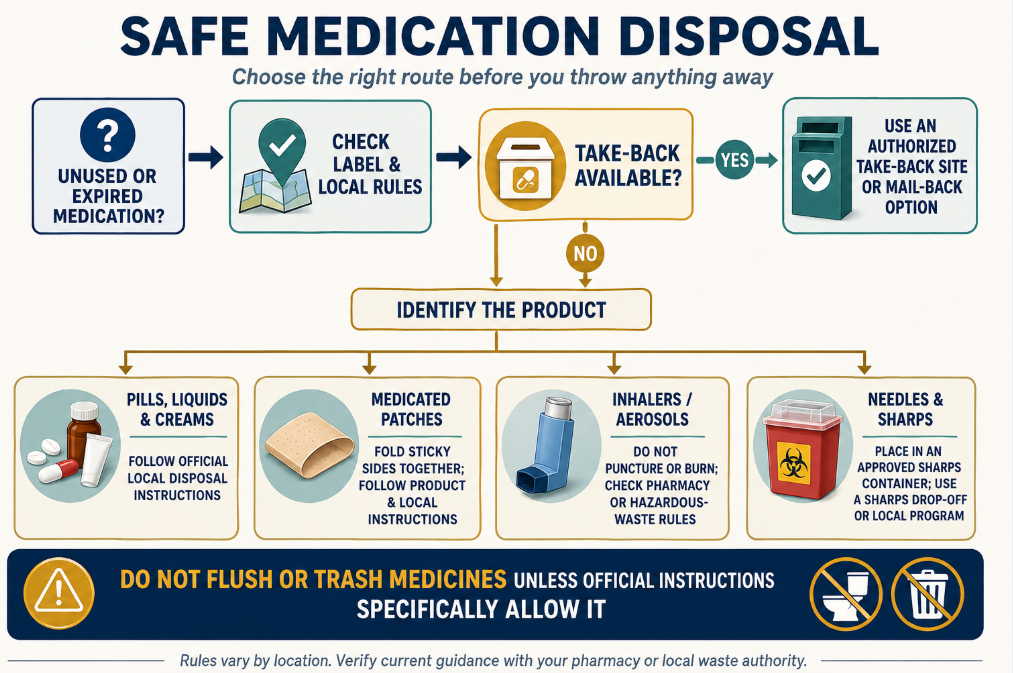
Quick answer: First confirm that the medicine is no longer needed and is actually yours to dispose of. Read its label and patient information, then check a current local pharmacy, regulator, take-back program, or waste authority. Use an authorized return or take-back route when one is available and accepts the product. Do not flush medicine unless current product-specific and local instructions explicitly tell you to. Do not place loose needles or other sharps in household trash or recycling. Until handoff, keep every item closed, identifiable, and securely out of reach. Remove or obscure personal details only when doing so will not interfere with the return program or safe identification.
Confirm the disposal decision before acting
“Not being used today” does not always mean “ready to discard.” A medicine may have been paused, replaced, recalled, damaged, left after a dose change, or separated because the label and medication list did not agree. Those situations call for different checks.
Before disposal, ask:
- Is this the correct medicine and the correct person’s supply?
- Has a prescriber or pharmacist confirmed that it was stopped, replaced, or no longer needed?
- If it appears expired, is the date clear and does it apply to the unopened product, the opened product, or a shorter after-opening period?
- If it was exposed to heat, freezing, moisture, or damage, has a pharmacist or manufacturer determined whether it is unusable?
- If it is subject to a recall, does the recall notice specify a return, refund, quarantine, or disposal route?
- Could it still be needed while a refill, replacement, or treatment decision is unresolved?
Do not let a cleanup project interrupt treatment. If the decision is uncertain, separate the item from active medicine, mark it so it is not used by mistake, and ask the dispensing pharmacy or prescriber what to do next. Do not discard a product simply because it is absent from memory or conflicts with a list. The accurate medication list is a reconciliation tool, not permission to make a treatment decision.
Once the medicine is confirmed as unwanted, discontinued, recalled for disposal, damaged beyond use, or expired, move promptly to route selection. “I might need it someday” is not a safe reason to keep a prescription indefinitely, and it is never appropriate to save it for another person.
Let the product and your location choose the route
Start with the pharmacy label, package, Medication Guide or patient leaflet, and any recall notice. Look for disposal instructions and warnings about a patch, pressurized container, device, controlled medicine, or hazardous component. If the wording is missing or unclear, contact a pharmacist.
Then verify what is available where you live. Useful official contacts may include:
- a community or dispensing pharmacy;
- a national or local medicine take-back locator;
- a health department, medicines regulator, or drug-enforcement authority;
- a municipal household hazardous-waste or waste service; and
- a manufacturer program named in the product instructions.
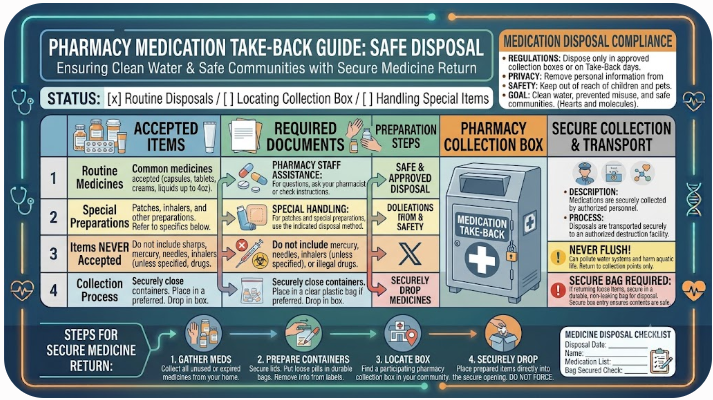
Ask what the program accepts before you travel there. A collection site that accepts tablets and capsules may exclude needles, inhalers, chemotherapy medicines, liquids, or batteries. A pharmacy may accept medicines but require sharps to arrive in an approved container through a different local program. Mail-back packages may also have eligibility, packaging, and mailing restrictions.
Current location matters more than a familiar rule from another country. In Canada, Health Canada tells consumers that unused and expired prescription drugs, over-the-counter medicines, and natural health products can be returned to a pharmacy. In the United States, the FDA recommends an authorized drop-off or prepaid mail-back option for most unused or expired medicines. These are useful examples, but neither rule should be copied automatically in another jurisdiction.
Make authorized return your first practical check
An authorized take-back route reduces the need to handle, mix, unwrap, or reinterpret the product at home. Depending on the local system, the route may be a permanent collection box, a pharmacy counter, a scheduled collection event, or an approved prepaid mail-back envelope.
Before handoff:
- Confirm the site, hours, and accepted items through a current official source.
- Keep products in the form and packaging the program requests.
- Do not combine different medicines in one unlabelled container unless the program explicitly directs it.
- Keep liquids closed and upright, patches contained, and devices protected from activation or damage.
- Carry the items directly to the destination rather than leaving them in a vehicle, lobby, or unattended bag.
Never place medicine beside a collection box that is full or closed. Do not mail medicine in an ordinary envelope or package because a website, friend, or social post suggests it. Use only an authorized mail-back system and follow its supplied instructions.
If no suitable return option is readily available, do not improvise immediately. Check the product information and a current local authority for the next permitted route. The answer may differ by medicine and municipality.
Do not turn flushing into a general rule
Most medicines should not be flushed simply because that seems to remove them quickly. Flushing is a narrow, jurisdiction- and product-specific instruction.
The U.S. FDA maintains a flush list for certain medicines that may cause severe harm or death after inappropriate use and advises flushing listed products only when a take-back option is not readily available. It also states not to flush medicines that are not on that list. That is a specific U.S. risk-management pathway, not a global medicine-disposal rule.
If you are in the United States, check the current FDA list and the product instructions rather than relying on a remembered drug name. If you are elsewhere, follow the applicable regulator and local wastewater or disposal guidance. Do not assume that a U.S. list authorizes flushing in Canada, the United Kingdom, Australia, or another country.
The same caution applies to sinks. “Dissolving it first” does not make a medicine appropriate for the drain. When the route is unclear, keep the item secure and ask.
Household trash is a fallback, not a default
Some jurisdictions permit certain medicines in household trash when take-back is not readily available and the product is not subject to special disposal instructions. Others direct residents to pharmacies or another collection system instead. Confirm local rules first.
For medicines that qualify for household-trash disposal under current U.S. FDA guidance, the FDA directs people to remove the medicine from its original container, mix it—without crushing tablets or capsules—with an undesirable substance such as dirt, cat litter, or used coffee grounds, place the mixture in a closed container, and put that container in household trash. Personal information should be removed or obscured from the empty packaging before it is discarded.
That procedure has important limits:
- it is not a substitute for an available take-back route;
- it does not apply to a medicine with different product-specific instructions;
- it does not authorize trash disposal where local rules prohibit it;
- it does not apply to loose needles or other sharps; and
- it should not be used to create a new exposure while handling a hazardous product.
Do not crush, burn, heat, puncture, aerosolize, or chemically alter a medicine to make disposal feel more complete. If a product cannot be handled safely using the authorized instructions, stop and contact the pharmacy, manufacturer, or local hazardous-waste authority.
Treat patches, inhalers, liquids, and controlled medicines as product-specific
Dosage form changes the practical risk.
Patches: A used medicated patch may retain active medicine. Follow the supplied instructions for folding, containment, take-back, or any product-specific flushing direction. Keep both new and used patches away from children and pets while awaiting disposal. Do not assume every patch has the same route.
Inhalers and aerosols: A canister may remain pressurized even when it seems empty. Do not puncture, crush, burn, or place it in a fire. Ask the pharmacy, manufacturer, or local waste authority whether the product belongs in a pharmacy return, aerosol-recycling, or household hazardous-waste program.
Liquids, creams, and gels: Keep them closed in their original containers unless the authorized program instructs otherwise. Do not pour them into a sink or toilet as a substitute for checking the route, and do not combine substances that could leak or react.
Controlled or high-risk medicines: Use an authorized take-back route promptly when available. Do not advertise, transfer, donate, or hand the medicine to an unofficial collector. If immediate disposal instructions differ because the product presents an exceptional ingestion risk, follow the current product and regulator directions exactly.
Devices and combination products: Autoinjectors, pumps, pens, cartridges, batteries, and electronic components may contain both medicine and device waste. Confirm whether components must stay together or use separate programs. Do not dismantle them unless the manufacturer or authorized program instructs you to.
Keep sharps out of the medicine-return bag unless accepted
Needles, syringes with attached needles, lancets, and other sharps require a puncture-resistant system. The FDA advises placing used sharps immediately into an FDA-cleared sharps container when possible and following community rules when the container reaches its fill line. Loose sharps should never go into household trash, recycling, a toilet, or an ordinary medicine-return bag.
Do not reach into a container to rearrange sharps, overfill it, or force an item through the opening. Keep the container upright, closed as designed, and away from children and pets. If an approved container is unavailable, follow the current local authority’s specifications for an acceptable alternative; do not assume that any bottle or jar is safe.
Final collection routes vary. They may include designated drop boxes, supervised sites, mail-back services, household hazardous-waste locations, or other local programs. Call ahead, because a pharmacy that accepts unused tablets may not accept a sharps container.
Protect people and privacy while medicine waits
Disposal may take time. Until handoff, use the same access controls described in safe medication storage at home, but keep the disposal group clearly separated from active medicine.
A practical waiting system should:
- remain locked or otherwise secured from children, visitors, pets, and unauthorized access;
- keep every product identifiable and closed;
- prevent leaks, broken glass, exposed adhesive, or device activation;
- keep sharps in their dedicated container;
- show that the items are “do not use—awaiting disposal”; and
- include a near-term date or task for completing the handoff.
Do not create a large, permanent “expired medicine” box that no one reviews. Secure waiting is a bridge to a verified route, not a new form of stockpiling.
Privacy comes after safe identification and program requirements. When an empty bottle, carton, or mail-back package will leave your control, remove or permanently obscure your name, prescription number, address, barcode, and other personal details if the program allows it. Do not damage a label that a pharmacist or authorized collector needs in order to identify or accept the product. When uncertain, ask what information should remain visible.
Do not share or casually donate medicine
A medicine prescribed for one person should not be given to a relative, neighbor, friend, or online contact. The recipient may have a different condition, dose requirement, allergy, interaction risk, or contraindication, and the product may no longer have reliable storage or identity information.
Donation is also not a do-it-yourself alternative to disposal. Some jurisdictions operate formal medicine-donation or repository programs with eligibility, packaging, chain-of-custody, and professional oversight requirements. A household should use only a verified program that is legally authorized to accept the exact product. Otherwise, choose the approved disposal route.
Use a repeatable disposal check
You can close the medication-safety loop with six decisions:
- Confirm: Is the medicine truly no longer needed, or does a professional decision remain unresolved?
- Identify: What exactly is it—medicine, patch, inhaler, liquid, controlled product, device, or sharp?
- Read: Does the label, leaflet, recall notice, or manufacturer provide disposal instructions?
- Verify locally: Which current authorized program accepts that item where you live?
- Secure: How will it remain inaccessible and identifiable until handoff?
- Complete: Has it actually reached the approved route, with privacy handled appropriately?
This process is more reliable than a yearly cabinet purge based on memory. Review stored medicines periodically and after a treatment change, move, death in the household, recall, or caregiving transition. But preserve the order: confirm first, dispose second.
Safe disposal is the final step in medication management, not an afterthought. When the route is product-specific, locally verified, and completed promptly, the household removes risk without creating a new one.
FAQ
Can I flush expired medicine down the toilet?
Only when current product-specific and local instructions explicitly direct you to. In the United States, the FDA flush list applies to certain medicines when take-back is not readily available. It is not a universal rule and should not be applied in another jurisdiction without confirmation.
Can I throw medicine in household trash?
That depends on the product and local rules. Some U.S. medicines may use the FDA’s household-trash fallback when take-back is not readily available, but other products and jurisdictions require a different route. Verify before discarding.
Should I remove tablets from blister packs before returning them?
Follow the receiving program’s instructions. Keeping a product identifiable and contained is often safer than opening or combining it, but acceptance and packaging rules vary.
What should I do with used medication patches?
Follow the exact patch instructions and local program. Used patches may retain active medicine, so keep them secured from children and pets and do not assume every patch uses the same disposal method.
Can inhalers go in recycling?
Do not place an inhaler in ordinary recycling unless a current local program specifically accepts it. Some canisters remain pressurized. Ask a pharmacy, manufacturer, or local waste authority and never puncture or burn the canister.
Where do used needles and lancets go?
Place them immediately in an appropriate sharps container and use the applicable local sharps-disposal program. Never place loose sharps in household trash, recycling, a toilet, or an ordinary medicine-return bag.
Can I give unused prescription medicine to someone who needs it?
No. Do not share medicine directly. If your jurisdiction has a legally authorized donation or repository program, ask whether the unopened product qualifies; otherwise use an approved disposal route.
Health Information Notice
This article provides general educational information and does not replace advice from a pharmacist, prescriber, poison service, waste authority, or other qualified local professional. Disposal requirements vary by product and jurisdiction and can change. Verify current instructions for the exact item and location. If medicine may have been swallowed, touched, injected, or otherwise accessed unintentionally, contact the appropriate local poison or emergency service promptly rather than relying on disposal guidance.
Sources
- FDA – Disposal of Unused Medicines: What You Should Know
- FDA – FDA’s Flush List for Certain Medicines
- FDA – Drug Take-Back Options
- Health Canada – Safe Disposal of Prescription Drugs
- FDA – Best Way to Get Rid of Used Needles and Other Sharps
- NHS Specialist Pharmacy Service – Managing Pharmaceutical Waste
More in This Cluster: Medication Safety
- How to Keep an Accurate Medication List
- Prescription and OTC Medicines: How to Check for Interactions
- How to Read a Medication Label Without Missing Key Directions
- What to Ask a Pharmacist About a New Medicine
- Safe Medication Storage at Home
- Travelling With Medication: A Practical Safety Checklist
- How to Dispose of Unused or Expired Medication Safely (you are here)