Quick summary
Since August 1, 2026, the U.S. Department of State has moved routine visa processing from 25 posts in Africa to regional hubs. The change covers both nonimmigrant visas, such as tourist, student, exchange, and many work visas, and immigrant visas, including family-, employment-, diversity-, adoption-, and fiancé(e)-related cases.
This does not mean the affected U.S. embassies and consulates have closed. It means routine visa interviews and processing have been reassigned. The correct destination depends on the applicant’s country, place of residence, and whether the case is a nonimmigrant visa (NIV) or immigrant visa (IV). Those two case types do not always use the same hub.
Before paying a new fee, changing an appointment, or buying travel, applicants should check the official processing-post list, read every case email, and confirm the destination country’s entry requirements.
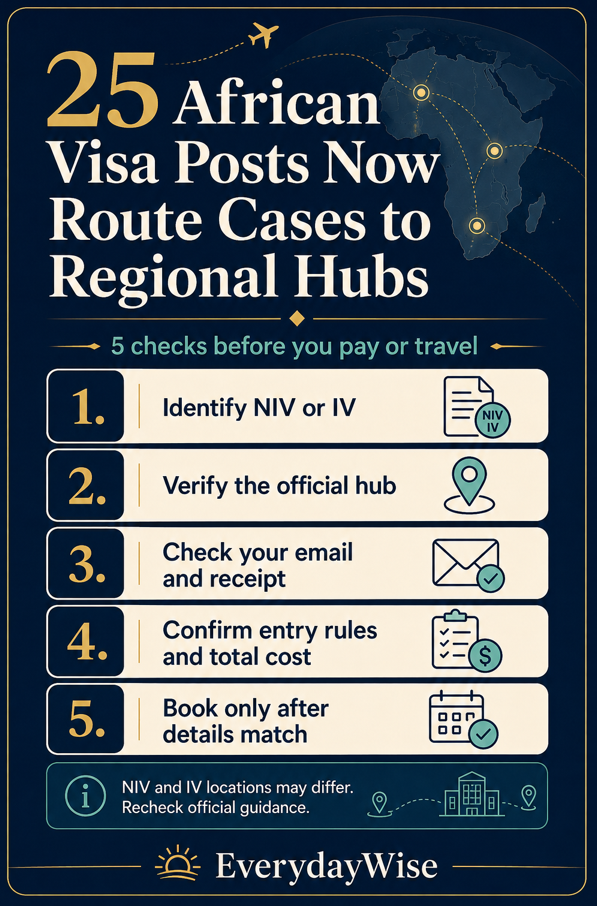
What changed on August 1?
The State Department realigned routine visa services previously handled in Antananarivo, Abuja, Asmara, Bamako, Banjul, Brazzaville, Bujumbura, Conakry, Cotonou, Durban, Freetown, Gaborone, Harare, Juba, Libreville, Lilongwe, Lusaka, Maputo, Maseru, Mbabane, N’Djamena, Niamey, Nouakchott, Ouagadougou, and Windhoek.
New applicants from the affected countries must use the designated regional location for their visa type. Routine services being moved include tourist and business visas, student and exchange visas, petition-based temporary work visas, immediate-relative and family-preference immigrant visas, employment-based immigrant visas, K visas, adoptions, Diversity Visas, and follow-to-join cases for certain asylees and refugees.
The realignment does not cancel a visa that is already valid. It also does not change the operating status of the affected embassy or consulate. Some posts continue American Citizen Services and limited nonimmigrant services, but “limited services” should not be read as permission to book an ordinary visa interview there.
Other U.S. policies remain separate. A processing hub does not override a visa suspension, a visa-bond requirement, or a pause that applies to a particular nationality or visa category.
First decide whether your case is NIV or IV
The most common planning error is choosing a city from a general hub list without first identifying the case type.
- Nonimmigrant visa (NIV): generally for a temporary purpose, including tourism, business, study, exchange, or temporary employment.
- Immigrant visa (IV): generally for permanent immigration, including many family- and employment-based cases. The official realignment also covers K visas, adoptions, Diversity Visas, and specified follow-to-join cases.
Use the classification shown on your application, petition, appointment notice, or National Visa Center communication. If the case type is unclear, confirm it through the official visa instructions before selecting a processing post.
Where affected applicants are directed
The table below reflects the State Department’s official NIV and IV processing-post lists as checked on August 4, 2026. It is a planning reference, not a substitute for the applicant’s case notice. “Johannesburg or Cape Town” means the official NIV list identifies both locations; appointment availability and case instructions still control.
| Country or affected post | Designated NIV location | Designated IV location |
|---|---|---|
| Madagascar (Antananarivo) | Johannesburg, South Africa | Johannesburg, South Africa |
| Nigeria (Abuja) | Lagos, Nigeria | Lagos, Nigeria |
| Eritrea (Asmara) | Kampala, Uganda | Nairobi, Kenya |
| Mali (Bamako) | Dakar, Senegal | Dakar, Senegal |
| The Gambia (Banjul) | Dakar, Senegal | Dakar, Senegal |
| Republic of the Congo (Brazzaville) | Kinshasa, Democratic Republic of the Congo | Kinshasa, Democratic Republic of the Congo |
| Burundi (Bujumbura) | Kampala, Uganda | Nairobi, Kenya |
| Guinea (Conakry) | Dakar, Senegal | Dakar, Senegal |
| Benin (Cotonou) | Lome, Togo | Abidjan, Côte d’Ivoire |
| South Africa (Durban) | Johannesburg, South Africa | Johannesburg, South Africa |
| Sierra Leone (Freetown) | Monrovia, Liberia | Monrovia, Liberia |
| Botswana (Gaborone) | Johannesburg, South Africa | Johannesburg, South Africa |
| Zimbabwe (Harare) | Johannesburg or Cape Town, South Africa | Johannesburg, South Africa |
| South Sudan (Juba) | Kampala, Uganda | Nairobi, Kenya |
| Gabon (Libreville) | Yaoundé, Cameroon | Yaoundé, Cameroon |
| Malawi (Lilongwe) | Nairobi, Kenya | Nairobi, Kenya |
| Zambia (Lusaka) | Johannesburg, South Africa | Johannesburg, South Africa |
| Mozambique (Maputo) | Johannesburg, South Africa | Johannesburg, South Africa |
| Lesotho (Maseru) | Johannesburg, South Africa | Johannesburg, South Africa |
| Eswatini (Mbabane) | Johannesburg, South Africa | Johannesburg, South Africa |
| Chad (N’Djamena) | Yaoundé, Cameroon | Yaoundé, Cameroon |
| Niger (Niamey) | Lome, Togo | Abidjan, Côte d’Ivoire |
| Mauritania (Nouakchott) | Dakar, Senegal | Dakar, Senegal |
| Burkina Faso (Ouagadougou) | Lome, Togo | Dakar, Senegal |
| Namibia (Windhoek) | Johannesburg or Cape Town, South Africa | Johannesburg, South Africa |
Because the State Department can revise live processing lists, open the current nonimmigrant visa processing-post list or immigrant visa processing-post list immediately before paying or scheduling.
If you already had an appointment, check your email first
Applicants with appointments at a post where routine services were discontinued should follow the case-specific email sent by the State Department. Do not assume that the appointment disappeared, moved automatically, or must be recreated at a hub.
Broader NIV and IV guidance says existing appointments generally remain, although a post may change one and notify the applicant. For an affected booking, the case email—not a social-media post, travel agent, or general map—is the immediate source of truth. Check spam folders and save the appointment confirmation and payment receipt.
If an immigrant visa appointment has already been scheduled and the applicant wants a different post, the official instruction is to contact the National Visa Center through its Public Inquiry Form rather than contacting a consular section directly. A transfer should not be treated as automatic or guaranteed.
What happens to an MRV fee already paid?
The transition rule was strict. The State Department told applicants who had paid a nonimmigrant visa application fee at a post moving to limited NIV services to schedule there by July 31. If they paid but did not schedule by that date, the official FAQ says the fee will not be refunded.
For applications made on or after August 1, the applicant must schedule and pay the required fee at the appropriate designated location. The Department’s general NIV guidance also warns that fees paid for applications at another embassy or consulate are not refundable or transferable.
Paying again before checking the first account can turn a location mistake into a second unrecoverable cost. Record the receipt and appointment status, read the post’s messages, verify the correct hub, and use the official contact route before paying again.
Budget for the trip to the hub, not only the visa fee
For many applicants, the real cost is now larger than the application fee. A hub appointment may require international airfare or ground travel, entry permission for the hub country, local transport, lodging, meals, and time away from work or caregiving. An immigrant visa medical examination may create another trip or additional days.
The State Department says IV applicants may complete the medical examination in their home country when an approved panel physician is available, or at the designated hub. Applicants should not assume that any local clinic can perform the exam; the appointment instructions and approved panel-physician information control.
Before buying nonrefundable travel, verify:
- the interview date and exact post;
- whether the hub country requires a visa, transit visa, vaccination proof, or other entry document for the applicant’s passport;
- how long the passport may remain with the U.S. post;
- where documents or passports will be delivered;
- the approved medical-exam location and timing for an IV case;
- whether a child, interpreter, petitioner, caregiver, or other companion may enter the post; and
- enough financial flexibility for a delay or an additional visit.
Do not infer permission to enter a hub country from the U.S. appointment letter alone. The government of the country being visited controls its own admission rules.
What if the case is urgent?
The State Department’s NIV and IV guidance allows rare exceptions for humanitarian or medical emergencies or foreign-policy reasons. That is not a promise that an expedited or local appointment will be granted.
Use only the emergency or expedited-request process published by the designated post or named in the applicant’s case instructions. Explain the documented urgency accurately and wait for approval before changing travel plans. For an immigrant case already handled by the National Visa Center, use the NVC route specified in the official guidance.
A five-step action plan
1. Identify the visa track
Confirm whether the case is NIV or IV from the official paperwork. Do not choose a hub based only on the purpose of travel described informally.
2. Verify the current hub
Use the live State Department list for that case type. Record the city and the date checked because assignments can change.
3. Protect the existing case
If there is already an appointment or payment, read the case email and account status before cancelling, transferring, or paying again. Keep copies of receipts and confirmations.
4. Price the complete route
Check the hub country’s entry rules, transportation, lodging, medical-exam arrangements, passport return, and the cost of a possible delay. A cheaper appointment slot may not produce the lowest total cost if it is not the designated post.
5. Commit only after confirmation
Buy nonrefundable travel only after the appointment location and date are confirmed and the applicant can legally enter the hub country. Recheck the post’s instructions shortly before departure.
The practical decision is to match the applicant’s country or residence, visa type, existing case status, and official processing post before spending more money. Preserve an existing booking until case instructions say otherwise, use the National Visa Center route for an IV transfer request, and treat entry to the hub country as a separate decision. This is a processing change—not a blanket embassy closure or cancellation of a valid visa.
FAQ
Did the United States close the affected embassies?
No. The State Department says the visa-processing realignment does not change the operating status of the affected embassies and consulates. Some continue American Citizen Services and limited visa services.
Does the change cancel a visa I already have?
No. The official realignment notice says currently valid visas are not affected. Other admission restrictions or case-specific issues may still apply.
Can I use the same hub for tourist and immigrant visas?
Not always. NIV and IV assignments differ for several affected countries, including Benin, Burundi, Eritrea, Niger, South Sudan, and Burkina Faso. Check the list for the actual case type.
Will an old appointment be cancelled automatically?
Existing appointments generally remain, but specific posts may make changes and notify applicants. If the appointment was at an affected post, check the email address and appointment account for case-specific instructions before taking action.
Can I transfer an MRV fee to the new hub?
Do not assume so. The State Department says fees paid for NIV applications are not refundable or transferable, and its realignment FAQ says an affected fee paid without an appointment scheduled by July 31 will not be refunded.
Can an immigrant visa applicant still complete the medical exam at home?
Possibly. The State Department says the exam may be completed in the home country if an approved panel physician exists there, or at the designated hub. Follow the case instructions and approved-physician list.
Is an emergency appointment guaranteed?
No. Rare exceptions may be considered for humanitarian or medical emergencies or foreign-policy reasons. Applicants must use the official request process and wait for a decision.
Sources
- U.S. Department of State — Realignment of U.S. Visa Services in Africa to Regional Hubs
- U.S. Department of State — Nonimmigrant Visa Processing Posts
- U.S. Department of State — Immigrant Visa Processing Posts
- U.S. Department of State — NIV Applicants in Their Country of Residence
- U.S. Department of State — IV Applicants in Their Country of Residence
This article provides general information, not legal or immigration advice. Visa-post assignments, fees, appointment procedures, entry requirements, and exceptions can change. Confirm the current instructions for your case with the U.S. Department of State, the designated embassy or consulate, and the government of the hub country before paying or travelling.