Quick Answer
Plan car repairs, school costs, and home maintenance by separating what is scheduled, likely but not precisely dated, and genuinely unexpected. Put known dates and required tasks on a 12-month calendar, estimate each cost from your own records, current quotes, school information, and manufacturer or property guidance, then convert the planned total into contributions that fit your cash flow.
Do not rely on one generic percentage or divide every estimate by 12 automatically. A school payment due in three months needs a different schedule from a roof replacement that may be several years away. Fund safety-critical and deadline-driven needs first, revisit uncertain estimates, and keep an emergency reserve for failures that were not reasonably foreseeable.
The aim is not to predict every repair. It is to stop predictable wear, recurring school expenses, and known property work from arriving as if they were surprises.
Begin With an Annual Cost Map
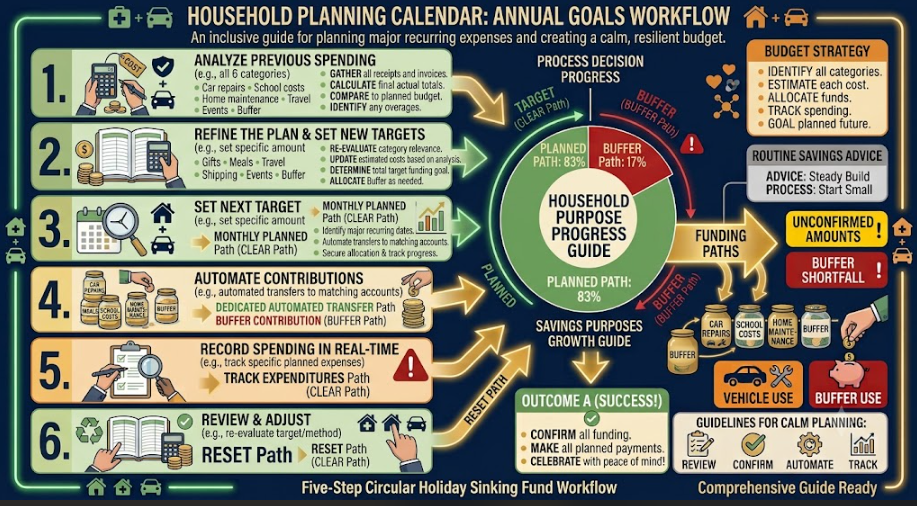
These expenses feel irregular because they do not appear in the same amount every month. Many are still visible in advance.
The Consumer Financial Protection Bureau’s annual planning tool recommends looking across a full year for periodic expenses and varying income. It specifically prompts users to consider school-related spending and costs that occur once or several times a year. That principle can be extended to vehicle service dates and seasonal home tasks.
Create a calendar with one row for each expected expense and record:
- the item or task;
- the earliest reasonable date;
- a target date or deadline;
- the best current cost estimate;
- how confident you are in the amount and timing; and
- the consequence of postponing it.
Start with evidence already available: last year’s transactions, school notices, enrollment dates, the vehicle owner’s manual, mileage, inspection notes, repair invoices, warranties, home inspection reports, appliance ages, contractor estimates, and a household maintenance log.
Avoid copying another household’s number. Vehicle model, mileage, climate, school arrangements, property size, local labor rates, insurance coverage, warranties, and who can safely perform a task all change the result.
Sort Costs by Predictability Before Choosing the Fund
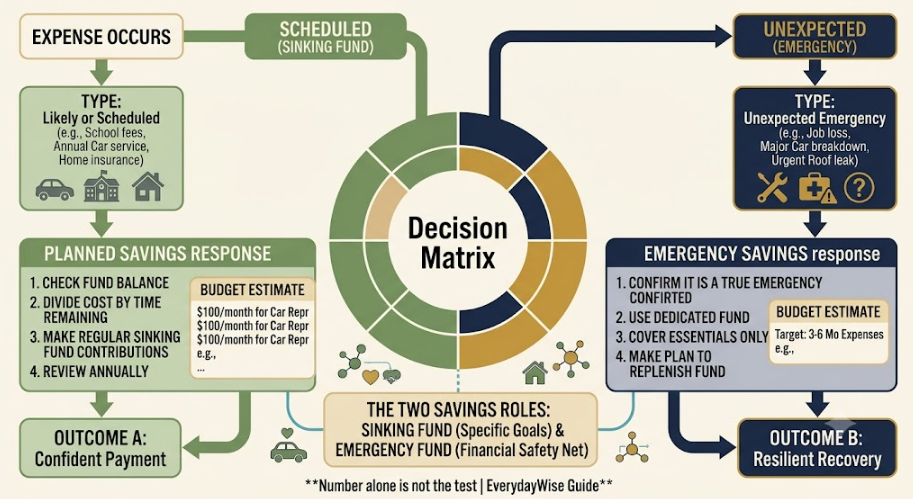
A useful plan distinguishes three kinds of cost.
Scheduled costs
These have a known date or interval: school registration, uniforms, activity fees, seasonal tire changes, a manufacturer-specified service, a furnace inspection, or a permit renewal. Treat them as ordinary planned expenses even if they occur only once a year.
Likely costs with uncertain timing
These are not on a fixed invoice but are supported by evidence. Worn tires may need replacement within a range of months. An aging appliance may still work but show signs of decline. A child may probably need a larger uniform before the next school year.
Use a working estimate and review date. Do not present the target as certainty. The plan should become more accurate as mileage, condition, prices, and dates become clearer.
Unplanned failures and financial emergencies
A collision repair, sudden plumbing failure, or urgent school-related family disruption may be genuinely unexpected. CFPB defines an emergency fund as cash reserved for unplanned expenses or financial emergencies and includes car and home repairs as possible examples.
The category depends on the facts, not the object. A brake replacement recommended at the last inspection is planned vehicle work; brake damage discovered without warning may be an emergency. A known roof project belongs in a sinking fund; storm damage may call for insurance, emergency savings, or both.
This article uses sinking fund as an EverydayWise practical label for money assigned to foreseeable costs. It is not a CFPB product definition.
Build the Vehicle Plan From the Car’s Evidence
Start with the manufacturer’s maintenance schedule for the vehicle and the way it is driven. The U.S. Federal Trade Commission advises consumers to compare a repair shop’s proposed schedule with the manufacturer’s schedule in the owner’s manual and ask why additional work is recommended.
Your vehicle list may include:
- scheduled service by time or mileage;
- inspections, registration, or required seasonal equipment;
- tires, brakes, battery, belts, hoses, and other wear items indicated by records or inspection;
- a known deductible if maintaining it as a separate planned target suits your system; and
- a replacement horizon for an aging vehicle, if that is a real household goal.
Do not invent a replacement date for a component solely because an online average says it is due. Use the manual, measured condition, a qualified inspection, warranty terms, and actual driving conditions.
For work that is not yet priced, obtain an estimate close enough to the likely service window to be useful. FTC guidance says a written repair estimate should identify the condition, needed parts, and anticipated labor charge. Local laws and shop practices vary, so confirm authorization and estimate rules where you live.
Suppose the evidence supports $420 for scheduled service in four months, $900 for tires in nine months, and $180 for registration in six months. The targets are hypothetical. Their first-month contributions are:
$420 ÷ 4 = $105
$900 ÷ 9 = $100
$180 ÷ 6 = $30
The combined vehicle contribution would initially be $235 per month. If that amount is unaffordable, do not postpone safety-critical work without professional input. Recheck the estimates, timing, warranty or coverage, and lower-priority spending, then make the trade-off explicit.
Build the School Plan Around the Actual School Year
School spending is often described as one back-to-school purchase, but the calendar may contain several waves: enrollment, supplies, uniforms, devices, transport, lunches, activities, photographs, trips, exams, graduation, or childcare during breaks.
Include only costs that reasonably apply to the learner and school. Publicly funded, private, home-based, post-secondary, and vocational education can have very different cost structures. Check current school or program information rather than assuming last year’s list is unchanged.
Separate required, important but adjustable, and optional items. This is not a judgment about a child’s interests. It is a way to protect deadlines and make constrained decisions visible.
For example, assume a household expects $360 of required supplies and clothing in four months, a $240 activity payment in eight months, and a $150 optional event in ten months:
$360 ÷ 4 = $90 per month
$240 ÷ 8 = $30 per month
$150 ÷ 10 = $15 per month
The initial total is $135 per month. If cash flow supports only $115, the $20 gap should trigger a decision now. The household might revise the optional event, reuse suitable items, confirm whether the list will change, or seek legitimate school or community assistance. It should not quietly underfund a known required payment.
If costs are shared between households or reimbursed, record who pays, the expected amount, and the date. Treat an expected reimbursement as unavailable until its timing and reliability justify including it.
Build the Home Plan From Condition, Season, and Responsibility
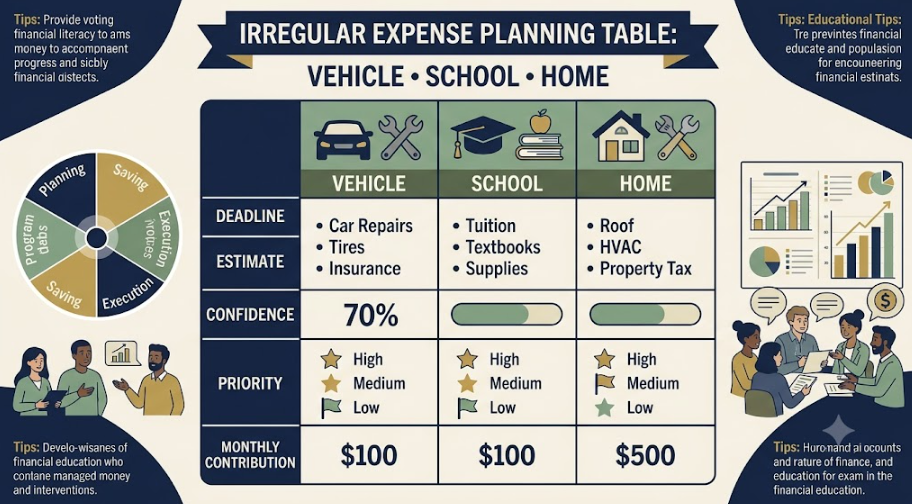
Home maintenance varies too much for a universal rule to be reliable. CFPB notes that costs can differ with local rates, climate, property characteristics, building codes, and energy efficiency. A renter, condominium owner, and detached-home owner also have different responsibilities.
First establish what you are actually responsible for under the lease, ownership documents, warranty, insurance policy, service agreement, or association rules. Then list:
- recurring inspections and servicing;
- seasonal preparation relevant to the climate;
- known repairs from an inspection or visible deterioration;
- appliance or system replacements supported by age and condition;
- deductibles or uncovered work you intentionally plan for; and
- larger projects that can be staged without creating a safety or damage risk.
Keep maintenance, improvement, and emergency response distinct. Servicing a heating system is maintenance. Replacing functioning cabinets for style is an improvement. Stopping an active water leak is urgent damage control. They may all involve the same property, but they should not compete as if they carry equal consequences.
Suppose a home plan contains a $300 service due in five months, an $840 exterior repair expected in 12 months, and a $2,400 appliance replacement tentatively planned in 24 months:
$300 ÷ 5 = $60 per month
$840 ÷ 12 = $70 per month
$2,400 ÷ 24 = $100 per month
The current contribution would be $230 per month. Review the appliance target before purchase because condition, efficiency, repairability, warranty, and prices may change. A planning estimate is a decision aid, not a reason to replace a working item automatically.
Combine the Three Plans Without Hiding the Trade-Off
The example contributions total:
| Category | Current monthly contribution |
|---|---|
| Vehicle | $235 |
| School | $135 |
| Home | $230 |
| Total | $600 |
These figures are assumptions, not a recommended household amount. The decisive question is whether $600 fits after essential expenses, required debt payments, and other commitments.
If only $450 is available, there is a $150 monthly gap. Do not reduce every goal by 25 percent automatically. That could leave the nearest or most consequential item underfunded. Rank each target using four questions:
- When is the money needed? A payment due next month has less flexibility than a tentative two-year replacement.
- What happens if it is delayed? Safety, legal compliance, access to school, prevention of further damage, and ability to earn income deserve particular attention.
- How certain are the date and amount? A current invoice is stronger evidence than a broad online estimate.
- What alternatives exist? A deadline may be movable, a quote may be revised, an optional item may be reduced, or responsibility may belong to a warranty provider, landlord, insurer, school, or association.
After ranking, fully fund the highest-priority near-term obligations where possible, then assign the remainder. Mark a lower-priority target as reduced or paused rather than pretending its original plan is still active.
Use Rolling Contributions as Costs Are Paid
The combined monthly amount does not have to remain attached to the same targets forever. When registration is paid, its $30 monthly contribution becomes available. You might redirect it to the next tire target, a school deadline, or a home repair.
This rolling contribution method helps the plan adapt without requiring new cash for every new target. Record the transfer deliberately so the total of all assigned balances still matches the real savings available.
Review monthly for transactions and quarterly for assumptions. Also review when you receive a new estimate, school notice, inspection result, warranty decision, change in mileage, move, change in household, or major shift in income.
At each review:
- reconcile assigned balances with actual cash;
- remove completed or no-longer-relevant targets;
- update dates and estimates from better evidence;
- redirect released contributions; and
- check whether a previously uncertain cost has become scheduled or urgent.
Know When the Plan Has Become an Emergency
Planning does not guarantee that every failure waits for its target balance. If a safety issue, active property damage, or essential school access problem arises before the fund is ready, protect people and prevent further harm first.
Check warranties, insurance, landlord or association responsibility, school support, payment terms, and available emergency savings. Compare repair options where time and safety allow. Do not delay urgent professional help merely to preserve a savings category.
After using emergency savings for a genuinely unexpected event, keep the accounting clear. Record what the planned fund paid, what the emergency fund paid, and whether insurance or reimbursement is pending. The next cluster explains emergency-fund sizing, storage, use, and rebuilding in depth; this article preserves that scope.
Decision Summary
Use a 12-month map to reveal car, school, and home costs before they compete for the same paycheck. Estimate from household-specific evidence, match each target to its real deadline, and prioritize by consequence, certainty, and available alternatives.
The best plan is not the one with the most categories or the largest guessed buffer. It is the one that protects high-consequence obligations, fits real cash flow, and becomes more accurate as new information arrives.
FAQ
How much should I save each month for car repairs?
There is no universal amount. List scheduled service and evidence-based likely work, subtract any amount already saved, and divide each target by the contributions remaining before it is needed. Use your owner’s manual, vehicle condition, repair records, and current estimates rather than a generic average.
Should school costs have their own sinking fund?
They may benefit from a separate category when the amount, deadline, or purpose needs to remain visible. If your system stays accurate with one combined planned-expense account and a clear ledger, a separate bank account is not required.
What home maintenance costs should I plan for?
Plan for tasks and repairs that apply to your responsibility, property, climate, systems, and known condition. Use inspection findings, service schedules, warranties, lease or association rules, and current estimates. Keep optional improvements separate from maintenance and urgent damage control.
Is a car or home repair a sinking-fund expense or an emergency?
It depends on predictability. Known wear, scheduled service, and an identified repair belong in planned savings. A sudden essential failure with no reasonable warning may qualify for emergency savings. The same object can produce either kind of expense.
What if I cannot afford all three savings goals?
Prioritize by deadline, safety, legal or school requirements, ability to work, risk of further damage, and certainty of the estimate. Recheck responsibility and alternatives, then reduce or pause lower-priority targets explicitly. Do not pretend every original target remains fully funded.
Should I use a percentage of my home’s value for maintenance?
A percentage can be a rough prompt, but it is not a reliable universal target. Actual needs vary with property type, age, condition, climate, local costs, responsibilities, and planned work. Build the operational target from known tasks and evidence, then review it as conditions change.
How often should I update the plan?
Reconcile transactions monthly and review assumptions at least quarterly. Update sooner when a new quote, school notice, inspection, repair, mileage threshold, move, warranty decision, or income change materially affects the date, cost, or priority.
This article provides general financial information, not individualized financial, tax, legal, insurance, automotive, education, or property advice. Costs, responsibilities, consumer protections, and support resources vary by country and circumstances
Sources
- CFPB – Annual Planner
- CFPB – Your Money, Your Goals Toolkit
- FTC – Auto Repair Basics
- CFPB – Figure Out How Much You Want to Spend
- CFPB – An Essential Guide to Building an Emergency Fund
More in This Cluster: Sinking Funds and Planned Expenses
- What Is a Sinking Fund and Who Needs One?
- How to Create Sinking Funds for Annual Bills
- Emergency Fund vs. Sinking Fund: Key Differences
- How Many Sinking Funds Are Too Many?
- Best Ways to Track Multiple Savings Goals
- How to Fund Holidays Without Credit Card Debt
- How to Plan for Car Repairs, School Costs, and Home Maintenance (you are here)