Quick Answer
The best way to track multiple savings goals is the simplest system that tells you three things accurately: how much cash you actually have, how much belongs to each goal, and whether each goal is on schedule.
You can do that with one savings account and a written ledger, bank-provided buckets, several savings accounts, a spreadsheet, or a budgeting app. None is automatically best. A single account can be enough when you reliably reconcile the assigned amounts with the real balance. Separate accounts can create stronger boundaries, but they may add fees, minimum-balance rules, transfers, and more places to review. Apps can automate visibility, but they may require access to sensitive financial data and still need human review.
Choose based on the problem you need the system to solve. If you spend from the wrong goal, stronger separation may help. If you avoid updating your spreadsheet, use a lower-maintenance method. If you share the plan with another person, choose a view both people can understand. Whatever method you use, the total assigned to goals should never exceed the actual cash available.
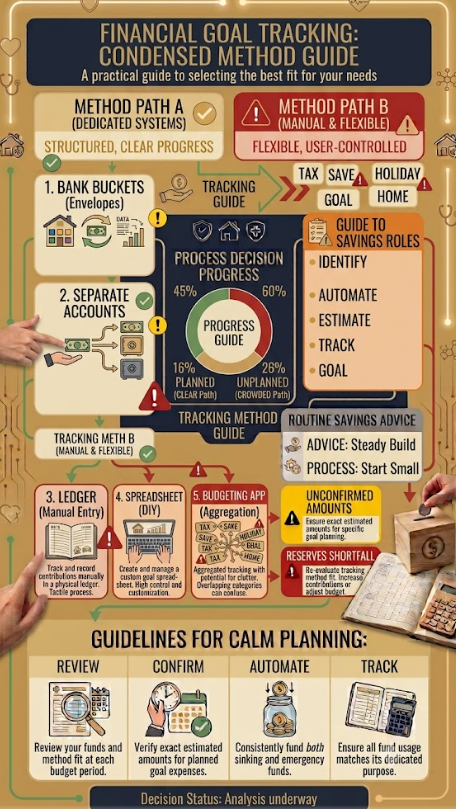
Tracking Is an Assignment System, Not Extra Money
Suppose one savings account contains $4,200. You have mentally reserved $1,500 for insurance, $1,200 for travel, $900 for vehicle maintenance, and $600 for school costs. Those assignments total $4,200, so the plan reconciles.
The labels do not create four additional pools of money. They explain the job of the same $4,200.
This distinction matters because a banking screen may show only the account balance. If you see $4,200 and spend $1,800 on travel without checking the assignments, you have not merely used “available savings.” You have used $600 that belonged to other goals.
The Consumer Financial Protection Bureau’s savings tools encourage people to name goals, assign target amounts and dates, and calculate what they need to save. CFPB does not require a particular sinking-fund tool. EverydayWise uses sinking fund as a practical term for money assigned to a planned expense; it is not presented here as a regulated financial product or an official CFPB category.
Every tracking method should preserve the same basic equation:
Actual cash = assigned goal balances + deliberately unassigned savings
If assigned balances total more than actual cash, the system is double-counting. If they total less, the difference should be identified as unassigned cash, interest awaiting allocation, or a correction—not ignored.
Compare the Five Main Tracking Methods
| Method | Best for | Main strength | Main trade-off |
|---|---|---|---|
| One account plus a ledger | A few goals and regular manual review | Simple banking structure | Requires accurate updates and reconciliation |
| Bank buckets or subaccounts | People who want visible labels without many institutions | Boundaries inside one banking interface | Features and rules vary by provider |
| Separate savings accounts | Goals needing strong separation | Each account balance has one clear job | More accounts, conditions, and transfers to manage |
| Spreadsheet | People who want customization and forecasting | Flexible calculations and history | Manual maintenance and formula risk |
| Budgeting or savings app | People who value automation and consolidated views | Convenient syncing and reminders | Data access, subscription, and classification concerns |
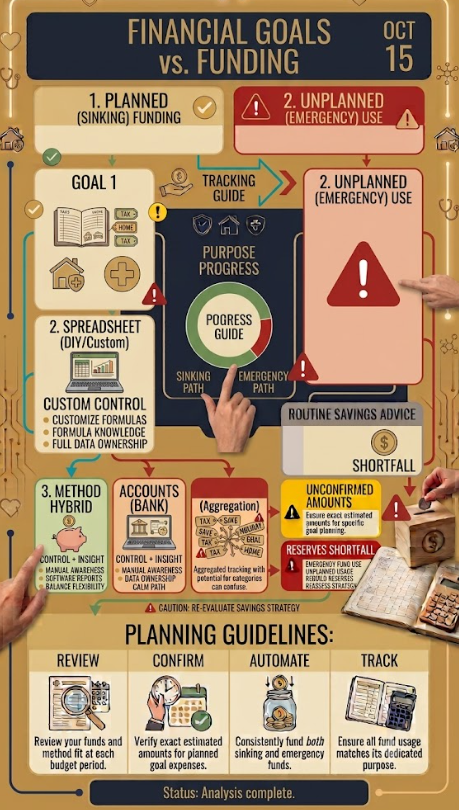
The table is a starting point. A household can also use a hybrid—for example, one insured savings account for the cash and a spreadsheet for assignments. The cash-holding location and the tracking interface do not have to be the same thing.
Option 1: One Savings Account Plus a Ledger
This is the leanest structure. All planned savings stays in one account, while a notebook, note, or simple table records the amount assigned to each goal.
A useful ledger needs only a few fields:
- goal name;
- current assigned balance;
- target amount;
- due date;
- planned contribution; and
- last update date.
This method works well when the number of active goals is manageable and you consistently record deposits, withdrawals, transfers between goals, and interest. It can also reduce the risk of opening several accounts with separate conditions.
Its weakness is that the bank balance does not enforce the assignments. The system depends on your record being current. If you withdraw $500 for a repair but forget to reduce the vehicle category, the ledger overstates what remains.
Choose this method if you prefer a minimal banking setup and will reconcile it at least monthly and after every goal withdrawal. Avoid relying on memory alone. A named balance written somewhere durable is safer than an informal promise to “remember what the money is for.”
Option 2: Bank Buckets or Subaccounts
Some banks and credit unions let customers label portions of savings as goals, buckets, vaults, or subaccounts. The exact structure varies: a label may be only a visual allocation inside one account, or each subaccount may have separate account details.
The appeal is immediate visibility. You can open one interface and see that the insurance, travel, and repair goals have different balances. This can reduce manual arithmetic and make it harder to mistake the full balance for spendable money.
Before relying on the feature, confirm:
- whether buckets are bookkeeping labels or separate legal accounts;
- whether each has an account number;
- how interest is credited;
- whether transfers are immediate;
- whether any withdrawal or transaction limits apply;
- what happens if the feature changes or the account closes; and
- whether you can export or reconstruct the assignments.
Do not assume the marketing name explains the legal or insurance treatment. Read the provider’s account agreement and deposit disclosures. The CFPB advises comparing account services, fees, minimum-balance requirements, and access features before opening an account.
Buckets are a strong default when your institution offers them without unwanted costs and the labels are visible enough to guide decisions. Keep a short backup list of goal balances or targets in case the interface becomes unavailable or you change institutions.
Option 3: Separate Savings Accounts
Separate accounts create the clearest boundary: one account balance can equal one goal balance. This may be useful for a large annual premium, a major trip, a move, or another goal that is easily raided when mixed with other savings.
Separation can also help two people coordinate. “The insurance account is fully funded” may be easier to verify than several assignments inside a shared total.
But every additional account can add work. Review maintenance fees, minimum balances, transfer timing, withdrawal rules, interest rates, statement delivery, inactivity policies, and whether account alerts are available. A system intended to protect savings should not quietly lose money to avoidable fees.
In the United States, opening several accounts at the same FDIC-insured bank does not automatically provide a separate insurance limit for each account. The FDIC generally adds deposits held by the same depositor in the same ownership category at the same insured bank. Credit-union coverage follows its own NCUA rules. Readers outside the United States should verify the deposit-protection system that applies where they live.
Use separate accounts selectively. Strong separation is valuable when it changes behavior or protects a consequential deadline. It is less useful when five small accounts create five statements and transfers without improving a decision.
Option 4: A Spreadsheet
A spreadsheet can combine several goals held in one or more accounts. It is especially useful when you want to forecast progress, test contribution changes, or record recurring bills with different due dates.
A practical sheet might include:
- goal and status: active, paused, or closed;
- actual account holding the cash;
- current assigned balance;
- target amount and target date;
- remaining amount;
- planned monthly contribution;
- next review date; and
- notes about withdrawals or changed estimates.
Spreadsheets make assumptions visible. If a $1,200 bill is due in six months and nothing has been saved, the sheet can show the $200 monthly contribution needed for that first cycle. It can also show whether all planned contributions fit your cash flow.
The risk is silent error. A broken formula, omitted transaction, duplicate row, or accidental overwrite can make a detailed sheet look more precise than it is. Keep formulas simple, distinguish inputs from calculated cells, protect important formulas if the software permits it, and compare assigned totals with real account balances.
Privacy also matters. Store the sheet in a location appropriate for financial information, use account nicknames rather than full account numbers, restrict sharing, and enable the security features available for the account or device. The goal tracker usually does not need login credentials, Social Security numbers, or other sensitive identifiers.
Choose a spreadsheet when its flexibility solves a real problem and you will maintain it. If opening the sheet feels like a monthly project, simplify it or move to a lower-effort view.
Option 5: A Budgeting or Savings App
An app can display balances, import transactions, categorize transfers, send reminders, and let more than one person view the plan. That can reduce manual work, particularly when savings is spread across institutions.
Automation does not remove the need for judgment. A transfer into savings may be classified incorrectly. A withdrawal may appear twice during synchronization. A renamed account can break a rule. The bank or credit-union statement remains the primary record of actual cash; the app is a tracking layer.
Before connecting an app, ask:
- What account and transaction data will it access?
- Does it require your banking credentials, or does the institution authorize access another way?
- What will the provider use the data for?
- Can you revoke access and request deletion?
- Is multifactor authentication available?
- Can you export your categories and history?
- What happens to your data if you cancel a subscription?
- Does the cost provide enough value to justify another recurring bill?
CFPB guidance notes that deleting an app from a phone may not end its access to financial data. If you stop using a service, revoke the authorization where possible and request deletion of data when appropriate. Continue reviewing statements for errors or unauthorized transactions.
An app is best when automation materially improves consistency and you are comfortable with the access, privacy terms, cost, and recovery process. It is not automatically superior because it has more charts.
How to Choose the Right Method
Choose stronger separation when the boundary changes behavior
If you repeatedly spend insurance money on travel, a separate bucket or account may be more useful than a ledger line. The extra structure has decision value.
Choose lower maintenance when updates are being skipped
A customized spreadsheet that is two months out of date is less reliable than three bank buckets you actually review. Choose the method you can sustain during a busy month.
Choose a shared view when more than one person decides
Partners do not need identical financial habits, but both should be able to identify what is funded and what is safe to spend. Agree on naming, update responsibility, and how reallocations are approved.
Choose less data sharing when automation adds little value
If a basic ledger provides the information you need, linking another service may offer limited benefit. If consolidation prevents missed updates across several accounts, the trade-off may be worthwhile after reviewing the provider’s terms and security controls.
Choose a hybrid when cash storage and planning need different tools
You might keep all planned savings in one insured account, use bank buckets for three major goals, and maintain a simple spreadsheet for annual forecasts. A hybrid is useful only if each layer has a clear job. Do not create two competing records that both claim to be authoritative.
Build a Tracking System That Reconciles
Use this seven-step setup:
- List active goals. Record each purpose, target amount, deadline, and current assignment.
- Identify where the cash is held. Separate the actual account from the tool used to label it.
- Choose one authoritative assignment record. Decide whether that is the bank’s buckets, a ledger, a spreadsheet, or an app.
- Enter the opening balances. Add the goal balances and compare them with actual cash.
- Document contribution and withdrawal rules. Record how deposits, spending, interest, and reallocations change the categories.
- Set a review rhythm. Review after a withdrawal and at least monthly; check targets after major price or date changes.
- Test recovery. Make sure you could reconstruct the plan if you lost access to the interface or changed providers.

During each review, verify two totals:
Assigned balances + unassigned savings = actual savings cash
Planned monthly contributions ≤ amount cash flow can reliably support
The first protects accuracy. The second protects affordability. A system can reconcile perfectly and still promise more each month than the household can contribute.
Common Tracking Mistakes
Treating the account balance as available to one goal. Check assignments before spending.
Updating contributions but not withdrawals. A category must decrease when money is used.
Maintaining two authoritative records. If the app and spreadsheet disagree, define which one controls and reconcile the other.
Ignoring fees and account conditions. Extra accounts are not free if they trigger charges or minimum-balance problems.
Assuming more detail means more accuracy. Ten categories with stale balances are less useful than four current ones.
Giving an app permanent access by accident. Review connected services and revoke access you no longer need.
Forgetting interest. Assign interest deliberately or record it as unassigned savings so totals continue to match.
Decision Summary
Use one account plus a ledger when you want minimal banking complexity and will reconcile manually. Use bank buckets when labels inside your existing account provide enough separation. Use separate accounts when a firm boundary protects an important goal and the account terms are acceptable. Use a spreadsheet when customization and forecasting justify maintenance. Use an app when automation and shared visibility justify its cost and data access.
The best tracking system is not the one with the most features. It is the one you can keep accurate, understand quickly, share appropriately, and reconstruct when something changes.
FA Q
Do I need a separate bank account for every savings goal?
No. One account can hold several goals if an accurate ledger, bucket system, spreadsheet, or app shows each assignment and the assignments reconcile with actual cash.
Are bank savings buckets the same as separate accounts?
Not always. Some are labels inside one account; others may be separate subaccounts. Check the provider’s disclosures, account numbers, fees, transfer rules, and deposit-protection treatment.
How often should I update my savings tracker?
Update it after contributions, withdrawals, and reallocations. A monthly reconciliation is a practical minimum for many households, but review more often when transactions are frequent or a deadline is near.
What if my categories do not equal my savings balance?
Find the difference before relying on the categories. Check for unrecorded interest, withdrawals, transfers, duplicate assignments, pending transactions, or deliberately unassigned cash.
Is a spreadsheet safer than linking a budgeting app?
It shares less data with an external financial service if kept locally or in a carefully secured account, but it still has privacy, device-security, backup, and sharing risks. Compare the actual controls and your behavior rather than assuming either format is risk-free.
Should I track my emergency fund in the same system?
You may display it in the same dashboard, but keep its purpose and assigned balance distinct from planned expenses. The previous cluster article explains how emergency and sinking funds serve different jobs.
Can two people manage the same savings goals?
Yes. Choose a shared view, name one authoritative record, agree who updates it, and document when money can be reallocated. Clear responsibility matters more than the particular tool.
This article provides general financial information, not individualized financial, tax, legal, insurance, cybersecurity, or investment advice. Account terms, deposit protection, privacy rights, and consumer protections vary by country and provider.
Sources
- CFPB – Your Money, Your Goals Toolkit
- CFPB – Building Your Savings? Start With Small Goals
- CFPB – Checklist for Opening a Bank or Credit Union Account
- CFPB – What to Consider When Sharing Your Financial Data
- FDIC – Understanding Deposit Insurance
- CFPB – Bank Accounts and Services
More in This Cluster: Sinking Funds and Planned Expenses
- What Is a Sinking Fund and Who Needs One?
- How to Create Sinking Funds for Annual Bills
- Emergency Fund vs. Sinking Fund: Key Differences
- How Many Sinking Funds Are Too Many?
- Best Ways to Track Multiple Savings Goals (you are here)
- How to Fund Holidays Without Credit Card Debt
- How to Plan for Car Repairs, School Costs, and Home Maintenance