Quick summary
The U.S. Department of Homeland Security has rescinded the 2022 public charge regulation. The change takes effect on September 18, 2026 and applies to adjustment-of-status applications postmarked or electronically submitted on or after that date, as well as applications for admission made on or after that date.
The new rule gives officers broader discretion to consider an applicant’s total circumstances, including required statutory factors, the applicant’s receipt of means-tested public benefits, and other relevant case-specific information. Receiving one benefit does not create an automatic denial. However, the precise implementation will depend heavily on USCIS guidance and revised forms that must be checked before filing.
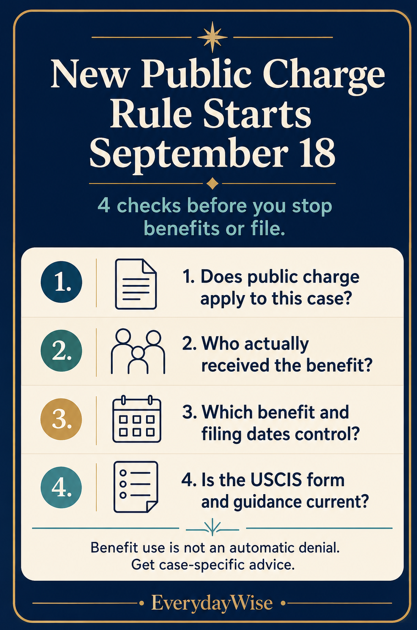
Do not stop health, food, housing, or other assistance solely because of a headline. First determine whether the public charge ground applies to the immigration category, who actually received the benefit, when it was received, and which filing date controls the case. Then obtain individualized immigration and benefits advice before changing coverage or filing strategy.
What changes on September 18?
The 2022 rule used regulatory definitions and a narrower framework. It generally focused benefit consideration on public cash assistance for income maintenance and long-term institutionalization at government expense.
The 2026 final rule removes most of that regulatory framework. DHS says officers will instead make individualized, fact-specific decisions based on the totality of the applicant’s circumstances. The law requires consideration of at least:
- age;
- health;
- family status;
- assets, resources, and financial status; and
- education and skills.
When required, an affidavit of support is also part of the analysis. Under the new framework, officers may consider the applicant’s receipt of means-tested public benefits, other relevant facts in the individual case, and empirical information relevant to self-sufficiency.
This is broader discretion, not a rule that everyone who uses Medicaid, SNAP, housing assistance, or another income-tested program must be denied. The final rule directs officers to weigh the whole record. Circumstances such as the type of benefit, amount, duration, recency, reason for receipt, and evidence of changed circumstances may matter under forthcoming implementation guidance.
The filing date creates two different tracks
The transition rule is unusually important.
| Situation | Governing approach |
|---|---|
| Adjustment application filed before September 18, 2026 | The 2022 public charge rule continues to govern that application. |
| Adjustment application postmarked or electronically submitted on or after September 18, 2026 | The new totality-of-circumstances framework applies. |
| Application for admission made on or after September 18, 2026 | The new framework applies. |
| Means-tested benefit received before September 18, 2026 | DHS says it will consider pre-effective-date receipt consistently with the 2022 rule. |
| Means-tested benefit received on or after September 18, 2026 | It may be considered under the new framework if the public charge ground applies. |
The agency also says USCIS will issue implementation guidance on or before the effective date. That means a person filing before September 18 should not assume an older form can be used indefinitely, while a person filing afterward should not rely on an unofficial checklist written before USCIS publishes its final instructions.
Does the rule apply to every applicant?
No. Public charge inadmissibility does not apply to every immigration benefit or every applicant. The controlling question is the immigration category and whether a statutory exemption or waiver applies. Refugees, asylees, certain humanitarian applicants, and some other categories may be exempt, but the exact result depends on the status sought and the legal basis for the application.
The final DHS rule directly governs applications for admission and adjustment of status. Consular visa processing involves the Department of State and should not be treated as identical to a USCIS Form I-485 case. Applicants abroad should follow the rules and instructions that govern their specific visa case.
Applicant benefits and family benefits are not the same
The new rule focuses on the person seeking admission or adjustment. DHS says a family member’s receipt of means-tested benefits should not simply be treated as benefits received by the applicant, and USCIS is not collecting household members’ benefit histories as though they belonged to the applicant.
That does not make the household completely irrelevant. If the record shows that a person the applicant is legally obligated to support qualified for assistance because the applicant’s income fell below a threshold, that financial fact may be considered when DHS evaluates the applicant’s assets, resources, and financial status. Benefits received by a family member may also matter if they are shown to be the applicant’s source of financial support.
The practical distinction is:
- not automatic attribution: a child’s or spouse’s benefit is not automatically counted as the applicant’s benefit; but
- possible financial relevance: facts revealed by that benefit may still bear on the applicant’s income, support obligations, or resources.
This is why a mixed-status family should not cancel a child’s health or food assistance based on a broad warning. The correct analysis requires the applicant’s category, the named recipient, the program, the dates, the household’s financial structure, and the new USCIS instructions.
What applicants should do now
1. Identify the exact immigration action
Confirm whether the person is applying for adjustment of status, admission, a consular visa, or another benefit. Then determine whether public charge inadmissibility applies or an exemption may control.
2. Preserve a benefit record
For each benefit, record the program name, recipient, approving agency, start and end dates, amount if available, and why the benefit was granted. Separate the applicant’s benefits from those received by a child, spouse, or other household member.
3. Confirm the controlling filing date
For Form I-485, retain proof of the postmark or electronic submission. A plan to file before September 18 is not the same as a completed filing, and an incomplete or rejected submission may not secure the expected treatment.
4. Recheck the official form and policy guidance
Immediately before filing, verify the accepted edition of Form I-485, its instructions, the USCIS Policy Manual, and any public charge alert. Do not copy answers from an older form or assume that a draft question is the final question.
5. Get advice before making an irreversible change
If benefit use, disability, long-term care, sponsorship, low income, or an uncertain exemption is involved, consult a qualified immigration lawyer or Department of Justice-accredited representative. Speak with the benefit agency or a qualified benefits counselor before ending assistance; reenrollment may not be immediate or guaranteed.
The decision to make now
The safest response is not “cancel every benefit” or “nothing has changed.” It is to classify the case accurately, separate the applicant’s record from the family’s record, preserve filing and benefit documents, and wait for the final USCIS implementation materials before treating any program as decisive.
For someone considering a September filing, timing may matter, but speed alone is not a strategy. Filing an incomplete case to reach an earlier date can create its own risk. Compare the two frameworks with qualified counsel, confirm that the application is ready, and use the official form edition accepted on the actual filing date.
Frequently asked questions
Does receiving Medicaid automatically cause a green card denial?
No. Under the new framework, an applicant’s receipt of a means-tested benefit may be considered as part of the total circumstances, but it is not an automatic denial by itself. The immigration category, timing, program, reason for receipt, and the rest of the applicant’s record matter.
Should my family stop SNAP or housing assistance now?
Not solely because of this rule. Determine who receives the benefit and whether public charge applies to the applicant. Ending assistance can harm the household and may not improve the immigration case. Obtain individualized immigration and benefits advice first.
Will the new rule apply if I file Form I-485 before September 18, 2026?
DHS says the new rule applies to adjustment applications postmarked or electronically submitted on or after September 18. Applications filed before that date remain under the 2022 rule, but applicants should confirm filing acceptance and current form requirements.
Can my child’s benefits be counted as my benefits?
DHS says a family member’s benefit receipt is not automatically attributed to the applicant. Related financial facts may still be relevant if, for example, the benefit reflects the applicant’s income or provides the applicant’s financial support.
Are refugees and asylees covered by the public charge ground?
They are generally among the categories exempt from public charge inadmissibility, but the status being requested and the statutory basis matter. Confirm the exemption for the specific filing rather than relying on a general label.
Is the revised Form I-485 available yet?
The final rule anticipates form and guidance changes, but applicants must check the USCIS Form I-485 page immediately before filing for the currently accepted edition and instructions. Do not rely on a draft form or an earlier downloaded copy.
Sources
- Federal Register / GovInfo – Public Charge Ground of Inadmissibility Final Rule
- USCIS – USCIS Rescinds 2022 Public Charge Regulation
- USCIS – Form I-485, Application to Register Permanent Residence or Adjust Status
- USCIS Policy Manual – Public Charge Ground of Inadmissibility
This article provides general educational information, not legal, immigration, medical, or public-benefits advice. Public charge rules, form editions, exemptions, and agency guidance can change. Do not stop benefits or file an immigration application based only on this article. Confirm current instructions with USCIS and obtain advice from a qualified immigration lawyer or DOJ-accredited representative and, when relevant, a qualified benefits counselor.