Quick summary
U.S. employers had an estimated 7.359 million job openings on the last business day of June 2026, according to the Bureau of Labor Statistics. During June, employers made about 5.348 million hires, workers initiated about 3.232 million quits, and employers reported about 1.766 million layoffs and discharges. BLS described all four measures as unchanged or little changed after accounting for statistical uncertainty.
That combination does not say the job market is either booming or collapsing. Openings show positions employers say they are actively recruiting for; hires show how many people actually entered payrolls; quits indicate workers’ willingness or ability to leave; and layoffs show involuntary separations. A high national openings total is not a personal job offer, while a stable layoff rate does not guarantee that every industry, employer, or occupation is safe.
For most people who can remain in their current job, the prudent response is not to resign because of one national headline. Test the market while employed, measure your own application-to-interview and interview-to-offer results, compare demand in your industry and location, and calculate how long your cash would last without income. If the job is unsafe or seriously harming your health, the decision may require a different timetable and outside support.
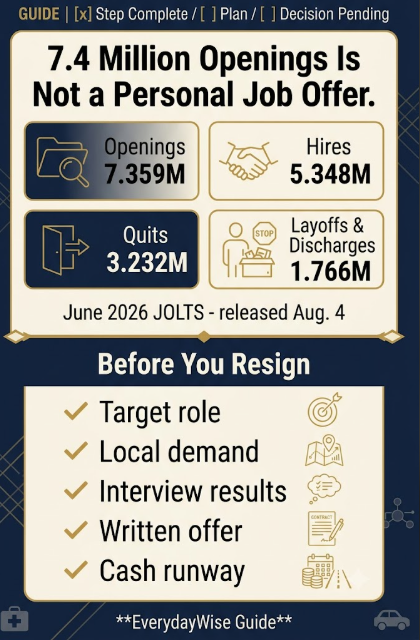
What the June JOLTS report actually found
The August 4 Job Openings and Labor Turnover Survey, or JOLTS, covers June 2026. BLS reported:
| Measure | June 2026 level | June rate | What it measures |
|---|---|---|---|
| Job openings | 7.359 million | 4.4% | Positions open on the last business day of June that employers were actively recruiting to fill |
| Hires | 5.348 million | 3.4% | Additions to payroll during the entire month |
| Quits | 3.232 million | 2.0% | Voluntary separations initiated by workers during the month |
| Layoffs and discharges | 1.766 million | 1.1% | Involuntary separations initiated by employers during the month |
The openings estimate fell by 178,000 from May, while hires rose by 96,000, quits rose by 79,000, and layoffs and discharges rose by 5,000. Those raw differences can make dramatic headlines. BLS nevertheless classified the national changes as statistically insignificant. In other words, the survey did not establish a meaningful month-to-month change at the national level.
May’s estimates were also revised after additional employer reports arrived and seasonal factors were recalculated. May openings were revised down by 57,000 to 7.537 million; hires were revised up by 82,000 to 5.252 million. This is one reason not to build an irreversible career decision around the first version of one monthly number.
Four numbers, four different questions
The most useful way to read JOLTS is to resist turning every measure into a synonym for “jobs available.”
Openings show stated demand, not your chance of being hired
An opening counts when a position exists, work could start within 30 days, and the employer is actively recruiting outside the establishment. It does not tell you how many applicants are competing, whether the listing matches your occupation or location, how quickly the employer intends to decide, or whether you meet its requirements.
The 7.359 million total spans the entire nonfarm economy. It includes jobs that may be irrelevant to your field, seniority, work authorization, pay needs, schedule, or commuting range. It should be treated as a broad demand indicator, not as 7.359 million interchangeable opportunities.
Hires show completed matches
The 5.348 million hires measure is closer to actual movement because it counts people added to payroll. Even so, it includes people hired from unemployment, people changing jobs, seasonal workers, rehires, transfers from other locations, and other additions. It does not reveal whether a particular applicant can quickly replace their salary and benefits.
When openings remain higher than hires, several explanations are possible: recruiting takes time, employers and applicants may not agree on pay or location, the needed skills may be scarce, or openings may be concentrated in different places and occupations from available workers. JOLTS alone cannot tell you which explanation controls your search.
Quits show voluntary movement, not a recommendation to quit
BLS says the quits rate can serve as a measure of workers’ willingness or ability to leave jobs. June’s quits rate held at 2.0 percent nationally. That suggests no statistically clear national shift in voluntary departures from May.
But people quit for many reasons: a new job, retirement, caregiving, relocation, education, dissatisfaction, or leaving work entirely. The quits figure does not say how many people had another offer, received higher pay, or later regretted leaving. It is a market signal, not evidence that quitting without a plan is safe.
Layoffs show employer-initiated exits
Layoffs and discharges remained at a 1.1 percent rate. That is relevant because it does not show a sudden national wave of involuntary separations in June. It still cannot protect an individual worker from a company restructuring, contract loss, plant closure, funding change, or weak occupation-specific demand.
The practical reading is balanced: employers were not broadly accelerating layoffs, but neither were hires surging enough to make a job search automatically easy.
Your industry can look different from the national total
The June report contained statistically significant industry movements even though the national opening count was little changed. Openings increased by 97,000 in transportation, warehousing, and utilities and by 39,000 in the federal government. They decreased by 74,000 in wholesale trade, 55,000 in nondurable-goods manufacturing, and 9,000 in mining and logging.
These changes are useful warnings against treating the national total as a local hiring map. They are not, by themselves, instructions to enter or leave an industry. A broad industry includes many occupations, employers, locations, and experience levels. Rising openings may reflect expansion, turnover, difficult-to-fill roles, or temporary demand. Falling openings may still leave strong demand for specialized skills.
Before resigning, narrow the evidence in this order:
- Occupation: Are employers seeking your actual role and level, not merely hiring somewhere in your industry?
- Location: Are the jobs within your commuting range, available remotely, or worth relocating for?
- Requirements: Do you meet the experience, license, education, security-clearance, portfolio, or work-authorization conditions?
- Compensation: Do posted pay, health coverage, leave, schedule, and retirement benefits meet your minimum?
- Hiring behavior: Are employers interviewing and making offers, or are you mainly seeing reposted listings and long delays?
Job boards help identify possible demand, but your own verified interview activity is stronger evidence for your decision.
Should you delay quitting?
For a worker with a tolerable current job and no signed offer, the June JOLTS data generally support testing the market before resigning, not rushing out and not abandoning a search. The national data describe a labor market with millions of openings, ongoing hiring, stable quits, and no sharp rise in layoffs—but also one where openings do not convert automatically into offers.
Delay a voluntary resignation long enough to gather better evidence when:
- you have submitted many tailored applications but received few interviews;
- interview processes repeatedly stall before a final round;
- your target roles require a location, credential, or pay level that greatly narrows the pool;
- your savings would cover only a short income gap;
- health insurance, immigration status, housing, tuition, or caregiving depends on uninterrupted employment; or
- you are relying mainly on national headlines rather than actual employer responses.
Quitting may be more reasonable when you have a written offer with major conditions resolved, enough cash for a realistic delay, a planned career break with funded costs, or a situation where staying creates serious health or safety harm. Even a written offer deserves review: start date, background check, licensing, references, financing, and other contingencies can matter.
This is not a rule that everyone must remain employed until the next job begins. It is a way to separate a reversible search decision from an irreversible loss of income.
Build a personal hiring dashboard
National data become more useful when paired with a small record of your own search. Track the last four to eight weeks rather than judging the market from one application or one unusually fast response.
Record:
- suitable roles found, excluding obvious mismatches;
- applications submitted after tailoring;
- recruiter screens or first interviews;
- later-stage interviews;
- offers received;
- days from application to first response;
- posted compensation and benefit quality; and
- reasons for rejection or withdrawal when known.
Two simple ratios can reveal where the problem lies:
- Interview conversion: first interviews divided by serious applications.
- Offer conversion: offers divided by completed interview processes.
There is no universal “good” ratio. Roles differ too much. Compare your recent results with your own earlier results and with feedback from credible people in your field. If suitable applications are producing interviews, the market may be workable even when national data look soft. If interviews are rare, resigning will not fix a résumé, skills, location, or targeting problem.
Calculate the cost of being wrong
Before giving notice, estimate the number of months your available cash can cover essential spending. Use cash that is genuinely available—not retirement funds, unused credit limits, or money reserved for taxes.
Start with:
- housing and utilities;
- food and transportation;
- health insurance and medical costs;
- minimum debt payments;
- childcare or other essential care;
- job-search and possible relocation costs; and
- taxes or benefit changes caused by leaving.
Then divide available transition cash by monthly essential expenses. This produces a planning estimate, not a guarantee. A search can last longer than expected, an offer can be delayed, and replacing employer health coverage may cost more than anticipated.
If the result is uncomfortably short, the choice is not limited to “quit now” or “give up.” You may be able to reduce expenses, build a larger buffer, search more selectively, complete a credential, ask for a schedule change, use leave, or pursue internal roles while keeping income.
Do not wait for one more report to make every decision
BLS is scheduled to release the July Employment Situation on August 7 at 8:30 a.m. Eastern Time. That report will provide newer information on payroll employment, unemployment, labor-force participation, and earnings. It may strengthen or weaken the current interpretation, and earlier payroll estimates can be revised.
However, it will still be a national report. A better payroll number will not turn an unsuitable posting into a good job, and a weak number will not erase a real written offer. If you can wait two days before making a non-urgent decision, reviewing the report is reasonable. If your decision rests on a confirmed offer, personal safety, health, or a firm deadline, the relevant facts may matter more than the national release.
A five-step decision plan before resigning
1. Define the role you would actually accept
Write down the occupation, level, location, minimum total compensation, schedule, and non-negotiable benefits. Count only openings that meet most of those conditions.
2. Test demand while employed
Run a focused search long enough to observe real responses. Tailor applications, speak with recruiters and people in the field, and distinguish interviews from automated acknowledgements.
3. Diagnose the search funnel
If applications do not become interviews, improve targeting, résumé evidence, portfolio, credentials, or referrals. If interviews do not become offers, review interview performance, references, compensation expectations, and role fit.
4. Price the transition
Calculate essential monthly costs and a cash runway. Include lost benefits and a delayed start. Decide in advance what would make the financial risk acceptable.
5. Set a resignation trigger
Examples include a signed offer with contingencies cleared, a target cash buffer plus evidence of active demand, or a documented health-and-safety exit plan. A clear trigger prevents a single bad day or optimistic headline from making the decision for you.
The bottom line
The June JOLTS report does not deliver a national “quit” or “stay” signal. It shows a market where openings, hires, quits, and layoffs were all broadly stable within the survey’s statistical limits, while some industries moved in different directions.
If your current job is manageable, use that stability to test the market before surrendering income and benefits. Let your target-role availability, interview conversion, offer quality, financial runway, and personal circumstances carry more weight than the 7.4 million headline. If staying is unsafe or medically harmful, prioritize an exit plan and appropriate professional support rather than waiting for national data to validate your experience.
FAQ
Does 7.4 million job openings mean it should be easy to find work?
No. The estimate covers the entire nonfarm economy and does not account for your occupation, location, qualifications, pay needs, or competition. Openings are active recruiting positions, not guaranteed hires.
Did job openings fall in June?
The preliminary estimate fell by 178,000 to 7.359 million, but BLS described the change as statistically insignificant. It is accurate to report the estimate and also explain that the survey did not establish a meaningful national decline.
Are employers hiring fewer people than there are openings?
Yes, the June estimates show 7.359 million openings at month-end and 5.348 million hires during the month. The measures cover different time concepts, so they should not be subtracted as though every unfilled opening failed during June.
Does a stable quits rate mean workers feel confident?
Quits can indicate workers’ willingness or ability to leave, but the rate does not reveal every person’s reason or whether a new job was secured. Treat it as a broad signal, not a personal confidence score.
Should I wait for the August 7 jobs report before giving notice?
If the decision is non-urgent and waiting is easy, the newer national data may add context. It should not replace reviewing a written offer, financial runway, benefits, safety, health, and evidence from your own job search.
Is it safe to quit after receiving a verbal offer?
A verbal offer can change. Review a written offer, start date, compensation, benefits, and unresolved contingencies before relying on it. Your risk tolerance and financial buffer still matter.
What if my job is harming my health or is unsafe?
National labor statistics should not force you to remain in dangerous conditions. Document concerns where appropriate, explore internal reporting, leave, accommodation, medical, legal, union, or safety resources, and build the safest feasible exit plan for your circumstances.
Sources
- U.S. Bureau of Labor Statistics – Job Openings and Labor Turnover Summary, June 2026
- U.S. Bureau of Labor Statistics – Job Openings by Industry and Region, June 2026
- U.S. Bureau of Labor Statistics – Hires by Industry and Region, June 2026
- U.S. Bureau of Labor Statistics – Quits by Industry and Region, June 2026
- U.S. Bureau of Labor Statistics – Layoffs and Discharges by Industry and Region, June 2026
- U.S. Bureau of Labor Statistics – August 2026 Release Calendar
This article provides general educational information, not individualized career, financial, legal, medical, immigration, or workplace-safety advice. Labor-market data are estimates and can be revised. Consider your own finances, benefits, contractual obligations, health, and safety before resigning.