A tub of salsa may not look like part of a fresh-pepper recall. Neither may a burrito, shrimp salad, roast beef sandwich, dip, or prepared turkey burger. That is what makes the current Salmonella recall easy to miss: some affected jalapenos were used as ingredients before the finished foods reached store shelves.
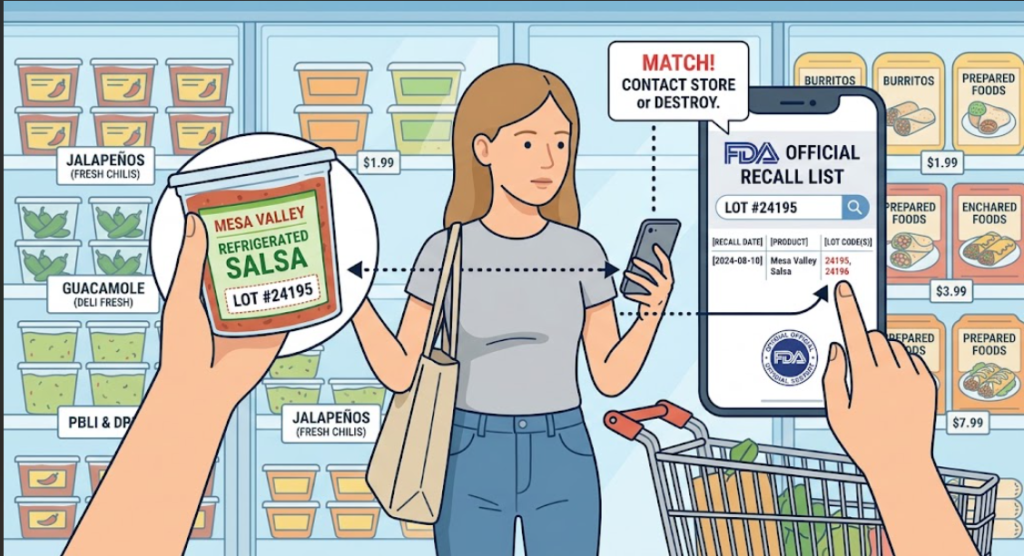
The recall does not cover every jalapeno or every jalapeno-containing food. The useful question is whether a product in your refrigerator or freezer matches the store, product name, identifying code, date, and distribution area in an official recall notice.
What to do now: Check recent purchases from the affected retailers, compare every available label detail with the live FDA or FSIS list, and do not eat a matching product. Throw it away or return it as the notice directs. Then wash items and surfaces it may have touched. If you develop severe symptoms, contact a healthcare provider.
Why It Matters
As of August 13, 2026, CDC and FDA report 345 illnesses across 27 states, including 36 hospitalizations and no deaths, in a Salmonella outbreak linked to jalapenos grown in Sinaloa, Mexico, and distributed by Coast Citrus Distributors. The investigation remains ongoing.
The first distribution was largely to restaurants and wholesalers. Downstream actions now cover whole peppers and finished foods, including burritos, bowls, dips, guacamole, sandwiches, salsa, salads, and wraps. On August 12, Whole Foods announced an additional recall of select products from its Produce and Prepared Foods departments.
Some date ranges continue through August 16. A product may therefore still be in a refrigerator, while an older product may remain in a freezer after its printed date has passed.
Key Verified Facts
- The outbreak count remains 345 illnesses, 36 hospitalizations, and 0 deaths in 27 states. The latest reported illness onset is July 20, 2026.
- The implicated fresh jalapenos were grown in Sinaloa, Mexico, and distributed by Coast Citrus Distributors.
- Taylor Fresh Foods recalled multiple branded and unbranded finished foods distributed through Hannaford, Kroger, Stop & Shop, Target, Trader Joe’s, Walmart, and Whole Foods. Depending on the product, “Best If Used By” dates extend through August 16, 2026.
- CDC’s combined consumer notice also names Albertsons, H-E-B, RaceTrac, Randalls, Tom Thumb, and Wawa among stores receiving recalled foods. Meat and poultry items may appear on the separate USDA Food Safety and Inspection Service alert rather than only on the FDA table.
- Whole Foods’ August 12 announcement covers select online, Produce, and Prepared Foods products sold in Texas, Oklahoma, Louisiana, Arkansas, Wisconsin, Michigan, Illinois, Indiana, Iowa, Missouri, Kentucky, and Ohio. Its listed “Best Before/By” dates run from August 7 through August 16, depending on the item.
- FDA and CDC do not consider Chipotle or QDOBA a current ongoing risk in this outbreak after the companies removed the affected supply.
Which Products Should You Check?
Begin with food bought recently from a retailer named in the official notices. Do not rely on the word “jalapeno” being prominent on the front. The recalled range includes products in which the pepper may be a minor ingredient.
The examples below show why all identifying fields matter. This is not the complete recall list.
| Store | Brand | Product | UPC | Date range | Distributed to |
|---|---|---|---|---|---|
| Hannaford | None listed | Diced Jalapenos, 3.75 oz | 030223082712 | Aug. 7-14 | ME, NY |
| Kroger | Private Selection | Spicy Roast Beef Sandwich, 8.53 oz | 011110678171 | Aug. 7-12 | AL, AR, GA, LA, MS, SC, TN, TX |
| Target | Taylor Farms / unbranded | Taco Dip, 20 oz | 030223073581 | Aug. 12-13 | FL, OH, TX |
| Trader Joe’s | Trader Joe’s | Fiesta Style Salad with Shrimp, 11.11 oz | 000000818377 | Aug. 7-12 | TX |
| Walmart | Freshness Guaranteed | Mild Pico de Gallo, 10 oz | 681131276344 | Aug. 8-16 | FL, IL, LA, MN, NE, OK, TX, WI |
| Whole Foods | None listed | Salsa Fresca Medium, 12 oz | 030223075080 | Aug. 7-16 | IL, TX |
Taylor Fresh Foods’ FDA notice contains the complete table for that recall, including additional Hannaford, Kroger, Stop & Shop, Target, Walmart, and Whole Foods products.
Whole Foods’ later announcement is a separate list. It uses product names and PLU codes rather than the UPC table above and includes numerous guacamoles, pico de gallo, salsas, dips, and prepared turkey-burger items. Check that list separately if you bought a Whole Foods Produce or Prepared Foods item, ordered one online, or discarded the outer packaging.
Meat or poultry products may be listed under the FSIS public health alert. For those items, compare the product name, establishment number, date, and distribution details on the FSIS product list.
A Five-Part Label Check
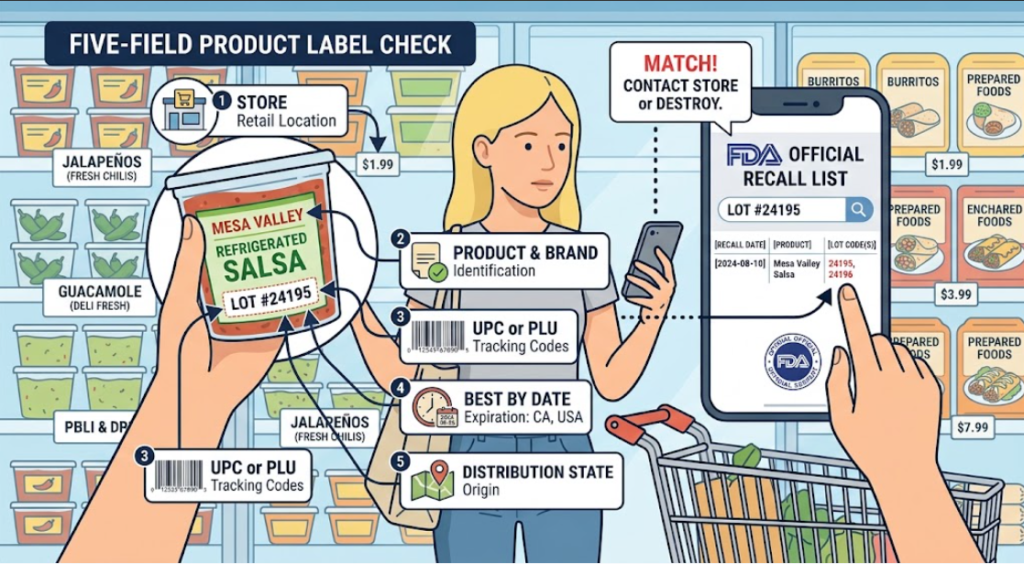
One matching detail is not enough. Use this order:
- Store: Where was the product bought or delivered?
- Product and brand: Match the full description, size, and brand. “None listed” or “unbranded” does not mean the item is exempt.
- UPC, PLU, or establishment number: Compare the code digit by digit. Whole Foods’ later recall uses PLU codes; FSIS items may use an establishment number.
- Date: Match the exact “Best If Used By,” “Best Before,” or “Best By” range stated for that product.
- Distribution area: Confirm that the product was sold or distributed in the listed state. Online Whole Foods purchases are included in the states named in its notice.
If all applicable fields match, do not taste the food to decide whether it is safe. Salmonella contamination cannot be identified reliably by appearance, smell, or flavor.
If the Package or Label Is Gone
A missing label makes a precise recall match harder, especially when refrigerated food has been transferred to another container or frozen.
Check the store receipt, digital receipt, loyalty account, delivery history, or credit-card date. Ask the retailer to identify the UPC or PLU connected with the purchase. A photo taken before freezing may also preserve the label and date.
For frozen fresh jalapenos from the implicated Sinaloa and Coast Citrus supply, FDA says recalled product should be discarded; the same applies when the receiving company cannot be identified. For an unlabeled finished food, the store, purchase date, product description, and official distribution area can still narrow the question. If it plausibly matches but cannot be verified, keep it separate from other food while contacting the retailer or discard it rather than serving it.
Throw It Away or Return It
Do not eat a product that matches an official list. Keep children, other adults, and pets from retrieving discarded food. Place it in a closed bag or container before putting it in the trash.
Taylor Fresh Foods says affected products may be returned to the place of purchase for a refund and lists its consumer line as 855-455-0098. Whole Foods says customers may discard affected products or bring a valid receipt to any Whole Foods Market store for a full refund; its consumer number is 1-844-936-8255.
A refund procedure does not require keeping contaminated food in the refrigerator. Photograph the label and product first if the store needs identifying information, then follow the retailer’s instructions.
Clean the Surfaces the Food Touched
Removing the food does not remove contamination that may have reached a shelf, drawer, container, cutting board, utensil, or countertop.
Wash affected items and surfaces with hot, soapy water or use a dishwasher where appropriate. FDA guidance then recommends sanitizing refrigerator walls and shelves, cutting boards, countertops, and utensils that may have contacted contaminated food. One stated option is a solution of one tablespoon of chlorine bleach to one gallon of hot water. Dry with a clean, previously unused cloth or paper towel, and wash your hands with soap and warm water after cleaning.
Never mix bleach with ammonia, vinegar, or other cleaners. Follow the product label, ventilate the area, and use a food-contact-surface sanitizer according to its directions if bleach is unsuitable for the material.
When to Contact a Healthcare Provider
Salmonella commonly causes diarrhea, fever, and stomach cramps. Symptoms usually begin 6 hours to 6 days after exposure, and most people recover in 4 to 7 days without specific treatment.
CDC advises calling a healthcare provider for severe symptoms, including:
- diarrhea with a fever above 102°F;
- diarrhea lasting more than 3 days without improvement;
- bloody diarrhea;
- vomiting that prevents you from keeping liquids down; or
- signs of dehydration, such as very little urination, a dry mouth or throat, or dizziness when standing.
Young children can become dehydrated quickly. Children under 5, adults 65 and older, and people with weakened immune systems are also more likely to develop severe illness. When speaking with a clinician, mention the recalled product or recent jalapeno-containing food, the purchase location, when it was eaten, and when symptoms began. Keep a photo of the label or receipt if available.
What Remains Uncertain
FDA is still determining the full distribution of the affected jalapenos and says the advisory will be updated as more information becomes available. The number of reported illnesses and the downstream product lists can change.
That uncertainty is a reason to use the live FDA, CDC, and FSIS pages immediately before deciding that a product is outside the recall. It is not a reason to discard every jalapeno product. A recall match depends on the specific identifiers in the applicable notice.
The Bottom Line
The current recall extends beyond loose peppers. Check salsa, guacamole, pico de gallo, dips, salads, sandwiches, burritos, bowls, wraps, and relevant prepared meat or poultry foods if they came from an affected retailer and date range.
The decision sequence is simple: store → product and brand → UPC, PLU, or establishment number → date → distribution area. A complete match means do not eat the product. Discard or return it, clean the surfaces it touched, and watch for symptoms. Recheck the live official lists because this investigation is ongoing.
Important Note
This newsletter provides general food-safety information, not individual medical advice. Contact a qualified healthcare provider about symptoms or personal risk, and seek urgent medical help when symptoms are severe or rapidly worsening.
Sources
- FDA — Outbreak Investigation of Salmonella: Jalapeno (August 2026)
- CDC — Salmonella Outbreak Linked to Jalapenos
- FDA — Taylor Fresh Foods Recall and Product Table
- FDA — Whole Foods Market Recall and Product List
- USDA FSIS — Public Health Alert for Meat and Poultry Products Containing Recalled Jalapenos
- FDA — Food Safety Tips During an Outbreak
- CDC — Symptoms of Salmonella Infection