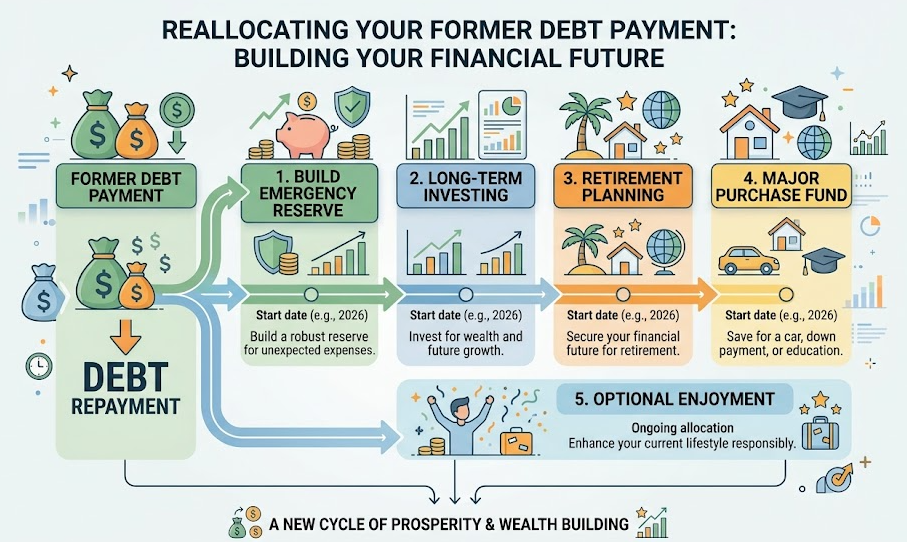
The final payment creates breathing room, but it also creates a new decision: what should the former debt payment do now?
Begin with orientation. First, confirm that the debt is actually finished and clean up the account. Next, protect the household from returning to debt. Then give the released payment several named jobs across near-term needs and long-term goals. The exact percentages can wait until those priorities are visible.
Debt freedom is not the absence of a plan. It is the point at which a repayment system can become a saving and investing system without requiring a new monthly sacrifice.
Quick decision: Keep the former payment active in the budget. For the first cycle, route it to a separate holding account while confirming payoff and account status. Then allocate it deliberately: repair any depleted emergency reserve, fund predictable irregular expenses, address near-term goals, review workplace benefits and other priority commitments, and direct the long-term portion according to timeframe, risk tolerance, tax rules, and local account options. Reserve a defined amount for enjoyment if desired, but do not let the entire payment disappear into ordinary spending.
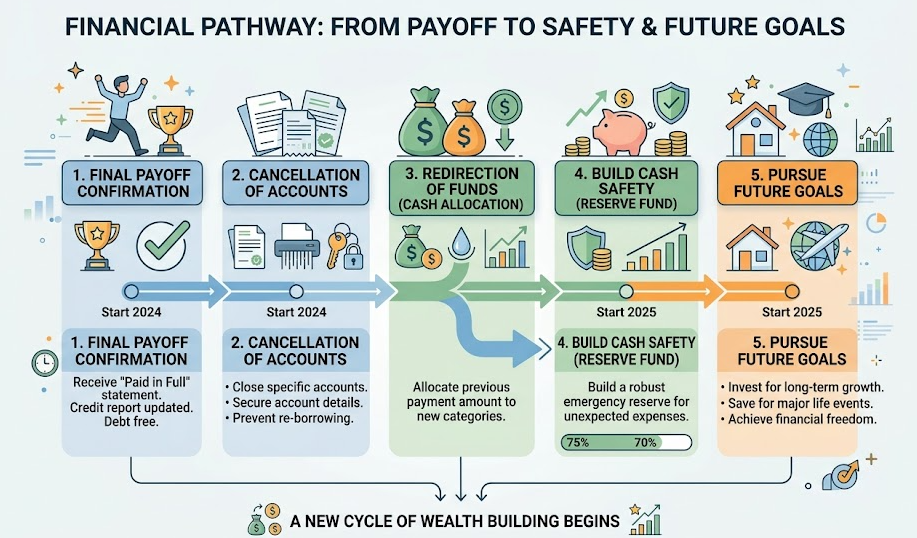
Confirm That “Paid Off” Means Finished
Do not rely only on a zero displayed in an app. Interest may have accrued between the last statement and payment, a pending transaction may post later, or a recurring charge may remain.
For each completed debt:
- request or retain the final payoff statement;
- confirm that the payment posted and the balance is zero;
- check for residual interest, fees, refunds, or credits;
- cancel any automatic debt payment only after confirmation;
- redirect recurring charges before closing a card;
- obtain written closure or lien-release documents when applicable; and
- store records securely.
If the debt was secured, ask what documentation shows that the lender’s interest has been discharged and whether a local registration must be updated. Rules, timing, and fees vary.
When closing a Canadian credit card, FCAC advises contacting the issuer, obtaining written confirmation, reviewing later statements for authorized or recurring transactions, and checking the credit report after allowing reporting time. Cutting up a card or letting it expire does not close the account.
Decide What Happens to Each Credit Account
Payoff and closure are separate decisions. Review every revolving account individually.
Possible actions include:
- close the account;
- keep it open with a lower limit;
- lock or freeze it;
- remove it from wallets and stored payment methods; or
- retain it for one defined use paid in full under a written rule.
Consider annual fees, insurance, rewards, account age, utilization, access to credit, spending behavior, and joint or authorized users. There is no universal instruction to close every card or keep every old account. FCAC suggests keeping only what can be managed responsibly and considering the effect of closing a long-held account.
If an account remains open, write its operating rule before the former payment is reassigned. “Use carefully” is vague. “One recurring utility, statement reviewed monthly, full statement balance automated from the bill account” is testable.
Review credit reports after enough time has passed for updates. A paid account may remain on the report; paid does not mean erased. Dispute inaccurate status through the applicable process, but do not pay a company promising to remove accurate history quickly.
Preserve the Payment Before Lifestyle Expands
The most valuable post-payoff asset may be the existing habit. The former payment already had a place in the budget. If it flows back into the chequing balance without instructions, ordinary spending may absorb it before a new plan begins.
On the same date the debt payment used to leave:
- send the same amount to a temporary transition account;
- keep the transfer for at least one normal budget cycle;
- verify that no old debt payment or residual charge remains;
- choose the permanent allocation; and
- replace the temporary transfer with named automatic transfers.
FCAC specifically identifies the end of a loan as an opportunity to redirect the former monthly payment to an emergency fund because the amount is already in the budget.
If the former payment was unusually aggressive and made the budget fragile, it need not remain intact forever. Test the new allocation against real cash flow. The principle is to make the release deliberate, not to impose permanent deprivation.
Rebuild the First Layer of Cash Safety
Debt payoff may have used most available cash. Before committing every released dollar to a distant goal, assess near-term resilience.
Separate two types of cash:
- Sinking funds for predictable but nonmonthly costs such as insurance, taxes, maintenance, school expenses, and annual subscriptions.
- Emergency savings for unplanned shocks such as urgent repairs, medical costs, or income interruption.
The target depends on income stability, household size, insurance, deductibles, essential expenses, available support, and other risks. Avoid copying a universal number without examining those factors.
CFPB describes emergency savings as a dedicated reserve for unplanned expenses and notes that even a small reserve can reduce reliance on cards or loans after a financial shock. Keep this money safe, accessible, and separate enough to discourage routine spending.
If a reserve was used during payoff, create a replenishment milestone. If it is already adequate, direct more of the former payment to other priorities rather than accumulating cash without a purpose.
Give Predictable Expenses Their Own Funding
Becoming consumer-debt-free does not make vehicle insurance, home maintenance, taxes, school costs, or annual fees disappear. Convert each known cost into a pay-period or monthly transfer.
For example:
Monthly sinking-fund amount = expected cost ÷ months until due
Use a separate label for each material expense or maintain one periodic-expense account with a detailed ledger. When the bill arrives, paying from that fund protects both emergency savings and the debt-free status.
This step may feel less exciting than investing, but it solves a common relapse mechanism: treating foreseeable costs as emergencies and borrowing for them again.
Jerome’s Experience: A Transition Point, Not an Invented Outcome
Jerome was able to clear his car financing when an investment-related lump sum became available. The car loan had a relatively higher rate and a smaller balance than his line of credit, making payoff feasible with that amount.
His account does not say what happened to the former car payment afterward. It does not describe saving, investing, spending, closing an account, or redirecting the payment. None of those outcomes should be inferred.
The experience belongs here only as a transition point: once a scheduled payment ends, money that previously had one required destination becomes available for a new instruction. The post-payoff plan must supply that instruction.
Fund Near-Term Goals on Their Own Time Horizon
List goals likely to require money within the next several years: a move, education, vehicle replacement, home repair, professional expense, family event, or other planned purchase.
For each goal, write:
- target amount;
- current amount;
- target date;
- required periodic contribution;
- priority relative to other goals; and
- acceptable flexibility in amount or date.
Money needed soon generally requires greater attention to principal stability and access than money intended for decades in the future. FCAC groups goals by short, medium, and long timeframes and says timeframe affects how a person saves or invests.
Do not use a volatile investment simply because its expected return appears higher if a near-term goal cannot tolerate a loss. Product selection belongs to a fuller saving or investing decision, including fees, risk, taxes, and local protections.
Review Benefits and Obligations Before Choosing Investments
Before opening a new account, check what already exists:
- workplace pension or retirement plan;
- employer contribution or matching rules;
- vesting and withdrawal conditions;
- government benefit eligibility;
- insurance needs;
- education or disability savings programs;
- tax-advantaged account eligibility and limits; and
- any remaining mortgage, business, family, tax, or other debt outside the completed payoff plan.
“Debt-free” may mean free of consumer debt rather than free of every liability. Define the milestone honestly. A remaining low-rate mortgage, for example, creates a different allocation decision than no debt at all.
Employer contributions can be valuable, but plan terms differ. Confirm eligibility, contribution requirements, limits, investment choices, fees, and withdrawal rules with authoritative documents. Do not assume every employer matches contributions or that every matched plan is immediately accessible.
Build a Long-Term Investing Bridge
Once near-term cash needs and benefits are understood, define the long-term goal before selecting products.
Write down:
- the purpose of the money;
- time horizon;
- contribution amount and frequency;
- capacity and willingness to accept losses;
- need for access;
- account tax treatment and contribution limits;
- investment costs;
- diversification approach; and
- review schedule.
FCAC recommends identifying and prioritizing goals, assigning amounts and timeframes, and reviewing them as circumstances change. This article stops at that bridge. It does not prescribe a security, fund, portfolio, tax strategy, or retirement contribution rate.
Automating the long-term portion can preserve the repayment habit. CFPB describes setting a goal, testing the plan, and then using automatic transfers to a savings or investment account. Automation still requires monitoring: confirm transfers, review fees and allocations, and update beneficiaries and contact information where relevant.
Include Enjoyment Without Losing the System
A debt-free milestone may deserve recognition. A planned celebration and permanent lifestyle expansion are different decisions.
Choose one of these structures:
- a fixed one-time amount funded after final confirmation;
- a small percentage of the first few released payments;
- a delayed reward after the emergency reserve reaches a milestone; or
- a recurring “life now” allocation within the permanent plan.
The amount should be paid from cash, not from reopened debt. Naming it in advance can reduce the urge to treat the entire former payment as unassigned money.
Avoid turning deprivation into the permanent identity of the plan. A sustainable system can support safety, future goals, and present enjoyment without allowing one category to silently consume the rest.
Write a Relapse-Prevention Rule
Debt can return through ordinary mechanisms: an annual bill, income disruption, a retained credit limit, a major repair, or spending that rises with available cash.
Create written rules for:
- when credit may be used;
- how card statements will be paid;
- minimum reserve levels;
- how sinking funds are replenished;
- what happens after an emergency withdrawal;
- which purchases require a waiting period;
- when new financing requires comparison or household discussion; and
- what triggers a return to a debt-payoff plan.
Review total debt and credit reports periodically, especially after account changes. Monitor identity-theft or reporting errors without obsessing over daily score movements.
Use a 30–90–365 Day Transition
First 30 Days
- confirm zero balances and payoff documents;
- handle residual transactions;
- decide each account’s status;
- move the former payment to the transition account;
- update the debt inventory; and
- choose a modest celebration, if desired.
By 90 Days
- establish permanent automatic transfers;
- restore sinking funds and the first cash-safety milestone;
- review credit-report updates;
- inventory workplace benefits and tax-advantaged options; and
- assign near-term goals.
By One Year
- compare planned and actual allocations;
- assess whether debt returned;
- review reserve adequacy and known annual costs;
- update goals, beneficiaries, insurance, and long-term contributions; and
- decide whether lifestyle spending changes are still affordable.

Decision Summary
- Confirm payoff before cancelling payments or closing accounts.
- Decide the future of each revolving account deliberately.
- Preserve the former payment in a transition account.
- Repair emergency savings and fund predictable expenses.
- Give near-term goals amounts and dates.
- Review workplace benefits and remaining obligations.
- Match long-term saving or investing to goal, timeframe, risk, access, taxes, and costs.
- Automate only after testing the allocation.
- Include enjoyment as a named choice.
- Write rules that prevent balances from returning.
- Review the transition at 30 days, 90 days, and one year.
The final debt payment closes one obligation. The next transfer opens a new system—one designed to keep more of tomorrow’s choices available.
This article provides general educational information, not individualized financial, legal, tax, credit, investment, insurance, or retirement advice. Account rules, taxes, benefits, consumer protections, and investment products vary by jurisdiction and personal circumstances.
FAQ
Should I close every credit card after paying off debt?
Not automatically. Review fees, account age, utilization, recurring charges, access needs, and spending behavior. Choose a clear close, reduce, freeze, or limited-use rule for each account.
What should receive the former debt payment first?
Confirm the payoff, then assess depleted emergency savings and predictable expenses that could cause reborrowing. The remaining allocation depends on goals, benefits, and circumstances.
Can I start investing immediately after becoming debt-free?
You can evaluate it, but first identify the goal, timeframe, risk tolerance, liquidity needs, fees, tax rules, and nearer-term cash requirements. This article does not recommend a product.
How much should I keep in emergency savings?
There is no single amount for everyone. Consider essential expenses, income stability, household needs, deductibles, likely shocks, and available support, then set staged milestones.
Is it acceptable to celebrate paying off debt?
Yes, if the amount is planned and paid from available cash. A defined celebration can coexist with a durable post-debt allocation.
When should I check my credit report?
Allow the creditor and bureaus time to update, then verify the balance and account status. Reporting timelines and dispute procedures vary by jurisdiction.
What if I become indebted again after payoff?
Identify whether the cause was a shock, predictable expense, insufficient income, or discretionary reuse. Protect required payments, stop further borrowing where possible, restore the relevant fund, and rebuild a realistic repayment plan.
Sources
- FCAC – Cancelling Your Credit Card
- FCAC – Credit-Report Information Retention
- FCAC – Setting Up an Emergency Fund
- CFPB – Essential Guide to Building an Emergency Fund
- FCAC – Setting Savings and Investment Goals
- CFPB – Set a Goal, Make a Plan, and Save Automatically
More in This Cluster: Debt Payoff Strategies
- Debt Snowball vs Debt Avalanche
- How to Prioritize Multiple Debts
- Should You Save or Pay Off Debt First?
- How to Pay Off Credit Card Debt Without Losing Momentum
- Debt Consolidation: When It Helps and When It Does Not
- How to Build a Realistic Debt Payoff Timeline
- What to Do After You Become Debt-Free (you are here)