The first question is often, “How soon can I be debt-free?”
A more useful question is, “How much can I keep paying when the year does not go exactly as planned?”
A payoff date built from an unusually good month can create urgency, but not reliability. Income changes, rates move, annual bills arrive, and some debts allow new borrowing. A credible timeline begins with actual cash flow, protects required payments and foreseeable expenses, and shows a range of outcomes rather than pretending that one date is guaranteed.
Quick decision: Start with verified payoff balances, rates, minimums, and due dates. Calculate a repeatable extra-payment amount from several months of cash flow after essentials, required minimums, predictable irregular expenses, and a basic buffer. Build at least three scenarios: a base case using the repeatable amount, a conservative case for lower income or higher costs, and an accelerated case that uses only defined windfalls or durable savings. Record the assumptions beside each date and review the plan every statement cycle, after a rate change, and after any material cash-flow event.
A Timeline Is a Model, Not a Promise
A debt-payoff calculator turns inputs into an estimated date. It cannot know whether income will change, a variable rate will rise, a recurring balance will be reused, or an irregular expense was omitted.
Treat the result as a planning model with four visible parts:
- Starting facts: balances, rates, required payments, and account terms.
- Payment rule: the amount and frequency you intend to pay.
- Assumptions: future rates, no new borrowing, and treatment of fees or windfalls.
- Review trigger: the date or event that requires recalculation.
FCAC advises setting a reasonable and affordable schedule aligned with the monthly budget. It notes that shorter schedules generally mean higher payments and less interest, while longer schedules lower the payment but increase interest. The useful timeline is not automatically the shortest one. It is the shortest plan that can survive ordinary variation without missed obligations or immediate reborrowing.
Verify the Starting Point
Create one debt inventory. For each account, record:
- creditor and debt type;
- current balance and, when available, payoff amount;
- fixed, variable, or promotional rate;
- minimum or contractual payment;
- due date and payment frequency;
- remaining term for instalment debt;
- promotional expiry, renewal, or maturity date;
- fees, prepayment conditions, and penalties;
- whether additional amounts can be borrowed; and
- whether the debt is secured.
A displayed balance may not equal the amount required to close an account on a specific date. Accrued interest, fees, or prepayment terms can change the payoff amount. Use the creditor’s written payoff figure when an exact final payment is approaching.
Do not add uncertain debts into a calculator as if the figures were verified. Mark disputed, estimated, or missing information and resolve it separately.
Find the Repeatable Payment Capacity
Begin with several months of actual transactions rather than one ideal budget.
Repeatable extra capacity = reliable net income − essentials − required debt payments − planned irregular expenses − protected savings commitments
This is a planning equation, not a universal recommendation. What counts as essential or protected depends on the household and the consequences of nonpayment.
Use conservative income:
- For stable pay, use ordinary take-home pay, excluding occasional overtime unless it is durable.
- For variable income, begin with a cautious baseline drawn from multiple months or a relevant seasonal cycle.
- For bonuses, refunds, commissions, gifts, or asset sales, create a separate windfall rule instead of treating them as monthly income.
Then examine the remaining amount. If the calculated extra has appeared only once, it is not repeatable yet. A smaller amount sustained across ordinary months may produce a more reliable timeline than a large target that repeatedly collapses.
Convert Irregular Costs Into Monthly Amounts
Annual and seasonal expenses are not surprises simply because they do not occur every month.
List property or vehicle insurance, school costs, professional fees, taxes, winter tires, maintenance, gifts, travel commitments, and other known periodic expenses. For each item:
Monthly sinking-fund amount = expected cost ÷ months until due
FCAC distinguishes occasional expenses from emergencies and recommends planning occasional costs in the budget. Its budgeting guidance also suggests spreading a known expense over the months before it is due.
If a $1,200 insurance premium is due in 12 months, reserving $100 each month reduces the amount available for debt repayment—but it also prevents the premium from returning to a card or line of credit. Excluding it creates a faster-looking schedule that may fail when the bill arrives.
Use the best available estimate and update it when a renewal notice or invoice provides a better figure.
Build Three Scenarios
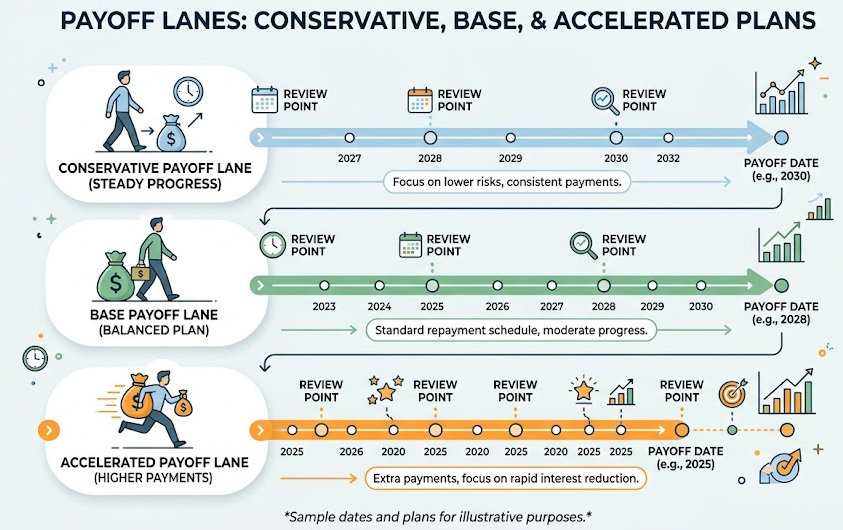
One date implies more certainty than the inputs deserve. Create three lanes instead.
1. Conservative Case
Use a lower but still credible extra payment. Include known periods of lower income, a modest expense overrun, or a reasonable variable-rate increase. This case answers: What might the payoff look like if conditions are less favorable but the plan remains intact?
2. Base Case
Use the repeatable extra amount supported by recent cash flow, current rates, and fully funded irregular expenses. This is the working plan—not the most optimistic result.
3. Accelerated Case
Add only defined resources: a fixed share of an expected bonus, a confirmed expense reduction, or a payment that rolls forward after another debt closes. Do not count an uncertain windfall at its maximum value.
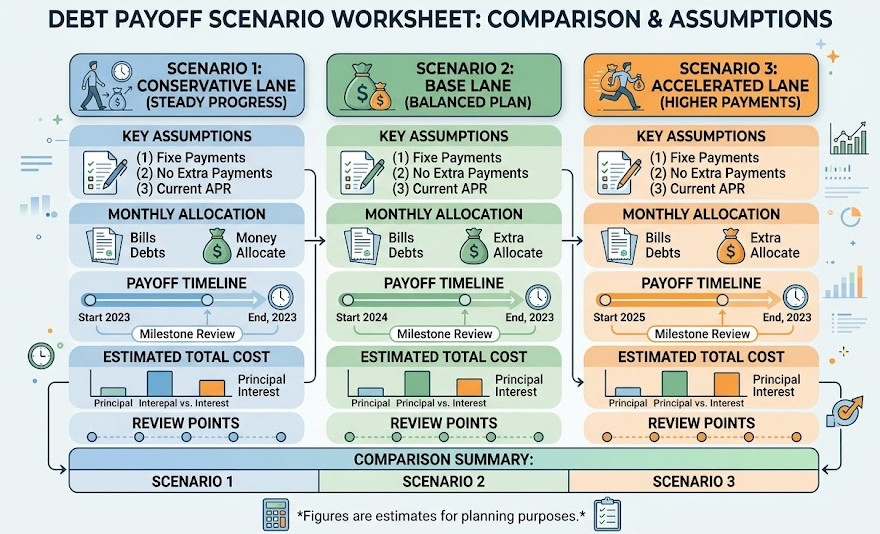
For every case, write down:
- monthly or pay-period payment;
- assumed rates;
- whether new borrowing is set to zero;
- windfall rule;
- target order;
- estimated payoff month or range;
- estimated interest or total payments, if the calculator supplies them; and
- next review date.
The scenarios are not three commitments. They show how sensitive the finish is to conditions you can and cannot control.
Model Rates Honestly
For fixed-rate instalment debt, use the contract rate and payment schedule while noting maturity, renewal, or prepayment terms. For variable-rate debt, do not assume today’s rate will persist for the entire payoff period.
Create at least one higher-rate scenario. Depending on the product, a rate increase may raise the payment, extend amortization, or direct more of the same payment to interest. Confirm how the account actually works.
FCAC advises leaving flexibility for interest-rate increases and notes that payments may rise when rates rise. For revolving debt, also verify whether the minimum changes with the balance or rate. A timeline that holds every future minimum constant may be misleading.
Promotional balances require two periods:
- the promotional rate through its exact expiry; and
- the rate that applies afterward.
If the accelerated case clears the balance before expiry but the base case does not, show both outcomes. Do not silently apply the promotional rate beyond its term.
Model Payment Timing and Debt Order
Pay all required minimums unless a creditor or qualified professional has agreed to another arrangement. Direct the planned extra payment according to the selected priority method.
When one debt closes, roll its former required payment into the next target unless the budget has a documented reason not to. This “payment roll-forward” can materially change later dates.
Use the payment frequency that matches cash flow:
- monthly after the primary income deposit;
- split across paydays; or
- minimums on due dates plus one scheduled extra.
Earlier payments may reduce interest sooner, but calculation and allocation rules vary. Use the creditor’s terms or calculator assumptions rather than assuming every product behaves identically.
If you are comparing snowball and avalanche methods, keep the same payment capacity in both models. Changing both the order and the amount makes the comparison difficult to interpret.
Jerome’s Experience: The Missing Line in the Timeline
Jerome described paying interest on a business line of credit without developing a consistent principal-payment habit. The required cost felt manageable, so principal reduction did not become a standing part of the monthly plan. When large home or vehicle insurance costs arrived during the year, the balance rose again after partial repayment.
No balance, rate, income, payment amount, or payoff date was provided, and none should be invented.
The planning lesson is precise: a timeline needs both a recurring principal-payment line and a separate line for predictable large expenses. Without the first, there is no reliable speed toward zero. Without the second, the model may count money for debt repayment that will later be needed for known bills.
Mark Milestones, Not Just the Final Date
A multi-year plan needs visible checkpoints. Useful milestones include:
- first three statement cycles completed as planned;
- first 10% of principal repaid;
- first account closed or paid in full;
- monthly interest below a chosen threshold;
- promotional balance cleared before expiry;
- variable-rate balance reduced before renewal; and
- halfway point based on principal, not elapsed time.
Add the milestone dates to the base case, but treat them as estimates. When a milestone is reached early or late, update the remaining schedule from the new balance rather than judging the entire plan as a success or failure.
Do not use available credit as the measure of progress. Track outstanding principal and total debt across all accounts.
Compare Planned and Actual Results Monthly
Once each statement cycle, record:
- planned payment;
- actual payment;
- interest and fees;
- new borrowing;
- ending balance;
- variance from the model; and
- reason for the variance.
Classify the reason:
- timing: a payment posted in another cycle;
- estimate: interest or a bill differed from the assumption;
- behavior: an optional purchase reduced the extra payment;
- capacity: income or necessary expenses changed; or
- structure: the rate, minimum, or product terms changed.
The response depends on the cause. A posting delay may need no plan change. A permanent income reduction does. Three months of repeated shortfalls are evidence that the base payment is too high, not a reason to keep copying the same number forward.

Know When to Recalculate
Recalculate the timeline when:
- a rate, minimum, fee, or promotional term changes;
- income changes materially;
- a new required expense appears;
- an annual bill differs substantially from its estimate;
- a balance is transferred, consolidated, settled, or refinanced;
- a windfall is actually received and applied;
- new borrowing occurs;
- a debt is paid off; or
- the actual result differs from the base case for several cycles.
Do not recalculate after every minor fluctuation. Set a regular monthly update and a deeper quarterly review. Constantly moving the final date can create noise; ignoring structural change creates false precision.
Keep prior versions. They show whether the assumptions improved and whether repeated schedule failures come from forecasting, insufficient capacity, or account reuse.
Build a Recovery Rule Before a Difficult Month
Write the setback sequence while the plan is stable:
- Protect essentials and urgent consequential obligations.
- Make required minimums where possible.
- Pause or reduce only the extra payment.
- Use the appropriate sinking fund or emergency reserve under its rule.
- Stop new discretionary borrowing.
- Contact creditors early if a required payment may be missed.
- Resume the base extra payment at the next feasible cycle.
- Recalculate only after the new cash flow is understood.
Do not compensate for one weak month with an unaffordable catch-up payment that causes overdraft or new debt. A realistic plan includes a route back into the schedule.
Recognize When a Self-Directed Timeline Does Not Work
The spreadsheet is not the problem if required payments exceed available cash, arrears are growing, essential services or secured assets are at risk, or the plan requires recurring borrowing.
Contact creditors and explain the amount that is realistically affordable. Ask about hardship or payment options and obtain terms in writing. Reputable credit counselling may help review the budget and debt options; formal insolvency processes require the appropriately licensed professional in the jurisdiction.
Avoid anyone who guarantees a rapid result without reviewing income, expenses, debt types, and legal context. A date is not credible merely because it is printed in a proposal.
Decision Summary
- Treat the payoff date as a model, not a guarantee.
- Verify balances, payoff amounts, rates, minimums, and terms.
- Base the extra payment on several months of real cash flow.
- Fund predictable irregular expenses separately.
- Build conservative, base, and accelerated scenarios.
- Stress-test variable rates and promotional expiry.
- Use one debt order and roll completed payments forward.
- Track milestones and plan-versus-actual results.
- Recalculate after material changes, not daily noise.
- Include a setback and recovery rule.
- Seek qualified help when required payments remain unaffordable.
A strong timeline does more than name a finish. It explains what must remain true for the finish to stay credible—and what to do when reality changes.
This article provides general educational information, not individualized financial, legal, tax, credit, mortgage, or insolvency advice. Rates, contracts, payment allocation, consumer protections, and professional requirements vary by product and jurisdiction.
FAQ
How accurate is a debt payoff calculator?
It is only as accurate as its inputs and assumptions. Rates, fees, payment timing, new borrowing, and cash-flow changes can move the result, so use a range and update it regularly.
Should I use my minimum payment to estimate the payoff date?
Use the contractual minimum as a required floor, then model the repeatable extra payment separately. Minimums may change as balances or rates change.
How many months of spending should I review?
Use enough history to capture ordinary variation and, when possible, a full seasonal cycle for variable income or periodic expenses. Do not rely only on an unusually favorable month.
Should bonuses and tax refunds be included?
Include them in an accelerated scenario only through a written rule and preferably after receipt. Keep the base case independent of uncertain windfalls.
What if interest rates rise?
Update the rate, payment mechanics, and payoff range. Maintain a higher-rate scenario in advance for variable debt and confirm how the creditor applies rate changes.
Should I change my payoff date after one bad month?
Not necessarily. Record the cause first. A one-time timing issue differs from a permanent capacity change; repeated shortfalls usually justify recalculation.
What if no realistic payment produces a manageable timeline?
Contact creditors early and compare reputable qualified help. A self-directed schedule cannot repair a persistent gap between required payments and available cash.
Sources
- FCAC – Paying Back Your Debt
- CFPB – Payoff Amount Versus Current Balance
- FCAC – Setting Up an Emergency Fund
- FCAC – How Do I Prepare a Budget?
- FCAC – Getting Help From a Credit Counsellor
More in This Cluster: Debt Payoff Strategies
- Debt Snowball vs Debt Avalanche
- How to Prioritize Multiple Debts
- Should You Save or Pay Off Debt First?
- How to Pay Off Credit Card Debt Without Losing Momentum
- Debt Consolidation: When It Helps and When It Does Not
- How to Build a Realistic Debt Payoff Timeline (you are here)
- What to Do After You Become Debt-Free