One debt disappeared when a lump sum was large enough to clear it. Another balance fell, rose again with predictable annual bills, and never seemed to cross a lasting threshold.
That contrast is easy to label as motivation versus mathematics. It is usually more complicated. A debt-payoff method chooses where the next extra dollar goes. It does not create that dollar, protect upcoming expenses, or stop a reusable credit line from filling again.
Quick decision: After bringing urgent past-due obligations under control and making every required minimum payment, use the debt avalanche if minimizing interest cost is the priority and you can sustain it. Use the debt snowball if an earlier account closure would materially improve follow-through. If neither feels durable, use a written hybrid rule. Whichever method you choose, set aside known irregular expenses and restrict reborrowing; otherwise a paid-down balance may return.

The Methods Change Only One Part of the Plan
Both methods begin with the same foundation:
- List each debt’s balance, required minimum, interest rate, fees, due date, and whether the rate can change.
- Keep making at least the required minimum on every debt.
- Send all available extra repayment to one target.
- When that target is cleared, roll its former payment into the next target.
The difference is the sorting rule.
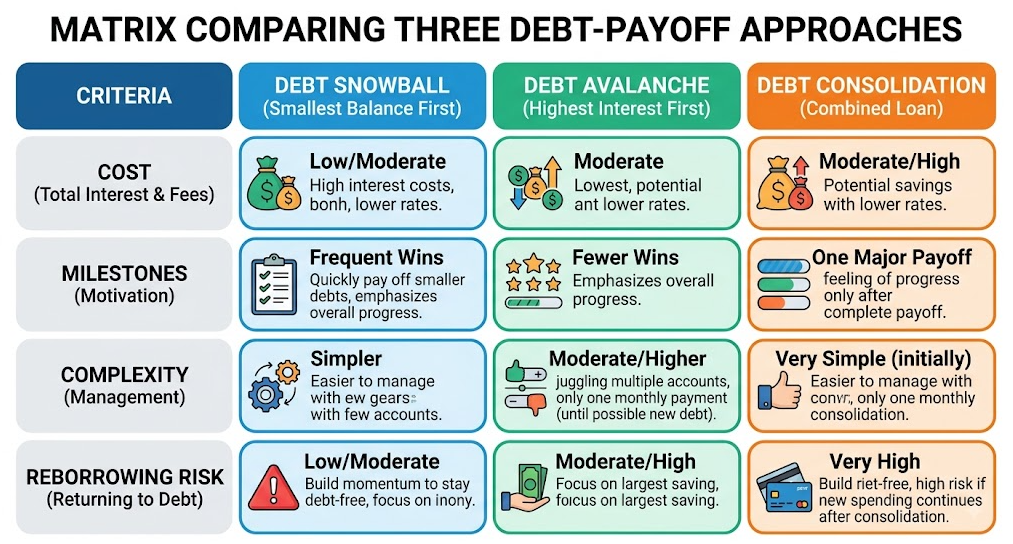
- Debt avalanche: target the highest effective interest rate first.
- Debt snowball: target the smallest balance first.
The Financial Consumer Agency of Canada describes both approaches. It notes that highest-interest-first generally reduces interest and can lead to earlier debt freedom, while lowest-balance-first may show progress quickly and support commitment but may cost more.
Neither method says to stop minimum payments elsewhere. Neither should begin by ignoring past-due accounts, essential housing costs, or debts with immediate legal or collateral consequences. Those priority questions belong before optimization.
Why the Avalanche Usually Costs Less
Interest is the price of carrying a balance over time. When the same extra payment is available under both methods, directing it to the highest-cost balance stops the most expensive interest from accumulating first.
Consider an illustration:
| Debt | Balance | Interest rate | Minimum payment |
|---|---|---|---|
| A | $1,200 | 8% | $40 |
| B | $3,500 | 22% | $110 |
| C | $7,000 | 12% | $180 |
The snowball starts with A because its balance is smallest. The avalanche starts with B because its rate is highest. If all other terms and payments remain identical, targeting B first will generally reduce total interest.
This table is not a payoff estimate. Actual interest may compound daily, minimums may change, fees may apply, and promotional or variable rates may reset. Compare the effective borrowing cost, not only the largest number printed on a statement.
The avalanche is a strong default when:
- the rate spread is large;
- the high-rate balance is substantial;
- you can follow a plan without needing an early account closure;
- minimums are current and affordable; and
- the target account will not be reused.
Its weakness is not mathematical. It is operational. A large high-rate balance can take months or years to close, so the plan needs visible milestones before the first account disappears.
Why the Snowball Can Be Rational
The snowball creates an earlier finish line by attacking the smallest balance. Clearing one account reduces the number of required payments and releases that minimum for the next target.
An early closure may be valuable when:
- several small balances create administrative overload;
- one fewer due date meaningfully reduces missed-payment risk;
- progress has repeatedly stalled under a rate-first plan;
- the smallest debt can be cleared quickly without sacrificing essentials; or
- the psychological benefit will be converted into a larger automatic payment—not new spending.
The cost is that a higher-rate debt may keep compounding while a cheaper small balance is targeted. Before choosing the snowball, calculate or estimate the trade-off. A modest extra interest cost may be acceptable to someone who will actually complete the plan; a very large cost deserves more caution.
Do not call the snowball “better for motivation” as if everyone responds the same way. Some people feel more motivated by seeing avoided interest, a falling high-rate balance, or a projected payoff date. The useful method is the one whose progress measure matters to the person using it.
Jerome’s Experience: A Payoff and a Refill
After immigrating to Canada, Jerome carried a mortgage, a car loan, and a line of credit used for business investment. He expected the balances to decline over time, but principal reduction did not become automatic.
When an investment produced a lump sum, the car loan was both relatively smaller and higher-interest than the LOC, so the available money could eliminate it. That resembles a moment when snowball and avalanche logic partly aligned: one payoff removed a whole account while also addressing the higher rate.
The LOC behaved differently. Interest-only payments felt manageable, paying principal was not habitual, and large recurring costs such as home and auto insurance pushed the balance back up after partial repayment. Jerome’s account does not prove that one payoff method works. It shows why the sorting rule is only one component. A revolving balance can resist both methods when predictable expenses are not funded and available credit is repeatedly reused.
No balances, rates, dates, investment return, or lender terms are supplied, so no claim can be made about which method would have minimized his cost.
Protect the Plan From Reborrowing
A repayment plan that ignores the next annual bill may create only temporary progress. Before calculating the extra debt payment, list predictable non-monthly expenses:
- insurance premiums;
- property or income taxes not withheld;
- vehicle maintenance and registration;
- professional or business renewals;
- school or caregiving costs; and
- seasonal utilities or travel obligations.
Divide the expected amount by the months until it is due and set that money aside regularly. This may make the payoff line move more slowly, but it makes the reduction more credible.
For a credit card or LOC, decide whether the account remains available during payoff. Options may include removing it from digital wallets, lowering a limit after considering consequences, freezing new discretionary use, or asking the lender about controls. Closing an account can affect access, fees, insurance, credit history, and emergency capacity, so review the contract and your situation first.
Choose With a Five-Step Test
Step 1: Check whether optimization is premature
If any account is past due, at risk of collection, tied to essential housing or transportation, secured by property, co-signed, or subject to a legal obligation, resolve the priority question first. FCAC advises considering past-due accounts before choosing a repayment strategy because fees, credit damage, collection, and legal consequences can escalate.
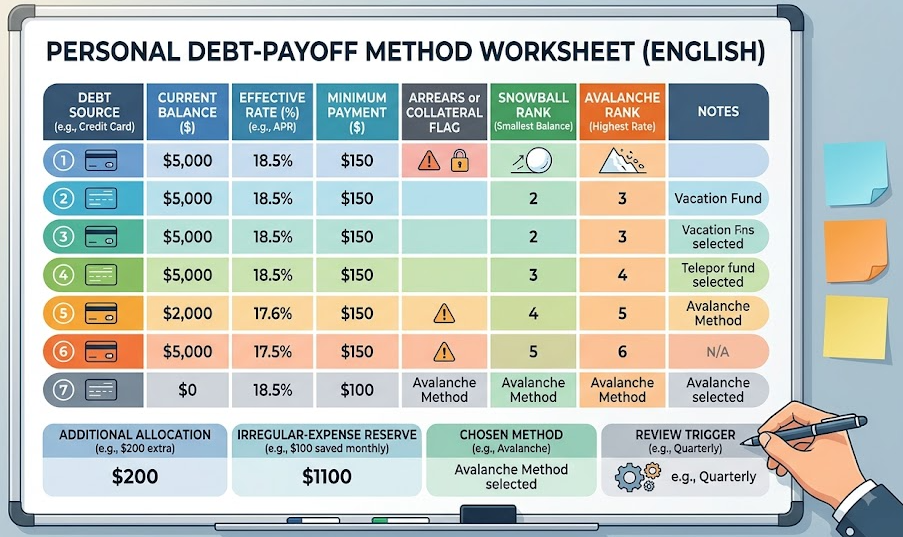
Step 2: Build two orders
Sort the same debt list twice:
- smallest balance to largest;
- highest effective interest rate to lowest.
If the first two targets are the same, there is no immediate conflict. Start there and revisit later.
Step 3: Compare the first meaningful milestone
Estimate how long it takes to clear the first snowball target and how much the avalanche target will fall in that same period. Use lender calculators or a transparent spreadsheet that includes rates, minimums, and payment timing. Treat the result as an estimate, especially for variable rates.
Step 4: Name the adherence risk
Complete this sentence: “I am most likely to abandon this plan when…” The answer may be a distant milestone, an unexpected bill, a variable income month, family disagreement, or continued access to credit. Design a control for that risk.
Step 5: Write the rule
Examples:
- “After all minimums, every extra dollar goes to the highest effective rate.”
- “I will clear the two balances under $500, then switch to highest-rate-first.”
- “Seventy-five percent of extra cash goes to the avalanche target and 25% funds predictable annual bills until the sinking fund is complete.”
A rule prevents each payment from becoming a new debate.
When a Hybrid Is Better Than Repeated Switching
A hybrid method is not random repayment. It is a rule chosen in advance.
Reasonable hybrids may include:
- clearing one very small balance, then using the avalanche;
- targeting an expiring promotional rate before returning to the snowball;
- funding an imminent predictable expense before resuming the target;
- dividing a windfall between a target debt and a minimum cash buffer; or
- using the avalanche while celebrating balance milestones rather than account closures.
Avoid switching because a statement balance looks discouraging that month. Repeatedly changing targets can spread extra payments across every account without closing any or meaningfully reducing the highest cost.
Review the order when a rate changes, a promotion expires, a debt becomes past due, a creditor changes terms, income changes materially, or a new safety or legal consequence appears.
Handle Lump Sums Deliberately
A refund, bonus, sale, or investment proceeds can accelerate either method. Before applying it:
- confirm taxes or transaction obligations associated with the money;
- cover immediately due essentials and known near-term expenses;
- retain the agreed minimum cash buffer;
- check prepayment limits or penalties; and
- obtain a payoff amount if closing an instalment loan.
Then apply the debt rule. A lump sum should not erase the system that governs next month’s cash flow.
Know When Neither Method Is Enough
Snowball and avalanche assume that required payments are affordable and that some extra cash exists. If expenses exceed income, minimums are being missed, balances rise despite stopping new discretionary charges, or collection and legal action are possible, choosing an order is not the primary problem.
Contact creditors early to discuss the situation. A reputable credit counsellor may help review a budget and repayment options. FCAC advises researching qualifications, services, costs, and the consequences of any debt-management plan; more serious situations may require advice about formal legal options.
Be cautious of anyone promising fast forgiveness, guaranteed results, or a special program while demanding upfront payment or financial information after an unexpected contact.
Decision Summary
- Keep all required minimum payments current unless an agreed arrangement changes them.
- Handle past-due and high-consequence obligations before optimizing.
- Use the avalanche to minimize interest under identical payment assumptions.
- Use the snowball when earlier account closure will materially improve execution.
- Compare effective cost, not only the advertised rate.
- Write a hybrid rule instead of changing targets impulsively.
- Fund predictable irregular expenses to reduce reborrowing.
- Treat LOC and credit-card reuse as a separate system problem.
- Reassess after rate, term, income, or legal-status changes.
- Seek reputable help when the cash flow cannot support required payments.
The best payoff method is not simply the one that looks strongest on paper. It is the least-cost method you can sustain without sacrificing essential obligations or rebuilding the balance behind you.
This article provides general educational information, not individualized financial, legal, tax, credit, or insolvency advice. Rates, contracts, protections, and formal debt options vary by jurisdiction. Review your agreements and seek qualified local help when needed.
FAQ
Is the debt avalanche always faster?
With the same debts, payments, and no new borrowing, highest-interest-first generally reduces interest and can shorten payoff. Actual timing changes with rates, fees, minimums, and payment behaviour.
Is the debt snowball a bad financial choice?
No. It may cost more interest, but an earlier account closure can improve execution. Compare the likely extra cost with the practical benefit rather than treating motivation as free.
Should I pay a small zero-interest balance before a high-rate card?
The avalanche would generally favour the high-rate card. A snowball or hybrid might clear the small balance first, but check when the zero-interest period ends and what rate or deferred-interest rule follows.
Do I include my mortgage in the list?
List it for a complete picture, but do not assume it should compete directly with unsecured debt. Prepayment limits, collateral, taxes, rates, and other goals make mortgage acceleration a separate decision.
What if my line of credit rate changes?
Update the effective rate and rerank the avalanche order. Also review whether continued access and recurring expenses are causing the balance to return.
Should a windfall go entirely to debt?
Not automatically. Check taxes, near-term essential costs, a minimum cash buffer, and prepayment terms first. Then apply your written payoff rule.
What if I cannot afford all minimum payments?
Do not rely on snowball or avalanche alone. Contact creditors promptly and consider reputable qualified credit or insolvency guidance appropriate to your jurisdiction.
Sources
- FCAC – Paying Back Your Debt
- FCAC – Getting Help from a Credit Counsellor
- FTC – Looking for Debt Relief? Here’s How to Avoid a Scam
More in This Cluster: Debt Payoff Strategies
- Debt Snowball vs Debt Avalanche (you are here)
- How to Prioritize Multiple Debts
- Should You Save or Pay Off Debt First?
- How to Pay Off Credit Card Debt Without Losing Momentum
- Debt Consolidation: When It Helps and When It Does Not
- How to Build a Realistic Debt Payoff Timeline
- What to Do After You Become Debt-Free