The question is often framed as, “Is my sleep bad enough to see a clinician?” A more useful question is, “What is this pattern costing me—and what might be missed if I keep treating it as a habit problem?”
One poor night rarely requires a medical appointment. But duration is not the only threshold. Repeated unintended sleep, impaired driving, witnessed breathing pauses, or unusual sleep behaviour can matter even before a pattern has lasted for months. A persistent problem that affects work, mood, memory, relationships, or daily function also deserves more than another round of generic sleep tips.
Quick decision: Stop any safety-critical activity when you cannot stay alert. Arrange a clinical discussion for persistent difficulty falling or staying asleep, excessive daytime sleepiness, repeated unintended dozing, loud snoring with gasping or breathing pauses, unusual nighttime behaviour, or sleep problems linked to medicines, health changes, or impaired daily function. Prepare a one- to two-week sleep diary, a complete medicine and substance list, and observations from someone who has seen you sleep. You do not need to diagnose yourself or choose a sleep test before the visit.
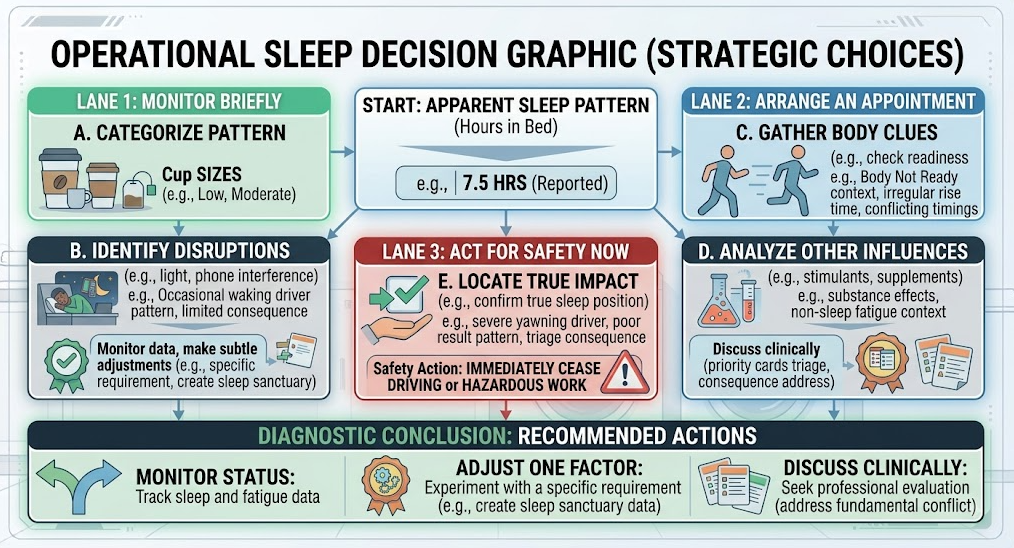
Use Three Levels, Not One Threshold
“See a doctor” is too vague when the reader needs to decide what happens next. Sort the situation into three levels.
Monitor briefly
Short observation may be reasonable when the problem:
- followed an obvious temporary disruption such as travel, acute stress, illness, or a schedule change;
- is mild and improving;
- has not caused unintended sleep or a safety concern; and
- does not substantially impair daytime function.
During this period, protect enough sleep opportunity and record the pattern. Do not keep “monitoring” indefinitely while the same problem continues.
Arrange an appointment
Book a routine or reasonably prompt appointment when the pattern is persistent, recurrent, unexplained, or affecting daily life. Examples include repeated difficulty falling asleep, frequent waking, waking much earlier than intended, unrefreshing sleep despite adequate opportunity, strong daytime sleepiness, or reliance on naps or stimulants to function.
NHLBI advises talking with a doctor when insufficient sleep affects daily activities. Its diagnostic overview notes that chronic insomnia involves difficulty falling or staying asleep at least three nights a week for three months or longer. Those numbers describe a diagnostic framework; they are not a rule that you must wait three months before asking for help.
Act for safety now
Stop driving, operating machinery, working at height, supervising a hazardous process, or doing another safety-critical task when you cannot maintain alertness. Arrange safe transportation or a safe place to stop. NHTSA identifies lane departures and hitting a rumble strip as warning signs of drowsy driving.
Call emergency services for an immediate medical emergency such as severe breathing difficulty, chest pain, collapse, seizure, new severe confusion, or another acute symptom according to local emergency guidance. This article cannot determine whether an acute event is caused by sleep.
Let Daytime Function Count
People often judge sleep only by hours or awakenings. Clinicians also need to know what happens while you are awake.
Bring forward changes such as:
- falling asleep unintentionally during conversations, meals, meetings, or passive activities;
- struggling to stay awake while driving or commuting;
- repeated errors, slowed reactions, or reduced concentration;
- memory problems that track with the sleep change;
- irritability, low mood, anxiety, or reduced emotional control;
- inability to complete ordinary work, study, caregiving, or household tasks; or
- needing frequent naps despite protecting an adequate sleep opportunity.
Excessive daytime sleepiness is different from feeling low in energy. Sleepiness is a tendency or urge to fall asleep; fatigue can feel like exhaustion without an ability to sleep. They can overlap, and neither term makes a diagnosis. Describe the actual event: “I nodded off twice in a meeting,” “I fought sleep at a red light,” or “I feel exhausted but cannot nap.”
MedlinePlus notes that extreme daytime sleepiness can occur in several sleep-disorder categories, while some people are simply not getting enough sleep. A clinical discussion helps sort these possibilities; the symptom alone does not identify the cause.
Report Breathing Clues Without Diagnosing Apnea
Many nighttime breathing events are noticed by someone else. Ask a bed partner or household member whether they have observed:
- loud or disruptive snoring;
- gasping, choking, or snorting;
- pauses in breathing;
- repeated restless awakenings; or
- unusual sleep positions apparently used to breathe more easily.
NHLBI recommends discussing snoring or gasping during sleep, especially when accompanied by excessive daytime sleepiness, with a healthcare provider. These clues can be relevant to sleep apnea, but snoring alone does not confirm it, and absence of snoring does not exclude every sleep-related breathing problem.
Record what was actually observed rather than translating it into a diagnosis. “My partner noticed three pauses followed by gasping” is more useful than “I definitely have apnea.” If possible, note when the observation began and whether alcohol, illness, sleeping position, or a new medicine appeared to change it.
Do not buy or adjust a breathing device solely on the basis of a consumer app or another person’s diagnosis. Evaluation and treatment depend on the type and severity of the problem and the individual’s health context.
Include Unusual Movements and Behaviours
Sleep concerns are not limited to insomnia and snoring. Mention:
- an uncomfortable urge to move the legs at rest;
- repetitive kicking or movements during sleep;
- sleepwalking, eating, shouting, or acting out dreams;
- waking confused or behaving unusually;
- sudden weakness associated with strong emotion;
- vivid experiences while falling asleep or waking; or
- sudden sleep episodes during ordinary activities.
These experiences have several possible explanations, including medicines, substances, sleep deprivation, neurological or mental-health conditions, and sleep disorders. Do not use a symptom list to select a diagnosis.
Protect immediate safety. Secure hazards if someone walks or acts unpredictably during sleep, and avoid situations in which sudden sleep or loss of control could cause injury. Arrange an appropriate clinical discussion rather than waiting for the event to become frequent.
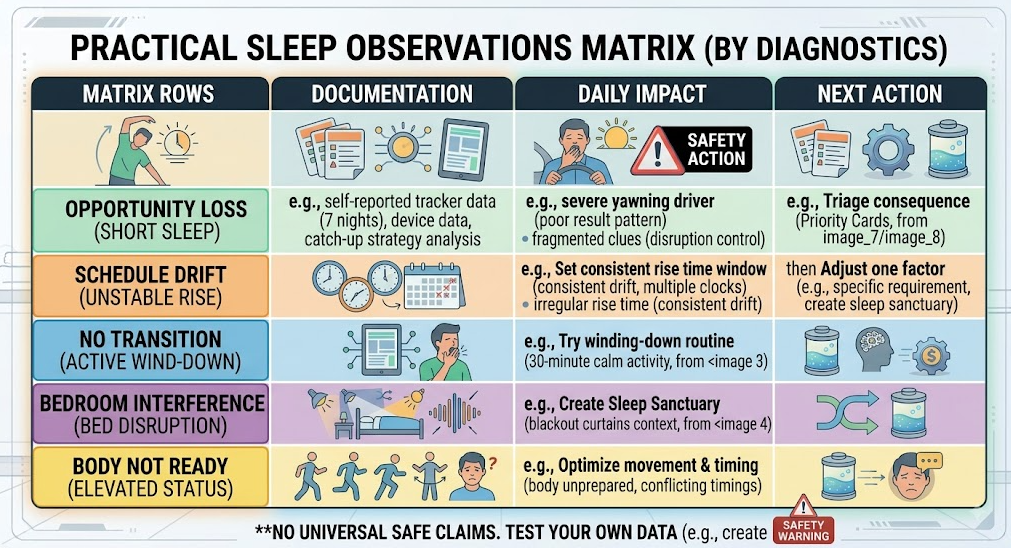
Review Medicines, Substances, and Health Changes
Sleep can change after starting, stopping, or changing the timing or dose of a prescription medicine, over-the-counter product, supplement, nicotine, alcohol, cannabis, or another substance. Some products increase alertness; others cause drowsiness; some can do both at different times.
Prepare a complete list with:
- product and active ingredient when known;
- dose;
- time taken;
- when it was started or changed;
- why you use it; and
- any relationship you noticed between the change and sleep.
Do not abruptly stop a prescribed medicine because it might affect sleep. Ask the prescriber or pharmacist how to review it safely. Include “non-sleep” medicines: allergy products, pain medicines, mood treatments, blood-pressure medicines, steroids, stimulants, and other products may be relevant depending on the person.
Also mention new or changing pain, breathing problems, reflux, urination at night, hot flashes, pregnancy, mood symptoms, neurological symptoms, and major schedule or work changes. The clinician decides what is relevant; your job is to provide the timeline.
Prepare a Visit That Produces Useful Information
You do not need a perfect tracker report. A clear one- to two-week diary is usually more useful than a folder of unexplained graphs.
NHLBI recommends recording sleep for one to two weeks before an insomnia visit, including sleep and wake times, naps, daytime sleepiness, caffeine or alcohol, and exercise. Add details that match your concern:
- time you went to bed and time you began trying to sleep;
- estimated time to fall asleep;
- number and approximate length of awakenings;
- final wake time and time out of bed;
- estimated total sleep;
- naps and unintended dozing;
- work or shift schedule;
- snoring, gasping, breathing pauses, movements, or unusual behaviours;
- medicines, supplements, caffeine, alcohol, nicotine, and other substances;
- morning refreshment and daytime function; and
- driving or workplace safety events.
Estimate honestly. Do not stay awake to watch the clock or create false precision. “About 30 to 45 minutes” is acceptable.
Bring your usual device or app summary only if it helps show timing or trends. Consumer wearables can support a conversation, but they do not independently diagnose insomnia, sleep apnea, narcolepsy, or another disorder.
Ask Questions, Not for a Predetermined Test
A clinician may review medical and sleep history, examine you, request a diary, order laboratory work, refer you, or recommend a sleep study depending on the pattern. MedlinePlus notes that diagnosis begins with medical and sleep history and a physical examination; some people also have a sleep study.
Useful questions include:
- What possible categories fit this pattern?
- Could a medicine, substance, health condition, or schedule be contributing?
- What should I track next, and for how long?
- Do I need testing or referral? What question would it answer?
- What can I do safely while waiting?
- Which activities should I avoid if sleepiness continues?
- When and how should I follow up?
Do not assume every sleep concern requires an overnight laboratory test. NHLBI explains that sleep studies can help diagnose sleep-related breathing, seizure, movement, and extreme-daytime-tiredness disorders, among others. Whether a study is appropriate—and which kind—depends on the clinical question.

Avoid Delays Caused by Self-Diagnosis
Online questionnaires, recordings, oxygen estimates, heart-rate data, and sleep-stage graphs can highlight a pattern. They can also produce false reassurance or unnecessary alarm.
Use them as observations:
- “The app shows repeated awakenings on work nights.”
- “My watch recorded a change after a medicine adjustment.”
- “This recording captured loud snoring and gasping.”
Avoid conclusions the device was not designed to make. A reassuring score does not override repeated unintended sleep or witnessed breathing pauses. A concerning score does not establish a disorder without appropriate evaluation.
Likewise, do not borrow sleep medicine, increase sedating products, or combine substances to force sleep. Treatment depends on the cause, and sedation can worsen next-day impairment or create other risks.
If Access Is Limited, Preserve the Safety Boundary
Not everyone can quickly reach a sleep specialist. Start with an available primary-care clinician, community clinic, pharmacist for medicine review, occupational-health service, or another appropriate local entry point. Ask about wait-list cancellation options, virtual visits, or the records needed for referral.
While waiting:
- protect an adequate sleep opportunity;
- keep the diary simple and current;
- avoid driving or hazardous work when sleepy;
- follow medicine directions and request advice before changes;
- ask household members to record observations safely; and
- seek more urgent care if symptoms or safety risks escalate.
Access barriers do not make dangerous sleepiness safe. If work scheduling repeatedly creates unsafe fatigue, document the timing and report the safety issue through the appropriate workplace channel as well as seeking healthcare guidance.
Decision Summary
You do not need to prove that a sleep problem is severe enough before discussing it.
- Monitor a mild, improving problem briefly when it follows a clear temporary disruption and creates no safety risk.
- Arrange an appointment when sleep difficulty or sleepiness is persistent, recurrent, unexplained, or impairing daily life.
- Report loud snoring with gasping or observed breathing pauses.
- Report unintended sleep, unusual movements or behaviours, and new medicine- or health-linked changes.
- Stop driving and other safety-critical activity when you cannot stay alert.
- Bring a one- to two-week diary, full medicine and substance list, and observer notes.
- Describe events and timing rather than diagnosing yourself.
- Ask what question a test would answer instead of requesting a predetermined test.
- Escalate if the pattern worsens while you wait.
The appointment is not an admission that your sleep habits failed. It is a way to separate what can be adjusted safely from what requires investigation.
This article provides general health information and cannot assess urgency, diagnose a sleep disorder, or select testing or treatment. Use local emergency services for an acute medical emergency, and stop safety-critical activity whenever sleepiness makes it unsafe.
FAQ
How long should I wait before discussing insomnia with a clinician?
Do not wait for a diagnostic time threshold if sleep difficulty is affecting daily activities, worsening, or creating safety concerns. Three nights a week for three months is part of the chronic-insomnia framework, not a requirement to delay asking for help.
Is loud snoring alone a reason to make an appointment?
Loud or disruptive snoring is worth mentioning, especially with gasping, breathing pauses, unrefreshing sleep, or daytime sleepiness. Snoring does not by itself diagnose sleep apnea.
What counts as excessive daytime sleepiness?
It includes a strong tendency to fall asleep or unintended dozing during usual waking activities. Describe what happened, how often, and whether it affected driving, work, or daily function.
Should I ask directly for a sleep study?
You can ask whether testing would help, but the best test depends on the clinical question. History, examination, a diary, medicine review, or other evaluation may come first.
What should I bring to a sleep appointment?
Bring a one- to two-week sleep diary, your work schedule, all medicines and supplements with timing, caffeine and alcohol information, observer notes, and examples of daytime or safety effects.
Can a smartwatch diagnose my sleep problem?
No. It may show useful timing or trend information, but consumer sleep stages, breathing estimates, and scores do not independently diagnose a sleep disorder.
What should I do if I become sleepy while driving?
Stop driving and get to a safe stopping place as soon as possible. Arrange another driver or transportation when needed. Do not treat a phone, open window, music, or willpower as a reliable solution.
Sources
- NHLBI – Insomnia: Diagnosis
- MedlinePlus – Sleep Disorders
- NHLBI – What Is Sleep Apnea?
- NHLBI – Sleep Studies
More in This Cluster: Sleep Foundations
- How Much Sleep Do Adults Need?
- Sleep Hygiene That Is Actually Practical
- Why You May Wake Up Tired
- Caffeine Timing and Sleep
- Naps: When They Help and When They Disrupt Sleep
- How Phone Use Affects Bedtime
- When to Discuss Sleep Problems with a Clinician (you are here)