An afternoon coffee can feel safely separated from bedtime. Six or eight hours seems like plenty of time for its effect to disappear. But caffeine does not switch off at a fixed hour. Part of the dose may still be circulating when you try to sleep—and the amount left depends on how much you consumed, how quickly your body processes it, and what else you had that day.
This is why “no caffeine after 2 p.m.” works for some people and makes little sense for others. Someone who sleeps at 9:30 p.m. has a different decision from someone who sleeps at 1 a.m. A 50-milligram tea is not the same experiment as a 300-milligram energy drink.
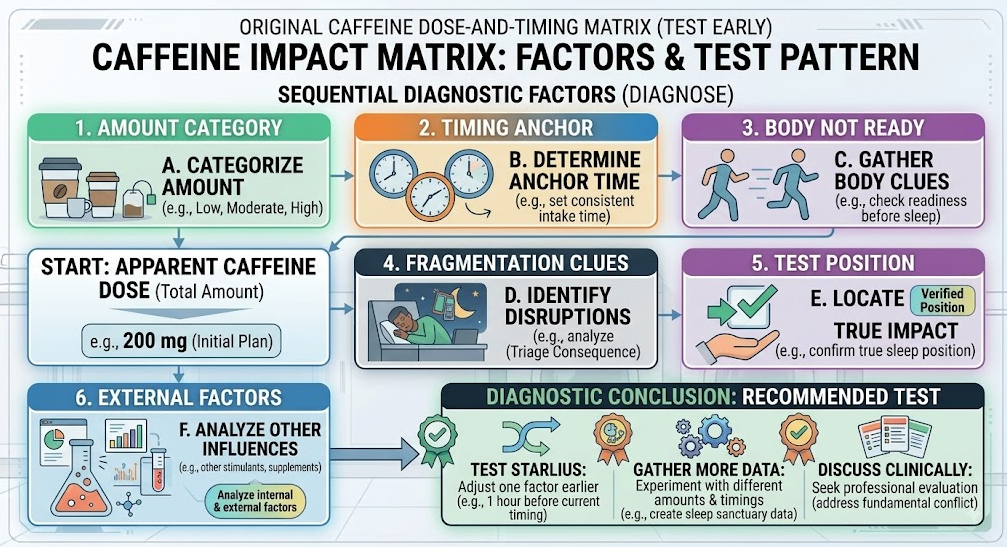
Quick decision: Work backward from your intended sleep time, count caffeine in milligrams from every source, and treat dose and timing as one decision. Start with a conservative last-caffeine boundary, keep the morning intake stable, and test the change for 10 to 14 days. Move the boundary earlier or reduce the dose if sleep remains delayed, fragmented, or unrefreshing. Do not use the FDA’s 400-milligram daily reference as permission to consume that amount late in the waking period.

Caffeine Leaves Gradually, Not All at Once
NIOSH explains that caffeine often takes about 30 minutes to take effect and has a typical half-life of about five to six hours, although it can remain in the body much longer. A half-life is the time required for the amount in the body to fall by half—not the time at which caffeine is gone.
Use a simplified example only to understand the direction:
- You consume 200 mg at 2 p.m.
- With a five-hour half-life, roughly 100 mg would remain around 7 p.m.
- Roughly 50 mg would remain around midnight.
That is an illustration, not a personal forecast. Absorption and elimination vary. FDA notes wide variation in sensitivity and in how quickly people eliminate caffeine, influenced in part by health conditions and medicines. Pregnancy, trying to become pregnant, breastfeeding, and some health or medication situations require individualized advice rather than a generic cutoff.
Do not use a half-life calculator to prove that a certain late dose is safe for you. Use it to understand why a drink can affect sleep long after the obvious “buzz” has faded.
“One Cup” Is Not a Dose
FDA’s typical ranges for 12-fluid-ounce drinks illustrate the problem:
| Product category | Typical caffeine in 12 fl oz |
|---|---|
| Caffeinated soft drink | 23–83 mg |
| Green tea | 37 mg |
| Black tea | 71 mg |
| Regular brewed non-specialty coffee | 113–247 mg |
| Energy drink | 41–246 mg |
These are category ranges, not a lookup table for a specific product. Brewing method, beans or leaves, serving size, formulation, and concentration can change the amount substantially. A large café drink may contain more than one nominal serving. “Decaf” also does not mean caffeine-free; FDA gives a typical range of 2–15 mg in an eight-ounce decaffeinated coffee.
Caffeine may also appear in:
- pre-workout and other supplements;
- energy or protein bars;
- chocolate and coffee-flavoured foods;
- gum or mints;
- some headache, cold, pain, or alertness products; and
- multiple drinks consumed close together.
Read the label for added caffeine and serving size. If a package contains two servings and you consume the whole container, count both. When the amount is not declared, check the manufacturer or use a reliable product-specific source rather than assuming that the category average applies.
Avoid pure or highly concentrated caffeine powders and liquids. FDA warns that very small measuring errors can expose users to toxic or lethal amounts.
Separate the Daily Limit From the Sleep Decision
For most adults, FDA cites 400 mg per day as an amount not generally associated with negative effects. This reference has two important limits:
- It is not an individualized target. Some people experience insomnia, palpitations, anxiety, jitters, nausea, or other effects at lower amounts.
- It says nothing by itself about bedtime placement. A daily total can be within 400 mg and still interfere with sleep when much of it is consumed too close to bedtime.
The sleep decision asks two questions at once:
- How much did I consume?
- How many hours before my intended sleep period?
A 2025 randomized crossover trial tested single 100 mg and 400 mg doses at 12, 8, and 4 hours before bedtime. In that study, 100 mg did not significantly affect measured or reported sleep at the tested intervals, while 400 mg delayed sleep initiation and altered sleep architecture within 12 hours, with more fragmentation closer to bedtime.
Do not turn one study into a guarantee that 100 mg four hours before bed is harmless for everyone. Participants, doses, and conditions were specific, and individual sensitivity varies. The result is useful because it demonstrates that dose changes the cutoff decision. It also found that people may not fully perceive some objective disruption, so “I can fall asleep after coffee” is incomplete evidence.
An earlier controlled study found that a 400 mg dose taken even six hours before bedtime reduced total sleep time compared with placebo. Together, the studies
Choose a Personal Starting Boundary
Use your sleep time—not noon, 2 p.m., or another internet rule—as the anchor.
Step 1: Record a normal caffeine day
For three ordinary days, write down:
- product and serving size;
- estimated milligrams;
- time started and finished;
- intended sleep time;
- time you tried to sleep;
- major awakenings; and
- next-morning refreshment and daytime sleepiness.
Include weekends, shift days, and unusually large servings separately. Do not average a night-shift schedule with a daytime schedule.
Step 2: Find the latest meaningful dose
A few milligrams in chocolate and a 200 mg drink should not be treated as equivalent. Identify the last dose large enough to be a plausible contributor, while still noting smaller sources if you are highly sensitive.
Step 3: Set a conservative test boundary
NIOSH recommends avoiding caffeine for several hours according to individual sensitivity and notes that night-shift workers may use it early in the shift but should stop several hours before the shift ends. For a conventional schedule, a practical first experiment is to place the last meaningful dose at least six hours before intended sleep—and earlier when the dose is high, sleep is already difficult, or you suspect sensitivity.
This is a starting experiment, not a universal medical standard. The 2025 trial suggests that a single 400 mg dose may require a much longer separation than six hours.
Step 4: Keep morning intake stable
If you simultaneously cut the amount, change the product, skip breakfast, and move the last serving, withdrawal and routine disruption can obscure the result. Hold the early-day pattern steady while moving only the late dose.
Step 5: Review after 10 to 14 days
Ask whether you:
- fell asleep more easily;
- woke less often;
- slept longer within the same opportunity;
- felt more refreshed;
- needed less rescue caffeine the next day; and
- could follow the boundary without creating unsafe sleepiness at work or while driving.
If the pattern improves, keep the boundary. If not, move it earlier or reduce the last dose and repeat. If sleep remains poor despite adequate opportunity and a meaningful caffeine adjustment, investigate other causes rather than removing more and more caffeine indefinitely.
Watch for the Caffeine–Sleep Loop
Caffeine can temporarily improve alertness, which is useful in some situations. It cannot replace sleep. A repeating loop can develop:
- short or fragmented sleep;
- more caffeine to function;
- caffeine taken later or in larger amounts;
- delayed or disrupted sleep; and
- greater need for caffeine the next day.
Break the loop at the point you can control. Often that means protecting sleep opportunity while moving the final dose earlier—not forcing yourself through dangerous sleepiness without a plan.
If you are struggling to stay awake while driving or doing hazardous work, the immediate action is to stop the unsafe activity. More caffeine can create temporary alertness but does not guarantee safe performance or prevent microsleeps in severe sleep deprivation.
Adapt the Boundary for Shift Work
A night-shift worker’s “morning coffee” may occur at 7 p.m. Clock labels are not useful; intended sleep time is.
For a block of night shifts:
- place caffeine near the beginning rather than the end of the shift;
- count the full dose from coffee, energy drinks, supplements, and medicines;
- stop several hours before the planned daytime sleep period;
- protect the post-shift sleep window from errands and avoidable tasks; and
- never rely on caffeine as proof that you are safe to drive home.
NIOSH specifically warns that caffeine near the end of a night shift may remain high enough to cause restlessness or awakenings during morning sleep.
Rotating shifts complicate testing because both the caffeine schedule and the sleep schedule move. Track each shift type separately. If workplace scheduling repeatedly prevents adequate sleep or alertness, the problem is not solvable through beverage timing alone.
Reduce Caffeine Without Making the Test Miserable
Daily caffeine users may develop withdrawal symptoms when they stop abruptly. FDA advises cutting back gradually because withdrawal is generally not dangerous but can be unpleasant.
Possible approaches include:
- reduce the size of one serving;
- mix regular and decaffeinated coffee;
- replace the final drink with a lower-caffeine or caffeine-free option;
- remove one dose every few days rather than all at once; or
- keep the ritual but change the product.
Do not use an unlabelled supplement, concentrated powder, or stimulant medicine as a substitute. If caffeine is being used to counter medication sedation, a sleep disorder, repeated night waking, or an impossible work schedule, address the underlying reason with an appropriate professional.
Withdrawal headache, fatigue, irritability, and reduced concentration can make the first days look worse. Mark the reduction dates so you do not mistake withdrawal for proof that more caffeine is medically necessary.

Know When to Ask for Individual Advice
Discuss caffeine with a healthcare professional when:
- you are pregnant, trying to become pregnant, or breastfeeding;
- a medicine or health condition may change caffeine sensitivity or elimination;
- caffeine causes palpitations, marked anxiety, tremor, severe stomach symptoms, or repeated insomnia;
- you rely on large amounts to prevent unintended sleep;
- you use pre-workout, energy, alertness, or concentrated products with uncertain totals; or
- sleep remains unrefreshing after a well-run timing experiment.
Seek urgent care or contact poison services for a suspected overdose or severe symptoms such as seizure, collapse, severe confusion, serious chest symptoms, or a very rapid or irregular heartbeat. Do not wait for bedtime to see whether the caffeine “wears off.”
Decision Summary
Caffeine timing is not one universal afternoon cutoff.
- Anchor the decision to your intended sleep time.
- Count milligrams and serving sizes from all sources.
- Treat daily amount and bedtime distance as separate safety and sleep questions.
- Remember that a five- to six-hour half-life means reduction, not disappearance.
- Start conservatively, especially with high doses or known sensitivity.
- Test one boundary for 10 to 14 days before changing it again.
- For night shifts, use caffeine earlier in the shift and stop well before planned sleep.
- Reduce gradually when you use caffeine every day.
- Do not use caffeine to conceal dangerous sleepiness or an unresolved sleep problem.
The best cutoff is the earliest boundary that protects sleep without removing a useful amount of caffeine unnecessarily. You find it through dose-aware testing, not by copying someone else’s clock.
This article provides general health information, not an individualized caffeine limit or treatment plan. Product content, sensitivity, medicines, health conditions, pregnancy, and work schedules change the decision. Seek professional or poison-service advice for concerning symptoms or possible overdose.
FAQ
How many hours before bed should I stop caffeine?
Six hours is a reasonable conservative starting experiment for a meaningful dose, but it is not universal. Higher doses, individual sensitivity, medicines, pregnancy, or slow elimination may require a longer interval.
Does caffeine stay in your body for 12 hours?
It can. With a typical five- to six-hour half-life, some of a dose may remain after 10 to 12 hours, and elimination can be longer in some people. Remaining caffeine does not equal the same effect in everyone.
Is 400 mg of caffeine safe before bedtime?
No such conclusion follows from FDA’s daily reference. FDA cites 400 mg per day as an amount not generally associated with negative effects for most adults, but a 400 mg dose can disrupt sleep even many hours before bedtime.
Can I drink coffee and still fall asleep normally?
Yes, but falling asleep is only one outcome. Caffeine may also shorten sleep or increase fragmentation, and people may not accurately perceive every effect. Track awakenings and morning refreshment as well as sleep onset.
Does tea count as caffeine?
Yes. Tea generally contains less caffeine than many coffees, but amounts vary by type, serving, and preparation. Count the actual product and portion rather than treating tea as caffeine-free.
Is decaf completely caffeine-free?
No. FDA reports that decaffeinated coffee typically contains a small amount. That may be unimportant for many people but relevant to someone who is highly sensitive or consumes several servings.
Should I quit caffeine all at once to improve sleep?
Usually not. FDA recommends gradual reduction for regular users because abrupt withdrawal can be unpleasant. Moving or reducing the latest dose first creates a more interpretable sleep experiment.
Sources
- CDC/NIOSH – Sleep Aids and Stimulants: Caffeine
- FDA – Spilling the Beans: How Much Caffeine Is Too Much?
- Gardiner et al. – Dose and Timing Effects of Caffeine on Subsequent Sleep
- Drake et al. – Caffeine Effects on Sleep Taken 0, 3, or 6 Hours Before Bed
- CDC/NIOSH – Prepare for Sleep