Jerome once treated sleep as time taken away from life. If he slept more than six hours, more than a quarter of the day seemed lost. The productive choice appeared obvious: sleep less and put the recovered hours into the things he wanted to build.
His experience changed after he began sleeping at least seven hours. He felt clearer, moved more actively in the morning, concentrated better at work, and found a regular routine easier to maintain. He also felt more recovered, found weight maintenance easier, and felt better able to stay focused while driving.
That account does not prove that seven hours produces those results for everyone. It reveals a more useful question, though. Instead of asking how little sleep you can tolerate, ask how much sleep lets you use your waking hours safely and well.
Quick answer: Adults ages 18–60 should generally get at least seven hours of sleep per 24 hours. CDC lists seven to nine hours for ages 61–64 and seven to eight hours for age 65 and older. These are population guidelines, not a stopwatch prescription. Your practical target also depends on whether the sleep is regular and refreshing, whether you function well without fighting sleepiness, and whether a health condition, medicine, work schedule, caregiving demand, or sleep disorder is affecting the result.

Start With a Range, Not a Minimum-Sleep Contest
For healthy adults ages 18–60, the joint consensus recommendation from the American Academy of Sleep Medicine and Sleep Research Society is to sleep seven or more hours per night regularly to promote optimal health. The statement also says that sleeping more than nine hours may be appropriate for young adults, people recovering from sleep debt, and people who are ill; uncertainty remains about the health effects of more than nine hours for others.
That makes seven hours a useful lower boundary for most adults, not a universal finish line. One person may function well with a little over seven hours, while another regularly needs eight or nine. Need can also change during illness, recovery, pregnancy, unusually demanding periods, or after accumulated sleep loss.
Age-specific tables differ slightly depending on the expert framework being summarized. CDC currently presents:
| Age | General daily recommendation |
|---|---|
| 18–60 years | 7 or more hours |
| 61–64 years | 7–9 hours |
| 65 years and older | 7–8 hours |
Do not use the narrower older-adult ranges to force yourself awake when you are recovering or unwell. At the same time, regularly sleeping for a long time and still feeling unrefreshed is not evidence that you simply need an ever-larger sleep target. NHLBI advises discussing it with a clinician if you sleep more than eight hours and do not feel well rested.
Separate Sleep Opportunity From Sleep Obtained
“I go to bed for seven hours” does not necessarily mean “I sleep seven hours.” Time in bed can include settling down, awakenings, caregiving, pain, bathroom trips, checking the clock, or lying awake before the alarm.
Work backward from the required wake time, but add realistic room for falling asleep and ordinary brief awakenings. If you need to wake at 6:30 a.m. and want to test an eight-hour sleep opportunity, being in bed from 10:30 p.m. to 6:30 a.m. provides eight hours in bed—not a guarantee of eight hours asleep.
Avoid trying to calculate sleep to the minute from memory. Consumer wearables can provide estimates and patterns, but they do not establish whether you have a sleep disorder. A plain diary is often enough for the first decision.
For two weeks, record:
- when you tried to sleep;
- roughly when you think you fell asleep;
- major awakenings and their likely reason;
- final wake time and when you got out of bed;
- naps;
- whether an alarm woke you;
- morning refreshment and daytime sleepiness; and
- unusual factors such as illness, pain, alcohol, caffeine, a new medicine, overnight caregiving, or shift work.
The goal is not a perfect sleep score. It is to see whether your schedule routinely leaves enough opportunity and whether adequate opportunity produces usable daytime alertness.
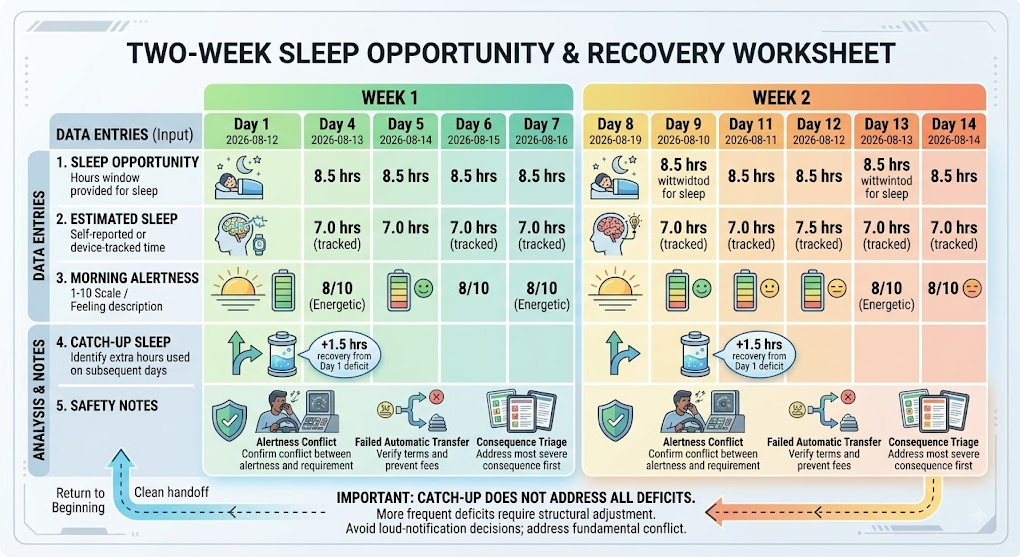
Judge the Result by Daytime Function
Sleep need is partly visible in what happens when you are awake. NHLBI describes sleep deficiency broadly: it can mean too little sleep, sleeping at the wrong time, poor-quality sleep, missing needed sleep stages, or a sleep disorder that disrupts sleep. This is why duration alone cannot answer every question.
During your two-week test, look for patterns rather than one difficult morning.
Signs your current opportunity may be too short
- You routinely need several alarms or repeated snoozing to get up.
- You sleep substantially longer on days off when given the chance.
- You struggle to remain awake during quiet activities, meetings, reading, or as a passenger.
- Concentration, reaction time, memory, judgment, patience, or mood worsens as the day continues.
- You depend on escalating caffeine simply to reach ordinary alertness.
- You become drowsy while driving or doing safety-critical work.
Sleeping longer on days off may be a clue that weekday sleep is insufficient. NHLBI notes that this catch-up pattern may help temporarily but can also disturb the sleep-wake rhythm. It is a signal to investigate, not a precise calculation of your sleep debt.
Signs the number alone may not be the main problem
- You consistently allow enough time but wake unrefreshed.
- You have repeated or prolonged awakenings.
- Someone notices loud snoring, gasping, choking, or breathing pauses.
- You fall asleep unintentionally despite a reasonable sleep opportunity.
- Your sleep timing conflicts with your work or biological schedule.
- Pain, breathing symptoms, reflux, restless sensations, mood symptoms, menopause symptoms, alcohol, or a medicine may be interfering.
Those patterns belong to the later question, “Why do I wake up tired?” Adding time may help when the opportunity is too short, but it does not diagnose or correct fragmented sleep, circadian misalignment, or a medical cause.
Run a Two-Week Sleep-Opportunity Test
Choose an ordinary two-week period if possible—not a vacation, acute illness, deadline sprint, or major time-zone change.
1. Anchor the wake time
Start with the time you genuinely need to get up on most days. Keep it reasonably steady, including days off when practical. If shifts rotate or caregiving makes this impossible, track each schedule separately rather than averaging incompatible days.
2. Protect at least the recommended opportunity
For an adult under 61, start by protecting enough time to make at least seven hours of actual sleep plausible. Many people will need more time in bed than that. If your current schedule allows only six hours between lights-out and the alarm, the first problem is opportunity, even before sleep quality is assessed.
3. Move bedtime gradually when necessary
An abrupt two-hour change may fail because your body clock and evening responsibilities have not moved with the plan. Shift the target in manageable increments while preserving the wake anchor. The next article in this cluster will address the routine and environment in detail.
4. Remove optional late-night tasks before essential ones
List what occupies the final hour: paid work, caregiving, chores, television, scrolling, gaming, exercise, or quiet personal time. Do not pretend every item is optional. Protecting sleep may require redistributing household work, changing a morning commitment, or acknowledging that the current schedule is structurally constrained.
When you do have a choice, compare the value of another late hour with the value of alertness the next day. This is the practical reversal Jerome discovered: sleep did not shrink the usable day; it improved how the waking part felt and functioned.
5. Review the pattern, not your best night
At the end of two weeks, ask:
- Did I usually create enough sleep opportunity?
- Did I sleep through most of that opportunity?
- Did I wake reasonably refreshed on most days?
- Could I remain alert through ordinary quiet periods without fighting sleep?
- Did I need large catch-up sleep on days off?
- Did sleepiness create a driving, work, caregiving, or fall risk?
If opportunity was consistently short, extend it and repeat. If opportunity looked adequate but sleep remained unrefreshing or daytime sleepiness persisted, the next decision is not simply “go to bed even earlier.” Look for quality, timing, health, and medication factors and consider clinical advice.
Do Not Treat Weekend Sleep as Full Repayment
NHLBI describes sleep debt as accumulated sleep loss. Naps or extra sleep may improve alertness in the short term, but they do not supply a simple hour-for-hour eraser for every effect of repeated insufficient nighttime sleep.
This does not mean extra recovery sleep is pointless. It means a cycle of five restricted nights followed by two very long mornings should not be mistaken for a stable plan. Large differences between workdays and days off can also move sleep timing, making the next early night or Monday wake-up harder.
Use the weekend pattern diagnostically:
- A little variation: may reflect normal flexibility.
- Regularly sleeping much longer: suggests the weekday opportunity may be too short or poorly timed.
- Long sleep without refreshment: raises a sleep-quality or health question.
- Inability to sleep despite exhaustion: may point toward timing, stress, insomnia symptoms, substances, medicines, or another factor.
Protect Safety Before Optimizing Productivity
The most urgent sign of insufficient sleep is not an imperfect tracker score. It is inability to stay alert during an activity where a brief lapse could injure someone.
NHTSA states that adequate sleep on a daily basis is the only true protection against drowsy-driving risk. Coffee or energy drinks may create short-lived alertness, but a severely sleep-deprived driver can still experience microsleeps.
Do not start or continue driving because the destination is close, the window is open, the music is loud, or you believe determination will keep you awake. If you are sleepy behind the wheel, move to a safe stopping plan. People who work with vehicles, machinery, heights, patients, children, electricity, heat, or other hazards need the same principle: stop treating sleepiness as a character test.
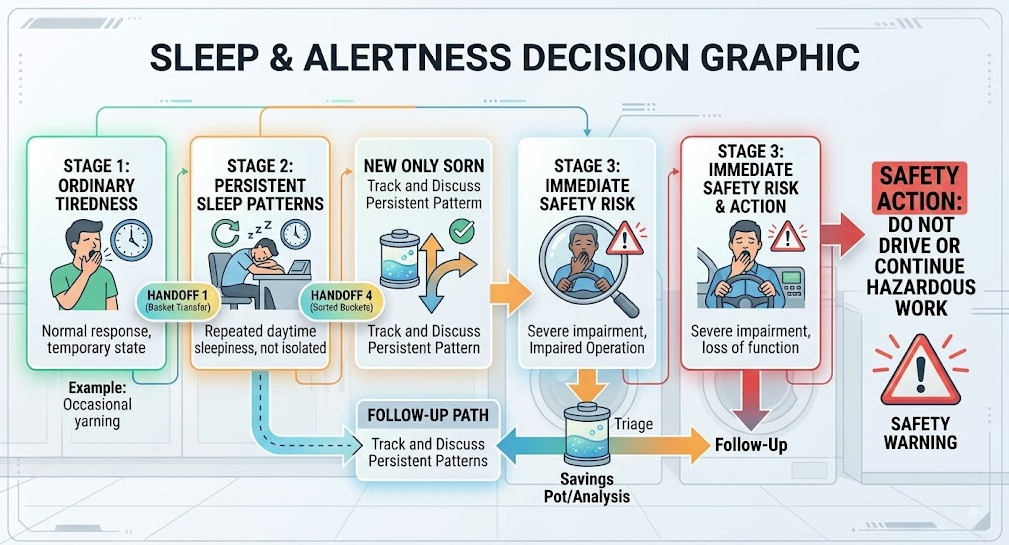
Know When the Question Is No Longer Just About Hours
Discuss sleep with a clinician when you regularly have trouble sleeping, continue to feel sleepy or unrefreshed despite adequate opportunity, sleep much longer without feeling restored, or have signs of a possible sleep disorder. CDC specifically identifies repeated night waking and tiredness after enough sleep as signs of poor sleep quality and advises talking with a healthcare provider about regular sleep problems or sleep-disorder symptoms.
Seek prompt professional guidance when sleepiness affects driving, work safety, caregiving, or falls. Breathing difficulty, chest pain, new confusion, fainting, or another acute symptom should be handled according to the symptom and local urgent-care guidance, not attributed to “just needing sleep.”
Bring a two-week diary, medication and supplement list, work schedule, nap pattern, and any observations from a bed partner. Do not stop a prescribed medicine because it may affect sleep without asking the prescriber or pharmacist.
Decision Summary
For most adults, the useful starting point is not six hours or the smallest number you can survive on. It is at least seven hours of actual sleep, with age, individual need, quality, timing, regularity, and daytime function included in the decision.
- Use the age recommendation as a starting range, not a productivity challenge.
- Protect more time in bed than the exact sleep total you hope to obtain.
- Track two ordinary weeks before drawing conclusions from one night.
- Treat catch-up sleep, alarm dependence, and daytime sleepiness as clues.
- Do not drive or continue hazardous work when you are struggling to stay awake.
- If adequate opportunity remains unrefreshing, investigate quality, timing, medicines, health conditions, and possible sleep disorders with appropriate professional help.
Sleep uses part of the 24-hour day. That is not the same as wasting it. The better measure is whether the remaining hours are alert enough, safe enough, and healthy enough to be used as you intend.
This article provides general health information, not an individualized sleep prescription or diagnosis. Sleep needs and constraints vary. A clinician can help assess persistent insomnia, excessive sleepiness, unrefreshing sleep, breathing-related symptoms, or safety concerns.
FAQ
Is six hours of sleep enough for an adult?
Six hours is below the general recommendation for most adults. A rare individual may report functioning well, but regularly tolerating a short schedule is not proof that it supports health or safety. Start by making at least seven hours of actual sleep plausible and judge the result over time.
Is seven hours exactly enough for everyone?
No. Seven hours is an important population-level lower boundary for most adults ages 18–60, not a universal endpoint. Many adults need eight or nine hours, and needs can change with age, recovery, illness, pregnancy, or accumulated sleep loss.
Does time in bed count as sleep?
Not automatically. Time spent falling asleep, awake during the night, or awake before getting up is part of the sleep opportunity but not necessarily sleep. Estimate both separately without trying to create false minute-by-minute precision.
Can I catch up on all my sleep over the weekend?
Extra sleep may improve how you feel temporarily, but it is not a dependable substitute for adequate regular sleep. Regularly sleeping much longer on days off is also a clue that the weekday schedule may be insufficient.
Why am I still tired after eight hours?
The eight hours may be time in bed rather than time asleep, or sleep may be fragmented, poorly timed, or affected by stress, pain, alcohol, medicines, a health condition, or a sleep disorder. Persistent unrefreshing sleep deserves evaluation rather than endless time expansion.
Should older adults need much less sleep?
No. CDC lists seven to nine hours for adults ages 61–64 and seven to eight hours for adults 65 and older. Sleep timing and continuity may change with age, but needing dramatically less sleep should not be assumed.
When should daytime sleepiness be taken seriously?
Take it seriously when you fall asleep unintentionally, struggle to stay awake while driving or doing hazardous work, or remain sleepy despite adequate sleep opportunity. Stop the unsafe activity and discuss persistent or unexplained sleepiness with a clinician.
Sources
- CDC – About Sleep
- American Academy of Sleep Medicine and Sleep Research Society – Recommended Amount of Sleep for a Healthy Adult
- NHLBI – How Much Sleep Is Enough
- NHLBI – What Are Sleep Deprivation and Deficiency?
- NHTSA – Drowsy Driving