Some laundry damage does not look dramatic at first. It shows up as one tissue shredded across a dark load, a zipper that has scratched another garment, a favourite shirt that suddenly feels twisted, a towel that never dries quite fresh, or a pair of pants with a forgotten receipt welded into the pocket.
Jerome learned this in the ordinary family way. Paper left in pockets sometimes came through the wash as lint scattered across clean clothes. A banknote was damaged. A load that should have been finished became extra work because one small step had been skipped before the machine started.
That is the useful lesson: many laundry mistakes are not knowledge failures. They are checkpoint failures. The person doing the laundry may know that pockets should be emptied, care labels matter, wet loads should not sit, and zippers can snag. But if those checks are not built into the routine, they are easy to miss when a household is busy.
This article closes the Laundry Systems cluster by turning common damage points into a simple prevention system. The goal is not to make every load perfect. It is to protect clothing, reduce re-washing, avoid preventable washer problems, and know when an item needs special care before routine laundry makes the damage worse.
Practical rule: Before a load starts, remove what can harm the wash. Before a load ends, stop heat, moisture, and storage mistakes from setting the damage in place.
Start With the Care Label and the Washer Manual
The care label is not a decoration sewn into the side seam. It is the garment’s first instruction system. In the United States, the FTC Care Labeling Rule requires covered garments to provide at least one safe care method and necessary warnings, such as instructions to wash separately when colour transfer is a foreseeable issue. Other countries may use different symbols or wording, but the everyday principle is the same: the item-specific label controls the decision.
The washer manual matters too. A machine is not just a box that spins clothes. It has load limits, dispenser instructions, balance requirements, and safety warnings. Manufacturer guidance commonly tells users to check pockets, close zippers and hooks, tie drawstrings, avoid tight packing, and leave room for clothes to move.
When the care label, washer manual, and internet advice disagree, use this order:
- the garment label for the item;
- the appliance manual for the machine;
- the laundry product label for detergent, bleach, softener, or pretreatment;
- only then, general household advice.
This order prevents a common mistake: treating a popular laundry tip as if it outranks the actual garment or machine in front of you.
Empty Pockets Before Every Load
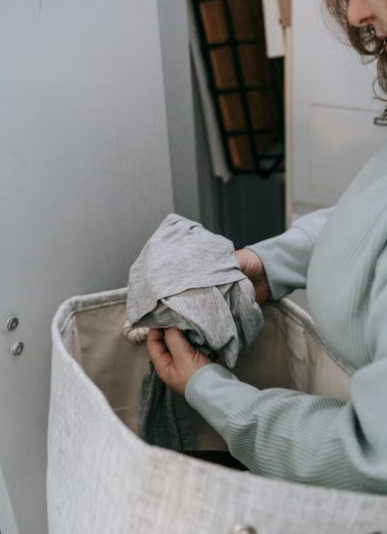
Pocket checks feel too obvious until they are missed. Paper tissues, receipts, pens, lip balm, coins, screws, toys, earbuds, keys, and gum can all create different problems. Some spread lint. Some stain. Some melt. Some scratch the washer drum or door. Some damage another garment more than the item they came from.
Make pocket checks a fixed step, not a memory test. If several people use the same hamper, place a small tray, jar, or shallow basket beside the washer for pocket contents. That changes the task from “remember to check” into “move everything to this place before loading.”
Use a two-pass pocket check for family laundry:
- Before sorting: check pants, jackets, hoodies, uniforms, aprons, and children’s clothing.
- Before loading: shake out heavier items and check again for folded receipts, tissues, or small objects caught in corners.
Children can help with this without being responsible for the whole laundry system. Matching socks, turning pockets out, and collecting small items are useful household tasks, but the adult running the load still owns the final check.
If paper has already shredded through a load, do not automatically put everything into the dryer. Shake items outside or over a bin, clean the washer gasket or drum area if needed, and remove as much loose material as practical before drying. Heat and tumbling can make cleanup harder.
Close, Tie, Turn, and Bag Before Washing
Fasteners protect clothing when they are managed and damage clothing when they are ignored. Open zippers can snag knits, scratch delicate surfaces, or catch on trim. Hooks can pull threads. Long drawstrings can tangle. Velcro can grab softer fabrics and fill with lint.
Before loading:
- close zippers;
- fasten hooks;
- tie drawstrings loosely;
- secure Velcro to itself;
- turn dark, printed, or embellished garments inside out when the care label allows;
- place delicate, small, or snag-prone items in a mesh laundry bag.
This is not about treating every T-shirt like formalwear. It is about identifying the items most likely to harm the rest of the load or be harmed by it. A hoodie with metal zipper teeth, a bra with hooks, a child’s costume with trim, a lace garment, and a printed shirt do not carry the same snag risk as a plain cotton towel.
Turning items inside out can reduce visible abrasion on some outer surfaces, especially dark fabrics, printed designs, and garments with surface finishes. But do not treat inside-out washing as a universal fix. If the care label gives a specific instruction, follow that first.
Mesh bags are useful when they solve a real problem: keeping small items together, reducing friction on delicate pieces, preventing straps from tangling, or separating hooks from softer fabrics. They are not a licence to ignore the care label. A hand-wash-only or professional-clean-only item does not become machine-safe merely because it is inside a bag.
Do Not Overload the Washer
Overloading is one of the easiest ways to make laundry worse while feeling more efficient. A packed washer may save one cycle today, but it can leave detergent unevenly distributed, reduce mechanical movement, increase tangling, trap soil, stress seams, and contribute to poor rinsing.
The American Cleaning Institute’s laundry basics guidance says not to overload the washer because clothes need room to move. LG washer guidance similarly tells users not to pack items tightly and to leave enough room for proper movement, while also recommending that pockets be checked and fasteners managed before loading.
A practical loading test is simple: the washer may look full, but the items should not be compressed into a solid block. The door or lid should close without force. In many top-load and front-load machines, mixed large and small items help movement and balance better than one dense mass of similar pieces.
Overloading also hides other mistakes. A stain may not get treated because it disappears in a pile. A tissue may remain in a pocket because the load was rushed. A delicate item may end up against jeans, towels, or hardware because there was no space to separate it. The problem is not only weight; it is the loss of control.
If laundry regularly needs to be overloaded, the routine from EW-L-0029 may need adjustment. The household may need smaller trigger points, a towel-only schedule, a bedding day, or a division of labour that gets clothing moving before every hamper is full.
Avoid Product Mistakes That Create Residue or Damage
More detergent does not automatically mean cleaner clothes. Too much product can leave residue, contribute to stiffness, dullness, odour, or poor rinsing, and make the next wash harder to diagnose. Too little product can leave soil behind. EW-L-0031 covers detergent dosing in detail; the prevention point here is that product labels and machine instructions should control what goes where and how much is used.
Avoid these recurring product mistakes:
- pouring detergent, bleach, or softener into the wrong compartment;
- using a product the garment label prohibits;
- mixing bleach with ammonia, acids, vinegar, or other cleaners;
- using chlorine bleach on items that only allow non-chlorine bleach;
- adding pods after clothes when the machine instructions require a different order;
- storing laundry packets where children can reach or see them.
The CDC warns users to follow bleach labels, ventilate as directed, and never mix household bleach with other cleaners or disinfectants. The CPSC also warns that single-load liquid laundry packets can cause harmful exposures and should be kept sealed in the original package and out of children’s sight and reach.
For garment life, the safest default is not a homemade chemical collection. It is a small, labelled set of products you understand: detergent, one compatible stain pretreatment if needed, and any specialty product that the garment or machine label permits. If a problem keeps recurring, change one variable at a time. Otherwise, you may not know whether the issue came from dose, product type, load size, water temperature, drying, storage, or the garment itself.
Respect Heat, Friction, and Time
Clothing wears down from repeated stress. Laundry adds three common stressors: heat, friction, and time in the wrong condition.
Heat can shrink, distort, fade, set stains, weaken elastic, or damage finishes when the item is not suited for it. Friction can pill knits, abrade dark surfaces, roughen towels, and wear seams. Time matters when a wet load sits, a stained item waits too long, or a clean garment remains crumpled until wrinkles and odour appear.
Use the earlier articles in this cluster as specific decision guides:
- Sort items when colour transfer, lint, fabric weight, soil, or care labels create a conflict.
- Dose detergent according to the product label, load, washer type, soil level, and residue signs.
- Diagnose towel odour by finding where moisture is trapped.
- Choose air drying or machine drying based on the care label, time, space, humidity, and heat sensitivity.
- Treat stains before routine washing or dryer heat makes them harder to remove.
For damage prevention, add one final checkpoint: after washing and before drying, ask whether this item is ready for heat. If the answer is uncertain because of a stain, care label, elastic, print, shape, or fabric, pause. Air drying or professional advice may be safer than treating the dryer as the automatic next step.
Do Not Leave Wet Loads Forgotten
A forgotten wet load creates two problems. First, the clothing may develop odour, wrinkles, dye transfer, or mildew-like smells. Second, the washer itself may begin to smell if moisture, soil, and residue remain trapped in seals, dispensers, or the drum area.
This is not a reason to panic over every delay. It is a reason to build a handoff. If a household starts laundry, someone should own the transfer step. A timer, phone reminder, washer signal, or visible laundry note can prevent the common pattern where “I started a load” becomes “I found a load tomorrow.”
When a wet load has sat long enough to smell, do not simply dry it and hope the odour disappears. Rewash according to the garment labels and machine instructions. Then dry fully before storage. If washer odour keeps returning, use the machine-cleaning process recommended by the appliance manufacturer rather than guessing with harsh or incompatible mixtures.
This point links back to Article “How to Prevent Musty Towel Odours From Coming Back”: recurring towel or laundry odour is often a system problem, not a fragrance problem. The solution is to interrupt moisture retention, residue, and delayed drying.
Store Clothes Only When They Are Clean, Dry, and Wearable
Laundry is not finished when the machine stops. It is finished when the item is clean enough for its purpose, dry enough for storage, and returned to a place where someone can find and wear it.
Storage mistakes can undo a good wash:
- folding damp towels or thick waistbands before they are fully dry;
- stuffing clean clothes into crowded drawers where airflow and visibility are poor;
- hanging heavy wet garments in a way that stretches them;
- storing seasonal clothing with food stains, body soil, or perfume residue;
- leaving delicate items under heavy piles;
- mixing items that still need repair with ready-to-wear clothing.
Before long storage, inspect clothing under decent light. Small stains that seem unimportant before storage may become harder to address later. Food residue can attract pests. Dampness can create odour. A missing button, loose seam, or broken zipper is easier to fix before the item disappears into a closet for months.
Create a small “not ready” zone: one place for repair, one place for donation, one place for professional cleaning, and one place for items that need another wash. Without a visible holding area, imperfect garments either re-enter circulation by mistake or sit in a vague pile that nobody wants to process.

Know When Routine Laundry Is the Wrong Tool
Some damage gets worse when a household tries to solve it with another normal wash. Stop before routine laundering when the item has:
- a professional-clean-only label;
- leather, suede, fur, structured tailoring, or specialty trim;
- unstable dye or colour bleeding during a test;
- fuel, solvent, pesticide, sewage, floodwater, or industrial contamination;
- a stain already treated with an unknown chemical;
- a strong chemical smell;
- sentimental, formal, or high replacement value;
- visible tearing, loose beads, broken hardware, or fragile seams.
In those cases, the next step may be professional cleaning, repair, disposal, employer guidance, public-health guidance, or local hazardous-waste advice. The important move is to stop treating every textile problem as a normal laundry problem.
This is especially true for flammable contamination. A garment that smells of gasoline, solvent, or similar material should not be put in a dryer. Heat and vapour are a safety issue, not merely a stain-removal issue.
Build a Two-Minute Damage-Prevention Routine
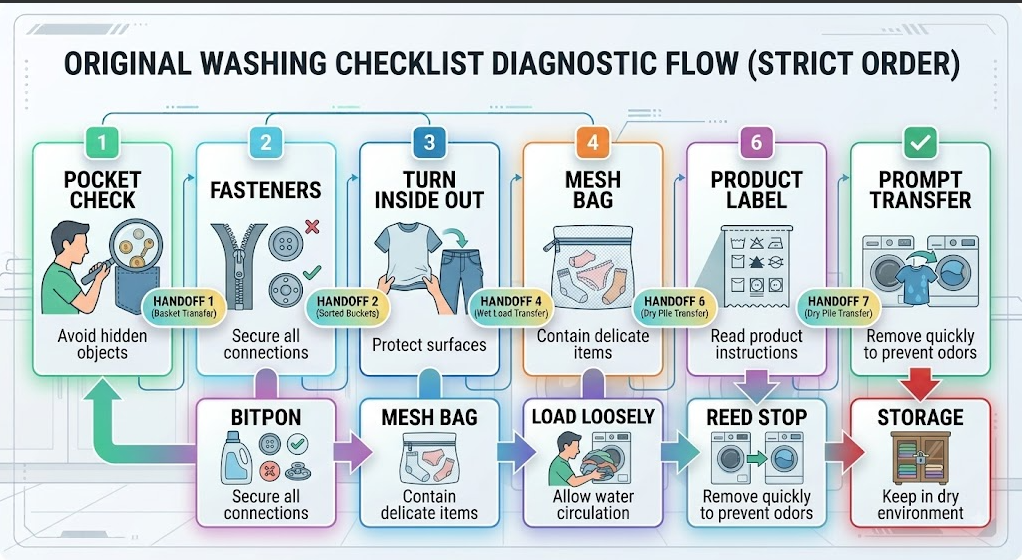
The best damage-prevention system is short enough to use on an ordinary day. Try this two-minute routine before starting each load:
- Empty pockets into a tray.
- Close zippers, hooks, snaps, and Velcro.
- Tie drawstrings and secure straps.
- Turn dark, printed, or delicate washable items inside out when appropriate.
- Put small, delicate, or snag-prone items in mesh bags.
- Remove items that conflict with the care label or load type.
- Load loosely enough for movement.
- Add only the correct product in the correct place.
- Set a transfer reminder.
- Inspect stains and heat-sensitive items before drying.
After drying, add a one-minute finish:
- Confirm thick seams, pockets, towels, and waistbands are fully dry.
- Separate repair, donation, and professional-care items from clean storage.
- Put clothes where they are actually used.
This routine may sound small, but it changes the household from damage repair to damage prevention. It also reduces blame. When pockets, zippers, wet loads, and storage decisions are built into the system, the outcome depends less on one person’s memory.
FAQ
Is it really necessary to empty every pocket?
Yes. A pocket check is one of the fastest ways to prevent lint, stains, washer scratches, melted items, and re-washing. Focus especially on pants, hoodies, jackets, uniforms, children’s clothing, and workwear.
Should zippers be open or closed in the wash?
Close zippers before washing. Open zipper teeth can snag other fabrics, catch on trim, or scratch surfaces. Also fasten hooks, secure Velcro, and tie drawstrings loosely to reduce tangling.
Do mesh laundry bags protect clothes?
They can help with delicate, small, strappy, or snag-prone washable items. They do not override the care label. If an item is professional-clean-only or not machine washable, a mesh bag does not make it safe for a normal cycle.
What happens if I overload the washer?
Overloading can reduce movement, trap soil, increase tangling, leave detergent unevenly distributed, and make rinsing less effective. Clothes need room to move. If overloading is routine, the household laundry schedule may need smaller or more frequent loads.
Can too much detergent damage clothes?
Too much detergent can leave residue, stiffness, dullness, odour, or poor rinsing. Use the product label as the starting point and adjust carefully based on load size, soil level, washer type, and residue signs.
Should I dry clothes if I am not sure a stain is gone?
No. Inspect stained areas before using dryer heat or an iron. If the mark remains, repeat a label-safe treatment or seek professional advice. Heat can make some stains harder to remove.
How do I stop forgetting wet laundry in the washer?
Assign the transfer step, not just the start step. Use a timer, phone reminder, washer signal, or visible note. If a load has sat long enough to smell, rewash it before drying and storing.
When should I stop and use professional cleaning?
Stop when the label requires professional care, the fabric or trim is fragile, dye transfers during testing, the item is valuable, or the contamination involves fuel, solvent, sewage, floodwater, pesticides, workplace chemicals, or unknown hazards.
Sources
- FTC – Clothes Captioning: Complying with the Care Labeling Rule
- LG USA Support – Sorting and Loading Your Front Load Washer
- American Cleaning Institute – Laundry Basics
- CPSC – Single-Load Liquid Laundry Packets: Harmful to Children
More in This Cluster: Laundry Systems
- How to Build a Laundry Routine That Actually Gets Finished
- Sorting Laundry: What Still Matters and What Can Be Combined
- How Much Laundry Detergent Should You Actually Use?
- How to Prevent Musty Towel Odours From Coming Back
- Air Drying vs Machine Drying: Which Is Better for Your Clothes?
- How to Treat Common Laundry Stains Before They Set
- Laundry Mistakes That Damage Clothes and Washers Too (you are here)