When Jerome was young, laundry seemed to disappear and return clean because his mother managed everything between those two moments. Living alone, he could wash a load, leave clothes on the bed, and find what he needed later. It was untidy, but one person’s shortcuts mostly affected one person.
Then laundry became four people’s clothing, children’s outfits, towels, and bedding. The work was no longer just putting clothes into a machine. Someone had to notice what was needed, collect it, separate it, start the right load, move it before it sat wet, dry it, match it, fold or hang it, and return it to the right place. A clean basket on the floor was not really finished if everyone still had to search through it the next morning.
That is the central decision in building a laundry routine: what system can your household reliably complete, from hamper to storage, before the next load creates a new bottleneck?
The answer may be a fixed laundry day, small loads throughout the week, or a hybrid. The best option is not the most elaborate schedule. It is the smallest repeatable system that keeps essential items available, protects special-care clothing, and makes unfinished work visible.
Practical rule: Define laundry as a six-stage loop—collect, sort, wash, dry, fold or hang, and put away. Schedule the whole loop, not only the washer.

Start With the Real Amount of Laundry
A routine designed for an imaginary household will fail in the real one. Before buying bins or assigning days, observe one ordinary week.
Count loads, not individual garments. Note which categories become urgent first:
- school or work clothes;
- underwear and socks;
- sports uniforms or activity wear;
- towels and washcloths;
- children’s sleepwear;
- bedding;
- reusable cleaning cloths; and
- special-care items that cannot join a routine load.
Also record the constraints around the machines. A household with an in-unit washer can respond to a full hamper differently from someone using shared machines, a laundromat, or a booked laundry room. A washer cycle may finish quickly while air-drying takes a day. A large washer paired with a smaller dryer creates a different bottleneck. Evening noise rules, utility-rate periods, work schedules, and the need to supervise young children can all change what is realistic.
You do not need a permanent spreadsheet. One week of notes is enough to answer three useful questions:
- How many routine loads does the household actually create?
- Which items cannot wait until the next planned laundry session?
- At which stage does clean laundry most often stop moving?
The third answer matters most. If wet clothes sit in the washer, the problem is not insufficient washing capacity; it is the transfer handoff. If clean clothes live in baskets, the problem is folding, hanging, or storage. If one missing uniform causes an emergency load, the problem may be priority planning rather than total volume.
Choose a Trigger: Calendar, Threshold, or Hybrid
There are three workable ways to decide when laundry starts.
A calendar routine
Specific categories have recurring times: clothes on Tuesday and Friday, towels on Saturday, bedding every other Sunday, for example.
This works best when household volume and weekly schedules are predictable. It makes responsibilities easy to see and helps people reserve enough time for drying and putting away. Its weakness is rigidity. A half-empty load may not need to run simply because the calendar says so, while a muddy week may exceed the schedule.
A threshold routine
A load starts when its designated hamper reaches a practical fill line or when a priority category is running low.
This works well when volume changes from week to week. It can reduce unnecessary small loads, but only if someone is clearly responsible for noticing the threshold. ENERGY STAR advises running full washer loads when possible because a clothes washer uses roughly the same amount of energy regardless of load size; the machine manual still controls the safe capacity and loading method.[1] “Full” does not mean compressed until items cannot move.
A hybrid routine
Most families benefit from combining the two. Set one or two protected completion windows each week, but allow an earlier load when a hamper reaches its line or an essential category falls below its reserve.
For example, a household might protect Wednesday evening and Saturday morning for complete laundry loops. Towels wait for Saturday unless their hamper fills first. A school-uniform load can move earlier when only one clean set remains. The calendar provides memory; the threshold prevents overflow and shortages.
Choose the approach that fits the household’s actual variability. A routine is successful when it catches changing demand without requiring constant mental tracking.
Design the Route Before You Assign the Work
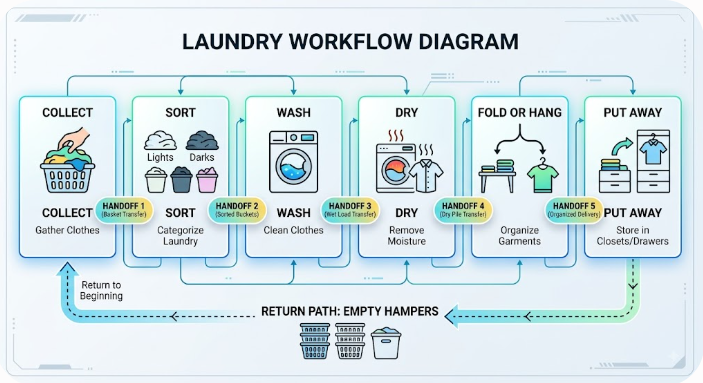
Every stage needs a place, a trigger, and a next action.
1. Collect
Put hampers where clothes come off, not where an idealized floor plan says they should go. A beautiful hamper in a distant laundry room will not capture socks left beside a child’s bed.
Use the fewest collection categories your household can maintain. One hamper per person can simplify ownership; shared hampers can reduce clutter. A separate container may be justified for towels, heavily soiled items, or special-care garments, but every extra category adds another rule.
2. Sort
At this stage, make only the decisions needed to create a safe load. Check care labels, isolate items requiring a different method, and separate categories your household has decided not to combine. The FTC’s Care Labeling Rule requires care instructions on covered clothing in the United States, and those instructions are the best starting point for how a specific garment may be cleaned.[2]
Detailed decisions about colour, lint, fabric weight, and soil belong in Article “Sorting Laundry What Still Matters and What Can Be Combined”. The routine only needs a dependable place for “not this load” items so they are not accidentally swept in.
3. Wash
Before pressing start, confirm that someone will be available when the cycle ends. Load according to the appliance manual, use the garment labels, and follow the detergent label rather than relying on a habitual capful. Detergent amount and dispenser choice belong in Article “How Much Laundry Detergent Should You Actually Use”.
Natural Resources Canada and ENERGY STAR both encourage full loads where practical and cold-water washing when suitable, because heating water uses energy.[1][3] That is an efficiency option, not permission to ignore a care label, hygiene need, detergent instruction, or machine setting.
4. Dry
The transfer from washer to drying is a time-sensitive handoff. Do not start a load if it is likely to sit forgotten overnight. CDC guidance written for healthcare laundry states that damp textiles should not be left in machines overnight and that equipment should be used according to manufacturer instructions.[4] An ordinary household is not a healthcare facility, but the operational lesson is sound: plan the transfer and avoid prolonged damp storage.
Machine drying and air drying have different capacity, fabric, time, energy, and indoor-humidity trade-offs. Article “Air Drying vs Machine Drying Which Is Better for Your Clothes” owns that comparison. In this routine, reserve enough dryer or rack space before the wash finishes.
5. Fold or hang
Attach this step to unloading, not to an undefined “later.” A clear folding surface, a set of destination baskets, and enough hangers matter more than a complicated folding technique.
Not every item needs folding. Underwear, sleepwear, cleaning cloths, or children’s play clothes may go directly into labelled drawers or bins if that works for the household. Spend precision where it prevents wrinkles, protects shape, or makes items easier to find.
6. Put away
Laundry is complete when items reach their assigned storage place and the empty hamper is available again. If putting away routinely fails, shorten the route. Give each person a destination basket, store children’s everyday clothes where they can help, or move frequently used linens closer to where they are needed.
Do not build a standard that only one meticulous person can satisfy. A slightly simpler system that four people use is more useful than a perfect system that depends on one exhausted adult.
Assign Ownership, Not Vague Help
“Help with laundry” is difficult to act on because it does not identify the stage or deadline. Divide ownership in complete, observable pieces.
One arrangement might be:
- one adult launches and transfers weekday clothing loads;
- another handles towels and bedding on the weekend;
- each family member brings a hamper to the collection point;
- children sort their clean clothes into simple categories and match socks; and
- the person who empties the dryer also clears the lint filter according to the appliance instructions and moves the load to its destination baskets.
The arrangement itself is not universal. The important features are that every handoff has an owner and that the less visible work—checking supplies, noticing shortages, reading a care label, and returning items—is not silently assigned to one person.
Children’s participation should match their age and ability. Sock matching, placing washcloths in a bin, or carrying an empty hamper can turn the routine into shared household knowledge. Jerome found that matching socks together could be enjoyable, and outgrown clothes became a quiet sign that the children were growing. Those moments do not remove the workload, but they can make it less invisible.
Protect the Bottleneck
Most laundry systems do not fail at every stage. They fail repeatedly at one.
If the bottleneck is collection, add a hamper where clothes accumulate.
If it is sorting, reduce the number of categories or add one clearly labelled special-care container.
If it is washer transfer, set a timer that ends when someone is home and able to move the load.
If it is drying capacity, wash fewer simultaneous loads or confirm rack and dryer space before starting.
If it is folding, remove unnecessary folding and prepare destination baskets first.
If it is put-away, simplify storage, reduce overfilled drawers, or give each person ownership of a basket.
Avoid solving every bottleneck with a purchase. A second hamper may fix collection, but no organizer can compensate for a load started at a time when nobody can finish it.
Create a Minimum Viable Routine for Hard Weeks

Illness, deadlines, travel, a new baby, and school transitions can overwhelm a routine. The answer is not to pretend the normal standard still applies. Use a minimum viable version:
- Identify the next three days of essential clothing and linens.
- Run one load that can be washed, dried, and put away completely.
- Keep special-care and stained items separate rather than risking damage in a rushed mixed load.
- Use destination baskets instead of creating a folding backlog.
- Reserve the next realistic completion window before starting another load.
When a large backlog already exists, do not start five loads simply because five loads are waiting. Begin with the item category causing the nearest shortage. Then move one load through the entire loop before launching the next, unless the machines and people can genuinely support overlapping stages.
A household may temporarily accept unfolded play clothes or delay nonessential bedding. That is prioritization, not failure. The goal is to restore the flow without damaging items or creating a room full of damp and half-finished work.
Review the System After Two Weeks
A new routine should be tested, not treated as a moral commitment. After two ordinary weeks, ask:
- Did anyone run out of an essential item?
- Which hamper overflowed first?
- Which load sat wet or clean for too long?
- Did the schedule create half-loads or emergency loads?
- Was one person still carrying all the noticing and follow-through?
- Did special-care or stained items have a safe waiting place?
- Could children or other household members complete their assigned stage?
Change one bottleneck at a time. Move a hamper. Shift a completion window. Reduce a sorting category. Add destination labels. Keep what worked.
Decision Summary
- Measure one real week before designing the routine.
- Identify the stage where laundry stops moving.
- Choose a calendar, threshold, or hybrid trigger.
- Define a complete loop: collect, sort, wash, dry, fold or hang, and put away.
- Follow garment care labels, product labels, and appliance instructions.
- Do not start a wash without a realistic transfer and drying plan.
- Assign named stages and deadlines, not vague requests to help.
- Simplify folding and storage until the whole household can use the system.
- Use a minimum viable routine during overloaded weeks.
- Review after two weeks and change the bottleneck, not everything at once.
The aim is not to make laundry impressive. It is to ensure that the clothes people need return clean, dry, wearable, and findable—without one person having to hold the entire household system in their head.
FAQ
Is it better to do one laundry day or a load every day?
Neither is universally better. A laundry day suits predictable volume and uninterrupted machine access. Smaller recurring loads suit limited drying space or categories that become urgent quickly. A hybrid—protected completion windows plus an earlier full-hamper trigger—often adapts best to family life.
How many laundry hampers does a family need?
Use the fewest that make the next decision easier. One per person may clarify ownership; shared hampers reduce clutter. Add a separate container only when it protects a meaningful category, such as special-care or heavily soiled items.
What counts as finishing a load of laundry?
A load is finished when it is dry and returned to its assigned storage place, with the hamper or basket ready for reuse. Stopping at the washer, dryer, or clean basket leaves work for someone else.
Should I wait until the washer is full?
Full loads are generally more efficient, but stay within the machine manual’s capacity and do not compress items so they cannot move as intended. An urgent essential-item load or a care-label exception may justify a smaller load.
How do I stop forgetting wet clothes in the washer?
Start loads only when someone can handle the transfer, use a timer tied to the expected finish time, and make the responsible person explicit. If forgotten loads continue, move washing to a different completion window rather than adding more reminders.
What should I do when the laundry backlog is overwhelming?
Prioritize the next few days of essential items, complete one load through put-away, isolate anything requiring special treatment, and schedule the next realistic window. Do not launch more loads than the household can dry and finish.
Sources
- ENERGY STAR – Clothes Washers
- FTC – Care Labeling of Textile Wearing Apparel & Certain Piece Goods
- Natural Resources Canada – Make Laundry Day More Energy Efficient
- CDC – Laundry and Bedding
More in This Cluster: Laundry Systems
- How to Build a Laundry Routine That Actually Gets Finished (you are here)
- Sorting Laundry: What Still Matters and What Can Be Combined
- How Much Laundry Detergent Should You Actually Use?
- How to Prevent Musty Towel Odours From Coming Back
- Air Drying vs Machine Drying: Which Is Better for Your Clothes?
- How to Treat Common Laundry Stains Before They Set
- Laundry Mistakes That Damage Clothes and Washers Too