You have a fixed amount available today. Rent, electricity, insurance, a car payment, and two credit-card minimums are due within days. There is no sequence in which the same dollars pay everything. The useful question is no longer, “How do I stay perfectly current?” It is: “Which payment protects the household from the most serious near-term harm, and what can I negotiate before the deadline?”
Reader decision: Use a bill-priority triage to protect immediate needs, compare the consequences of delay, contact providers with a specific proposal, and document a short-term plan for every unpaid balance.
Treat the pileup as a decision window
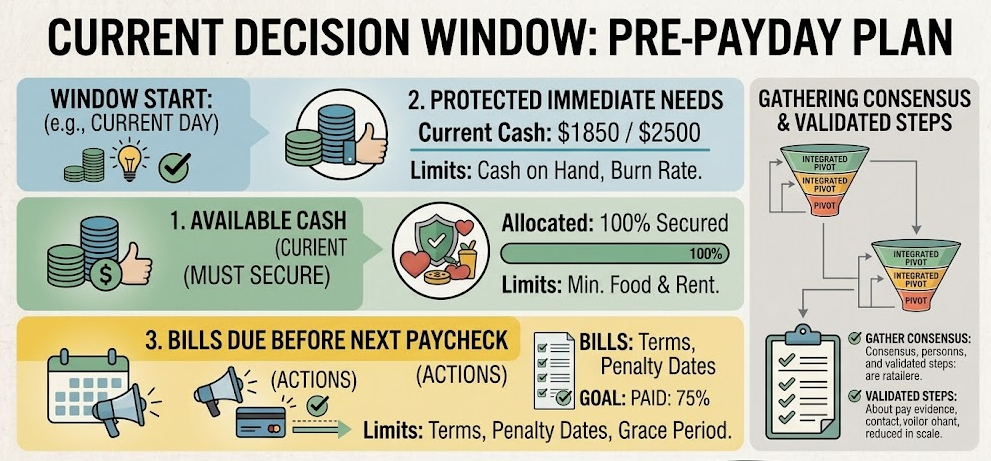
When bills crowd together, speed matters—but panic is not a payment strategy. Start by defining the window you are solving: today through the next dependable income date. Write down the cash that is actually available during that window. Do not include unused credit, an overdraft limit, hoped-for overtime, a tax refund that has not arrived, or money already committed to a payment in transit.
Then reserve what the household must use before the next dependable deposit:
- basic food and medication;
- transportation needed for work, school, medical care, or caregiving;
- essential childcare or caregiving;
- urgent health or safety needs; and
- any payment already initiated that cannot safely be stopped.
The remainder is the available bill cash. If it cannot cover every obligation due in the window, name the shortfall. A clear shortfall is easier to act on than a vague feeling that the account is “low.”
This is triage, not permission to ignore lower-priority bills. Every legitimate obligation still needs a plan. Triage decides what receives scarce cash first and where early contact may prevent a worse result.
Build one complete bill list
Collect statements, account screens, overdue notices, automatic-payment confirmations, and any letters mentioning service interruption, eviction, foreclosure, repossession, cancellation, default, collection, or court action. For each item, record:
- the amount required and total past due;
- the due date and current status;
- the date a payment would clear;
- the consequence of missing or delaying it;
- when that consequence could occur;
- whether a partial payment changes the outcome;
- the provider’s contact information; and
- any assistance or payment arrangement already offered.
Do not rely on the loudest reminder. A frequent call, bright warning banner, or large late fee can command attention without representing the greatest household risk. Conversely, a quiet notice may concern a service, vehicle, insurance policy, or legal obligation whose loss would be difficult to reverse.
Verify unfamiliar debts before paying. Use a trusted statement, the provider’s official website, or a phone number you independently confirm. Do not provide personal or financial information to an unexpected caller merely because the caller claims urgency.
Rank consequences, not companies
There is no universal bill order that works for every household or jurisdiction. The Consumer Financial Protection Bureau’s bill-prioritization guidance tells consumers who cannot pay everything to weigh the risks of not paying each bill. Apply that principle through five consequence questions.
1. Could delay threaten safe housing or essential service?
Review rent or mortgage, electricity, heating fuel, water, and other services necessary for health or habitability. Confirm the actual process and timeline. A due date, late-fee date, disconnection notice, eviction notice, and court date are not interchangeable.
Housing and utility rules vary substantially. Contact the landlord, servicer, utility, local assistance program, housing counselor, tenant service, or legal aid appropriate to your location. Do not assume that making an unagreed partial payment automatically prevents enforcement.
2. Could delay interrupt the household’s ability to earn income?
Consider transportation to work, required childcare, tools, licences, phone or internet genuinely required for work, and any other cost without which income may stop. A vehicle payment may carry repossession risk, but the practical importance of the vehicle also depends on whether safe alternatives exist. Insurance may be legally required or necessary to protect a critical asset.
The question is not whether an expense feels important. It is whether losing it would materially reduce the household’s ability to keep earning or meet essential responsibilities.
3. Could delay create an immediate legal or contractual consequence?
Court-ordered obligations, taxes, fines, support payments, insurance requirements, and secured debts can carry consequences unlike an ordinary late fee. Read the actual notice and obtain qualified local help when legal rights or deadlines are involved. Never ignore court papers; this article cannot determine legal priority for a particular jurisdiction.
4. Could delay create a serious health, safety, or coverage gap?
Medication, medically necessary equipment, essential insurance, and safety-related repairs may deserve protection even when they do not resemble a conventional monthly bill. Confirm whether an insurer offers a grace period and what happens to coverage; do not infer that coverage continues merely because payment can still be submitted online.
5. What is the financial and credit consequence if this payment waits?
For credit cards, unsecured loans, subscriptions, and other obligations, record late fees, interest, possible penalty terms, collection risk, and credit-reporting consequences. These matter, but they should be compared with the risk of losing housing, utilities, transportation, income, coverage, or compliance with a court order.
A high interest rate does not automatically make a debt today’s first payment. Debt-payoff optimization is a different decision from short-term bill triage.
Use the Bill-Priority Triage
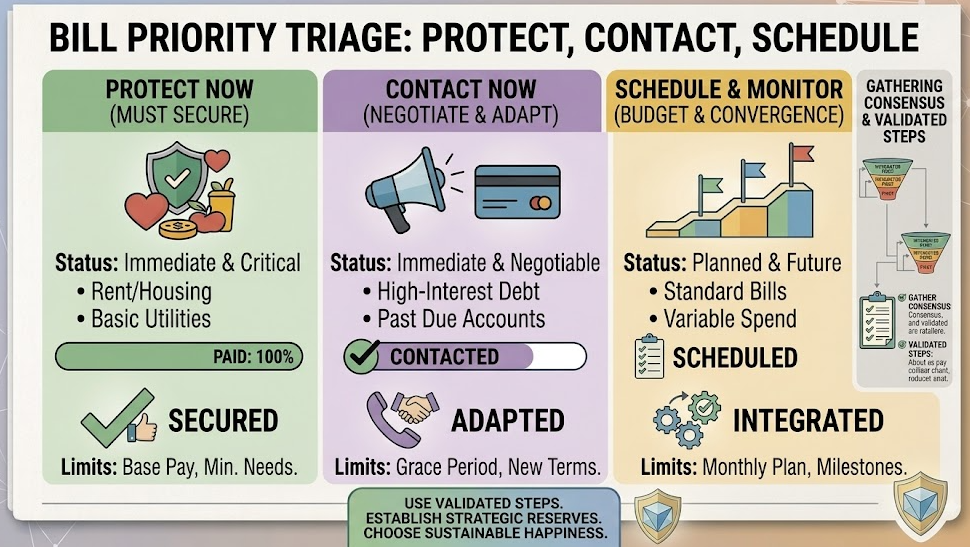
Create three working groups rather than pretending every item can be assigned a permanent rank.
Protect now
Place a bill here when delay within the current window could produce a severe and difficult-to-reverse consequence, and payment is the verified way to prevent it. Include the amount necessary to achieve that protection—not automatically the full balance. If a provider confirms that a smaller amount prevents interruption or keeps an arrangement active, record the confirmation.
Contact now
Place a bill here when you cannot pay as agreed, but the provider may offer a due-date extension, fee waiver, temporary lower payment, payment plan, hardship option, or other arrangement. Contact before the deadline when possible. Early contact does not guarantee help, but waiting can reduce options and add fees.
Schedule and monitor
Place a bill here only after you have considered its consequences and set a specific follow-up date. “Lower priority” does not mean forgotten. Record the unpaid amount, expected charges, next action, and the money or income event that will fund it.
Make contact with a workable proposal
Before calling, decide what you can truthfully offer. The CFPB advises credit-card customers who cannot make the minimum to explain why, state what they can afford, say when normal payments might resume, and request a specific temporary amount and duration. The same preparation improves conversations with many providers, although available options differ.
Use a concise structure:
“My income or expenses changed, and I cannot pay the full amount due on [date]. I can pay [amount] on [date]. My next dependable income is expected on [date]. What short-term options are available, and what would each option change about fees, interest, service, coverage, account status, or credit reporting?”
Ask precise follow-up questions:
- Does a partial payment prevent the consequence I am concerned about?
- Is there a hardship plan, extension, fee waiver, or different payment date?
- Will interest continue or the repayment period change?
- Will service, coverage, collateral status, or account access change?
- Does accepting the option affect credit reporting or future eligibility?
- When does the arrangement begin, and what must I pay next?
- Can you send the terms in writing or place them in my secure account?
Record the date, time, representative, reference number, terms, and next deadline. Read any written confirmation before sending money. If the written terms differ from the call, ask for clarification.
Do not promise an amount that competes with a higher-consequence need or depends on uncertain income. A small agreement you can keep is more useful than a reassuring promise that fails days later.
Control automatic payments during the shortage
Review every scheduled debit. An automatic payment can be useful when funded, but in a shortage it can take money reserved for food, medication, rent, or transportation and may trigger overdraft or returned-payment fees.
If you need to change or stop a payment, follow the bank’s and provider’s procedures and timing requirements. Cancelling an automatic debit does not cancel the underlying bill. Keep the obligation in the triage and contact the provider about what happens next.
Also check payments already pending. Counting cash without subtracting a debit in transit creates a second shortfall.
Test partial payments before using them
Partial payment is not automatically protective. Depending on the account and local law, it may reduce a balance without preventing late status, disconnection, cancellation, repossession, eviction action, or collection. It may also be applied in a way you did not expect.
Before paying less than required, ask:
- What exact result will this amount produce?
- Will the account still be considered late or in default?
- Does it stop or postpone the threatened action?
- Are there additional fees or interest?
- Is a formal arrangement required?
Obtain written confirmation when possible. Do not scatter small amounts across every creditor merely to feel that everyone received something if those payments protect nothing.
An illustrative triage
Assume $1,250 is available until the next paycheck. The household needs $350 for food, medication, and work transportation, leaving $900 in available bill cash. Bills due before payday total $1,700:
- $700 rent balance;
- $250 electricity notice;
- $300 car payment;
- $150 auto insurance;
- two $150 credit-card minimums.
The arithmetic shortfall is $800 after immediate needs: $1,700 due minus $900 available. That calculation does not determine the order. The household must verify consequences and dates.
Suppose the utility confirms that $125 under a written arrangement prevents disconnection, the insurer confirms $150 is required to avoid a coverage lapse, and the landlord agrees in writing to accept $625 now and $75 on the next paycheck. Those three commitments use the full $900. The household then contacts the auto lender and both card issuers immediately with realistic proposals and records the responses.
This example does not establish a standard hierarchy. If the vehicle is at immediate repossession risk and essential for income, if the rent notice has a later procedural deadline, or if local assistance covers the utility, the decision can change. The tool works by verifying consequences, not copying someone else’s order.
Avoid solutions that deepen the emergency
Be cautious about payday loans, cash advances, overdraft use, buy-now-pay-later plans, or new credit offered as an instant bridge. They can move the due date while adding fees, interest, or another mandatory payment. Compare total cost, repayment date, and effect on the next cash-flow window before borrowing.
Debt-relief scams also target people under pressure. The Federal Trade Commission warns against companies that demand upfront payment, guarantee fast debt reduction, or contact you unexpectedly seeking personal or financial information. Do not redirect bill money to a third party without verifying the organization, understanding the service, and receiving terms in writing.
Close the window with a written plan
At the end of the triage, every bill should have one of four statuses:
- paid or scheduled with adequate funds;
- covered by a confirmed arrangement;
- awaiting a documented response with a follow-up time; or
- unpaid with a known consequence and a specific next action.
Recalculate the account balance after scheduled payments and protected needs. Review the plan when any provider responds or money arrives—not only at month-end.
If the same pileup returns despite reliable income and adequate monthly totals, revisit the paycheck-to-bill matching work from the previous article. If recurring income does not cover recurring needs and obligations, timing changes and triage are not enough; the household needs a broader budget, income, cost, debt, or qualified-assistance response. The next article addresses building a one-month cash buffer, but that longer project should not delay today’s calls.
The goal of bill triage is not to make a shortage painless. It is to use limited cash deliberately, reduce avoidable harm, and replace silence with verified arrangements and dates.
FAQ
Which bill should I pay first when I cannot pay everything?
Start with verified consequences, not the loudest creditor. Protect immediate needs, then examine housing, essential services, ability to earn income, required coverage, legal obligations, and other serious near-term risks in your circumstances.
Should I pay a little toward every bill?
Not automatically. A partial payment may reduce a balance without preventing late status or another consequence. Ask what the exact amount will accomplish before dividing scarce cash.
Is it better to call before or after I miss a payment?
Before, when possible. Explain the problem, what you can afford, and when normal payment may resume. Options vary, so ask for specific terms and written confirmation.
Can a creditor refuse a payment arrangement?
Yes. Assistance is not guaranteed, and provider policies and legal requirements differ. Record the response, reassess the consequence, and seek qualified local help when housing, utilities, collateral, insurance, or court deadlines are involved.
Should I stop automatic payments if cash is short?
Review them immediately. A funded automatic payment may remain useful; an unfunded one may create overdraft or returned-payment costs. Follow the required cancellation procedure, and remember that stopping the debit does not cancel the debt.
Should I use a credit card or payday loan to cover the pileup?
Only after comparing the full cost and the next repayment window. Borrowing may postpone the shortage while making the following cycle harder. High-cost short-term credit deserves particular caution.
Where can I get help if housing or utilities are at risk?
Contact the provider and local housing, utility-assistance, legal-aid, or nonprofit financial-counseling resources promptly. In the United States, 211 may help locate local rent and utility resources; other countries and regions have different services.
Sources
- CFPB – Prioritizing Bills
- CFPB – Behind on Bills? Start With One Step
- CFPB – What Should I Do If I Can’t Pay My Credit Card Bills?
- FTC – How to Get Out of Debt
- FTC – Looking for Debt Relief? Here’s How to Avoid a Scam
- CFPB – Get Help Paying Rent and Bills
More in This Cluster: Cash Flow Management
- Cash Flow vs Budget: Why the Difference Matters
- How to Match Bills to Your Pay Schedule
- What to Do When All Your Bills Arrive at Once (you are here)
- How to Build a One-Month Cash Buffer
- Weekly vs Monthly Budgeting
- How to Manage Irregular Large Expenses
- Simple Cash Flow Systems for Busy Households