When payday arrives, Jerome feels a brief lift. Then the money begins leaving. Some of it goes to the credit card, some to utilities, and more to the regular costs of running a household. Friends who keep careful records seem to know every recurring amount—insurance, property tax, internet, rent or mortgage—and can picture the pluses and minuses in their heads. Jerome knows the broad shape, but not with the same precision.
Each month can feel like a matching game between take-home pay and outgoing payments. Yet payday also creates room for something enjoyable: dinner at a nearby restaurant with his wife and children, or beef added to the grocery cart. Those moments are part of family life, not proof that he does not care about money.
The more useful question is what the matching game is revealing. Is the household spending more than it receives over time? Or is enough money coming in overall, but arriving at the wrong time for the bills? Those are different problems, and they require different responses.
Reader decision: Determine whether your pressure comes mainly from an unsustainable monthly budget, a cash-flow timing gap, or both, so you work on the right problem first.
A budget and cash flow answer different questions
Over the whole period, is the money coming in enough for the money going out and the priorities I have chosen?
Consumer.gov’s basic budgeting guidance follows this logic: list monthly income, list bills and other expenses, and subtract expenses from income. A negative result means the plan is not balanced.
Cash flow adds sequence. It follows when money becomes available and when it must leave. The Consumer Financial Protection Bureau describes a cash-flow budget as tracking the timing of income and expenses so that enough is available from week to week. Its central question is:
At each point during the period, is enough usable money available for what is due next?
These views overlap, but neither replaces the other. A monthly budget can be positive while the account still runs short before payday. A cash-flow calendar can show exactly when the shortage happens, but rearranging dates cannot make a permanently negative budget sustainable.
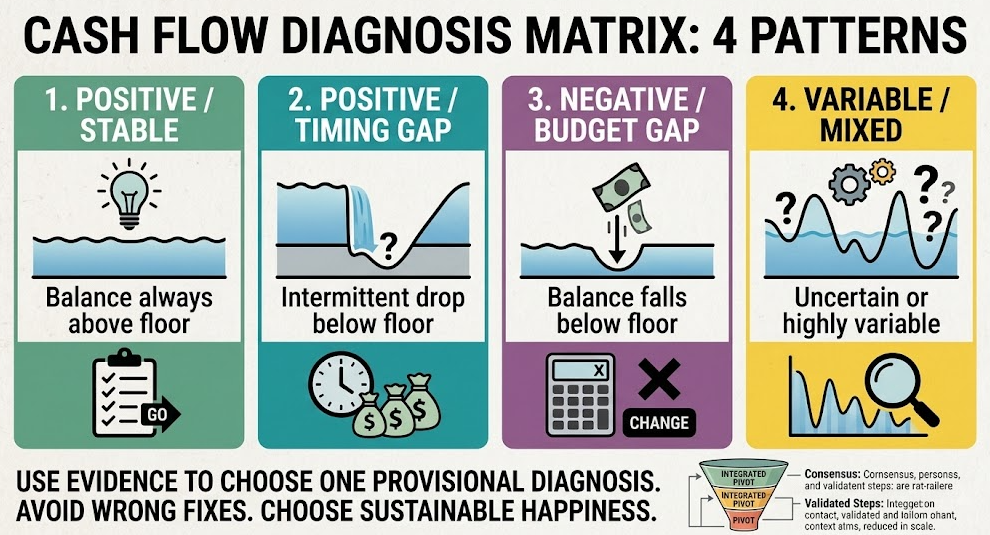
Four patterns that can look like the same money problem
The feeling “my paycheck disappears” can come from several underlying patterns.
1. The monthly plan is positive and the timing works
Income covers expenses and planned savings, and the balance stays adequate between deposits. That does not mean every purchase is effortless. It means the plan and the sequence are currently workable.
2. The monthly plan is positive, but timing creates a shortage
Suppose a household receives enough during the month to cover its obligations, but rent, insurance, a loan payment, and utilities are all due before the larger paycheck arrives. The month may end positive on paper while the account reaches an unsafe low point in the first week.
This is mainly a timing problem. The total matters, but the order is creating the immediate pressure.
3. The monthly plan is negative, but timing temporarily hides it
A paycheck may make the account look comfortable for a few days. If recurring expenses, ordinary living costs, minimum debt payments, and realistic savings needs exceed income, however, the positive balance is temporary. Moving due dates may reduce late-payment risk, but it cannot close the underlying gap.
This is mainly a budget problem, even if it first appears as a stressful bill week.
4. Both the total and the timing are unstable
Variable work hours, seasonal income, fluctuating utilities, medical costs, irregular support payments, or repeated overdrafts can make both views difficult. Averages may conceal low-income months, and one unusually good month may make the plan look healthier than it is.
This pattern needs two kinds of visibility: whether the household is sustainable across an appropriate period and when the lowest cash points occur within that period.
Use a Cash-Flow Diagnosis before choosing a fix
You do not need a complicated app. Use recent statements, pay records, bills, benefit dates, and a calendar. If one month is highly unusual, review several months rather than treating it as normal.
Step 1: Calculate the monthly balance
Start with money you can reasonably expect to receive during the period. Use take-home income rather than gross pay when take-home pay is what reaches the household. Include other dependable resources that are actually available for household expenses, while respecting restrictions on benefits that can be used only for particular purposes.
Then list realistic outflows:
- fixed obligations such as housing, insurance, minimum debt payments, childcare, and subscriptions;
- variable necessities such as groceries, transportation, utilities, and medication;
- savings or reserve contributions you have deliberately chosen;
- discretionary spending, including ordinary enjoyment rather than an imaginary month with none;
- a realistic share of periodic costs when they are already known.
Subtract planned outflows from available inflows.
- Positive: The period has a surplus on paper.
- Near zero: Small changes may turn the result positive or negative.
- Negative: Timing changes alone will not make the plan sustainable.
Do not force the result to look balanced by using wishful estimates. A budget that assumes groceries, fuel, children’s needs, or all enjoyment will cost nothing is not a decision tool.
Step 2: Put the money on actual dates
Now place each deposit and withdrawal on the date it usually occurs. Include automatic payments, transfers to savings, cash spending, card payments, and predictable weekly costs. A credit-card purchase and the later card payment should not be counted twice; decide whether your working view records spending when it happens or cash when the card bill is paid, and use that view consistently.
If an amount varies, use a cautious estimate or a range. If the date varies, mark the earliest reasonable date. Precision is useful only when it reflects reality.
Step 3: Follow the running balance
Begin with money that is genuinely available—not an overdraft limit or unused credit. Add income when it becomes available and subtract expenses when they are expected to clear. The CFPB’s cash-flow tool carries each week’s ending balance into the next week’s beginning balance; the same logic can be used daily, weekly, or by pay period.
The important number is not only the ending balance. Find the lowest-balance point: the smallest projected balance before the next inflow.
A month that ends with $300 can still contain a day at negative $80. Conversely, a low balance that never crosses the household’s required floor may feel uncomfortable without creating an actual payment failure.
Step 4: Mark volatility and uncertainty
Add a note beside amounts or dates that are not dependable. Useful labels are:
- Stable: amount and date are generally predictable;
- Variable amount: date is known, amount changes;
- Variable date: amount may be known, arrival or withdrawal date changes;
- Irregular: neither amount nor date is dependable.
This prevents a tidy calendar from creating false confidence. A projected balance based on guaranteed wages is not equivalent to one based on hoped-for overtime.
Step 5: Name the diagnosis
Use the evidence, not the emotion of payday, to choose one provisional diagnosis:
| Monthly balance | Lowest-balance pattern | Likely diagnosis | What that means now |
|---|---|---|---|
| Positive | Stays above the required floor | Plan and timing currently fit | Monitor; avoid creating complexity without a problem |
| Positive | Drops below the required floor before income arrives | Primarily a timing gap | Preserve the surplus while examining sequence |
| Negative | May stay positive briefly after payday | Primarily a budget gap | The total must change; date changes are only supportive |
| Unclear or highly variable | Repeated uncertain low points | Mixed or insufficient evidence | Track a longer or more representative period |
This diagnosis is not a moral grade. It is a way to avoid applying a timing fix to an amount problem—or cutting valued parts of life when the real problem is a cluster of due dates.
A simple example: positive month, negative week
Imagine a household starts the month with $200. It expects two take-home paychecks of $2,200, for $4,400 of income. Planned monthly outflows total $4,100. The budget therefore shows a $300 surplus.
But the first paycheck arrives on the 10th. Rent, insurance, utilities, and ordinary spending before then total $1,150. The household is $950 short before the first paycheck, even though the month as a whole is positive.
That does not automatically mean the household “cannot afford” its entire lifestyle. It means the current starting balance and timing cannot carry the first ten days. The following article in this cluster addresses how to compare bill dates with pay dates. For this diagnosis, the important point is that reducing the restaurant meal by a modest amount would not by itself explain or close a $950 early-month gap.
Now change the example. If monthly outflows are $4,650 against $4,400 of income, the household is $250 short for the month. A later due date may delay the pressure, but the deficit remains. The diagnosis has changed.
Why payday spending deserves context, not blame
When money has felt tight, spending shortly after payday can look like the obvious cause. Sometimes it is relevant. A cluster of unplanned purchases can deepen a low point, and the diagnosis should include them honestly.
But “discretionary” does not mean “meaningless.” A meal out, a preferred grocery item, a child’s activity, or a small celebration may carry real value. Removing every enjoyable expense can produce a plan that nobody wants to follow while leaving a large structural gap untouched.
A better test is proportional:
- What did the spending cost over the full period?
- Did it materially cause the lowest-balance problem?
- Was it planned, occasional, or repeating more often than intended?
- What would change if it were reduced?
- Would the household still face a deficit or timing gap afterward?
This protects two truths at once: ordinary enjoyment belongs in a realistic life, and repeated spending still has consequences. The purpose is not to defend or condemn the purchase. It is to measure what problem it actually creates.
Common mistakes when comparing cash flow and a budget
Looking only at the account balance on payday
The balance is a snapshot before later obligations. Subtract what is already committed before deciding what is available.
Using a monthly average for irregular income
An average can help with long-range planning, but it may overstate what is available in a low-income month. Mark variability and test a conservative period.
Treating a credit limit as income
Credit can move a payment into the future, but it does not increase household income. Interest and fees may enlarge later outflows.
Counting money twice
Transfers between your own accounts are not new income. Likewise, inconsistent treatment of credit-card purchases and card payments can duplicate expenses.
Ignoring pending and automatic transactions
The displayed account balance may include money that is already spoken for. Work from the projected available balance after known commitments.
Assuming every shortage is a discipline failure
Low income, high essential costs, unstable hours, benefit delays, caregiving, disability, emergencies, and unavoidable price changes can create gaps that careful recordkeeping cannot erase. Clear diagnosis helps identify the scale of the problem; it does not guarantee that an easy fix exists.
Decide what kind of next step is justified
After one representative cycle, choose the smallest accurate conclusion.
If the budget is positive but timing fails
Your next question concerns sequence: which obligations arrive before which income, and how large is the gap? Do not automatically cut the entire budget before confirming that the total is the problem.
If the budget is negative
The plan needs a change in amounts, income, obligations, or some combination. Timing work may still prevent a late fee or reduce a dangerous low point, but it is not the main solution.
If both are unstable
Use a longer view and distinguish dependable income from variable income. Avoid building fixed commitments around the best month. The later articles on irregular large expenses and simple household systems will address parts of this situation without pretending that all volatility can be eliminated.
If the plan works but feels restrictive
Check whether the plan includes values as well as obligations. A sustainable plan may include a bounded amount for family enjoyment. The right amount depends on priorities and constraints; it is not supplied by a universal percentage.

The distinction that changes the decision
A budget tells you whether the totals can work. Cash flow tells you whether the sequence can work. You need both views when bills and income do not arrive together.
For Jerome, the disappearing-paycheck feeling is a useful signal, but not yet a diagnosis. The family meal is visible; housing, utilities, insurance, debt, and future obligations may be larger but less emotionally vivid. Putting totals and dates side by side shows which part of the pressure comes from the amount, which comes from timing, and which comes from uncertainty.
That distinction does not end the monthly matching game. It makes the next move more accurate—and leaves room to enjoy ordinary life without asking one pleasant evening to carry the blame for an entire financial system.
FAQ
Is cash flow the same as income minus expenses?
Not quite. Income minus expenses gives the net result for a period. Cash flow also considers when each inflow and outflow occurs and how the available balance changes along the way.
Can I have a good budget and still run out of money before payday?
Yes. A monthly surplus can coexist with a temporary shortage when several payments are due before income arrives. Confirm the running balance rather than relying only on the month-end total.
Can changing bill dates fix a negative budget?
No. It may reduce timing pressure or late-payment risk, but it does not close a recurring gap when total expenses exceed total income.
Should savings count as an expense in this exercise?
Include planned transfers to savings as outflows in the cash-flow view because the money leaves the spending account. In the broader budget, label them as savings rather than consumption so you can see their purpose and adjust deliberately if circumstances require.
How long should I track cash flow?
Start with at least one representative month. Use several months or a longer planning period if income, benefits, utilities, or major expenses vary substantially.
Does using a credit card improve cash flow?
It can postpone when cash leaves the account, but it creates an obligation and may add interest or fees. It changes timing; it does not create income or erase the cost.
What if I cannot cover food, housing, utilities, or medication?
Prioritize immediate safety and essential needs. Contact relevant service providers, local assistance programs, qualified nonprofit financial counselors, or emergency resources in your jurisdiction. A tracking framework should not delay urgent help.
Sources
- CFPB – Creating a Cash Flow Budget
- Consumer.gov / FTC – Making a Budget
- CFPB – An Essential Guide to Building an Emergency Fund
- CFPB – Improving Cash Flow
More in This Cluster: Cash Flow Management
- Cash Flow vs Budget: Why the Difference Matters (you are here)
- How to Match Bills to Your Pay Schedule
- What to Do When All Your Bills Arrive at Once
- How to Build a One-Month Cash Buffer
- Weekly vs Monthly Budgeting
- How to Manage Irregular Large Expenses
- Simple Cash Flow Systems for Busy Households