You may already have the ingredients of a career decision scattered across browser tabs, notes, course pages, saved job postings, and conversations. The friction appears when none of them has a date, a spending limit, or a clear reason for happening before something else.
A 12-month career plan turns that evidence into a sequence. It does not predict exactly when an employer will hire you, guarantee that a training program will run, or require you to resign by a chosen month. Its purpose is to make the next year deliberate: to identify the outcome you are working toward, schedule the actions you control, and define when new evidence should change the plan.
The strongest plan is not the most ambitious one. It is the one you can keep using when work becomes busy, a course is cancelled, an experiment challenges your assumptions, or the target role proves different from what you expected.
Reader decision: Choose a realistic 12-month outcome, sequence the evidence and preparation required for it, and decide in advance when to continue, revise, pause, or change direction.
Define the year by a decision-ready outcome
Start with what should be true at the end of 12 months. Avoid goals that depend entirely on another person, such as “I will be hired as a product manager by June.” You can influence that result, but you cannot schedule it like an appointment.
Use an outcome that combines a direction with evidence you can produce:
By [date], I will be ready to decide or compete for [specific next step] because I will have [evidence, qualification, experience, or validated conditions].
Examples include:
- being ready to apply for entry-level roles with two relevant work samples and verified local requirements;
- deciding whether a credential is justified after completing a prerequisite and testing the work in a closer setting;
- being ready to seek an internal move after demonstrating a target skill in two bounded assignments;
- deciding not to proceed after testing a critical condition and identifying a better alternative.
That last outcome is not failure. A plan that prevents an expensive mismatch has produced value.
Keep the outcome narrower than a complete reinvention of your working life. If you are still uncertain about the occupation, the year may end with a well-supported commitment decision rather than a job change. If the direction is already well supported and entry requirements are clear, the year may reasonably include applications. Match the outcome to the evidence you actually have, not to the urgency you feel.
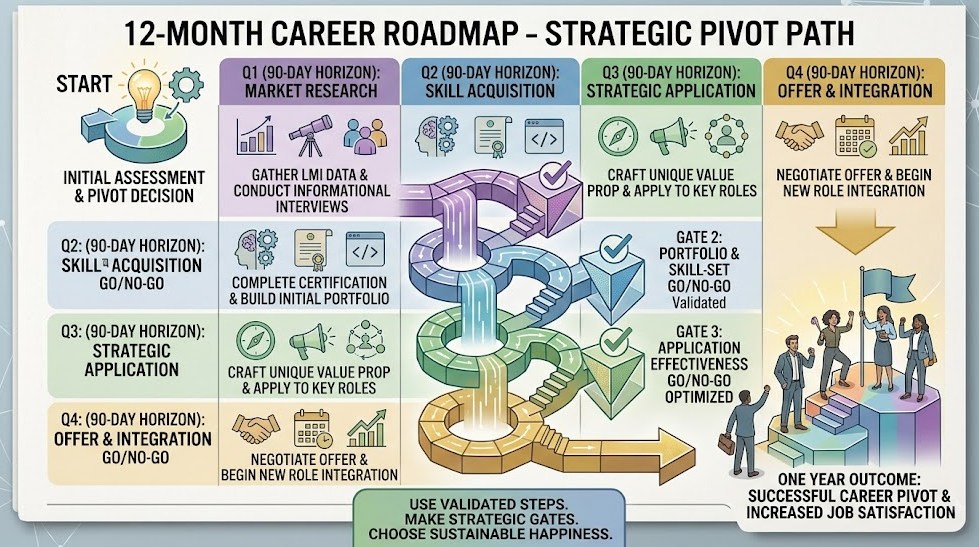
Build a 12-Month Career Roadmap
Use one page or a simple document that you will review. The roadmap has seven parts.
1. Year outcome
Write the end-of-year statement and the date. Add two boundaries:
- What this outcome includes: the decision, evidence, or readiness you intend to reach.
- What it does not promise: an employer decision, a fixed salary, a guaranteed admission, or another result outside your control.
This distinction prevents a useful plan from being judged solely by whether an external event happened on schedule.
2. Evidence milestones
Work backward from the outcome. Ask what would have to be demonstrated, verified, completed, or decided first. A milestone should change what you know or what you are ready to do.
“Take a course” is an activity. “Produce a work sample that meets three criteria used in current postings” is an evidence milestone. “Network” is vague. “Complete two informational interviews with deliberately different perspectives and verify the claims that affect my plan” is bounded.
Choose three to six major milestones for the year. Too many milestones make everything look equally important. Typical categories are:
- confirm a requirement or remove a major uncertainty;
- complete a prerequisite or foundational skill block;
- produce evidence of ability;
- test a work condition or constraint;
- compare readiness with current opportunities;
- make a defined commitment decision.
Use the tools from your earlier exploration as inputs. Do not repeat an assessment merely because planning feels safer than acting. Reopen a question only when new evidence materially challenges it.
3. Four 90-day horizons
Divide the year into four planning horizons rather than assigning 52 weeks at once.
| Horizon | Main purpose | Typical question |
|---|---|---|
| Days 1–90 | Remove the most consequential uncertainty and establish capacity | Is this direction justified enough for further investment? |
| Days 91–180 | Build or test the first material requirement | Can I do the preparation under real constraints? |
| Days 181–270 | Produce stronger evidence and compare it with current reality | Is my readiness becoming credible for the next step? |
| Days 271–365 | Consolidate evidence and make the next commitment decision | Apply, continue building, revise, pause, or stop? |
The horizons are not mandatory career stages. A licensing pathway, apprenticeship, degree, caregiving season, or irregular work schedule may require a different sequence. Their value is that they keep distant work visible while allowing the next 90 days to remain specific.
For each horizon, identify one primary milestone, one supporting milestone, and one review date. If everything is primary, the plan has not made a choice.
Put commitments on a real calendar
A plan becomes operational when it competes honestly with the rest of your life. Estimate the hours required for learning, projects, travel, administration, conversations, and recovery. Then decide where those hours will come from.
Use three levels of commitment:
- Appointments: fixed events such as course sessions, application windows, examinations, or scheduled conversations.
- Work blocks: recurring periods for practice, research, portfolio work, or preparation.
- Review gates: protected times to examine evidence and change the plan.
Do not schedule to your theoretical maximum. A plan that requires every evening and weekend to go perfectly is already fragile. Leave capacity for illness, overtime, family obligations, and the slower pace of unfamiliar work.
Set a minimum viable week: the smallest action that preserves continuity during a difficult period. It might be one 45-minute practice block, one application-quality improvement, or one administrative step. The minimum is not the desired pace; it is a bridge that prevents one disrupted week from turning into abandonment.
If your employment, health, disability, or caregiving responsibilities make a weekly rhythm unrealistic, use monthly capacity instead. The planning unit should fit your life rather than conceal it.
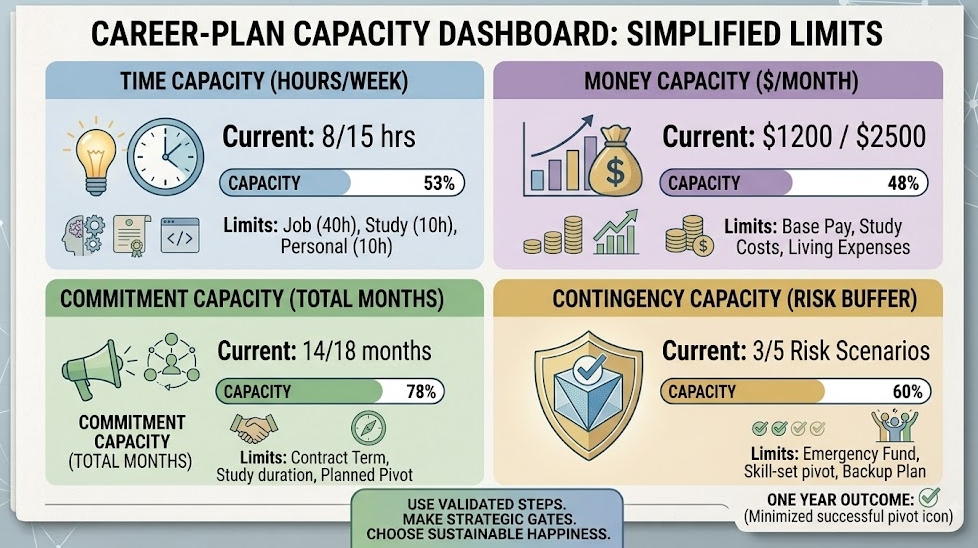
Set a resource ceiling before spending
Career plans can quietly accumulate tuition, subscriptions, travel, equipment, exam fees, reduced work hours, and unpaid time. Record both direct costs and opportunity costs before committing.
Create three limits:
- Money ceiling: the maximum you can spend during the year without undermining essential obligations or emergency stability.
- Time ceiling: the sustainable hours available in an ordinary month, not an unusually easy one.
- Commitment ceiling: the point beyond which you will not enrol, resign, relocate, or take on debt without a formal review.
Verify prices, refund rules, prerequisites, schedules, and financial-aid conditions with the relevant provider. Do not assume that a credential is required because it is marketed to career changers. Compare the expense with the gap it is meant to close and the evidence employers or regulators actually require.
Where costs are uncertain, plan ranges rather than false precision. Keep a contingency amount or reduce the scope. A lower-cost sequence may take longer but protect your ability to continue.
Use decision gates, not automatic escalation
Every major investment should have a gate before it. A gate is a scheduled decision based on evidence, not a reward for having stayed busy.
At each gate, ask:
- What did I expect to learn or produce?
- What evidence now supports the direction?
- What evidence challenges it?
- Which assumption remains consequential and unverified?
- Have my time, money, health, or family constraints changed?
- Is the next step the smallest one that can answer the next important question?
Choose one of four decisions:
- Continue: the direction remains supported and the next investment is justified.
- Revise: the direction may still fit, but the sequence, target, pace, or method needs to change.
- Pause: current constraints make further investment imprudent, but the evidence does not reject the direction.
- Stop or redirect: evidence now supports a different path or shows that a critical condition is unacceptable.
Do not let money or time already spent decide the next step. Completed work may still have transferable value, but past investment does not make a weak next investment stronger.
Plan for dependencies and failure points
Some milestones depend on dates or decisions you do not control. Training may have one annual intake. An examination may require approval. A manager may decline a stretch assignment. Hiring may slow. Childcare, transportation, immigration status, benefits, health, or income stability may constrain the available routes.
For each critical milestone, record:
| Field | Question |
| Dependency | What must happen first, and who controls it? |
| Earliest confirmation date | When can I verify availability or eligibility? |
| Failure signal | What would show that the planned route is no longer viable? |
| Fallback | What lower-risk action preserves progress or evidence? |
| Replan date | When will I choose rather than wait indefinitely? |
A fallback should serve the same evidence need when possible. If a course is cancelled, an alternative may be a supervised project or another recognized provider—not an unrelated certificate chosen merely to remain busy. If an employer-controlled opportunity does not appear, decide whether an external project, different employer type, or longer timeline is appropriate.
Safety, discrimination, harassment, serious health concerns, unlawful conduct, or immediate income risk should not be forced through a slow annual planning cycle. Use appropriate professional, organizational, legal, medical, or emergency support as the situation requires. The roadmap supports career development; it does not replace urgent protection or individualized advice.
Track evidence, not just completion
A row of checked boxes can hide a year of low-value activity. For every meaningful action, capture the result in one sentence:
Action → Evidence produced → Decision affected → Next justified step
For example:
Completed a short data-cleaning project → learned that I can sustain the technical work but need stronger quality-control habits → target remains plausible → repeat with review criteria before paying for advanced training.
This record makes quarterly reviews easier and prevents memory from turning a mixed experience into a simple success or failure. It also shows when several activities are producing the same weak evidence and a different method is needed.
Do not measure progress mainly by hours, certificates, messages sent, or applications submitted. Those may be useful process measures, but the plan exists to improve readiness and decisions. Include quality measures connected to the milestone: an external standard met, a requirement verified, a work sample completed under realistic constraints, or an assumption revised after conflicting evidence.

Review monthly, decide quarterly
Use a short monthly review to maintain the plan:
- update completed and delayed actions;
- compare actual time and cost with the budget;
- record new evidence;
- schedule the next month’s work blocks;
- identify one dependency that needs early attention.
Use the 90-day gate for larger decisions. Do not redesign the entire plan every time a week goes poorly. Conversely, do not wait until month 12 to acknowledge that a prerequisite, cost, or work condition has invalidated the sequence.
When you revise, preserve the reason. Write: “Version 2 changes X because evidence Y affected decision Z.” This turns adaptation into accountable planning rather than drift.
A practical first 30 minutes
To start, create one page and complete these fields:
- 12-month outcome and date
- Evidence already available
- Most consequential remaining uncertainty
- Three to six yearly milestones
- First 90-day primary milestone
- First calendar action
- Money and time ceilings
- First review gate
- One critical dependency and fallback
Then schedule the first action and review. Do not spend the first month perfecting the template. The roadmap should be detailed enough to guide the next commitment and light enough to change when reality supplies better information.
A good 12-month career plan does not lock you into the person you imagined becoming today. It gives you a disciplined way to invest, learn, and change course without confusing motion with progress.
FAQ
Should a 12-month career plan end with a new job?
Not necessarily. The right outcome may be application readiness, completion of a verified prerequisite, a supported decision to pursue training, or a decision not to proceed. Use an outcome appropriate to your current evidence and constraints.
How many goals should I include?
Use one primary year outcome and roughly three to six major milestones. Supporting tasks can sit underneath them. More goals do not make the plan stronger if they compete for the same limited time and money.
What if I do not know exact course or hiring dates yet?
Record the dependency, the earliest date you can confirm it, a fallback, and a replan date. Do not build the rest of the year on an unverified schedule.
How often should I review the plan?
Maintain it briefly each month and hold a deeper decision gate about every 90 days. Review sooner when a critical assumption, cost, requirement, or personal constraint materially changes.
Should I quit my current job to make faster progress?
Not by default. Treat resignation, debt, relocation, or major income reduction as a high-commitment gate requiring verified requirements, a realistic financial assessment, and evidence that lower-risk steps are insufficient.
What if I fall behind in the first few months?
Compare the plan with your actual capacity and identify the cause. Reduce scope, change the sequence, or extend the timeline when appropriate. A delay is information; it is not automatically evidence that the career direction is wrong.
Can I use the same plan after changing direction?
Yes, but revise the outcome, milestones, evidence gaps, and resource assumptions. Keep useful transferable evidence and record why the direction changed rather than simply replacing the title at the top.
Sources
- CareerOneStop – Set Career Goals
- OPM – Career Development
- OPM – Talent Management
- OPM – Performance Management Cycle