One phrase can change the meaning of an outreach message: “I am looking for information, not asking about a job.” It tells the recipient what you want, limits the implied obligation, and keeps a career conversation from becoming a disguised application.
That distinction matters because an informational interview is not a shortcut to employment. It is a brief, focused conversation with someone who has first-hand experience of a role, workplace, training route, or career transition you are investigating. Used well, it can reveal the routines, variations, and trade-offs that occupational profiles and job postings cannot fully show. Used poorly, it can produce little more than one person’s opinion—or make the other person feel that a sales pitch has been hidden inside a request for advice.
The goal is not to collect contacts or seek approval for a career idea. It is to close a specific evidence gap and leave knowing what one person’s experience can support, what it cannot, and what you should verify next.
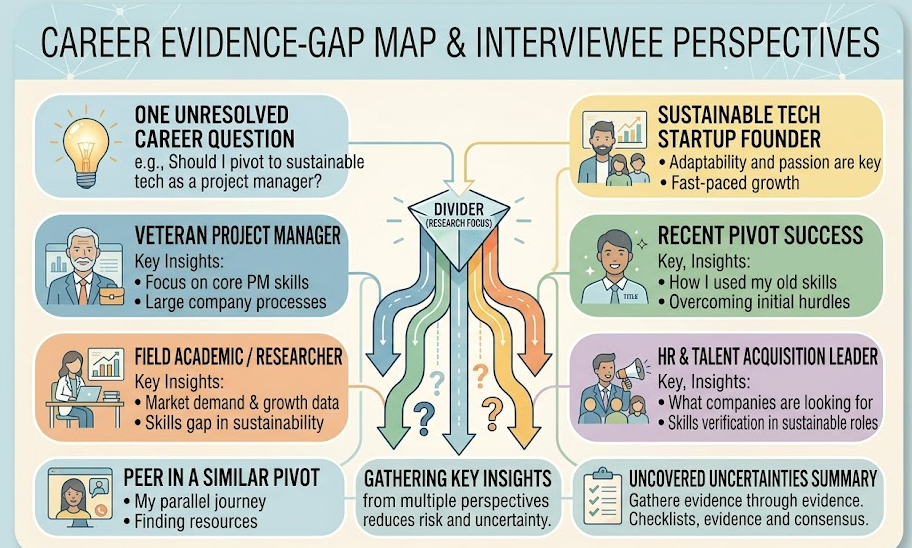
Reader decision: Decide whom to approach, what uncertainty the conversation should reduce, and how much weight to give the answers before taking a career step.
Start with the gap, not the person
A prestigious title does not automatically make someone the right interviewee. The useful person is the one whose experience is close to the question you need answered.
Suppose your research says a role can be remote, but current postings are inconsistent. A senior executive may explain company strategy, while a recently hired worker can describe how location rules operate in an entry-level role. If you are comparing two training routes, someone who entered 15 years ago may have a compelling story but outdated knowledge of current screening. If you want to understand a career change, a person who followed the conventional path may not be able to explain the transition you face.
Before searching for names, write one sentence:
I need to understand whether [specific condition] is common, variable, or unusual for [specific role, level, employer type, or location].
Use the Variable, Unverified, or Contradicted claims in your Career Research Dossier. Choose a gap that public sources cannot resolve well: how work is divided on a real team, what beginners commonly misunderstand, how much client contact a specialty involves, or why similar employers implement the same occupation differently.
Do not use a conversation to replace an authoritative source. A worker can describe the license they hold; the regulator should confirm what the law currently requires. A manager can describe a salary range at one employer; reliable labor-market data and current postings provide broader context. The interview is strongest when it explains variation rather than pretending to settle every fact.
Build an Informational Interview Brief
Prepare a one-page brief before you send a request. It keeps the conversation proportionate and helps you choose questions for a reason rather than copying a generic list.
1. Career hypothesis
State the direction you are considering narrowly enough to discuss.
“I am exploring entry-level operations roles in midsize healthcare organizations, especially work that combines process improvement with cross-team coordination.”
This is more useful than “I am thinking about business.” It gives the other person enough context without asking them to decide your future.
2. Evidence gap
Name the uncertainty that could change your next step. Examples include:
- how much of the week is spent on the task that attracts you;
- what distinguishes entry-level work from senior work;
- whether a schedule or travel pattern varies by employer;
- which entry requirements are truly screened and which are merely preferred;
- what someone with a nontraditional background must demonstrate;
- which burdens or routine tasks career descriptions tend to understate.
3. Right perspective
Describe the person who could speak closest to that gap. Consider role, seniority, specialty, employer type, geography, and recency of entry. For entry-level reality, a newer practitioner may be more informative than a director. For hiring criteria, a hiring manager may be more appropriate than a peer. For daily work, the worker doing it is usually more useful than a general recruiter.
No single interviewee needs to cover everything. Two people with deliberately different perspectives can be more informative than two people with impressive but similar backgrounds.
4. Priority questions
Choose five to seven questions that serve the evidence gap. Keep optional questions in reserve. A short conversation rarely improves when you rush through a long checklist.
5. Evidence limits
Write what this person cannot establish: the whole occupation, every employer, current law outside their jurisdiction, your personal fit, or a guaranteed route into the field. Naming the limit before the call makes it harder to overinterpret a confident answer afterward.
Find people without treating access as entitlement
Start with places where some relationship or shared context already exists:
- colleagues, former colleagues, classmates, friends, and family connections;
- alumni networks, career centres, workforce programs, or professional associations;
- speakers, authors, or practitioners whose public work directly relates to your question;
- employees in a relevant function or employer type, approached through an appropriate professional channel.
Look for relevance, not celebrity. A person with a smaller public profile may have more direct knowledge of the role and level you are considering.
Respect privacy and organizational boundaries. Use contact information made available for professional communication. Do not hunt for personal phone numbers, repeatedly switch channels when someone does not answer, contact subordinates to bypass a refusal, or imply a referral that was not actually offered. In sensitive fields, a worker may be unable to discuss clients, cases, systems, security, or internal decisions. Ask about patterns and processes, not confidential details.
Write a request that is easy to understand and decline
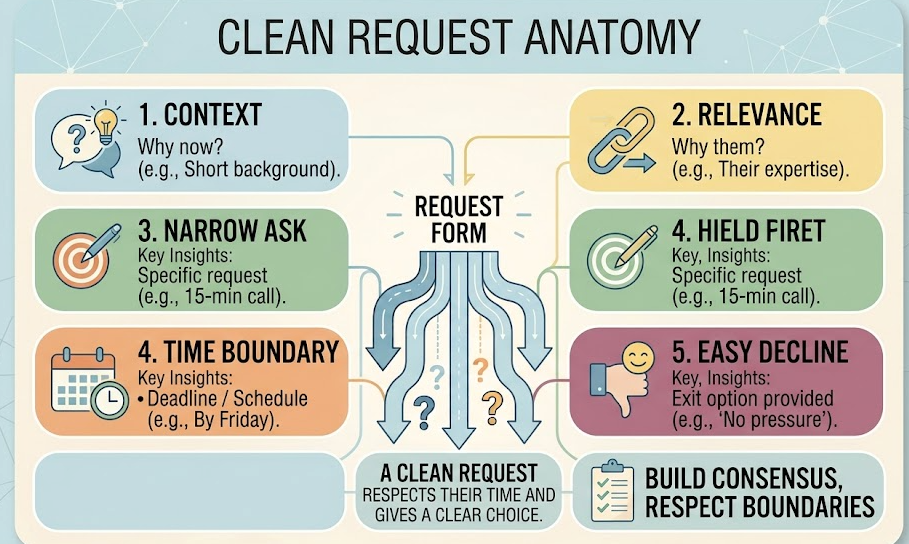
A useful request answers five questions quickly:
- Who are you?
- Why did you choose this person?
- What specific area are you researching?
- How much time are you asking for?
- Are you seeking information rather than a job?
For example:
Subject: 20-minute question about entry-level museum registration work
Hello Ms. Chen,
I am researching museum registration as a possible career direction and found your presentation on collections moves through the provincial association. I am trying to understand how entry-level staff divide their time among documentation, coordination, and hands-on collections work. If you are open to it, would you have 20 minutes for a phone or video conversation in the next few weeks? I am seeking career information, not asking about an opening. I am happy to work around your schedule, and I understand if you are unavailable.
Thank you for considering it,
[Name]
Personalize the reason, not with exaggerated praise but with a genuine connection between their experience and your question. Offer a short, bounded time. Do not attach a résumé unless it is requested or clearly useful to the conversation. Do not ask them to review a portfolio, introduce you to a hiring manager, or solve your career plan in the first message.
One polite follow-up after a reasonable interval is usually enough. Silence is not permission to escalate. Move to another appropriate person without interpreting nonresponse as a judgment of you.
Ask questions that reveal work, variation, and evidence
Begin with what the person has directly experienced. Open-ended questions invite detail; comparison questions reveal variation; evidence questions help separate a pattern from an impression.
Questions about actual work
- What activities take most of your time in a normal week?
- Which recurring task is least visible to people outside the role?
- What decisions do you make independently, and what requires approval or coordination?
- What makes a difficult week difficult in this work?
Questions about variation
- Which parts of your experience are specific to this employer, specialty, or location?
- How does entry-level work differ from the work of someone more senior?
- Where have you seen this role structured differently?
- Which conditions have changed since you entered the field?
Questions about entry and preparation
- What evidence helped you get your first relevant opportunity?
- Which skills are expected on entry, and which are normally learned after hiring?
- What do newcomers often invest in that employers value less than they expect?
- If someone entered from my kind of background, what gap would they need to address first?
Questions that test an assumption
- I found conflicting information about [schedule, credential, travel, remote work, or task]. How does it work in your setting?
- I have assumed that [specific claim]. Where is that accurate, and where does it break down?
Avoid asking for private salary history, protected personal information, confidential employer data, or gossip about named colleagues. You can ask how compensation is structured, which public ranges are realistic for a level, or what factors create variation—while making it easy for the person not to discuss figures.
Do not ask, “Would I be good at this?” after a short conversation. The person does not have enough evidence. Ask what the work requires and compare that evidence with your own inventory and experiments.
Lead the conversation without performing a job interview
At the start, thank the person, restate the purpose, and confirm the agreed end time. Briefly explain your career hypothesis and evidence gap, then let the other person do most of the talking.
Listen for examples. If someone says the work is “fast-paced,” ask what creates the pace: volume, deadlines, interruptions, emergencies, staffing, or client expectations. If they say a credential is “necessary,” ask whether it is legally required, required by their employer, common among strong applicants, or simply helpful. The follow-up turns a label into usable evidence.
Take notes only with consent and in a way that does not disrupt the conversation. Ask before recording; laws and workplace policies differ, and a participant may reasonably decline even where recording is lawful. Treat the conversation as private unless the person explicitly agrees otherwise. Do not publish quotes, screenshots, contact details, or internal information without clear permission.
Monitor the time yourself. Near the agreed end, say that you want to respect their schedule and ask your final priority question. Continue only if they clearly invite it. You may ask whether another type of perspective would help, but do not pressure them for names. If they offer a referral, ask whether you may mention them and how they prefer the introduction to be made.
Convert the conversation into bounded evidence
Within a day, review your notes using four labels:
| Label | What belongs here | How to use it |
|---|---|---|
| Observed in this setting | What the person directly does or has seen | Evidence for that role, employer, level, and period |
| Personal interpretation | Preferences, advice, and conclusions | A perspective, not a general fact |
| Broader claim to verify | Claims about pay, demand, credentials, or the whole field | Check against current authoritative or multiple independent sources |
| New question | Variation or uncertainty the conversation exposed | Research, test, or ask a deliberately different person |
This prevents a vivid story from outweighing stronger evidence. A satisfied worker does not prove that you will be satisfied. A frustrated worker does not prove the occupation is poor. Their experience may accurately describe a particular setting while being unrepresentative elsewhere.
Compare the answer with your dossier. If two people disagree, do not average their opinions. Look for the variable: employer size, union coverage, seniority, specialty, location, business model, shift, or year of entry. A disagreement can be the most useful result because it shows where your original question was too broad.
Finish with a bounded conclusion:
This conversation supports ____ for [specific setting]. It challenges ____. I still need to verify ____. My next justified step is ____.
That next step may be another interview with a contrasting perspective, a check of an official source, or a small experiment. It is not automatically an application, enrolment, resignation, or major career commitment.

Follow up without turning gratitude into a campaign
Send a brief thank-you message soon after the conversation. Mention one specific insight and, if appropriate, the verification or exploration it prompted. Correct any promise you made—for example, sending a public resource—but do not create an obligation for ongoing mentoring.
Keep the person’s details securely and use them only for the professional purpose reasonably expected. Do not add someone to a mailing list, send repeated updates, or treat the conversation as consent to future requests. If you later have a meaningful update, one concise message may be welcome; continued contact should develop through mutual interest, not a networking quota.
An informational interview has succeeded when you understand the decision better, including reasons not to proceed. A referral, friendship, or job lead may occur, but none is owed and none is required for the conversation to have value.
A final check before you send the request
- Can I name the evidence gap in one sentence?
- Is this person close to the role, level, setting, or transition I need to understand?
- Does my message explain the relevance and make the time boundary clear?
- Have I said that I am seeking information, not a job?
- Are my priority questions answerable from this person’s experience?
- Have I avoided confidential, intrusive, or easily researched questions?
- Do I know what this conversation cannot prove?
- Am I prepared to accept no response or a refusal gracefully?
If these answers are clear, the request is ready. The purpose is not to sound perfectly polished. It is to make a respectful exchange possible and to gather evidence at the level it deserves.
FAQ
How long should an informational interview be?
Ask for a short, defined conversation—often about 20 minutes—and follow the time the other person agrees to. A focused 15-minute call can be useful; a longer conversation is appropriate only when the participant invites it.
Should I ask for a job at the end?
No. If you requested an informational conversation, keep that promise. You may ask where opportunities are normally posted or what evidence employers value, but converting the meeting into an unannounced application can undermine trust.
Is it acceptable to contact someone I do not know?
Yes, when you use an appropriate professional channel, explain the specific relevance, make a modest request, and make refusal easy. Do not pursue private contact details or repeatedly message someone who has not responded.
How many informational interviews do I need?
There is no universal number. Seek enough deliberately varied perspectives to understand the material differences affecting your decision. One conversation is rarely sufficient for a broad claim; additional conversations should fill a gap, not merely increase a count.
Can I record the conversation?
Only with explicit permission and after checking applicable law and workplace policy. Consent to talk is not consent to record. Written notes are often sufficient and may allow a more natural exchange.
What if two people give conflicting advice?
Identify the conditions behind each answer—role level, employer, specialty, location, timing, or personal preference. Verify factual claims independently and seek another perspective only if the disagreement matters to your decision.
Should I send my résumé beforehand?
Not by default. Send it when the person requests it or when reviewing your background is an agreed part of the conversation. Otherwise, a short description of your situation and the question you are researching is usually enough.
Sources
- CareerOneStop – Informational Interview
- BLS – Informational Interviewing: Get the Inside Scoop on Careers
- U.S. DOL, Veterans’ Employment and Training Service – Department of Labor Employment Workshop
- CareerOneStop – Thank-You Notes