You have an occupational profile open in one tab, a salary page in another, and six job postings that seem to describe six different careers. One employer wants a degree. Another emphasizes experience. A third uses the same title for work that barely resembles the first two.
This is not necessarily bad research. It is often the moment when a career idea stops being a label and starts becoming a real decision. The differences reveal what is typical, what varies, and what still needs verification.
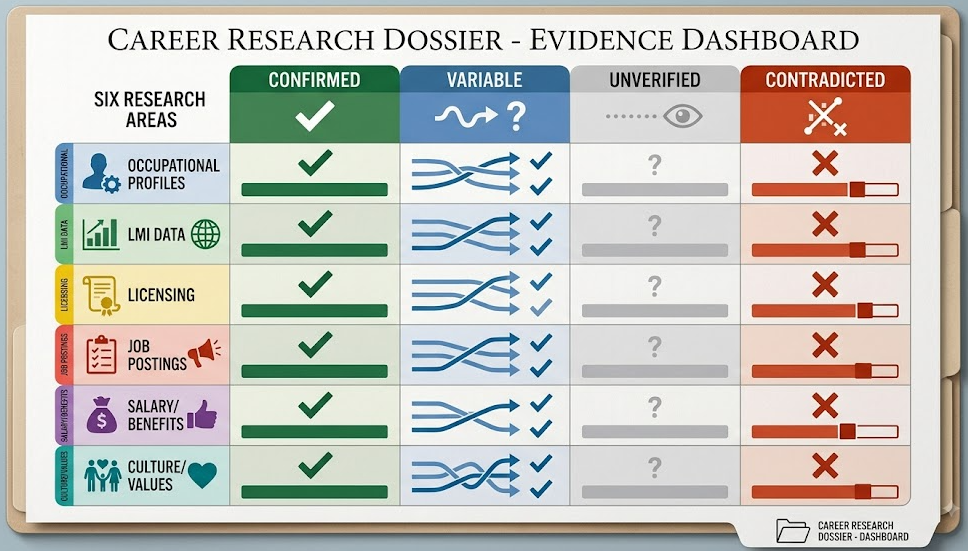
Quick answer: Research a career by comparing several kinds of evidence, not by trying to find one perfect description. Confirm the occupation’s recurring work and work context; check entry requirements, licenses, pay, outlook, and local demand; then compare current job postings and employers. Record each important claim as Confirmed, Variable, Unverified, or Contradicted. Commit only as far as the evidence supports. Occupational statistics describe groups, not your individual outcome, and national averages may not represent your location, specialty, or target employer.

Research the Decision, Not Just the Occupation
Career research is most useful when it begins with a decision question. “Tell me about cybersecurity” is too broad. “Could an entry-level security analyst role in my region meet my schedule and income constraints without a new degree?” is researchable.
Bring forward the provisional direction from the earlier articles in this cluster:
- the conditions you want from the next role;
- the skills, interests, constraints, and gaps you can currently support with evidence; and
- whether you are investigating a role, employer, occupation, or field change.
Do not rebuild those tools. Convert their uncertain points into questions. If your Role Reality Brief says travel is unacceptable, research how often target roles actually travel. If your Career Evidence Inventory marks a credential gap as assumed, check whether employers and regulators truly require it. If your Change-Level Diagnosis points to a field change, compare the same occupation across at least two fields.
Use a specific working target: an occupational title or code, likely level, location, and type of employer. Titles are inconsistent, so treat the target as provisional. Your first task is to determine whether different sources are discussing the same work.
Build a Career Research Dossier
Create one page or spreadsheet with six sections:
| Research area | Question to answer | Useful evidence |
|---|---|---|
| Occupation identity | What work does this title actually represent? | Official occupational profiles, alternative titles, task descriptions |
| Work and setting | What would I repeatedly do, and under what conditions? | Tasks, work activities, work context, schedules, travel, physical and social conditions |
| Entry path | What is legally required, typically expected, or merely preferred? | Licensing authority, occupational profile, current postings, employer career pages |
| Rewards and market | What pay range and demand are plausible in my location and segment? | Official wage data, projections, local data, current postings |
| Employer variation | How does the occupation change by organization, industry, or specialty? | Multiple employer sites and postings, organizational reports, credible public materials |
| Evidence gaps | What cannot be answered confidently from published information? | Contradictions, missing local data, questions for later testing or conversations |
For every decision-critical claim, record the source, geography, publication or update date, and what the source actually supports. Then assign a status:
- Confirmed: several suitable sources agree, including the authority that controls the requirement when relevant.
- Variable: the answer legitimately differs by employer, specialty, location, or level.
- Unverified: you have a claim or impression but not enough reliable evidence.
- Contradicted: credible sources disagree in a way that affects the decision.
These labels are not confidence scores produced by a validated instrument. They are an EverydayWise editing device for keeping facts, variation, and assumptions separate.
Step 1: Confirm That You Are Researching the Right Occupation
Begin with an official occupational profile. In the United States, the Bureau of Labor Statistics Occupational Outlook Handbook describes typical duties, work environment, entry education and training, median pay, and outlook. O*NET adds detailed tasks, work activities, work context, worker requirements, and training and credential links. CareerOneStop provides occupation profiles and comparison tools. Readers elsewhere should use the corresponding national statistical agency, occupational classification, regulator, and public employment service.
Search alternative titles and read the tasks, not just the summary. “Program manager,” “business analyst,” “technician,” and “consultant” can cover substantially different work. Conversely, employers may use different titles for similar work.
Test the occupational identity with three questions:
- Which recurring tasks appear across official profiles and current postings?
- Which attractive or unattractive tasks appear only under certain employers or specialties?
- Are you comparing entry-level work with senior work, or employee work with freelance or managerial work?
If the sources describe different core activities, split the target. It is better to research two narrower possibilities than to average incompatible jobs into a career that does not exist.
Step 2: Investigate the Workday and Work Context
Job descriptions often emphasize outcomes and qualifications while saying less about the repeated experience of doing the work. Research both what workers do and the conditions in which they do it.
Look for evidence about:
- the share of time spent creating, analyzing, selling, supervising, documenting, traveling, or responding to problems;
- independence, decision authority, pace, deadlines, and interruption;
- contact with customers, patients, students, the public, or other teams;
- remote, office, outdoor, vehicle, laboratory, clinical, industrial, or changing-site work;
- typical schedules, on-call expectations, seasonal peaks, and overtime;
- physical demands, safety equipment, exposure, and travel; and
- how the work changes with seniority, specialty, employer size, and industry.
BLS notes that an Occupational Outlook Handbook work-environment profile may cover hours, travel, physical activity, safety equipment, and injury risk. O*NET defines work context as the physical and social factors affecting the nature of work. These are useful starting points, but they describe an occupation broadly. A target employer may organize the same work differently.
Mark broad occupational conditions separately from employer practices. “Some roles require travel” is not the same as “this employer expects 50 percent travel.” If a condition is a Must Have or Will Not Accept item, do not settle for vague language such as “occasional,” “flexible,” or “fast-paced.” Record the ambiguity.
Step 3: Separate Legal Requirements From Market Preferences
The phrase “you need” can hide several different claims:
- a government license or legal authorization;
- a credential required by a professional body or for a protected title;
- typical education reported for an occupation;
- a particular employer’s screening requirement;
- a commonly preferred qualification; or
- one person’s opinion about the safest path.
Verify them in that order. For regulated work, the licensing or regulatory authority in the place where you intend to work is the controlling source. CareerOneStop’s License Finder can locate U.S. state requirements, but the relevant state agency should confirm the current rule. Requirements may differ by state and can include education, examinations, supervised hours, background checks, fees, renewal, or continuing education.
Then compare a meaningful sample of current postings. Do not count every phrase as mandatory. Separate “required,” “preferred,” and “equivalent experience accepted.” Note whether the same requirement appears across employers, and whether postings at your actual target level differ from occupational averages.
“Typical education needed for entry” in BLS data is a classification of what workers usually need to enter an occupation. It does not mean every worker has that credential, every employer must require it, or a degree alone makes someone competitive. Before purchasing education or certification, identify the precise barrier it is intended to remove. Detailed decisions about programs and credentials belong to later Learning content; this article only verifies whether the barrier exists.
Step 4: Read Pay and Outlook Without Turning Them Into Promises
Pay research should answer a bounded question: what range appears plausible for this occupation, level, geography, and employer segment?
Start with an official median or distribution, then narrow it with local or regional data when available. Compare annual and hourly figures carefully. Check whether the source covers wage-and-salary workers, self-employed workers, bonuses, commissions, overtime, or benefits. BLS occupational wage data, for example, do not cover every form of work or every component of compensation.
Next, review postings that disclose pay and compare industries or employers. A national median is not an entry-level offer, a guaranteed salary, or a local budget. A posted range may also be wide and may not reveal where a new hire is likely to land.
Treat outlook similarly. The current BLS Occupational Outlook Handbook uses 2024–2034 projections. These are modeled long-term estimates, not a forecast of your personal odds. BLS states that projections do not predict future labor shortages or surpluses. Projected openings are annual averages over a decade and can include openings created when people leave an occupation, even when total employment is declining.
Ask four separate questions:
- Is total employment projected to grow, remain relatively stable, or decline?
- How many openings are expected relative to the occupation’s size?
- Are openings driven mainly by growth or by replacement and occupational transfers?
- What does current evidence show in the location and specialty where you would compete?
Do not use one growth percentage as a verdict. A growing occupation can still be difficult to enter in one city or specialty. A declining occupation can still have replacement openings. Local demand, required experience, applicant supply, and timing all matter.
Step 5: Compare Employers, Not Just Job Titles
Choose several organizations that employ the target occupation. Include variation where relevant: large and small employers, different industries, public and private organizations, or different service models.
For each employer, examine:
- the products, services, customers, or public mission that create the work;
- the team in which the role sits and what it appears responsible for;
- current and archived job descriptions where available;
- location, schedule, travel, and work-arrangement language;
- required and preferred qualifications;
- advancement routes and adjacent roles;
- public information about financial or organizational stability; and
- whether the employer’s claims are specific enough to verify.
Company videos and employee stories can reveal vocabulary, settings, and questions worth investigating. They are curated material, not independent proof of daily reality. Reviews and social posts may surface patterns, but anonymous accounts can be incomplete, outdated, role-specific, or manipulated. Use them as leads, not verdicts.
A strong employer comparison often turns a supposed occupational fact into a variable. One organization may combine analysis with client sales; another may separate those functions. One may require frequent travel; another may centralize the work. That variation matters if it changes whether the career meets your constraints.
Step 6: Reconcile the Evidence
Do not hide disagreement by choosing the source you prefer. Investigate why two sources differ.
Common explanations include:
- different occupational titles or classification codes;
- national versus local data;
- median pay versus a posted hiring range;
- entry-level versus experienced roles;
- legal minimum versus employer preference;
- different industries or specialties;
- employee versus self-employed work; and
- sources updated in different years.
Use a simple reconciliation table:
| Decision claim | Status | Best evidence | What could explain variation? | Next verification |
| Core work includes substantial client contact | Variable | Official tasks plus 8 postings | Employer service model | Compare two target employers |
| A license is required in my state | Confirmed | Current state regulator | Other states differ | Record renewal and transfer rules |
| Entry pay meets my minimum | Unverified | National median only | Level and geography | Find local wage data and posted ranges |
| Remote work is common | Contradicted | Postings conflict with commentary | Specialty and employer policy | Narrow to target segment |
The goal is not to eliminate all uncertainty. It is to prevent an unverified assumption from carrying the weight of a major commitment.
Decide How Far the Evidence Supports You Going
Finish the dossier with one of three research conclusions:
Go deeper
The occupation’s central work, setting, entry path, and plausible rewards fit well enough to justify further investigation. Critical requirements have been verified, and remaining uncertainty can be tested without a major commitment.
Keep as an alternative
The direction has credible promise, but one or more material conditions vary. Name the employer, specialty, location, credential, or timing condition that must be true.
Pause before investing
A critical requirement conflicts with your current constraints, the desired version of the occupation appears unusually rare, or the evidence needed to justify training, resignation, relocation, or debt is still missing. “Pause” is not a permanent rejection. It means the present evidence does not yet support the cost.
Write the conclusion as a decision statement:
I am considering [specific occupation/level/location]. The evidence confirms ____. It varies on ____. Before I invest [time, money, relocation, or job exit], I still need to verify ____.
Published research cannot answer every question. A small experiment can test whether you like an activity or can build relevant evidence; that belongs to the next article. An informational interview can explore variation that public sources cannot resolve; that belongs to article 6. Neither should replace authoritative licensing rules or reliable labor-market data. The final article will turn a sufficiently supported direction into a 12-month plan.
Good career research does not make the future certain. It makes the remaining uncertainty visible—and keeps a compelling title, salary figure, or employer story from making the decision alone.
FAQ
How many job postings should I review?
There is no universal number. Review enough relevant postings to see recurring and variable requirements across several employers. Ten carefully matched postings may be more useful than 100 that mix levels, locations, specialties, or different occupations. Record the sample and do not treat it as a complete labor-market survey.
Which career information source should I trust most?
Match the source to the claim. Use regulators for licensing and legal requirements, official statistical and occupational sources for broad duties and labor-market data, and employers for their own current roles. Use multiple sources when the decision depends on variation. No single source reliably answers every career question.
What if official profiles and job postings disagree?
Check the title, occupational code, location, level, industry, and update date. Official profiles describe an occupation broadly; postings describe one employer’s current need and may include aspirational requirements. Mark the claim Variable or Contradicted until you can explain the difference.
Does a high job-growth rate mean it will be easy to get hired?
No. Growth projections describe expected employment change across an occupation. They do not measure your qualifications, local applicant competition, employer screening, or timing, and BLS does not use its projections to predict shortages or surpluses.
Is median pay what I should expect as a beginner?
No. The median is the point at which half of covered workers earn more and half earn less. It includes workers with different experience, locations, industries, and responsibilities. Use entry-level postings and local wage data to develop a more relevant range.
Should I enroll in training before finishing career research?
Not merely because training is frequently advertised. First confirm the exact role, the legally required or commonly accepted entry routes, your actual gap, and whether employers recognize the proposed credential. Research can establish the need; later evaluation should compare specific learning options, cost, time, and outcomes.
Can career research replace talking to people or trying the work?
No. Published sources are better for broad occupational structure, requirements, and labor-market data. Conversations and small experiments may clarify employer variation and personal fit. Use each evidence type for the question it can answer, and do not let personal testimony override a regulator or official requirement.
Sources
- BLS – Occupational Outlook Handbook
- O*NET OnLine Summary Report Help
- CareerOneStop Toolkit
- CareerOneStop – License Finder Help
- BLS – Employment Projections Frequently Asked Questions
- BLS – Occupational Separations Methodology FAQs
More in This Cluster: Career Direction
- How to Identify What You Want from Your Next Role
- Skills, Interests, and Constraints
- Career Change vs Job Change
- How to Research a Career Before Committing (you are here)
- Testing a Career Direction with Small Experiments
- How to Use Informational Interviews
- Creating a 12-Month Career Plan