Career advice often begins with a deceptively simple instruction: find what you are good at and what you enjoy. That can produce useful clues, but it leaves out the conditions under which a career decision must actually work.
You may be good at a task you do not want to perform all week. You may be interested in a field but unwilling or unable to accept its training cost, schedule, location, physical demands, or income uncertainty. You may also dismiss an option because you do not yet have one visible credential, even though much of your existing experience could transfer.
The goal of a career self-inventory is therefore not to discover a hidden “perfect fit.” It is to assemble enough evidence to decide which directions deserve investigation—and which do not deserve your time right now.
Quick answer: Build a career self-inventory in four parts: skills you can support with evidence, interests that repeatedly hold your attention, constraints that shape what is workable, and gaps between your current position and a possible role. Classify each item by confidence and flexibility. Then use the combined picture to create three lists: directions to explore now, directions to explore only if a condition can be resolved, and directions to set aside for the present. No assessment score, skill, or constraint should make the decision alone.

Why One List Is Not Enough
Skills, interests, and constraints answer different questions.
- Skills: What can you currently do, and what evidence supports that claim?
- Interests: What kinds of subjects, problems, and activities draw your attention?
- Constraints: What conditions must a realistic option respect?
- Gaps: What would have to change before you could enter or perform well in a role?
Blending them produces weak conclusions. “I am not qualified” may describe a trainable gap, a legally required credential, or simply unfamiliarity. “I love technology” identifies a broad subject interest, not whether you want to code, sell, teach, repair, analyze, regulate, or manage technology. “I cannot travel” is not evidence of low ambition; it is a condition that removes some roles and leaves many others.
The categories become useful when they remain separate long enough to reveal trade-offs.
Part 1: Identify Skills From Evidence
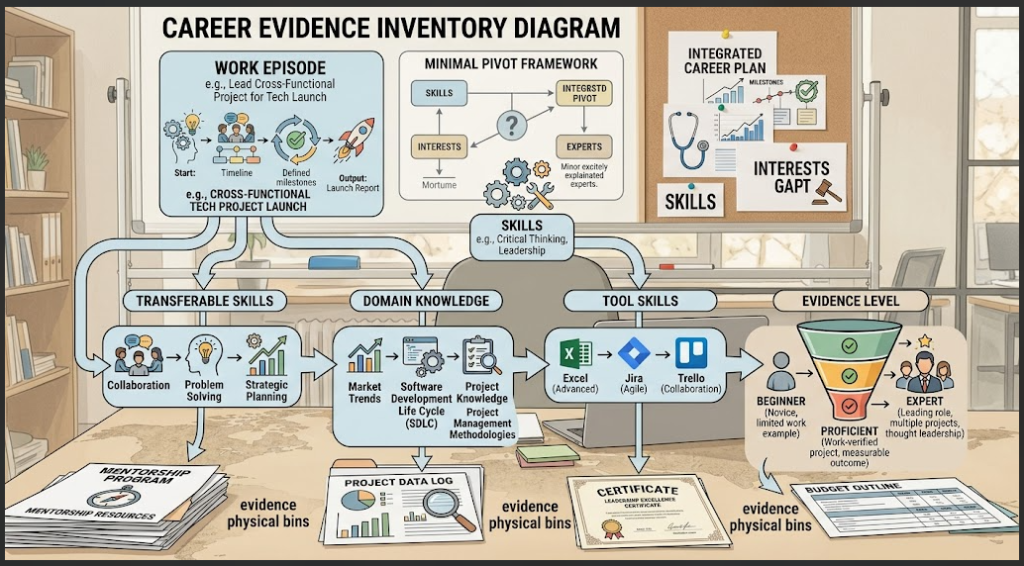
Start with episodes, not adjectives. Words such as organized, strategic, creative, and good with people are too broad until they are connected to something you did.
Review paid work, education, volunteering, caregiving, community responsibilities, side projects, and difficult personal projects. For each example, write:
- Situation: What needed to happen?
- Action: What did you personally do?
- Result: What changed, improved, finished, or became possible?
- Conditions: What tools, support, authority, time, and context helped?
“Managed a project” becomes more informative when written as: “Coordinated five contributors, built a weekly schedule, identified late dependencies, and delivered the event by the fixed date.” That statement contains planning, coordination, communication, monitoring, and problem-solving. It also gives you evidence that can be checked rather than a flattering label.
Separate Three Kinds of Capability
Use three buckets:
| Capability | What it means | Examples |
|---|---|---|
| Transferable skill | Useful across occupations and industries | Writing, active listening, analysis, coordination, negotiation, troubleshooting |
| Domain knowledge | Understanding tied to a subject or field | Construction processes, insurance terminology, child development, procurement rules |
| Tool or method skill | Ability to use a specific system or technique | Spreadsheet modeling, CAD, a CRM, laboratory procedure, project methodology |
This distinction matters because each travels differently. A software product may change while the underlying analytical or workflow skill remains useful. Domain knowledge may transfer strongly to a neighboring role but weakly to an unrelated field. A general skill can travel widely, yet employers may still want evidence that you can apply it in their context.
O*NET organizes occupational information across skills, knowledge, work activities, work context, and other worker and job characteristics. Its advanced searches can also surface occupations that use related duties, activities, soft skills, or technologies. These are useful translation tools when your existing title hides what you actually know how to do.
Rate Evidence, Not Self-Worth
For each skill, assign one evidence level:
- Demonstrated: Used repeatedly with a result you can describe.
- Developing: Used in a limited setting or with substantial support.
- Unverified: Suspected strength without enough real-world evidence.
- Outdated: Once demonstrated, but the tool, rule, or context has materially changed.
Do not turn the rating into a judgment about your potential. It describes the current evidence base. A developing skill may be a sensible investment; an unverified skill may need a small test; an outdated technical skill may rest on durable knowledge that is still valuable.
Part 2: Treat Interests as Patterns, Not Promises
An interest is a reason to investigate, not proof that you will enjoy a job.
Look for recurring patterns across several kinds of experience:
- subjects you return to without being assigned;
- problems you enjoy trying to understand;
- activities that hold your attention after the novelty fades;
- people or outcomes you like helping;
- environments in which curiosity grows rather than closes down; and
- work you want to improve at, even when you are not immediately good at it.
Then make each interest more specific. Replace “I am interested in business” with “I like comparing why operating results differ from a plan.” Replace “I want to help people” with “I like explaining a confusing process one-to-one until someone can act.” Specific interests can be matched to recurring work activities. Broad identities cannot.
Also distinguish four reactions:
- Topic interest: You like learning about the subject.
- Activity interest: You like doing a related task.
- Environment interest: You like being around the people, pace, or setting.
- Outcome interest: You care about the result the work serves.
These do not always travel together. Someone may care about education but prefer designing learning materials to teaching a classroom. Someone may follow financial news but dislike detailed financial analysis. Someone may admire entrepreneurship but want predictable income and limited sales responsibility.
The O*NET Interest Profiler and CareerOneStop Interest Assessment can suggest occupational families based on reported interests. Use their results to generate questions and options. Do not treat a match as evidence that you possess the required skills, will accept the working conditions, or will enjoy a particular employer’s version of the role.
Part 3: Map Constraints Without Apology
Constraints are facts or boundaries that affect feasibility. They may come from finances, health, disability, caregiving, immigration or licensing rules, geography, transportation, language, time, risk tolerance, or commitments outside work.
A useful inventory makes them specific:
- “I need income” becomes “I cannot sustain more than three months below my minimum monthly income.”
- “I cannot go back to school” becomes “I cannot attend full time or take on additional debt; part-time training under six hours a week may be possible.”
- “I need flexibility” becomes “I need to be available for school pickup by 3:30 p.m. on three weekdays.”
- “I cannot relocate” becomes “I need to remain within commuting distance of this city for the next two years.”
Next, classify each constraint:
| Constraint type | Decision meaning |
| Fixed for now | Must be respected during the current decision period |
| Negotiable | Can change if the role provides a sufficient benefit or accommodation |
| Changeable with a plan | Could shift through savings, training, support, timing, or another preparation step |
| Uncertain | Based on an assumption that needs verification |
This prevents two opposite errors. One is ignoring reality and choosing a path that cannot be sustained. The other is treating every current condition as permanent.
Some constraints are also role filters rather than career filters. A caregiving schedule may rule out rotating shifts but not an entire occupation. A physical limitation may change the setting, equipment, or accommodations required without eliminating all related work. A location restriction may narrow employers while leaving remote or local variants. Preserve that level of detail instead of concluding, “This field is impossible for me.”
Part 4: Define the Gap Before You Try to Close It
Once you have a possible direction, compare your inventory with what the role actually requires. A gap may involve:
- a mandatory license, certification, degree, or legal authorization;
- a technical skill employers expect on entry;
- recent evidence or a portfolio;
- domain knowledge;
- experience at a larger scale or with greater responsibility;
- communication in a specific setting; or
- a practical condition such as schedule, transportation, or location.
Do not enroll in training merely because it is available. First ask:
- Is this requirement legally mandatory, commonly preferred, or present in only some postings?
- Must it be completed before entry, or can it be learned on the job?
- Can existing experience demonstrate an equivalent capability?
- What is the smallest credible way to test or close the gap?
- Would closing it improve several plausible options or only one uncertain option?
The Bureau of Labor Statistics’ Occupational Outlook Handbook separates typical entry education, work experience, on-the-job training, work environment, pay, and outlook. O*NET provides more detailed worker and job requirements. Those sources can establish an occupational baseline, but employers and jurisdictions may differ. Save the final verification for actual roles and local requirements.
Label each gap:
- Entry-critical: The direction is not currently accessible without it.
- Competitive: Not always required, but likely to affect hiring strength.
- Trainable after entry: Commonly developed in the role.
- Assumed: Not yet supported by reliable occupational or employer evidence.
This classification protects you from solving the wrong problem. An assumed gap needs research. A developing skill may need evidence. An entry-critical credential may require a genuine investment decision.
Build a Career Evidence Inventory
Create one page with these columns:
| Item | Category | Evidence or reason | Confidence | Flexibility | Career implication |
| Coordinating schedules and dependencies | Skill | Delivered three multi-person projects | High | Transferable | Explore operations and project roles |
| Explaining complex rules clearly | Skill + interest | Repeated positive feedback; enjoy the task | High | Transferable | Explore advisory, training, or client education work |
| Predictable weekday hours | Constraint | Ongoing caregiving responsibility | High | Fixed for now | Exclude rotating-shift roles |
| Advanced data software | Gap | Appears in several target postings | Medium | Changeable | Verify level required before training |
Then compare this inventory with the five dimensions from your Role Reality Brief: Work, Setting, People, Rewards, and Direction. The brief states what you want from the next role. The inventory shows what you bring, what pulls your attention, what the choice must respect, and what may need to change.
Look for four kinds of alignment:
- Skill-interest alignment: You have evidence of doing something well and want to keep doing it.
- Skill-reward alignment: A demonstrated capability contributes to compensation, stability, learning, or another reward you need.
- Interest-setting alignment: The activity still appeals under the role’s real pace, environment, and social conditions.
- Constraint-direction alignment: The entry path and future progression are workable within your current boundaries.
No option will align perfectly. The purpose is to identify which uncertainty matters next.
Sort Directions Into Three Lists
End the exercise with no more than three directions in each list.
Explore Now
There is meaningful skill or interest evidence, no known fixed constraint blocks the path, and any gaps appear limited or testable.
Explore If
The direction remains plausible only if a named condition is resolved. Write the condition explicitly: “Explore if employers accept equivalent experience,” “Explore if the schedule can be verified,” or “Explore if the required training fits my budget.”
Set Aside for Now
A current fixed constraint, entry-critical gap, or weak fit makes further effort low value at present. “For now” matters. You are making a resource decision, not declaring a permanent inability.
Do not choose among the finalists solely from this inventory. The next decision is whether the change you need is mainly a different job or a broader career change. Later steps will research actual careers, test promising directions through small experiments, use informational interviews, and build a 12-month plan.
For now, a good result is modest and useful: fewer vague possibilities, clearer evidence, visible conditions, and a short list of directions worth examining.
FAQ
What if I cannot identify my strongest skills?
Start with three specific episodes when you completed something difficult, improved a result, or helped someone move forward. Describe your actions before naming the skill. Job descriptions, performance reviews, project records, and feedback can provide additional evidence, but do not rely only on praise or self-ratings.
Are transferable skills the same as soft skills?
Not exactly. Many interpersonal and thinking skills transfer across roles, but technical, analytical, operational, and tool-based capabilities can also transfer. The important question is whether you can show how the capability applies in a new context.
Should I choose a career that matches my interests even if I lack the skills?
Interest can justify investigation, not immediate commitment. Determine whether the missing skills are entry-critical, competitive, trainable after entry, or merely assumed. Then compare the time and cost of closing a real gap with the strength of your interest evidence.
What if I am skilled at work I no longer want to do?
Keep the skill in the inventory, but separate the capability from its current application. Ask where else the underlying skill could be used and whether you want it to remain central, become secondary, or stop being part of your work.
Is a family or health limitation a reason to rule out a career?
It may rule out particular schedules, settings, entry paths, or employers without eliminating the entire career. Define the constraint precisely, classify how fixed it is, and verify whether role variants or reasonable changes affect feasibility.
How accurate are online career assessments?
Use them as structured prompts and option generators. Results depend on the questions, your responses, and the tool’s model. They do not verify your capability, local opportunity, working conditions, or whether a specific role respects your constraints.
How many career directions should remain after this exercise?
A practical target is a few directions rather than one final answer or a long unranked list. Keep up to three in Explore Now and up to three in Explore If. Set aside the rest unless new evidence changes the decision.
Sources
- ONET Resource Center – The ONET Content Model
- O*NET Interest Profiler
- CareerOneStop – Skills Tools
- BLS – Occupation Finder: Occupational Outlook Handbook
- U.S. Department of Labor – O*NET Career Exploration Tools
- CareerOneStop – Interest Assessment