Two households can begin the month with the same income, the same bills, and the same grocery target. One checks the plan again on the last day of the month. The other pauses every Friday. By the third Friday, both have spent more than expected on food—but only one has seen the pattern while there is still time to respond.
That does not make weekly budgeting universally better. The weekly household may be checking categories that barely change, while the monthly household may already have protected every bill and need very little supervision. The useful question is not which calendar is more disciplined. It is how often your money requires a decision.
Reader decision: Choose a planning and review cadence that protects the full month, reveals problems early enough to act, and remains simple enough to repeat.
Separate the budget period from the review rhythm
A monthly budget plans income, bills, spending, saving, and required payments across a month. It fits many recurring obligations because rent, utilities, insurance, subscriptions, and debt statements often arrive monthly. It also makes the full financial picture visible: whether dependable income can cover realistic total outflows.
A weekly budget divides some or all available spending into shorter decision periods. Its value is feedback. Instead of discovering at month-end that a flexible category was exhausted early, the household can compare the plan with reality every seven days and adjust what remains.
These are not necessarily competing systems. The Federal Deposit Insurance Corporation’s Money Smart guidance uses a monthly spending and saving plan as the foundation, then describes weekly check-ins and a monthly review as different ways to use that plan. A household can therefore have:
- a monthly planning horizon;
- weekly limits for selected variable categories;
- a brief weekly check-in; and
- a complete reconciliation at month-end.
This distinction prevents a common mistake: converting every monthly bill into a weekly number even though the bill still leaves the account once a month. You can reserve the full rent amount on payday while managing groceries weekly. The bill does not need to become weekly for the spending decision to become weekly.
What each cadence does well
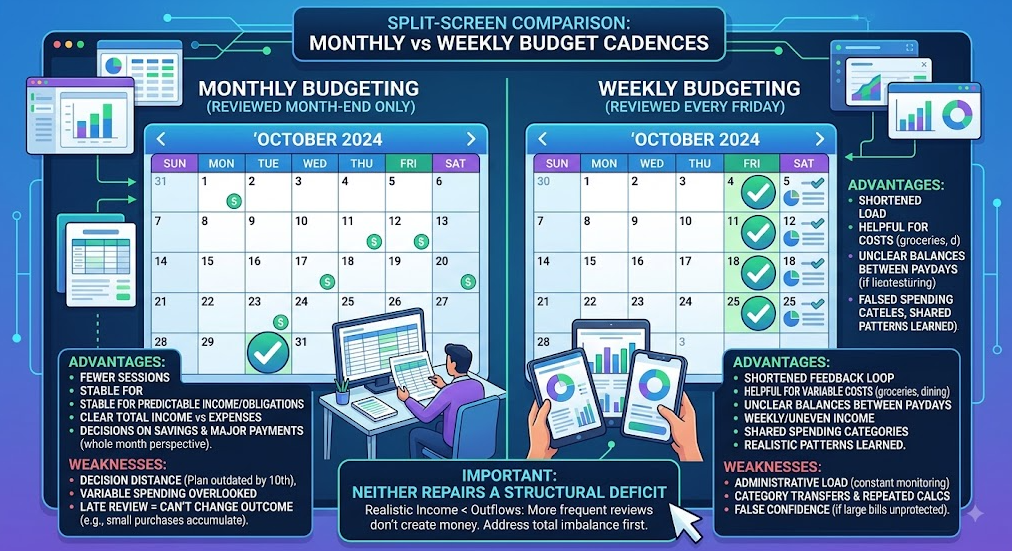
Monthly budgeting is often a strong starting point when income and major obligations are predictable. It requires fewer planning sessions and keeps the relationship between total income and total expenses clear. It is especially useful for decisions that only make sense across the whole month, such as whether the household can cover all required payments and a savings contribution.
Its weakness is the distance between decisions. A plan made on the first can become inaccurate by the tenth. If variable spending is easy to overlook, or if several people use the same categories, a month-end review may arrive too late to change the outcome.
Weekly budgeting shortens that feedback loop. It can help when:
- groceries, transportation, dining, or household purchases vary from week to week;
- account balances regularly become uncertain between paydays;
- income arrives weekly or in uneven amounts;
- more than one person spends from shared categories;
- small purchases accumulate faster than expected; or
- the household is learning its realistic spending pattern.
Its weakness is administrative load. Four or five check-ins, more category transfers, and repeated calculations can turn budgeting into constant monitoring. A weekly limit can also create false confidence if large monthly bills have not been protected first.
Neither cadence repairs a structural deficit. If realistic monthly income is lower than realistic monthly outflows, reviewing the same shortage more frequently does not create money. Return to the budget-versus-timing diagnosis and address the total imbalance rather than treating cadence as the solution.
Use the Budget Cadence Fit Test
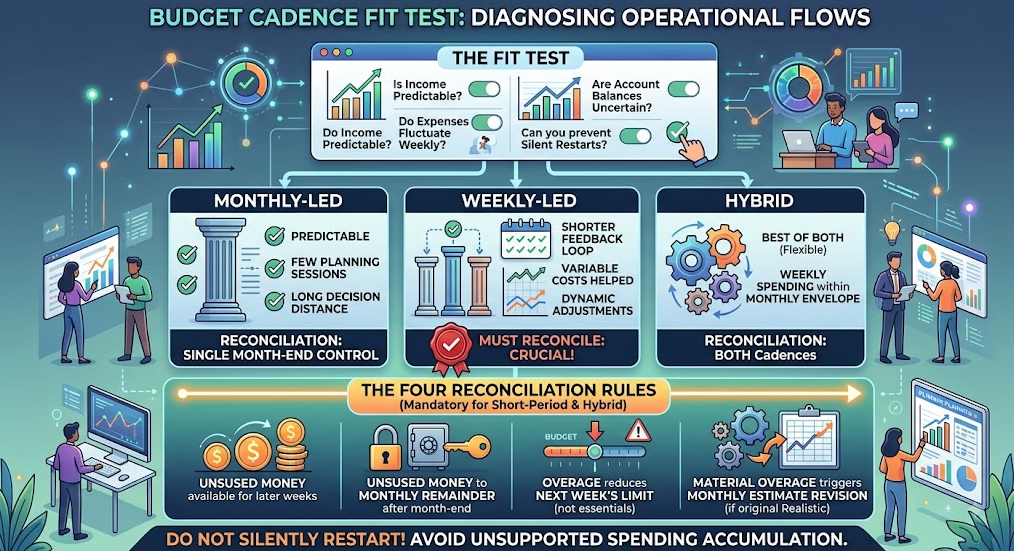
Choose a cadence from observed cash flow rather than personality labels. You do not need to decide whether you are a “weekly person” or a “monthly person.” Test the work the budget must perform.
1. Set the planning horizon
Begin with one complete month unless another period better reflects your actual obligations. List dependable take-home income, recurring bills, required payments, essential variable spending, and any amounts already committed to saving or planned goals.
This monthly layer is the control total. It protects the household from spending money that appears available in week one but belongs to a bill in week four.
If income is not monthly, estimate cautiously. Consumer.gov advises people who are not paid monthly to use prior income to develop a monthly estimate; with variable income, use records long enough to avoid treating a strong recent week as dependable. Do not budget money merely because it might arrive.
2. Mark the pay pattern and cash-flow pressure points
Record usable deposit dates and the dates major outflows occur. Weekly pay does not automatically require a weekly budget, and monthly pay does not require waiting a month to review. The relevant issue is what happens between deposits.
Ask:
- How long must one deposit support ordinary spending?
- Are major bills concentrated in one part of the month?
- Does the account approach its lowest safe balance before a particular payday?
- Are income dates or amounts uncertain?
Use the paycheck-to-bill map from the earlier article to protect scheduled obligations. Cadence selection happens after—not instead of—that protection.
3. Find where variation actually occurs
Review at least one month of transactions and preferably several ordinary months. Separate categories into three groups:
- Fixed or scheduled: rent, insurance, subscriptions, minimum payments;
- Flexible but necessary: groceries, fuel, transit, household supplies;
- Discretionary or deferrable: dining out, entertainment, optional shopping.
Weekly control is most useful where repeated decisions can change the result. Checking a fixed rent amount every Friday adds work without creating a new choice. Checking grocery and dining totals may reveal a pattern early enough to act.
4. Decide how early you need detection
Look for the point at which new information becomes actionable. If overspending in week one usually forces borrowing or missed obligations later, monthly-only review is too slow. If all flexible spending is modest, bills are protected, and balances remain comfortably above the operating floor, weekly category management may be unnecessary.
A shorter cadence is also useful temporarily. Someone establishing a new household, returning from leave, changing pay schedules, or recovering from repeated overdrafts may use weekly reviews for two or three months, then reduce the frequency once the numbers stabilize.
5. Measure the management burden
The best cadence is one the household will repeat accurately. Count the work: transaction review, category updates, transfers, conversations, and reconciliation. If a detailed weekly budget takes an hour and is abandoned after two weeks, it is less protective than a ten-minute check-in that continues.
Choose the minimum detail needed for the next decision. One household may review only the checking balance, pending transactions, protected bills, and three flexible categories. Another may need closer tracking because several people spend from shared accounts. More detail is justified only when it changes a decision.
6. Select monthly, weekly, or hybrid
Use the evidence:
- Monthly-led: suitable when income and outflows are predictable, bills are protected, variable spending is stable, and the household can detect exceptions without frequent review.
- Weekly-led: suitable when most money decisions occur weekly, income is frequent or variable, flexible categories drift quickly, or early correction is essential.
- Hybrid: suitable when the full month must be protected but a few categories benefit from weekly limits and check-ins. This is often the most practical design, but it is not automatically best for everyone.
Write the choice as an operating rule, not a preference:
“We plan the complete month before it begins, reserve scheduled obligations, review groceries and transportation each Friday, and reconcile all categories after month-end.”
7. Define the reconciliation rule
Every short-period system needs a return to the control total. Decide what happens to an unused weekly amount and how an overage affects the rest of the month.
Possible rules include:
- unused money remains available for later weeks in the same category;
- unused money returns to a monthly remainder only after month-end;
- an overage reduces the next week’s limit, but never money already reserved for essentials or required payments; or
- a material overage triggers a revision to the monthly estimate if the original amount was unrealistic.
Do not silently restart every Monday. Without reconciliation, five individually reasonable weeks can exceed the amount the month can support.
Convert monthly amounts without inventing money
Calendar months do not contain exactly four weeks. A year has 52 weeks but only 12 months. For a weekly equivalent that reconciles across a year, use:
Monthly amount × 12 ÷ 52 = weekly equivalent
The FDIC notes that dividing a monthly amount by four can be used as a quick estimate, but it produces a larger weekly allowance than the annualized conversion. That difference matters if the weekly amount is treated as spendable every week.
Suppose the monthly grocery target is $650:
$650 × 12 ÷ 52 = $150 per week
Dividing by four would produce $162.50. Spending $162.50 for 52 weeks totals $8,450, while twelve $650 monthly targets total $7,800—a $650 annual difference.
The annualized method is better when a weekly amount must reconcile with a stable monthly target. But real spending does not occur in perfectly equal weeks. A household may deliberately assign $140 to ordinary weeks and keep the remainder for a longer or higher-cost week. The calculation is a boundary, not a prediction.
Do not convert fixed monthly bills merely to make the worksheet symmetrical. Reserve them according to their real due dates or holdback plan. Also avoid double-counting a credit-card purchase in a weekly category and then treating the entire card payment as a second monthly expense.
An illustrative hybrid month
Consider a household with $4,800 in dependable monthly take-home income. Its complete monthly plan includes:
- $3,200 for fixed essentials, required payments, and assigned saving;
- $650 for groceries;
- $260 for transportation;
- $240 for household and personal spending; and
- $450 for other planned monthly uses.
The total is $4,800. Before weekly spending begins, the household protects the $3,200 and the other monthly commitments. It then converts only the three categories that benefit from frequent decisions:
- groceries: $650 × 12 ÷ 52 = $150 per week;
- transportation: $260 × 12 ÷ 52 = $60 per week; and
- household and personal: $240 × 12 ÷ 52 ≈ $55.38 per week.
The household rounds the last category down to $55 and leaves the small difference in the monthly category balance. Its Friday check-in asks only five questions:
- What has cleared, and what is still pending?
- Are all protected bills still fully assigned?
- What remains in the three weekly categories?
- Did a one-time event distort this week?
- Does next week need an adjustment within the monthly total?
In week two, groceries run $24 over because basic items were bought in bulk. The household does not label the week a failure or take $24 from rent. It verifies that the purchase reduces later grocery needs, records the overage, and carries $24 less across the remaining grocery weeks. If the same pattern repeats without later savings, $650 may be an unrealistic monthly target and should be revised.
The example is illustrative. It does not prescribe category amounts or assume that every household has room to move money between weeks.
Run a two-cycle trial
Do not judge a cadence after one unusual week. Test it for two complete monthly cycles while keeping the same definitions.
At each check-in, record:
- minutes spent managing the plan;
- unexpected transactions found;
- categories adjusted before money ran short;
- transfers reversed or bills put at risk;
- differences between planned and actual totals; and
- whether household members understood what remained available.
At the end of two cycles, choose one of four actions:
- Keep: the cadence catches useful issues and the work is sustainable.
- Simplify: it works, but too many categories or check-ins add little value.
- Increase frequency: problems are discovered too late to act.
- Reduce frequency: the numbers are stable and repeated reviews do not change decisions.
If income or essential costs changed materially during the test, revise the underlying monthly plan before blaming the cadence. If bills remain unaffordable, use shortage-triage and qualified assistance as appropriate; a different review schedule is not a substitute for resources.
Choose the rhythm that creates timely decisions
Weekly budgeting offers earlier feedback. Monthly budgeting offers a complete view with less maintenance. A hybrid preserves the full-month boundary while shortening the feedback loop where spending is most variable.
The right cadence is therefore not the one with the most tracking. It is the slowest rhythm that still detects a meaningful problem while you can do something about it. Protect the month, monitor the categories that move, reconcile every short period to the whole, and change the rhythm when the evidence changes.
FAQ
Is weekly budgeting better if I am paid weekly?
Not automatically. Weekly pay may make weekly reviews convenient, but the budget still needs to protect monthly and less-frequent obligations. Choose the cadence based on when decisions and risks occur.
Can I use a monthly budget and still set weekly spending limits?
Yes. A hybrid can reserve the full month’s bills and goals while using weekly limits for flexible categories such as groceries or transportation.
Should I divide every monthly category by four?
No. Months do not contain exactly four weeks. For an annualized weekly equivalent, multiply the monthly amount by 12 and divide by 52. Keep fixed bills on their actual schedule when that is clearer.
What happens in a five-week month?
Use a weekly amount that reconciles with the longer period, or deliberately hold part of the monthly category for the extra spending week. Do not create a fifth allowance without checking the monthly total.
How often should I review variable income?
Review after income actually arrives and often enough to avoid committing uncertain money. Keep a conservative monthly control total and adjust from verified deposits rather than optimistic estimates.
What if weekly check-ins make me anxious or take too long?
Reduce the number of categories and focus on protected bills, pending transactions, the safe account floor, and the few categories that drive decisions. If frequent checking worsens distress without improving choices, a simpler cadence may be safer.
When should I change budgeting cadence?
Reassess after a pay-schedule change, new household costs, repeated overspending, overdrafts, or several stable cycles in which frequent reviews no longer change decisions.
Sources
- FDIC – Money Smart for Adults, Module 4: Your Spending and Saving Plan
- Consumer.gov / FTC – Making a Budget
- Consumer.gov / FTC – Budget Worksheet