Quick Summary
The U.S. Department of Health and Human Services announced on August 21, 2026, that it will work with the Department of Justice and the Federal Emergency Management Agency to develop a National Autism Missing and Endangered Person Alert initiative.
The project is intended to improve how agencies identify, search for, and safely return missing autistic children and adults. It is an initiative under development—not a completed nationwide alert that families can activate today.
Reader Decision
Do not wait for the new initiative before preparing. Create a current missing-person response profile, learn the procedure used by your local 911 and law-enforcement agencies, and make sure schools, care providers, and other trusted supporters know what information to share immediately.
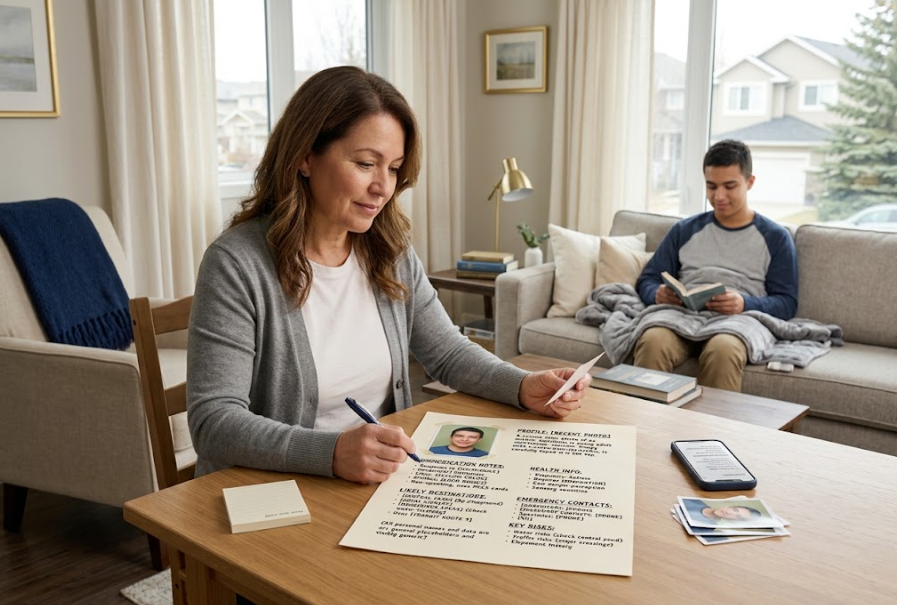
Why It Matters
Some autistic people may leave a supervised or expected location and be unable to communicate their name, address, destination, or need for help. The circumstances differ widely. A person may be drawn toward water, transportation, a familiar route, or a preferred place; may hide; may avoid lights, sirens, touch, or unfamiliar people; or may respond best to a particular communication method.
These are individual possibilities, not traits that should be assumed about every autistic person. They become useful in an emergency only when families and responders know which details apply to the missing individual.
A national framework could help agencies share more consistent practices. Until its design, implementation schedule, and local participation are announced, families must still rely on existing emergency services and local missing-person procedures.
Key Verified Facts
- HHS announced the initiative on August 21, 2026.
- HHS says it is developing the effort with DOJ and FEMA.
- The stated purpose is to create nationwide best practices and stronger coordination for identifying, searching for, and safely returning missing autistic children and adults.
- The announcement begins a development process. It does not establish that one operational alert is already available in every state or community.
- HHS has not yet provided all of the details families would need to use the future system, including a universal activation method, implementation date, local participation process, or final eligibility criteria.
Prepare a Response Profile Before It Is Needed
An emergency is a difficult time to collect scattered information. A short profile can help a dispatcher or officer understand both the search priorities and how to approach the person safely.
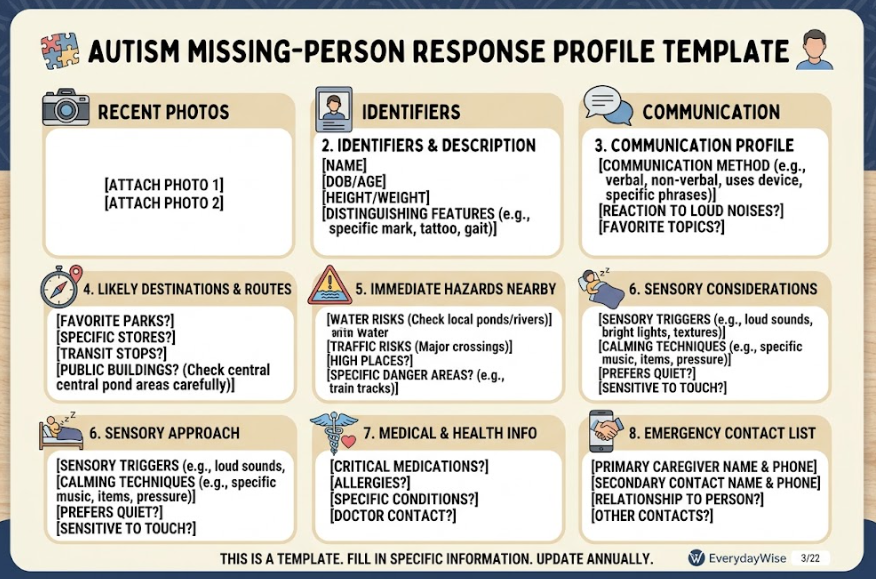
Include information that is current and specific:
- Recent photographs. Keep a clear face photo and a full-length image. Update them when appearance changes.
- Basic identifiers. Record the person’s name, age, height, approximate weight, hair and eye color, and identifying features. Note current clothing when reporting an actual disappearance.
- Communication. Explain whether the person speaks, uses limited speech, signs, gestures, an AAC device, pictures, or written language. Include words or prompts they are likely to recognize.
- Likely destinations and interests. List familiar routes, favorite locations, transit sites, parks, playgrounds, stores, previous locations, and other places the individual may seek.
- Immediate hazards. Identify any known attraction to water, roads, railways, vehicles, heights, machinery, or secluded spaces. Keep this individualized; do not add risks that do not apply.
- Sensory and approach information. Describe reactions to sirens, flashing lights, touch, crowds, dogs, or uniforms, as well as calming objects, familiar names, and approaches that may help.
- Health and safety needs. List relevant medical conditions, mobility needs, allergies, essential medication information, and what may happen if medication is missed. Do not place more private detail in widely shared copies than responders need.
- Contacts. Include caregivers, trusted relatives, school or program contacts, clinicians when appropriate, and another person who can help while the primary caregiver speaks with responders.
Store the profile where it can be found quickly. Give appropriate copies to trusted people involved in the person’s care, and protect the file as sensitive personal information. A school, workplace, residential program, or respite provider may need its own authorized copy and response plan.
Check the Procedure Where You Live
Ask the local non-emergency law-enforcement line how a missing autistic child or adult should be reported and what information dispatchers can record in advance. Confirm whether the jurisdiction offers a voluntary safety registry, special-needs database, or local alert program—and learn who can access the data, how it is protected, and how often it must be updated.
Also ask the person’s school, day program, workplace, transportation provider, or residential service what happens if they leave unexpectedly. A useful plan identifies who calls 911, who searches the immediate safe area, who contacts the family, and who brings the response profile.
Registries, identification products, door alarms, cameras, and location devices may support a broader safety plan, but none guarantees prevention or recovery. Consider the individual’s age, autonomy, consent, privacy, living situation, and ability to use or remove a device. Technology should not replace supervision, environmental safeguards, or an emergency call.
If the Person Goes Missing
Treat an unexpected disappearance as urgent when the person may be unable to protect themselves or communicate their needs. Call 911 or the local emergency number immediately. There is no waiting period required to report a missing child. For a missing adult, clearly explain the person’s vulnerability and the specific hazards that make the situation urgent.
Tell dispatchers about the highest-priority risks first—especially nearby water, traffic, railways, severe weather, medication needs, or a history of going to a particular place. Provide the current photo, last known location and time, clothing, likely destinations, communication method, sensory response, and a safe approach strategy.
Follow responder instructions. If others help search, coordinate them rather than sending people independently into hazardous areas. Keep one person available by phone, preserve home-camera or location information, and record new sightings or changes so they can be relayed accurately.
What the Federal Announcement Does Not Yet Answer
The HHS announcement does not yet show whether the future initiative will resemble AMBER Alert, create a separate public notification, standardize responder training, connect existing state programs, or use another model. It also does not mean every autistic person who goes missing will automatically meet one national activation standard.
Those details should be updated when HHS, DOJ, FEMA, or participating jurisdictions publish operational guidance. Until then, families should describe the project as a developing national initiative and continue using the emergency procedure currently available where they live.
The Practical Takeaway
The new initiative may eventually give families and responders a more consistent national framework. Its immediate value is also a reminder that the most useful emergency information is personal: where this individual may go, what dangers apply, how they communicate, and how someone can approach without increasing distress.
Prepare that information now, confirm who will call and what they will share, and update the profile when appearance, routines, communication, health needs, or favorite places change. A future alert may improve coordination; current preparation can improve the first minutes of a response.
This newsletter provides general U.S. safety information and does not replace individualized advice from local emergency services, clinicians, schools, or care providers. If a child or vulnerable adult is missing or in immediate danger, call 911 or the appropriate local emergency number now.
FAQ
Is the National Autism Missing and Endangered Person Alert operating now?
Not as a completed nationwide alert available in every community. HHS announced a federal initiative to develop best practices and interagency coordination. Implementation details remain pending.
Should a family wait before reporting a missing autistic child?
No. Contact law enforcement immediately; there is no required waiting period for a missing-child report. State the person’s vulnerabilities and immediate hazards clearly.
Should every autistic person have the same safety profile?
No. Include only the communication methods, likely destinations, sensory responses, health needs, and hazards that apply to that individual. Avoid treating autism itself as a complete description.
Can a tracking device replace a missing-person plan?
No. A device can fail, lose power, be removed, or provide incomplete information. Evaluate privacy and consent, and use technology only as one part of a broader individualized plan.
Sources
- HHS — HHS Launches National Autism Missing Person Alert Initiative
- HHS — Fact Sheet: National Autism Missing Person Alert Initiative
- National Center for Missing & Exploited Children — If Your Child Is Missing
- National Center for Missing & Exploited Children — Autism and Wandering