Quick Summary
Coverage of GLP-1 medicines for obesity is becoming less common among large employers surveyed by Business Group on Health. The share reporting coverage fell from 72% in 2025 to 60% in 2026. Reuters reports that about 14% had already dropped or planned to drop GLP-1 coverage in 2027.
That does not mean your employer made the same decision. The 127 surveyed employers cover 11 million people globally, including 8.7 million in the U.S. This is a large-employer trend—not your 2027 plan terms.
The most important distinction is the covered indication. A plan may exclude weight-management use while covering a related product for type 2 diabetes or another approved use. Drug, diagnosis, formulary status, and authorization rules all matter.
Reader Decision
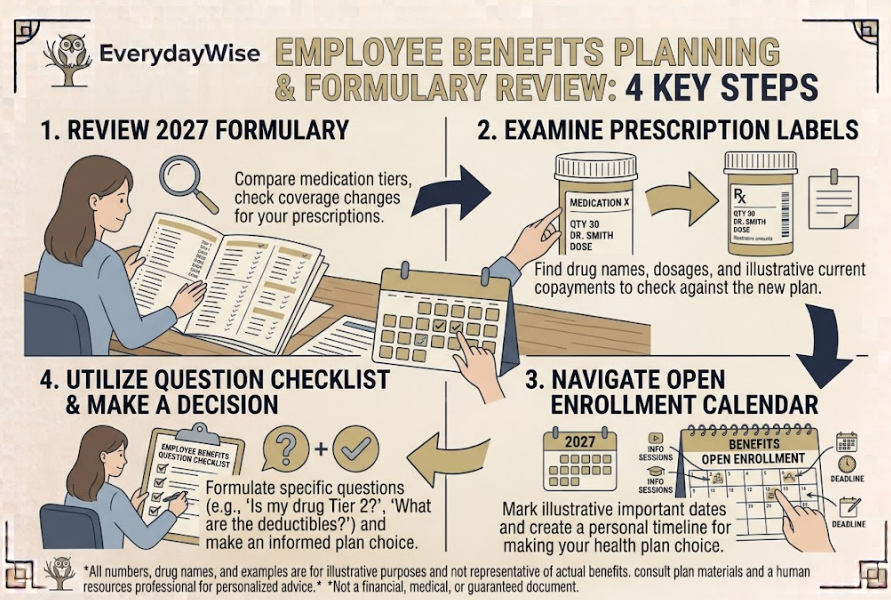
Before open enrollment closes, obtain the 2027 formulary and plan documents for the exact option you are considering. Ask for a written answer about your drug, diagnosis, prior authorization, required program, expected cost, and what happens to current patients on January 1.
What the Survey Actually Found
Business Group on Health released its survey on August 25. Participating employers projected a median healthcare cost increase of 9.2% for 2027 before plan changes and 8% after changes. Pharmacy represented 25% of total healthcare spending, with increased GLP-1 use among the cost contributors.
The survey found that fewer participating employers covered GLP-1s to treat obesity in 2026 than in 2025. Reuters also reported that two-thirds of respondents were seeing greater use of the medicines and that about 14% had already dropped or intended to drop coverage in 2027.
The findings justify an early benefits check. They do not establish that every employer is reducing coverage or that an existing authorization will continue.
“GLP-1 Coverage” Is Not One Yes-or-No Benefit
Start with the exact prescription and its purpose. Plans commonly apply different rules to:
- a medicine prescribed for type 2 diabetes;
- a medicine prescribed for chronic weight management;
- a product with another FDA-approved indication;
- use that the plan treats as off-label; and
- different brands, doses, or formulations within the GLP-1 class.
A benefits representative saying “we cover GLP-1s” is therefore incomplete. Ask whether the specific product is on the 2027 formulary for the diagnosis submitted by your prescriber.
Coverage can remain while its conditions change. A plan may add clinical thresholds, prior authorization, designated clinicians, a required program, step therapy, different cost sharing, or pharmacy restrictions.
Do not assume a 2026 approval carries into 2027. Ask whether current users will be grandfathered, need a new authorization, receive a transition supply, or meet newly adopted criteria.
A Seven-Question Open Enrollment Check
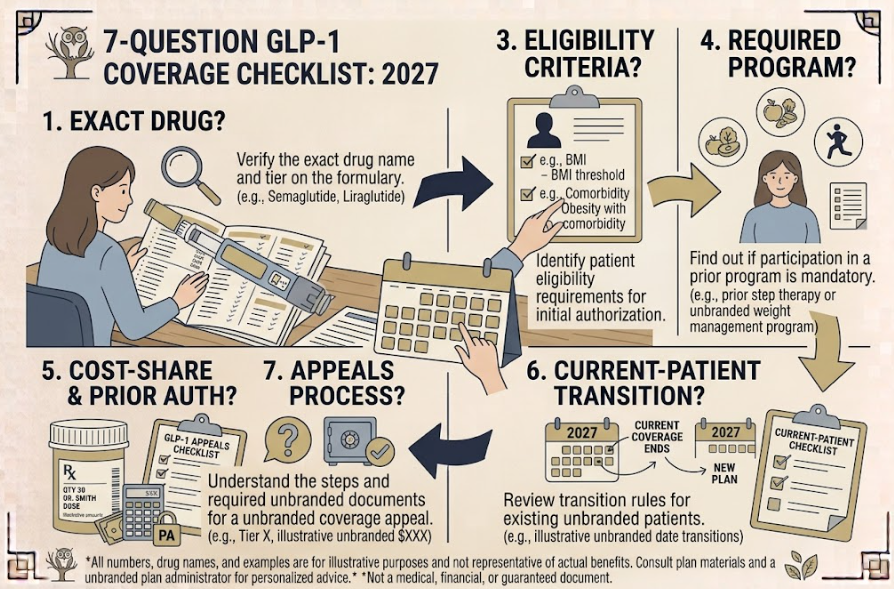
Use the formulary, plan documents, enrollment materials, and pharmacy-benefit contact. Record the date, representative, reference number, and source for each answer.
- Is my exact medicine on the 2027 formulary? Check the brand, formulation, and dose—not only the drug class.
- Is it covered for my diagnosis? Ask how the plan distinguishes obesity treatment, diabetes treatment, and other approved indications.
- What eligibility rules apply? Request the written prior-authorization criteria, including any clinical thresholds, documentation, step therapy, or prescriber restrictions.
- Is a program mandatory? Confirm whether enrollment, participation, coaching, weigh-ins, nutrition visits, or another vendor program is required to start or continue coverage.
- What will I pay? Check deductible treatment, copay or coinsurance, specialty-drug tier, pharmacy restrictions, and whether the estimate changes after a deductible is met.
- What happens to current patients on January 1? Ask about renewed authorization, grandfathering, transition fills, and the date by which paperwork must be submitted.
- How do exceptions and appeals work? Request the deadline, required forms, clinical documentation, urgent-review process, and the address or portal used to file.
Ask for the Answer in Writing
The U.S. Department of Labor describes the Summary Plan Description as an important source explaining what an employer plan provides and how it operates. The formulary supplies more specific drug information. An informal HR conversation may not control a disputed claim.
Save the documents available during enrollment. When a representative gives a phone answer, ask where the rule appears in writing and note the call details.
Repeat the check for every plan you may choose. Compare premiums, deductible exposure, medication cost sharing, required-program fees, and other expected care—not the drug copay alone.
If Coverage Is Ending or a Request Is Denied
Contact the prescribing clinician promptly. Coverage uncertainty is not a reason to ration doses, change products, alter dosing, or stop treatment without medical guidance. Ask what documentation the plan needs and whether a clinically appropriate covered alternative exists.
A denial should include a reason and review instructions. Many denials can receive an internal appeal and, where applicable, external review. Processes vary, so follow the denial notice and plan documents rather than assuming one universal deadline.
Keep the denial, prior-authorization request, clinician letter, supporting records, appeal submission, delivery confirmation, and call notes. Ask whether expedited review is available when the situation is medically urgent.
An appeal may challenge how a rule was applied or seek an exception; it does not necessarily require a plan to add an excluded benefit. Identify whether the issue is the formulary, indication, eligibility, documentation, or medical necessity.
Treat Advertised Cash Prices as Separate Offers
Manufacturer programs, direct-pay services, discount cards, and telehealth offers have their own eligibility, supply, clinical-service, and renewal terms. Verify the full recurring cost and licensed prescribing arrangement. Ask whether off-plan payments count toward your deductible or out-of-pocket maximum; many do not.
The Practical Takeaway
The employer survey is an early warning to check—not proof that your benefit is disappearing. The useful question is more precise than “Does my employer cover GLP-1s?” It is: “Under the 2027 plan I may select, will this exact medicine be covered for my documented indication, under what conditions, at what total cost, and with what transition or appeal options?”
Resolve that question before open enrollment closes whenever possible. A written answer gives you and your clinician more time to prepare an authorization, compare plans, request an exception, or discuss a medically appropriate alternative.
This newsletter provides general U.S. health-benefit information and is not medical, legal, insurance, or financial advice. Employer plans, formularies, clinical criteria, appeal rights, and deadlines vary. Confirm current terms with your plan administrator, insurer or pharmacy-benefit manager, and qualified healthcare professional. Do not change or stop a prescribed medicine without medical guidance.
FAQ
Does the survey mean 40% of all U.S. employers exclude GLP-1s for obesity?
No. The 60% coverage figure applies to the employers participating in the Business Group on Health survey. The sample is influential and large-employer focused, but it is not a census of every U.S. employer.
If my plan stops covering Wegovy for weight management, will it still cover Ozempic for diabetes?
Possibly, but do not infer the answer from the drug class. Plans can distinguish products and indications. Check the exact 2027 formulary and clinical criteria for the prescription and diagnosis involved.
Can my current prior authorization continue automatically into 2027?
It may or may not. Ask whether the authorization expires, whether new criteria apply, and whether current patients receive grandfathering or a transition supply.
Can I appeal if the plan excludes weight-management drugs entirely?
You may be able to request review or an exception, but available rights and likely outcomes depend on the plan language and reason for denial. Follow the denial notice and obtain help from the plan administrator or benefits office when the process is unclear.
Sources
- Business Group on Health — 2027 Employer Healthcare Strategy Survey Release
- Business Group on Health — 2026 GLP-1 Employer Survey
- Reuters — More U.S. Employers to Drop Weight-Loss Drugs in 2027
- U.S. Department of Labor — Plan Information
- U.S. Department of Labor — Benefit Claims Procedure Regulation FAQs
- HealthCare.gov — Internal Appeals
- HealthCare.gov — External Review