Quick Summary
The Pennsylvania Department of Health confirmed two measles-associated deaths on August 25, 2026. Both people were unvaccinated residents of Lancaster County. They were the first measles-associated deaths reported in the United States in 2026 and Pennsylvania’s first in 35 years.
The announcement comes during a broader U.S. rise. CDC had received reports of 2,777 confirmed cases as of August 20, including 36 outbreaks newly reported in 2026. Those national numbers are preliminary and will change as health departments complete investigations.
Families do not need to treat every fever or rash as measles. They should know where their vaccination records are, whether each person has the recommended evidence of immunity, and whom to call if a school, health department, airline, clinic, or other organization reports a possible exposure.
Reader Decision
Check vaccination records before an exposure notice arrives. If you think someone in your household was exposed or has compatible symptoms, call a healthcare provider or local health department immediately before visiting a clinic, pharmacy, or emergency department. They can assess immunity, timing, and safe evaluation arrangements.
Why This Matters Now
Measles spreads through the air when an infected person breathes, coughs, or sneezes. The virus can remain infectious in the air for up to two hours after that person leaves. Among people without protection who have close contact with a person who has measles, as many as nine in ten may become infected.
The national count does not mean risk is equal in every community. State and local health departments have the most current outbreak information. A family’s immediate risk depends on local transmission, travel, contact with a confirmed case, and each person’s immunity.
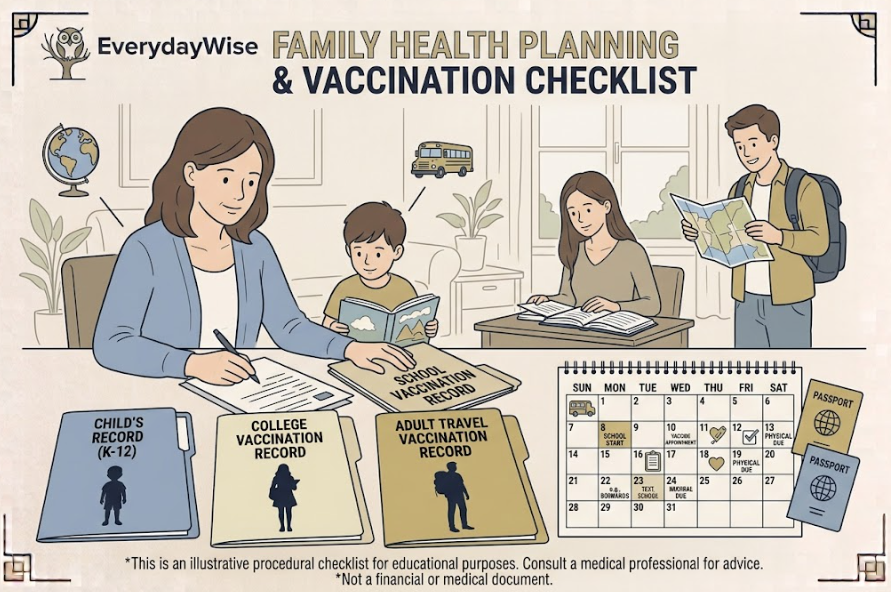
Start With the Record, Not a Guess
CDC recommends two MMR doses for children, routinely given at 12–15 months and 4–6 years. Adults generally need at least one documented dose or other acceptable evidence of immunity. Some adults are recommended to have two doses, including students at post-high-school institutions, healthcare personnel, international travelers, and certain other higher-risk groups.
Acceptable evidence may include written documentation, laboratory evidence of immunity, laboratory confirmation of prior disease, or—under CDC’s general criteria—birth before 1957. Professional review matters when exposure or travel is involved.
Use this short check:
- Find each household member’s official vaccination record.
- Compare the documented doses with the person’s age and risk group.
- Check school, college, employer, or destination requirements separately.
- Ask a clinician about missing or unclear documentation rather than trying to reconstruct it from memory.
- Keep a secure digital copy that can be reached during travel or outside office hours.
If records cannot be found, a healthcare professional can determine what evidence or vaccination is appropriate. This is especially important for someone who is pregnant, immunocompromised, seriously ill, or has a history that may affect vaccination.
If You Receive an Exposure Notice
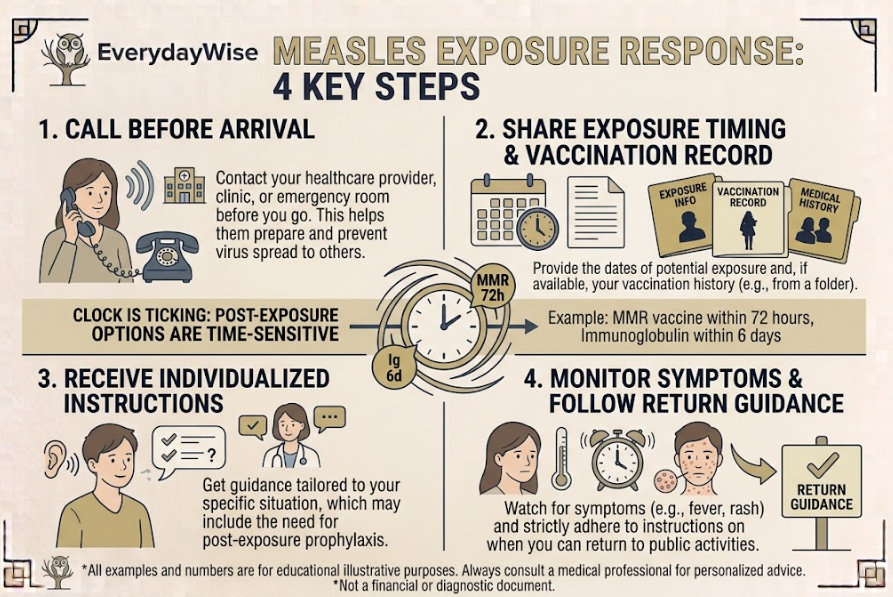
Call promptly. Do not wait for a rash, and do not walk unannounced into a waiting room. A provider or health department may need to arrange an entrance, room, or appointment that avoids exposing other patients and staff.
Have this information ready:
- the date, time, and place of the possible exposure;
- the exposure notice or case reference, if one was provided;
- vaccination records for the exposed person;
- age, pregnancy status, immune conditions, and relevant treatments;
- current symptoms and when they began; and
- upcoming school, childcare, healthcare-work, or travel commitments.
Timing matters. For a person without immunity, MMR vaccination within 72 hours of the initial exposure may provide some protection or lead to milder illness. Some people at high risk of severe disease may instead be considered for immune globulin within six days. These are time-limited clinical and public-health decisions; they are not do-it-yourself instructions and may not be appropriate for everyone.
Public-health authorities may also issue temporary instructions about school, childcare, work, or other shared settings. Follow the return date they provide rather than estimating it yourself.
Know the Symptoms Without Self-Diagnosing
Measles often begins with high fever, cough, runny nose, and red, watery eyes. Symptoms commonly appear 7–14 days after contact, although public-health guidance may use a broader monitoring window. Tiny white spots may appear inside the mouth, and the rash typically begins three to five days after the first symptoms, starting near the hairline and spreading downward.
These symptoms overlap with other illnesses, and a rash photo cannot confirm measles. Call first and report the possible exposure.
Measles can cause pneumonia, brain swelling, hospitalization, and death. Children under five, adults over 20, pregnant people, and people with weakened immune systems face a higher risk of complications. For an emergency or rapidly worsening symptoms, seek urgent care and alert the facility before arrival when possible.
School and Travel Need Separate Checks
For school or college, confirm both the health record and the institution’s submission process; state requirements differ. International travelers should be fully vaccinated before travel. CDC recommends an early MMR dose for infants 6–11 months who will travel internationally, followed by the two routine doses after the first birthday. Review current travel-health guidance rather than relying only on border-entry requirements.
What the Latest Numbers Do—and Do Not—Tell You
CDC’s August 20 count recorded 2,777 confirmed U.S. cases, with 94% associated with outbreaks. Kindergarten MMR coverage was 92.4% in 2025–2026, below CDC’s 95% community-immunity target, and local rates may be lower. Use national data to prompt preparation and local public-health notices to guide immediate action.
The Practical Takeaway
The useful response to rising measles cases is preparation, not generalized fear. Locate records now. Confirm who has adequate evidence of immunity. Resolve missing documentation before school deadlines or travel. Save the contact details for your healthcare provider and local health department.
If an exposure or compatible illness occurs, call immediately and before arriving in person. That single step helps preserve time-sensitive options while protecting other patients, staff, classmates, and family members.
This newsletter provides general U.S. health information and is not medical advice. Vaccination recommendations, outbreak instructions, school rules, and post-exposure actions can vary by age, health history, location, and public-health investigation. Contact a qualified healthcare professional or your local health department for individualized guidance. Seek urgent medical care for severe or rapidly worsening symptoms, and call ahead when measles is suspected whenever circumstances allow.
FAQ
Does every adult need two MMR doses?
No. CDC generally recommends at least one documented dose for adults without other evidence of immunity, while certain higher-risk groups are recommended to have two. Ask a healthcare professional to assess your records and risk group.
Should I go directly to urgent care after a measles exposure?
Call first unless there is a medical emergency. The facility can assess urgency and arrange evaluation without exposing people in a shared waiting area. For an emergency, seek care promptly and have someone alert the facility before arrival when possible.
Can a vaccinated person still get measles?
Yes, but it is uncommon. CDC estimates one MMR dose is about 93% effective against measles and two doses about 97% effective. A provider should still assess a credible exposure or compatible symptoms.
What if my vaccination record is missing?
Try to retrieve records from prior healthcare providers, schools, pharmacies, or an immunization information system. If written documentation cannot be found, ask a clinician what evidence or vaccination is appropriate for you.
Sources
- Pennsylvania Department of Health — Two Measles-Associated Deaths, August 25, 2026
- Reuters — Pennsylvania Reports First U.S. Measles Deaths This Year
- Associated Press via STAT — First Two U.S. Measles Deaths This Year
- CDC — Measles Cases and Outbreaks
- CDC — Measles Vaccination
- CDC — Questions About Measles
- CDC — Measles Symptoms and Complications
- CDC — About Measles