Quick Summary
The U.S. Department of Education issued a Dear Colleague Letter on August 26, 2026, emphasizing duties under FERPA and PPRA. It is guidance and an enforcement notice—not a new federal statute.
FERPA generally lets a parent inspect education records directly related to their child and maintained by the school or a party acting for it, and seek amendment of inaccurate, misleading, or privacy-violating information. It does not open literally every school document or let a parent force a change to a grade or professional judgment.
PPRA covers specified sensitive surveys and other defined activities. The letter says SPPO will treat a school-official-administered survey involving any protected area as “required” and expect inspection opportunity plus written parental consent before a minor participates. Under this announced position, opt-out alone is insufficient.
Reader Decision
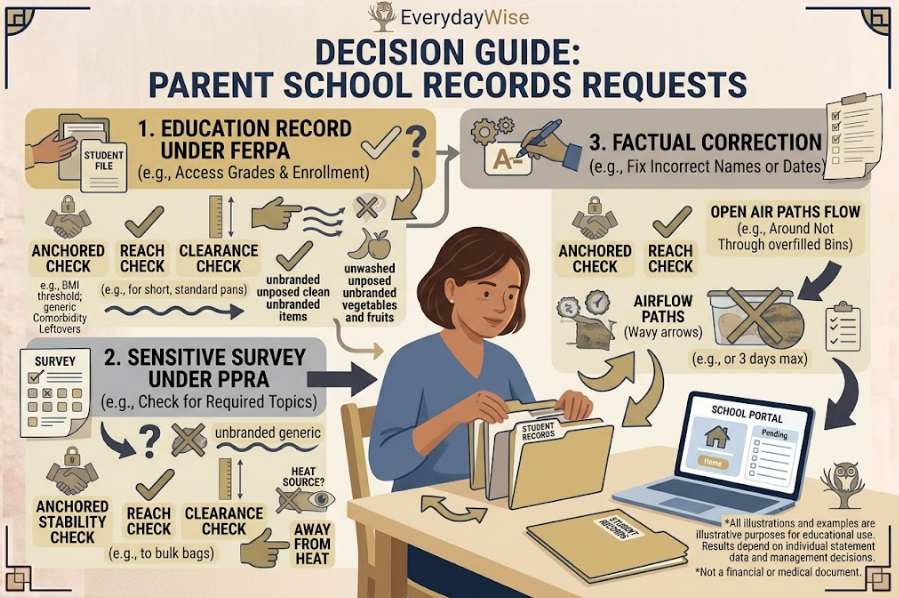
Identify what you are asking for before writing the school. Request an existing education record under FERPA; request a sensitive survey or covered instructional material under PPRA; and describe a factual error separately if you want an amendment. A narrow written request usually creates a clearer record than asking to “see everything.”
What Changed on August 26
The letter accompanied a required annual notification and emphasizes records, sensitive surveys and mental-health screeners, instructional materials, contractors, and education apps. FERPA and PPRA already existed; the letter states how SPPO currently plans to enforce them.
FERPA: Access to Education Records, Not Every School Document
FERPA generally covers records that are directly related to a student and maintained by an educational agency or institution, or by a party acting for it. The format and label are not decisive. A record does not fall outside FERPA merely because the school calls it unofficial, stores it separately, or keeps it in an electronic system rather than the cumulative file.
Records may include attendance, report cards, discipline, evaluations, retained communications, and student-specific information maintained by a contractor acting for the school. Statutory exclusions include qualifying sole-possession memory-aid notes and certain school law-enforcement-unit records. When a record concerns several students, access is generally limited to information about the parent’s own child.
The right also is usually a right to inspect and review, not an automatic right to receive any requested format or unlimited free copies. A school must provide access within a reasonable time, no later than 45 days after receiving the request; a shorter state deadline may apply. If distance or another circumstance would otherwise prevent meaningful inspection, the school must make an effective alternative arrangement.
FERPA rights normally transfer to the student at age 18 or upon postsecondary attendance at any age. Parents should not assume K–12 access continues unchanged.
If the Record Is Wrong, “Amendment” Has Limits
A parent may ask the school to amend an education record believed to be inaccurate, misleading, or in violation of the student’s privacy rights. The request should identify the exact record, the disputed statement, and the proposed factual correction.
The school need not accept the change. After denial, FERPA provides a hearing process and, if amendment is still refused, a right to attach a statement of disagreement to the contested information. This does not ordinarily reopen substantive grades, evaluations, or discipline.
PPRA: Surveys, Screeners, Marketing, and Materials
Its eight protected survey areas are:
- political affiliations or beliefs;
- mental or psychological problems;
- sex behavior or attitudes;
- illegal, antisocial, self-incriminating, or demeaning behavior;
- critical appraisals of people with close family relationships;
- legally recognized privileged relationships, such as with lawyers, physicians, or ministers;
- religious practices, affiliations, or beliefs; and
- income, except where legally required to determine program or financial-assistance eligibility.
The letter says SPPO will treat a survey, evaluation, or analysis administered by an educator, counselor, or other school official and involving one of these areas as “required.” Under that position, the parent must be able to inspect it and give written consent before a minor participates; passive consent through an opt-out notice is insufficient.
This emphasis is especially relevant to behavioral or mental-health screeners. The Department says instruments probing emotional well-being, internal distress, social interactions, or psychological states can fall within PPRA’s protected mental or psychological category.
Parents may also request to inspect covered surveys, certain marketing-data instruments, and curriculum materials other than academic tests or assessments. Not every classroom activity follows one identical consent rule.
What About Data in School Apps?
An outside platform does not automatically place data beyond FERPA. A vendor may qualify as a school official if it performs an outsourced institutional function, remains under the school’s direct control over the records, and observes FERPA use and redisclosure limits. Name the platform and ask whether it maintains student-specific records for the school, then request the district’s annual FERPA notice and approved-app or student-data policy.
A Practical Written Request
Send the request to the school or district office identified in its annual FERPA or PPRA notice. Keep a dated copy. A simple request can say:
I am the parent or legal guardian of [student name]. Under FERPA, I request an opportunity to inspect and review education records directly related to my child and maintained by the school or by a party acting for the school concerning [specific subject, date range, staff office, or app]. Please confirm receipt, identify the person coordinating access, and explain any portion withheld and the basis for doing so.
For a survey, use PPRA language instead:
Before my child participates, please provide the survey, evaluation, or analysis for inspection; identify whether it asks about any PPRA-protected area; state whether participation is required; and explain the consent or opt-out procedure the school is applying.
Include only details needed to locate the material. Send a separate amendment request for a correction.
If the School Does Not Respond
Escalate through the principal, privacy or records officer, and district office, and request the reason for denial in writing. FERPA access is due within 45 days at most, although state law may be faster.
FERPA or PPRA complaints may be filed with SPPO, generally within 180 days of the violation or when the parent knew or reasonably should have known of it. Contacting the school first is required for a PPRA complaint and strongly encouraged for FERPA. This is a federal enforcement process, not a damages claim or guaranteed individual remedy.
The Practical Takeaway
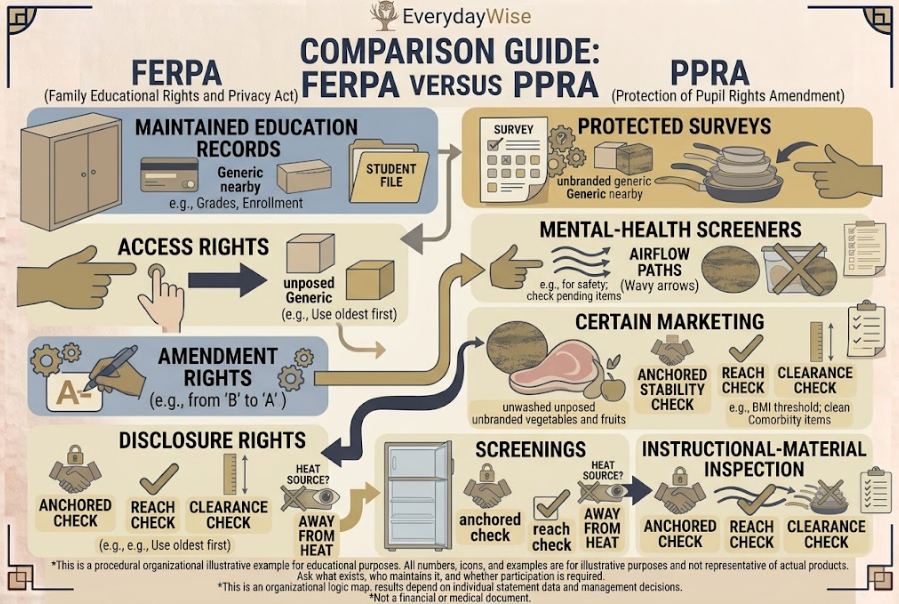
FERPA follows maintained education records; PPRA governs specified surveys and activities. Ask a focused question, use the right law, and preserve dates and responses. That is more effective than demanding “every record.”
This newsletter provides general information about U.S. federal student-privacy law and the Department of Education’s August 2026 guidance. It is not legal advice. FERPA and PPRA coverage depends on the institution, funding, student status, record, activity, and applicable exceptions. State law and school policy may provide additional rules. Verify current requirements with official sources or qualified counsel for a specific dispute.
FAQ
Must a school give parents every email mentioning their child?
Not necessarily. An email may be an education record if it is directly related to the student and maintained by the school or a party acting for it, but context, maintenance practices, statutory exclusions, and information about other students matter. Ask for a defined subject and date range rather than assuming every mention is covered.
Does FERPA require the school to send copies within 45 days?
FERPA requires meaningful access to inspect and review within a reasonable time, no later than 45 days. It does not always require copies. The school must make another effective arrangement when failure to provide copies or remote access would prevent the parent from exercising the right.
Is an opt-out email enough for a school mental-health survey?
Under SPPO’s August 2026 announced enforcement position, a school-administered survey or screener seeking information in a PPRA-protected area is treated as required and needs advance written parental consent; opt-out alone is not sufficient. The instrument and circumstances still should be checked.
Can a parent force the school to correct a disputed grade?
Usually not through FERPA merely because the parent disagrees with the teacher’s judgment. FERPA’s amendment procedure addresses inaccurate, misleading, or privacy-violating records, not ordinary challenges to substantive academic or disciplinary decisions.
Where can a parent complain?
FERPA and PPRA complaints go to the U.S. Department of Education’s Student Privacy Policy Office. Complaints generally must be written, fact-specific, and timely within 180 days. A PPRA complainant must first contact the school or agency to seek resolution.
Sources
- U.S. Department of Education — August 26, 2026 Press Release
- Student Privacy Policy Office — August 26, 2026 Dear Colleague Letter
- U.S. Department of Education — FERPA
- U.S. Department of Education — What Is PPRA?
- U.S. Department of Education — File a FERPA or PPRA Complaint
- U.S. Department of Education — FERPA Access Deadline