Quick Summary
The Federal Trade Commission finalized orders on August 26, 2026, against Cox Media Group and two marketing firms over a service called “Active Listening.” The companies had promoted it as using an algorithm to detect conversations captured from consumers’ smart devices and target local advertising.
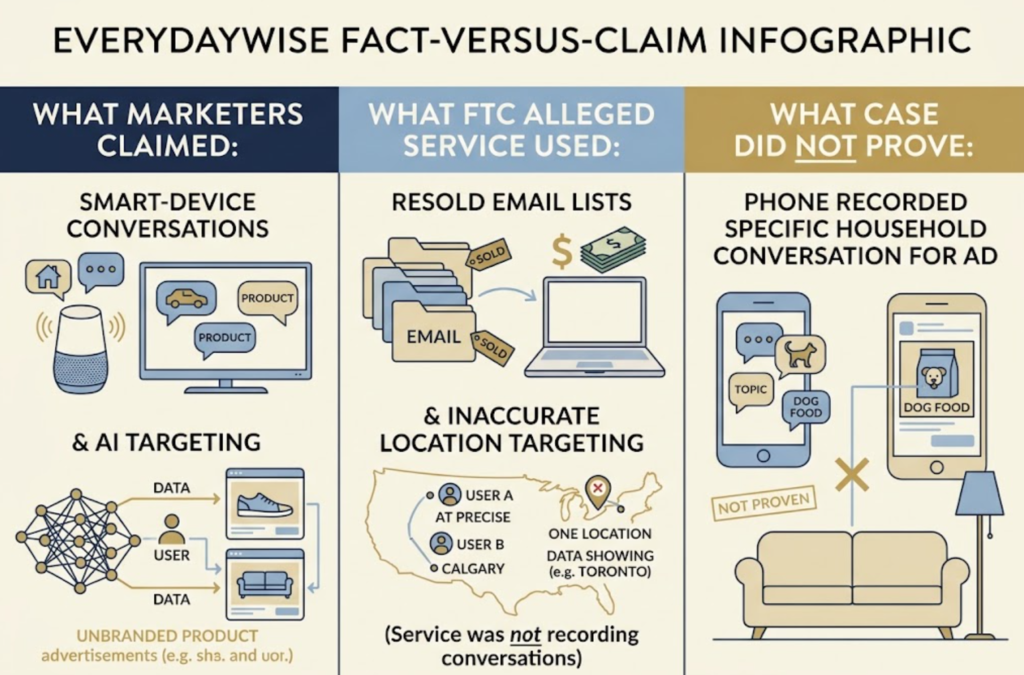
The FTC did not find that the service actually listened to those conversations. Its complaints alleged the opposite: the service was not based on voice data. According to the FTC, it largely resold email lists from other data brokers, did not accurately deliver the claimed geographic targeting, and falsely told prospective business customers that consumers had opted in.
The three companies will pay a combined $930,000 under final consent orders and are barred from misrepresenting their marketing services, voice-data practices, consent, and geographic targeting.
Reader Decision
Do not use this case as proof that your phone recorded a particular conversation for an ad. Use it as a reason to separate evidence from suspicion: review which apps can access the microphone, remove permissions that do not fit an app’s function, examine privacy activity where your device provides it, and adjust advertising and cross-app tracking settings separately.
What the FTC Finalized
The companies are CMG Media Corporation, doing business as Cox Media Group; MindSift LLC; and 1010 Digital Works LLC. The FTC first announced proposed complaints and settlements in May. After receiving two public comments, the Commission voted 2–0 to approve the consent agreements as final.
CMG must pay $880,000. MindSift and 1010 Digital Works must each pay $25,000. The total may be used for redress to CMG customers affected by the challenged practices and related administration. This is not a claim fund for every person who owns a phone or smart speaker.
The orders prohibit the firms from misrepresenting:
- the qualities or features of advertising or marketing services;
- the collection and use of voice data;
- whether consumers consented to collection, use, or disclosure of voice data; and
- geographic targeting capabilities.
The CMG order also requires information needed for the FTC to administer customer redress. The companies neither admit nor deny the complaint allegations except for jurisdictional facts.
What “Active Listening” Was Supposed to Do
The FTC says the companies told potential small-business customers that the service could listen for relevant conversations overheard by smart devices in real time and use those conversations to place ads in selected local areas.
They also claimed consumers had opted in through terms accepted when downloading and using apps. The FTC rejected that explanation. Its May announcement said clicking through mandatory terms of service would not constitute opt-in consent for such an invasive use of voice data from inside homes.
The FTC said that, had the service operated as advertised, using household voice data without adequate consent would violate the FTC Act.
But the factual allegation about the product was different. The FTC said the service did not listen to conversations or use voice data at all. It allegedly consisted of email lists bought from data brokers and resold at a significant markup, while failing to place ads accurately in the desired geographic locations.
That makes this a deception case in two directions. Business customers allegedly did not receive the sophisticated service sold to them, and the sales explanation falsely invoked consumer consent for data the service was not actually using.
What the Case Does Not Establish
It does not establish that:
- a named phone, app, television, or smart speaker secretly recorded users for this service;
- CMG obtained a database of household recordings;
- a particular ad appeared because of something said near a device;
- all personalized advertising uses microphone data;
- operating-system permission controls failed; or
- consumers who saw targeted ads are automatically entitled to payment.
FTC complaints are allegations resolved through consent orders, not trial findings that every allegation was litigated and proven. The final orders carry legal force for the companies’ future conduct, but the respondents did not admit the substantive allegations.
That legal distinction should not become a reason to ignore privacy concerns. It identifies what this evidence can support and what it cannot.
Why Ads Can Feel Like Eavesdropping
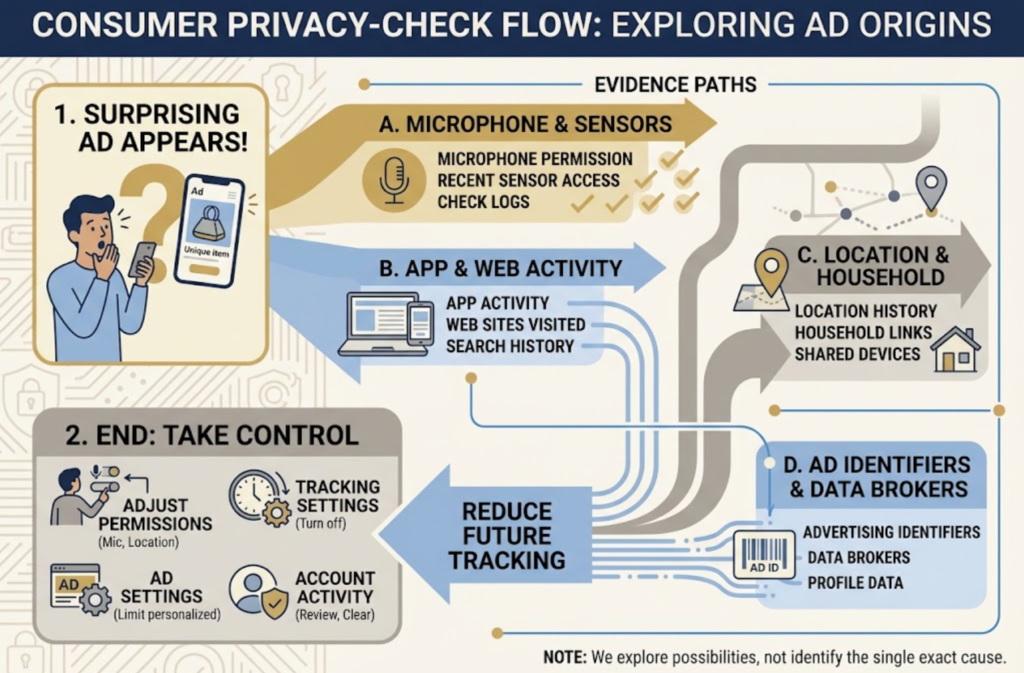
An ad can appear uncannily relevant without microphone access. Advertising systems may draw from searches, app activity, purchases, location, household associations, demographic inferences, and broker lists. Another household member may have interacted with the subject, or the person may notice the ad only after discussing it.
Those possibilities do not identify how a specific ad was selected. They explain why “I spoke about it, then saw it” can prompt a privacy review but is not evidence of an audio recording.
A Practical Microphone-Permission Check
On an iPhone or iPad, open Settings → Privacy & Security → Microphone and review the apps that requested access. Apple also provides App Privacy Report, which can show how often apps accessed privacy-sensitive data such as the microphone during the report period after the feature is enabled.
On Android, open an app’s information page and review Permissions, or use the privacy permission manager to see apps by permission type. Android also provides camera and microphone indicators on supported versions; tapping an active indicator can show which app or service is using the sensor.
For each app, ask:
- Does its main function require audio?
- Does it need access all the time or only during active use?
- Can I use the feature without microphone permission?
- Is an unfamiliar or unused app retaining access?
- Does the app’s privacy disclosure explain audio collection and use?
Remove access when it is unnecessary. Test the app afterward; a legitimate voice, calling, recording, accessibility, or camera feature may stop working until permission is restored.
Smart speakers, televisions, browsers, and apps have separate controls. A phone permission does not govern every connected device.
Review Advertising Controls Separately
Microphone permission and ad personalization are different settings.
Apple lets users manage app tracking permissions and turn Apple personalized advertising on or off. Apple notes that disabling personalized ads may make ads less relevant but does not necessarily reduce the number shown.
Android users can review the device advertising ID controls; supported versions allow users to reset or delete the advertising ID. Google notes that apps can have their own settings affecting the ads a person sees.
Also check account ad personalization, location history, browser permissions, unused apps or extensions, connected household accounts, and available data-access or deletion tools.
Changing these settings does not erase every profile held by a data broker or explain every previous ad. It reduces or changes particular data pathways.
If You See an Unexplained Microphone Indicator
Open the indicator or privacy activity view promptly and identify the app or service. Capture the time and app name, then close the app and review its permission and account activity.
If access does not fit the feature you were using:
- remove microphone permission;
- update the operating system and app;
- uninstall an app you do not trust or need;
- review sign-ins and connected devices;
- change the account password and enable multifactor authentication if compromise is possible; and
- contact the platform or app developer with the recorded details.
A single indicator can reflect a legitimate call, camera, dictation, voice assistant, accessibility feature, or browser tab. Investigate the event before describing it as advertising surveillance.
The Practical Takeaway
The FTC’s case undercuts, rather than confirms, the specific “Active Listening” sales story. The companies allegedly marketed smart-device voice targeting that the service did not perform and claimed consent they had not obtained.
Consumers still have good reasons to limit unnecessary microphone, location, and tracking access. The strongest response is not to treat every eerily timed ad as proof. It is to inspect the permissions and activity records that can be checked, tighten the settings that do not match your use, and preserve evidence when a device reports unexpected access.
This newsletter provides general consumer-privacy and technology information. It is not legal or cybersecurity advice. Device menus and privacy features vary by model, account, operating-system version, and region. Verify current manufacturer instructions and seek qualified help for suspected account compromise or unlawful surveillance.
FAQ
Did the FTC prove that smartphones listened to conversations for ads?
No. The FTC alleged that the marketed service was not based on voice data and instead resold email lists. The case did not establish that a specific consumer device recorded a conversation for advertising.
Why did the FTC discuss voice-data consent if no voice data powered the service?
The companies allegedly claimed consumers had consented. The FTC said that claim was false and added that, had the service worked as advertised, collecting household voice data without adequate consent would itself violate the FTC Act.
Who receives the $930,000?
The orders allow the money to support redress for CMG business customers affected by the practices and related administration. It is not an automatic payment to smart-device users.
Does turning off microphone permission stop personalized ads?
Not by itself. Ads may use many other signals. Review microphone access, app tracking, advertising identifiers, location, account activity, and app-specific privacy settings separately.
What should I do if my phone shows unexpected microphone use?
Identify the app through the device indicator or privacy report, record the details, remove unnecessary permission, update or uninstall the app, and review account security. Investigate before assuming the access caused a particular ad.
Sources
- FTC — Final Orders in the “Active Listening” Marketing Case
- FTC — May 2026 Complaints and Proposed Settlements
- FTC — CMG Media Final Decision and Order
- Apple — Control What You Share on iPhone
- Apple — About App Privacy Report
- Google — Change App Permissions on Android
- Google — Advertising ID Controls