Suppose a household needs $18,000. If the amount and purchase date are already known, receiving the money once and following a defined repayment schedule may be useful. If the need will arrive in several uncertain stages, borrowing only when each expense occurs may prevent interest from starting on money that is still sitting unused.
Those situations can involve the same borrower, the same lender, and even a similar advertised rate. They are still different borrowing problems. One asks for a planned path out of debt. The other asks for controlled access to debt.
Quick decision: A personal loan generally fits a known, one-time amount when a defined payment schedule and payoff date are valuable. A line of credit generally fits uncertain or repeated shortfalls when the borrower can limit withdrawals and make a deliberate principal-repayment plan. Compare actual annual cost, rate-change rules, fees, collateral, payment requirements, and total payoff—not convenience or rate alone.

Start With the Shape of the Need
Before comparing products, describe the expense without mentioning a lender.
Ask:
- Is the amount known now?
- Will the money be needed once or in stages?
- Is there a firm purchase date?
- Can part of the expense be delayed or paid from cash flow?
- Will the asset or benefit last longer than the repayment period?
- What event will stop the household from borrowing again?
- How quickly can principal realistically be repaid?
A fixed project with accepted quotes has a different shape from an unpredictable series of repairs. A single debt-consolidation amount is different from a monthly cash-flow gap that has not been solved. A vehicle purchase is different from keeping credit available “just in case.”
The product should match the need’s shape. If the need itself is unclear, fast access to credit can hide that uncertainty rather than resolve it.
How a Personal Loan Usually Works
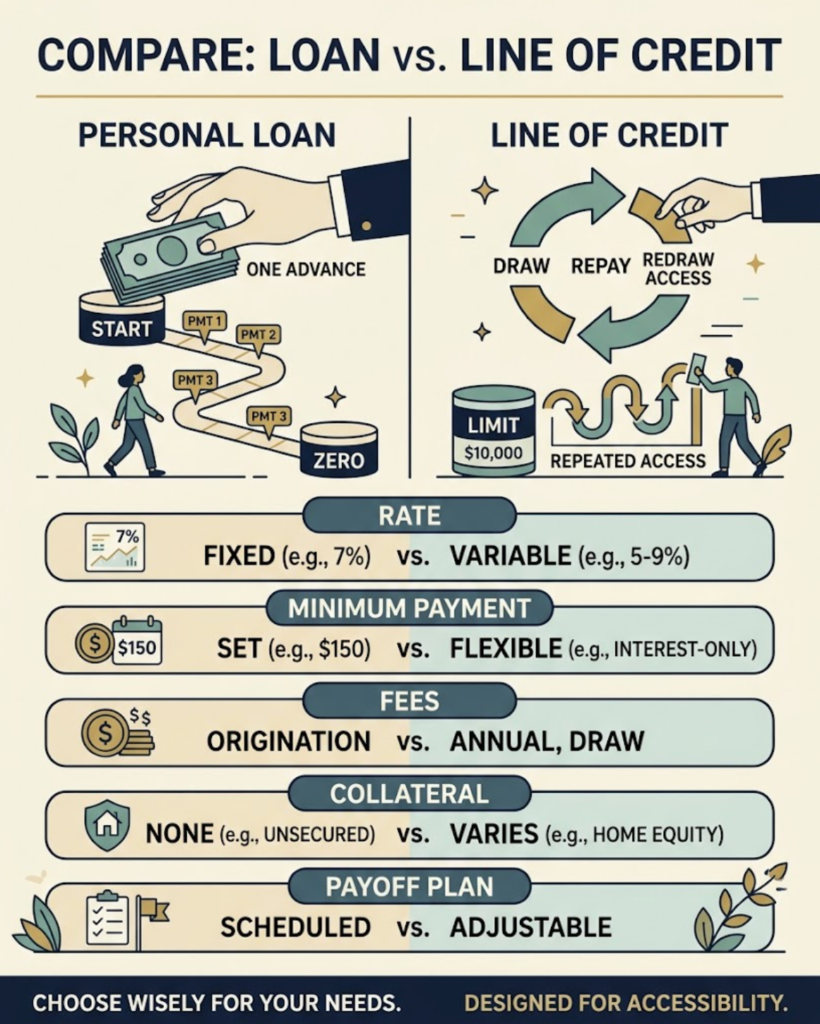
With a personal loan, the lender advances an agreed amount. The borrower then makes payments according to the contract. The rate may be fixed or variable, and the loan may be secured by an asset or unsecured. Product rules vary by lender and jurisdiction.
The structure often provides:
- a known opening balance;
- a scheduled payment;
- a stated term or repayment period;
- an expected final payment date if the contract is followed; and
- no automatic ability to borrow the principal again after it is repaid.
This structure can make the debt visible. Each payment belongs to a defined plan, and the borrower can see when the obligation is expected to end.
That clarity does not make a personal loan inexpensive. FCAC advises Canadian borrowers to consider the interest rate, fees, and loan term, and to compare total cost rather than the payment alone. A longer term may reduce the required payment while increasing the amount paid overall. Article”How Loan Terms Change the Total Cost“ will examine that trade-off in detail.
Personal loans may also include origination, administration, optional insurance, late-payment, returned-payment, or early-repayment terms. Names and disclosures differ. The quoted payment is therefore not enough to evaluate the offer.
How a Line of Credit Usually Works
A line of credit provides a borrowing limit rather than delivering the entire limit as cash. The borrower can generally withdraw up to the available amount, repay some or all of the balance, and borrow again while the account remains open and within its terms.
Interest is generally charged on the amount actually borrowed, not the unused portion of the limit. The rate is commonly variable, although the contract controls. Access may be available through transfers, cheques, cards, or linked accounts, depending on the institution.
The structure often provides:
- a maximum available limit;
- repeated access rather than one advance;
- interest on the outstanding balance;
- a required minimum payment; and
- renewed borrowing capacity after principal is repaid.
That last feature creates both the value and the risk. A line can support staged expenses without forcing the borrower to take all the money at once. It can also remain in use indefinitely if new withdrawals replace the principal being repaid.
FCAC warns that easy access can lead to serious financial trouble when spending is not controlled. It also notes that rising interest rates can make repayment harder. A minimum payment keeps an account contractually current only if made as required; it does not prove that the debt is shrinking at a useful rate.
The Structural Difference
| Question | Personal loan | Line of credit |
|---|---|---|
| How money arrives | Usually one agreed advance | Withdrawals up to a limit |
| Best-matched need | Known, one-time amount | Uncertain, staged, or repeated need |
| Repayment structure | Scheduled path toward an expected end date | Minimum required payment plus borrower-controlled principal repayment |
| Borrow again automatically | Usually no | Often yes, as capacity becomes available |
| Interest begins | Generally on the advanced loan amount | Generally on amounts withdrawn |
| Rate | May be fixed or variable | Commonly variable; contract controls |
| Main behavioral protection | Defined payment and end point | Borrower must create withdrawal and payoff limits |
| Main structural risk | Taking more money or a longer term than needed | Revolving balance that never receives a real payoff plan |
This table describes common structures, not a substitute for the agreement. A lender may offer fixed-rate portions, conversion options, demand features, introductory rates, or repayment arrangements that change the comparison.
From Jerome: When Easy Access Was Useful—and Easy
From Jerome, EverydayWise Contributor
When I arranged a mortgage in Canada, the bank told me the borrowing amount available under its assessment. After the mortgage amount was set, the remaining approved capacity was made available to me as a line of credit under the bank’s arrangement. I have used that line for purposes including business investment and buying vehicles.
The advantage is that the money is very easy to access. It can feel almost like transferring my own cash. That is also the disadvantage. It becomes easy to think, “If something comes up, I can just take a little from the line,” and borrow sooner than I otherwise would.
I usually buy used vehicles. When the financing rate offered for a used vehicle was higher, I used the line of credit instead and reduced some interest cost. The line has also been genuinely useful when money was needed quickly. But the lower rate did not change the fact that I had created debt that still needed a repayment plan.
Jerome’s experience shows why a line of credit cannot be evaluated only by its rate. The bank’s arrangement, security, limit, and legal terms belong to his specific contract; another borrower should not assume that mortgage approval automatically creates the same product. If a home or another asset secures the line, nonpayment can place that asset at risk.
His vehicle comparison was also narrower than “a line of credit is better than auto financing.” He compared offers available to him at that time. A fair comparison would include the applicable rate, whether it can change, lender and dealer fees, any vehicle incentives lost by not using dealer financing, collateral, payment schedule, and how quickly the line balance will actually fall.
Known Expense: Why a Personal Loan May Fit Better
Consider a $12,000 expense that occurs once. The household can afford $400 a month and wants the debt gone without managing it manually.
A personal loan may fit because the advance and repayment path are tied to the known expense. The scheduled payment creates a default reduction in principal according to the contract. The borrower cannot casually restore the balance by swiping or transferring from the same loan.
The comparison still requires questions:
- Is the quoted rate fixed or variable?
- What fees are included in the annual percentage rate or equivalent disclosure?
- How many payments are required?
- What is the total of all payments?
- Is the loan secured?
- Can the borrower repay early, and under what terms?
- Is optional insurance included in the quote?
A low monthly payment can come from a long term, not a low cost. A fixed payment can also be difficult if income is unstable. Product fit does not remove affordability risk.
Uncertain or Staged Expense: Why a Line May Fit Better
Now consider repairs expected to cost between $5,000 and $15,000 over six months. Contractors will be paid after separate stages, and the household does not know whether every stage will be needed.
A line of credit may avoid borrowing the entire high estimate on day one. If only $7,000 is ultimately drawn, interest is generally based on that balance rather than the unused limit. Repaid principal may also become available if another stage arises.
The household still needs rules before the first withdrawal:
- Define the eligible expense.
- Set a household borrowing cap below or equal to the lender’s limit.
- Record every draw.
- Set a principal payment above the contractual minimum when affordable.
- Stop new discretionary use until the project balance is repaid.
- Recalculate if the variable rate rises.
- Decide what condition would make the project pause.
Without those controls, staged flexibility can become an open account for unrelated spending.
The Credit Limit Is Not the Household Budget
A lender’s approved limit reflects its underwriting rules and information, not the household’s full life plan. The lender does not know every future childcare cost, job risk, business need, family obligation, or savings goal.
Create an internal limit based on repayment capacity. One practical test is to calculate the required principal payment for the household’s chosen payoff date, then add interest using a higher-rate scenario. If that amount does not fit after essential bills, irregular expenses, and a reasonable buffer, the borrowing plan is too large or too fast for the current cash flow.
For a revolving line, write the internal limit somewhere visible. A $40,000 facility can be operated as a $10,000 household limit. The unused lender capacity remains unavailable for ordinary spending unless the household deliberately revises the plan.
Do not count unused credit as emergency savings. A lender may reduce, freeze, or close access according to the agreement and applicable law, and borrowing creates a payment obligation at the moment the household may already be under stress.
Secured Credit Changes the Consequence
Both personal loans and lines of credit may be secured or unsecured. Collateral can reduce the lender’s risk and may support a lower rate, but it transfers a more serious consequence to the borrower.
A home equity line of credit uses the home as collateral. FCAC explains that HELOCs often carry lower rates than unsecured loans and credit cards, but the home may be at risk if the borrower does not repay. CFPB similarly describes a HELOC as open-end credit that permits repeated borrowing against home equity.
Do not compare a secured line with an unsecured personal loan as if rate were the only difference. Ask what happens after missed payments, whether the lender can demand repayment, how the account interacts with a mortgage, what registration or appraisal costs apply, and what must be repaid when the property is sold or refinanced.
Using home-secured credit for a declining asset or short-lived spending deserves particular scrutiny. The purchase may disappear long before the claim against the home does.
Compare the Same Borrowing Plan
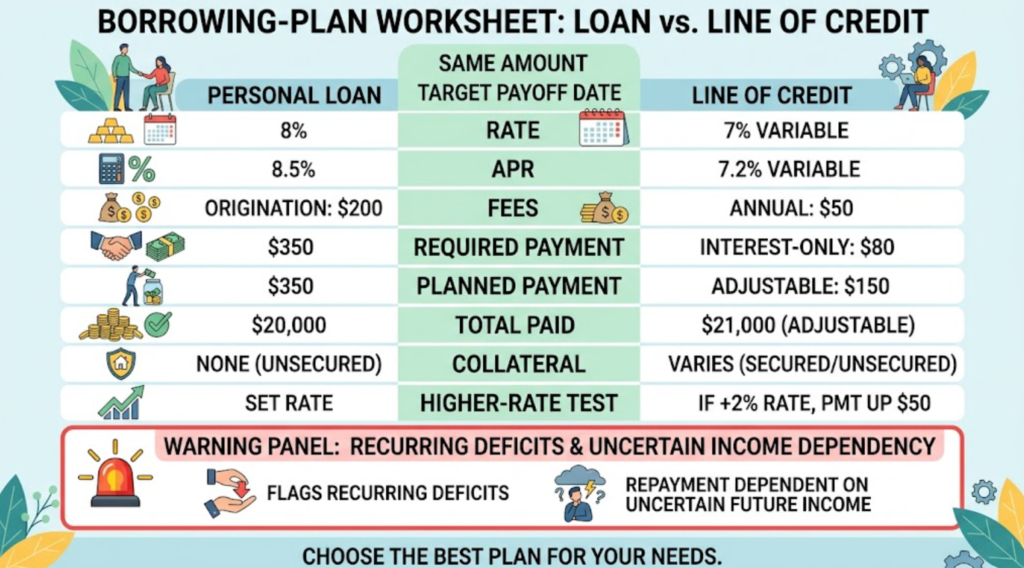
To compare fairly, use the same amount and target payoff date for both products.
For each option, record:
- amount borrowed;
- annual interest rate and APR or comparable annual-cost measure;
- fixed or variable status;
- index and margin, if applicable;
- all mandatory fees;
- optional products included in the quote;
- required payment;
- planned payment;
- number of payments to zero;
- total interest and total paid under that plan;
- collateral and default consequence;
- early-payment terms; and
- whether more borrowing remains available.
Do not compare a three-year personal loan with a line of credit receiving minimum payments. That compares two repayment behaviors as much as two products. Give the line the same planned payoff date and calculate the payment required to reach it.
If the line’s rate can change, run at least one higher-rate scenario. Article”Fixed vs. Variable Interest Rates” will explain fixed and variable rates, while Article”How Loan Terms Change the Total Cost“ will show how term and payment timing change total cost.
Warning Signs That Neither Product Solves the Problem
- the money will cover recurring essential expenses with no income or spending change;
- the amount needed is still unknown because the purchase has not been defined;
- repayment depends on an unconfirmed bonus, sale, refinancing, or investment gain;
- the household must use one credit product to make another product’s minimum payment;
- the loan is being presented as urgent before written terms can be reviewed;
- collateral loss would make the household unsafe;
- the borrower cannot explain when and how the balance reaches zero; or
- an existing line repeatedly returns to its limit after repayment.
Borrowing can bridge timing. It cannot permanently repair a structural cash-flow deficit. In that situation, the useful next step may be to reduce or delay the purchase, negotiate the expense, seek benefits or assistance, sell an asset, change the project scope, or obtain qualified nonprofit credit counseling appropriate to the country.
A Practical Selection Process
- Name the purpose. Write the purchase or cash shortfall in one sentence.
- Estimate the amount. Separate a confirmed amount from a maximum possibility.
- Map the timing. Identify whether funds are needed once or in stages.
- Choose a payoff date. Do this before seeing the lender’s minimum payment.
- Calculate affordable principal reduction. Leave room for essential and irregular expenses.
- Collect written offers. Include at least one alternative when practical.
- Normalize the comparison. Use the same borrowed amount and payoff date.
- Stress the rate. Test a higher payment when the rate can change.
- Identify collateral. State exactly what can be lost or claimed.
- Create access rules. If choosing a line, define eligible withdrawals and an internal limit.
- Read exit terms. Confirm early repayment, closure, demand, renewal, and sale-related rules.
- Wait before drawing. Approval is available capacity, not evidence that the purchase is wise.
The better product is the one whose structure supports the household’s repayment behavior at an acceptable total cost and consequence. Sometimes that is a personal loan. Sometimes it is a line of credit. Sometimes the comparison shows that the expense should wait.
FAQ
Is a line of credit always cheaper than a personal loan?
No. A line may have a lower stated rate, but its rate can change, fees may apply, and flexible minimum payments may keep the balance outstanding longer. Compare total cost using the same amount and payoff date.
Does interest apply to the full line-of-credit limit?
Interest is generally charged on the amount drawn, not the unused limit. Confirm the contract, including fees that may apply even when little or no money is borrowed.
Is a personal loan always fixed rate?
No. Personal loans may have fixed or variable rates. Read the disclosure to learn whether and how the rate or payment can change.
Can I use a line of credit to buy a used car?
It may be possible, but compare the line with the actual auto-financing offer. Include variable-rate risk, fees, incentives, collateral, required payments, and the payment needed to clear the line by a chosen date.
What is the danger of making only the minimum line-of-credit payment?
Depending on the contract, the minimum may reduce principal slowly or primarily cover interest and charges. Continued withdrawals can offset repayment. Calculate a separate principal payment tied to a target payoff date.
Is a home equity line of credit just a regular line with a lower rate?
No. A HELOC is secured by the home. The lower rate may come with appraisal, registration, demand, repayment, sale, and default consequences that an unsecured product does not share.
Should I accept the largest credit limit offered?
Not automatically. The lender’s limit is not a spending recommendation. Set a smaller internal borrowing limit based on the purpose, repayment date, essential expenses, and a higher-rate test.
Sources
- Personal Loans — Financial Consumer Agency of Canada
- Lines of Credit — Financial Consumer Agency of Canada
- Home Equity Lines of Credit — Financial Consumer Agency of Canada
- Borrowing Against Home Equity — Financial Consumer Agency of Canada
- What Is a Personal Line of Credit? — Consumer Financial Protection Bureau
- What Should I Look for When Shopping for a Personal Line of Credit? — Consumer Financial Protection Bureau
- What Is a Home Equity Line of Credit? — Consumer Financial Protection Bureau
More in This Cluster: Borrowing and Personal Loans
- Personal Loan vs. Line of Credit: How to Choose (you are here)
- Fixed vs. Variable Interest Rates: What Risk Are You Choosing?
- How Loan Terms Change the Total Cost
- What to Check Before Accepting a Loan Offer
- Good Debt vs. Bad Debt: A More Useful Framework
- When Borrowing for a Major Purchase May Be Reasonable
- How to Compare Early-Payment and Penalty Terms