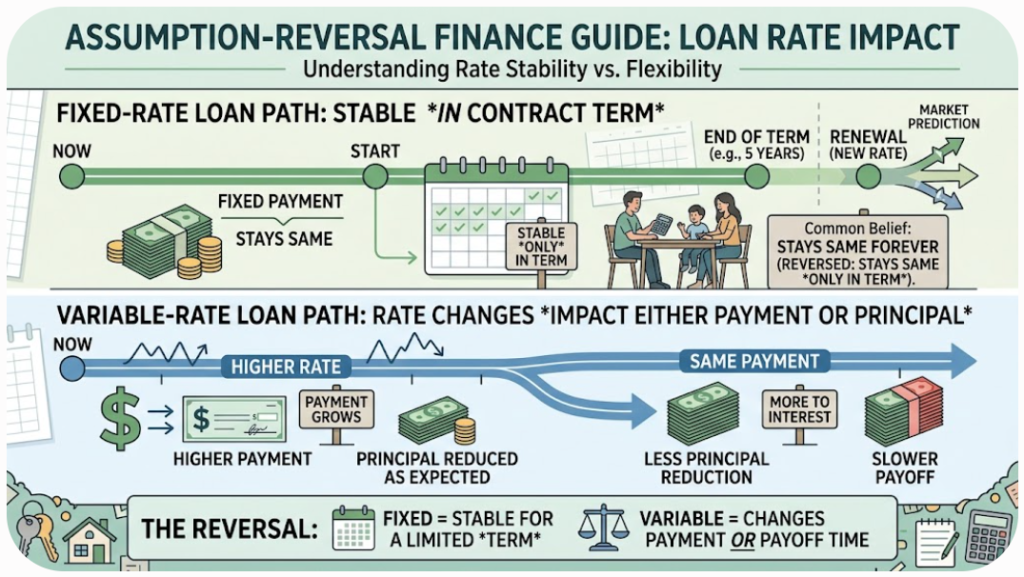
A fixed rate does not always fix the cost of a debt until the balance reaches zero. It fixes the rate for the period stated in the agreement. If the loan must be renewed, refinanced, or replaced before it is fully repaid, a different rate may apply later.
A variable rate does not always cause the scheduled payment to change immediately. Some contracts recalculate the payment when the rate changes. Others may temporarily keep the payment stable while changing how much goes to interest and principal.
The familiar choice between “certainty” and “risk” is therefore incomplete. Both products contain uncertainty. The important question is where that uncertainty sits—and whether the household can absorb it.
Quick decision: Prefer fixed-rate borrowing when payment or interest-cost stability during the stated period is worth the offered premium and the household has little room for increases. Consider variable-rate borrowing only when you understand the reference rate, lender margin, adjustment rules, payment response, maximum exposure, and exit terms—and can afford a higher-rate scenario without depending on rates to fall.
Fixed and Variable Describe a Contract Feature
The labels do not tell you whether a loan is affordable, inexpensive, secured, flexible, or appropriate. They describe how the interest rate behaves during a specified period.
Fixed rate
A fixed interest rate remains the same for the period defined by the contract. Depending on the product and country, that period may be the entire repayment life or a shorter term followed by renewal.
The structure can provide:
- predictable interest calculations during the fixed period;
- stable principal-and-interest payments when the contract is designed that way;
- protection from market-rate increases during that period; and
- easier household budgeting.
The borrower may pay a higher opening rate than an available variable offer. Fixed-rate contracts may also contain prepayment, break, refinance, or transfer terms that affect flexibility. Article”How to Compare Early-Payment and Penalty Terms“ will examine those exit conditions.
Variable rate
A variable rate can increase or decrease according to the contract. It is often built from a reference rate or index plus a lender-set margin. FCAC gives the example of a Canadian HELOC priced at the lender’s prime rate plus a percentage. CFPB describes an adjustable-rate mortgage as using an index and margin to determine changes.
The structure can provide:
- a lower opening rate than a comparable fixed offer in some markets;
- lower interest expense if the applicable reference rate falls and other terms remain unchanged;
- easier or different prepayment terms in some products; and
- rate exposure that shifts from the lender to the borrower.
The opening advantage is not guaranteed to last. A variable loan should be evaluated at rates above the starting rate, not only at the rate shown on application day.
Identify the Reference Rate and Margin
“Variable” is not a complete formula. Find the contract language that determines the rate.
It may look like:
Reference rate + lender margin = borrower rate
For example, if a contract states “prime + 1.00%,” a prime rate of 5.00% would produce a 6.00% borrower rate. If prime rose to 6.00% while the margin remained unchanged, the borrower rate would become 7.00%.
This is an illustration, not a current quote or forecast.
Ask:
- What exact reference rate or index is used?
- Who publishes or sets it?
- What is the lender’s margin?
- Can the margin change, or only the reference rate?
- How often can the rate adjust?
- Is there a delay between index movement and loan adjustment?
- Is there a periodic or lifetime cap?
- Is there a minimum or floor?
- Does an introductory rate later reset?
- What happens if the reference rate is discontinued?
Two offers described as “prime plus” are not necessarily equal. Lenders may use their own prime rates, margins may differ, and adjustment or conversion terms may change the result.
Find Out What Changes When the Rate Changes
The rate is only the first moving part. The agreement should explain how a change affects repayment.
Payment changes
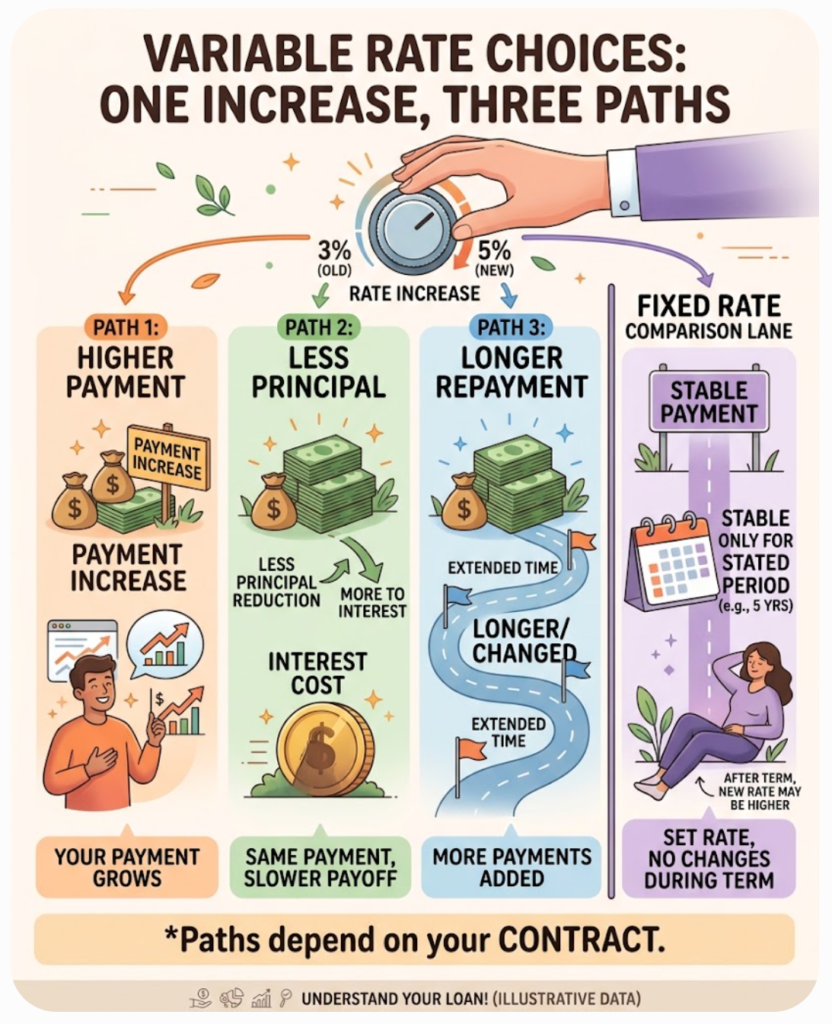
Some variable-rate loans recalculate the required payment so the debt remains on its intended repayment path. If the rate rises, the required payment may rise. If it falls, the payment may fall, subject to contract rules.
The household experiences the rate change directly in monthly cash flow. This structure makes the cost increase visible, but the new payment may arrive when other expenses are also high.
Payment remains fixed while allocation changes
Some variable-rate products may keep the scheduled payment stable for a period. When the rate rises, more of each payment goes to interest and less to principal. FCAC warns that with some fixed-payment variable-rate mortgages, the borrower can reach a point where none of the payment reduces principal; in some circumstances, the amount owed may increase.
Stable payment therefore does not always mean stable progress.
Repayment period changes
Depending on the contract, a higher rate may lengthen the time needed to repay, trigger a higher payment later, require an additional payment, or create difficulty at renewal. Do not assume the lender will preserve the original payoff date without changing another term.
Fixed Rate Buys a Defined Kind of Certainty
The difference between a fixed and variable opening rate can be viewed as the price of transferring rate risk to the lender for a stated period. That price may be worthwhile when certainty protects an important household boundary.
Fixed may fit better when:
- the required payment already uses much of the household’s available cash flow;
- income is stable in amount but leaves little monthly surplus;
- the borrower would lose sleep or make disruptive decisions after rate increases;
- the debt is large relative to income;
- the fixed period covers most or all of the planned repayment;
- the borrower values a known budget more than possible savings; or
- the household cannot make extra principal payments if rates rise.
This does not mean the borrower should accept any fixed offer. A high fixed rate, expensive fees, restrictive prepayment clause, or unnecessarily long borrowing period can still make the loan unsuitable.
Certainty also has a boundary. If a mortgage has a 25-year amortization but a five-year fixed term, the rate is fixed for five years—not 25. Renewal creates a future pricing decision.
Variable Rate Requires Capacity, Not Confidence
A variable rate should not be chosen merely because someone believes rates will fall. Forecasts can be wrong, and the household still owes the debt while waiting.
Variable may be workable when:
- the payment at a meaningfully higher rate still fits comfortably;
- the borrower holds adequate cash reserves outside the credit facility;
- income can absorb volatility without cutting essential expenses;
- the balance is small or will be repaid quickly;
- extra principal can be paid without unacceptable penalties;
- the borrower understands how the payment or amortization responds; and
- the contract’s cap, conversion, and exit rules are acceptable.
The capacity test should be numerical. Replace “I think rates will stay manageable” with “At this higher test rate, the required or planned payment would be ___, leaving ___ after essential and irregular expenses.”
Do not use the lender’s qualification result as the stress test. Approval answers whether the lender will extend credit under its model. The household must decide whether it can carry the debt while preserving its own priorities.
From Jerome: A Long Debt Contains More Than One Rate Decision
From Jerome, EverydayWise Contributor
When I bought a home in Canada, I took a mortgage with a 25-year repayment horizon. I do not choose the interest rate once for all 25 years. The mortgage is renewed periodically, so the rate and the available choices return as real decisions.
I also have a line of credit connected to the banking arrangement made when the mortgage was established. The line has been useful for business investment and used-car purchases, especially when another financing offer had a higher rate. Its convenience makes the current rate important, but it also makes repayment discipline important because the money can be borrowed again so easily.
Jerome’s account separates three timelines that are often collapsed into one: the life of the debt, the period for which a rate is set, and the period over which a household plans to repay a particular withdrawal. The exact legal structure of his line is not established by the experience provided, so it should not be assumed to be a HELOC or any other specific product.
His experience also does not establish that variable credit is cheaper over time. It shows that he compared the rate available on his line with a used-vehicle offer at a particular moment. The result can change when the line’s rate changes, repayment takes longer than expected, or fees and incentives differ.
Compare Fixed and Variable on the Same Plan
Do not compare a fixed offer using its scheduled payoff with a variable offer using only the current minimum payment. Choose the same amount and target repayment date.
For each offer, record:
- amount borrowed;
- opening rate;
- whether the rate is fixed for the whole repayment or only a term;
- reference rate, margin, floor, and cap;
- adjustment frequency;
- required payment at the opening rate;
- required or planned payment at higher test rates;
- expected principal after one, two, and three years;
- mandatory fees and optional products;
- prepayment and conversion rules;
- collateral; and
- balance or renewal exposure when the fixed period ends.
The initial rate matters, but so does the path. A variable rate that begins lower and rises early may cost more than expected. A fixed rate may cost more if rates fall, but the difference purchased budget stability. Neither outcome proves that the original decision was foolish; the quality of the decision depends on the information, capacity, and trade-offs at the time.
Run More Than One Rate Scenario
A single forecast creates false precision. Use scenarios instead.
Suppose a borrower is comparing a fixed rate of 7.0% with a variable rate starting at 5.5%. The exact payment depends on the amount, repayment method, compounding, fees, and product. Rather than declaring the 1.5-percentage-point opening difference a saving, test at least:
- Lower scenario: the variable rate declines;
- Stable scenario: the variable rate remains near its opening level;
- Higher scenario: the rate rises enough to challenge the budget; and
- Early-shock scenario: the increase happens sooner than expected.
For each scenario, calculate or obtain from the lender:
- payment changes;
- interest paid during the comparison period;
- principal remaining;
- effect on the target payoff date; and
- action required to keep the debt on track.
The purpose is not to predict which path will occur. It is to determine whether any plausible path creates a household failure.
If the plan works only in the lower-rate scenario, the borrower is relying on a market outcome rather than selecting a resilient loan.
Account for Rate Resets and Renewals
Borrowers often focus on the opening rate because it determines today’s payment. Long-lived debts require attention to the next decision point.
Before accepting the product, identify:
- the date the fixed period, introductory rate, or initial adjustment rule ends;
- what rate applies afterward;
- whether the lender can change the margin;
- what notice will be provided;
- whether the loan can be converted, refinanced, transferred, or repaid;
- what fees or penalties apply; and
- what balance is expected at that date.
For mortgages, country structures differ substantially. In Canada, a mortgage term can be shorter than the amortization period, creating renewal exposure. In the United States, many fixed-rate mortgages set the interest rate for the life of the loan, while adjustable-rate mortgages follow their adjustment rules. Do not transfer terminology or assumptions from one country to another.
Build a Response Plan Before Rates Move
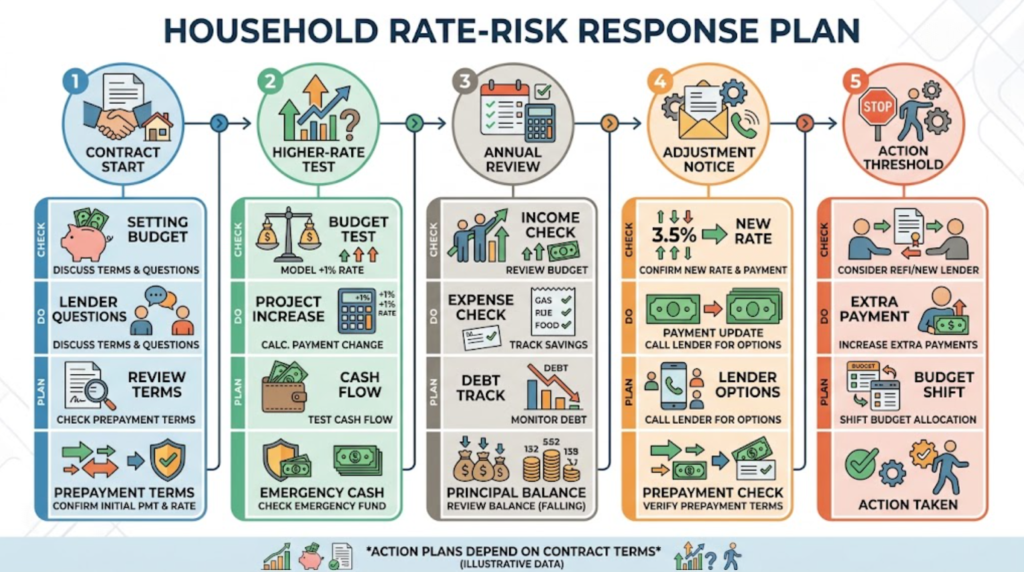
A variable-rate borrower should decide what to do at specific thresholds rather than improvising after a notice arrives.
Possible actions include:
- increase the payment while the budget still has room;
- direct a permitted lump sum to principal;
- stop new line-of-credit withdrawals;
- reduce or delay a nonessential expense;
- preserve additional cash reserves;
- ask the lender how the payment, allocation, or amortization has changed;
- compare conversion or refinance terms without assuming they are beneficial; and
- seek qualified nonprofit credit counseling before missed payments occur.
Do not make a large emergency prepayment without checking the contract, near-term cash needs, and prepayment terms. A household can reduce debt and still create a new cash shortfall if it empties the funds needed for essential expenses.
Fixed-rate borrowers also need a response plan. Track the end of the fixed period, estimate the balance at renewal, and begin comparing choices before a deadline limits negotiating time.
Warning Signs in a Rate Comparison
Pause when:
- the lender or salesperson discusses only the opening rate;
- the variable formula cannot be explained in plain language;
- the quote omits the margin, adjustment timing, floor, or cap information available under the agreement;
- affordability depends on rates falling;
- the payment is stable but no one can explain the principal trajectory;
- the fixed period ends long before the household expects to repay;
- the borrower must use credit to cover the stressed payment;
- conversion is described as guaranteed savings without written terms; or
- a promotional rate is compared with another product’s regular rate.
An understandable contract is not automatically a good contract, but an incomprehensible rate mechanism is not ready for acceptance.
A Practical Choice Framework
- Define the amount and target payoff date.
- Identify how long each offered rate is actually fixed.
- Write the complete variable-rate formula.
- Determine how rate changes affect payment, principal, and repayment time.
- Compare mandatory fees and collateral.
- Test at least one meaningfully higher rate.
- Calculate the cash remaining after the stressed payment.
- Identify renewal, conversion, and prepayment terms.
- Decide the action threshold before signing.
- Choose based on household capacity and the value of certainty—not a prediction alone.
A fixed rate exchanges possible savings for defined stability during a stated period. A variable rate accepts changing costs in exchange for a different opening price or flexibility. The better choice is the one the household can carry through an unfavorable scenario without sacrificing essential stability.
FAQ
Is a fixed rate always higher than a variable rate?
No. Fixed rates may be higher than comparable variable rates in some markets, but pricing changes by product, lender, borrower, term, and market conditions. Compare current written offers rather than relying on a general rule.
Does a fixed rate mean my payment can never change?
Not necessarily. The interest rate may be fixed only for a stated term, and other components of a total payment may change. A renewed or refinanced debt may receive a new rate. Read the product-specific agreement.
If my variable-rate payment stays the same, am I protected from rate increases?
No. More of the payment may go to interest and less to principal. In some structures, repayment can lengthen, a later payment may rise, or the balance may increase. Ask for the updated principal trajectory.
What are an index and margin?
The index or reference rate moves with the measure identified in the contract. The margin is an added percentage set under the lender’s terms. Together they commonly determine the borrower rate.
Should I choose variable if I think rates will fall?
A forecast can inform but should not control the decision. Test whether the household can afford a higher-rate path. If the plan works only when rates fall, it is not resilient.
Can I switch from variable to fixed later?
Some contracts allow conversion, but availability, timing, new rate, fees, term, and prepayment conditions vary. A conversion option is not a guarantee that switching later will be inexpensive or advantageous.
How high should I stress-test a variable rate?
There is no universal percentage. Use the contract’s caps where applicable, lender illustrations, relevant regulatory qualification tests, and a rate meaningfully above the opening offer. The goal is to expose a household cash-flow failure, not predict the market.
Sources
- Managing Your Money When Interest Rates Rise — Financial Consumer Agency of Canada
- Lines of Credit — Financial Consumer Agency of Canada
- Home Equity Lines of Credit — Financial Consumer Agency of Canada
- Choosing a Mortgage That Is Right for You — Financial Consumer Agency of Canada
- Interest on Mortgages — Financial Consumer Agency of Canada
- Fixed-Rate and Adjustable-Rate Mortgages — Consumer Financial Protection Bureau
- ARM Index and Margin — Consumer Financial Protection Bureau
- What to Check in an Adjustable-Rate Mortgage — Consumer Financial Protection Bureau
More in This Cluster: Borrowing and Personal Loans
- Personal Loan vs. Line of Credit: How to Choose
- Fixed vs. Variable Interest Rates: What Risk Are You Choosing? (you are here)
- How Loan Terms Change the Total Cost
- What to Check Before Accepting a Loan Offer
- Good Debt vs. Bad Debt: A More Useful Framework
- When Borrowing for a Major Purchase May Be Reasonable
- How to Compare Early-Payment and Penalty Terms