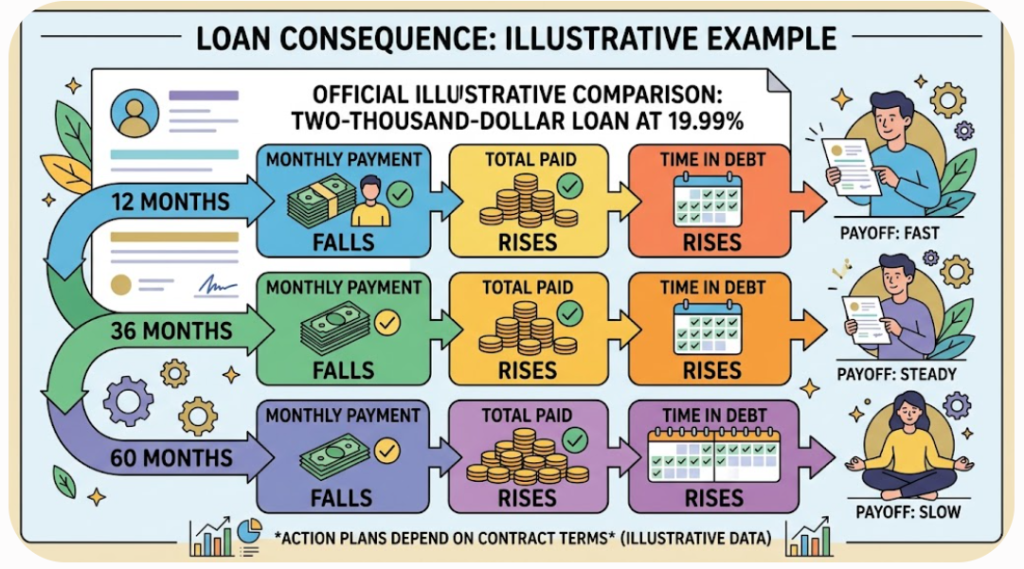
In an official Financial Consumer Agency of Canada example, the same $2,000 personal loan carries a 19.99% rate under three repayment choices. The 12-month option requires about $185 a month and costs $2,220 in total. Stretching the loan to 60 months lowers the payment to about $53—but raises the total cost to $3,180.
The monthly obligation falls by $132. The borrower pays $960 more overall and remains in debt four years longer.
Nothing in that comparison makes the longer term automatically wrong. A payment the household cannot make is not improved by a lower total cost on paper. But the consequence is clear: lowering the payment by extending time can be a purchase of cash-flow relief, and its price should be measured.
Quick decision: Compare loans using amount borrowed, all mandatory costs, payment, number of payments, total of payments, and balance over time. Choose the shortest repayment period whose required payment remains sustainable after essential and irregular expenses—not the shortest possible term or the lowest displayed payment.
A Loan Has More Than One Time Period
Borrowing language can become confusing because “term” does not mean exactly the same thing in every product or country.
For a typical personal or auto loan, the term often describes the number of months scheduled to repay the balance. For some mortgages, especially in Canada, the mortgage term is the period covered by the current contract, while the amortization period is the longer estimated time needed to repay the mortgage in full. A 25-year amortization may contain several shorter terms and renewals.
Before comparing offers, identify:
- Repayment period: How long the scheduled payments take to clear the debt under stated assumptions.
- Contract or rate term: How long the current agreement or rate applies.
- Payment frequency: Weekly, biweekly, semimonthly, monthly, or another schedule.
- Deferral or introductory period: Time before regular principal-and-interest repayment begins.
- Balloon or residual amount: Any balance still due after scheduled payments.
- Renewal or reset date: When price or other terms may change.
Do not treat a five-year term, five-year amortization, and five-year fixed-rate period as interchangeable. The agreement must show what ends after five years and what remains owed.
Why More Time Usually Means More Interest
Interest is the cost of using the lender’s money. When principal remains outstanding longer, the borrower generally pays interest on that balance for more periods.
In an amortizing loan, each scheduled payment is allocated according to the contract. CFPB explains that early in many amortizing auto loans, a greater portion of the payment generally goes to interest; later, a greater portion goes to principal. The amortization schedule shows this path.
A longer repayment period usually changes several things at once:
- required payment decreases;
- principal declines more slowly;
- interest has more time to accumulate;
- total interest increases when other terms are equal;
- the debt remains exposed to income disruption for longer; and
- the financed asset may lose value while the balance is still high.
This relationship assumes the same amount, rate structure, fees, and payment method. A shorter offer with a much higher rate or fee is not automatically cheaper. Compare complete written terms.
Read the Total of Payments
The monthly payment answers one question: what is due during a payment period? It does not answer what the credit costs.
For a fixed-payment installment loan, a first approximation is:
Scheduled payment × number of scheduled payments = total of scheduled payments
Then determine whether that figure includes every mandatory fee, financed add-on, final payment, and charge. Subtract the amount that actually pays for the purchase or is delivered to the borrower to see how much the financing adds, subject to the contract’s definitions.
The calculation becomes less certain when:
- the rate is variable;
- payments may be deferred;
- fees are charged separately;
- the borrower can redraw funds;
- a balloon payment remains;
- optional products are financed;
- late or returned payments occur; or
- the borrower plans to repay early.
In those cases, compare scenarios and ask the lender for the applicable disclosure or amortization schedule. Article”What to Check Before Accepting a Loan Offer“ will cover the full loan-offer review.
The Payment Can Hide the Purchase Price
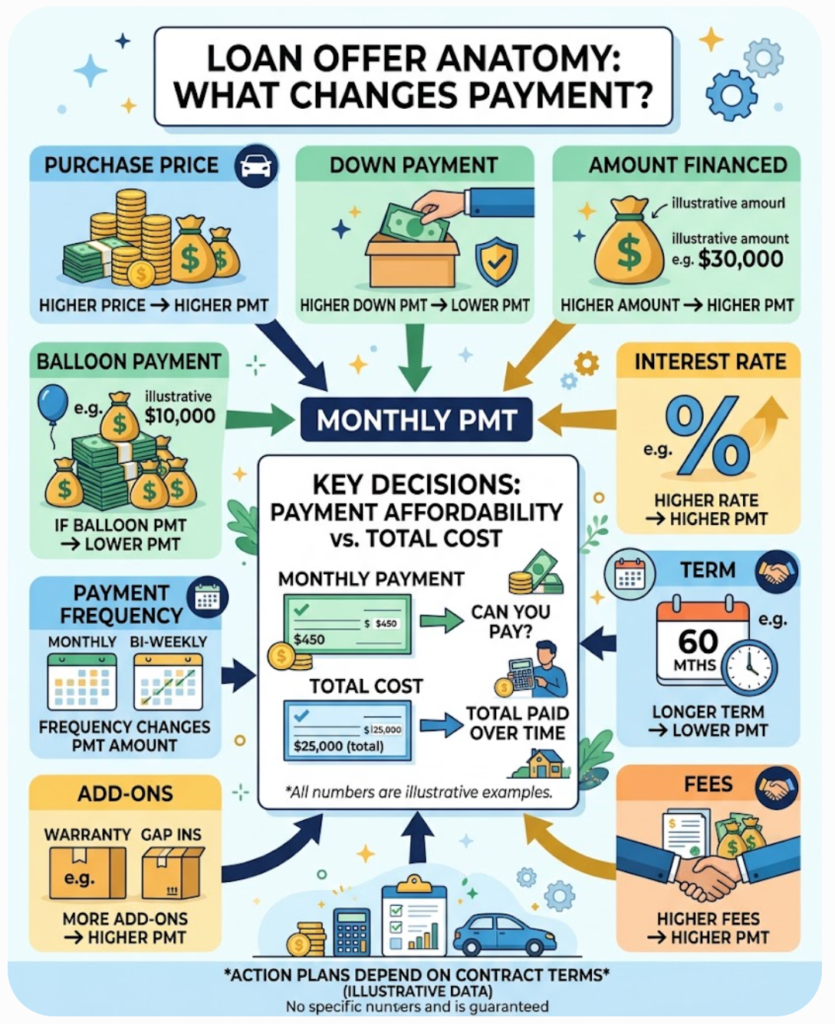
A seller or lender may begin with “What monthly payment do you want?” That question can be useful for budgeting, but it can also allow several costs to move unnoticed.
A lower target payment may be created by:
- extending the term;
- increasing a down payment;
- moving a trade-in value;
- adding a balloon or residual amount;
- changing the rate;
- removing or adding products;
- deferring the first payment; or
- changing payment frequency.
Negotiate or compare the purchase price, amount financed, rate, fees, add-ons, and repayment length separately. A payment that “fits” can still include an overpriced asset, unwanted insurance, or years of additional interest.
CFPB advises auto-loan shoppers to look beyond the monthly payment. In one CFPB illustration, paying a $20,000 auto loan over three years produces $1,498 in interest, while six years produces $3,024—more than twice as much interest. The page’s lesson is about term length; a reader should not transplant those figures to another offer without matching the underlying assumptions.
Shorter Is Not Always Safer
Paying principal faster generally reduces interest when other terms remain the same. That does not mean every borrower should select the highest possible payment.
A term is too short when the required payment predictably forces the household to:
- miss rent, mortgage, utilities, food, insurance, or other essentials;
- use a credit card or line of credit for ordinary bills;
- stop maintaining a necessary asset;
- eliminate all emergency cash;
- depend on overtime or a bonus that is not reliable; or
- miss payments after a normal irregular expense.
Missed payments can create fees, collection activity, credit damage, default, and loss of collateral. Those consequences may exceed the interest saved by choosing an unrealistic schedule.
The objective is not the mathematically shortest term. It is the shortest sustainable term: a schedule that makes meaningful principal progress while leaving the household able to operate.
Longer Can Be a Deliberate Trade-Off
A longer period may be reasonable when it protects essential cash flow, but the decision should name its cost and include a plan.
For example, a household might choose a longer required term but plan voluntary extra principal payments when allowed. That structure can provide a lower contractual minimum during a difficult month while permitting faster repayment in stronger months.
It works only if:
- the contract permits extra payments on acceptable terms;
- extra money is actually directed to principal;
- the lender applies payments as expected;
- the borrower does not repeatedly redraw the amount;
- the rate and fees do not erase the benefit; and
- the household reviews progress against a target date.
Do not assume the right to prepay without cost. Mortgage, personal-loan, auto-loan, and student-loan rules differ by contract and jurisdiction. Article”How to Compare Early-Payment and Penalty Terms“ owns that analysis.
Watch the Balance, Not Only the Payment
A loan can feel manageable while the balance declines too slowly for the asset or purpose.
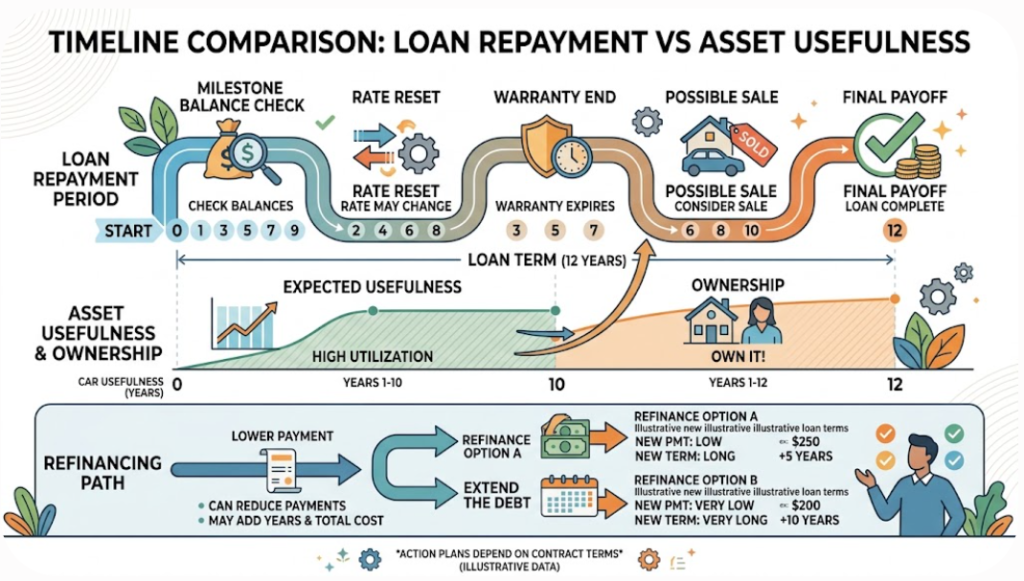
Check the projected balance at practical milestones:
- after 12 months;
- when a warranty ends;
- when the borrower may sell or replace the asset;
- at a mortgage renewal;
- when an introductory rate ends; and
- at the household’s own target payoff date.
For a vehicle, a long term increases the chance of negative equity—owing more than the vehicle is worth. CFPB and FCAC both warn that longer auto-loan terms can lower payments while increasing interest and the risk that the debt outlasts the useful or economic value of the vehicle.
Negative equity does not automatically require immediate sale or extra payment. It becomes especially important when the borrower needs to sell, trade, replace, or refinance the vehicle. Rolling an unpaid balance into another loan can increase the next amount financed.
For education, business equipment, renovations, or another purchase, ask whether the benefit is likely to remain useful while payments continue. A debt that survives the thing it financed can narrow future choices.
Payment Frequency: Confirm the Annual Amount
“Biweekly” and “accelerated biweekly” are not always the same schedule.
A standard biweekly payment may simply divide the annual required amount into 26 payments. An accelerated structure may collect half of a monthly payment every two weeks, which results in the equivalent of an extra monthly payment over a year. FCAC notes that accelerated mortgage payments can reduce interest because more money is paid toward the mortgage annually.
Before treating a frequency as savings, compare:
- total paid per year;
- how quickly principal is applied;
- fees for the schedule;
- whether interest accrues daily, monthly, or by another method;
- whether extra amounts are permitted; and
- whether the payoff date actually changes.
More frequent labels do not create savings by themselves. Paying more principal earlier can.
Deferrals and Skipped Payments Usually Move Cost
A payment deferral can provide necessary short-term relief. It usually does not erase the payment or interest.
Depending on the agreement, deferred interest may:
- continue accruing;
- be added to the balance;
- increase later payments;
- extend the repayment period; or
- become due at another point.
Ask for the post-deferral balance, new payment, new payoff date, and total additional cost in writing. If the relief changes a secured loan, also ask how it affects renewal or default status.
FCAC warns that extending mortgage amortization to reduce payments increases interest cost and may add thousands or tens of thousands of dollars. Relief can still be appropriate when it prevents default or protects essential needs. Its cost should be visible rather than mistaken for forgiveness.
Refinancing Resets the Clock
Refinancing can lower a rate or required payment. It can also extend the debt, add fees, or move unpaid costs into a new principal balance.
Compare the remaining old loan with the proposed new loan from today forward. Do not compare the new payment only with the original payment.
Record:
- current payoff amount;
- remaining payments and expected remaining interest;
- prepayment or discharge cost;
- new amount financed;
- new rate and APR or comparable annual-cost measure;
- all new fees;
- new number of payments;
- total of new payments; and
- date the debt will end under each option.
A lower rate can still produce a higher future cost if the balance is stretched across enough additional years. Conversely, a refinance can be useful if the savings exceed costs and the borrower preserves or shortens the payoff timeline.
Separate Loan Term From Ownership Horizon
Ask how long the household expects to keep the financed asset.
If the likely ownership period is three years, a seven-year vehicle loan deserves a specific exit analysis. If a home may be sold before a fixed mortgage term ends, transfer and prepayment terms matter. If equipment will become obsolete before its loan ends, the business could pay for an asset it can no longer use.
The debt does not need to be shorter than the asset’s life in every case. But the mismatch must be intentional and affordable, with a plan for the remaining balance.
The same principle applies when borrowing finances consumption rather than an asset. If the event or purchase is over immediately, the remaining payments compete with future needs without providing a saleable resource.
A Five-Number Comparison
Before accepting a term, place these five numbers side by side for every offer:
- Amount financed: The principal created after down payment, trade-in, fees, and financed add-ons.
- Required payment: The contractual amount and frequency.
- Number of payments: Include any final or balloon payment.
- Total of payments: What scheduled payments add up to under stated assumptions.
- Projected balance at a decision date: What remains when the household may renew, sell, trade, refinance, or need the payment capacity back.
Then add the nonnumeric consequences: collateral, flexibility, missed-payment risk, prepayment terms, and whether the financed benefit remains useful.
A Practical Term-Selection Process
- Confirm the purchase price and amount financed.
- Collect at least two term options using the same rate and fees when possible.
- Calculate the total of payments for each.
- Identify the interest and mandatory financing cost.
- Review an amortization schedule or projected balance.
- Test the higher payment against essential and irregular expenses.
- Check whether the asset may be sold or replaced before payoff.
- Verify prepayment, deferral, balloon, renewal, and refinance terms.
- Reject a term that works only with uncertain income.
- Choose the shortest schedule that remains sustainable under ordinary disruption.
The payment is the entry price to the household budget. The term determines how long the obligation remains and how much opportunity it has to collect interest. A sound comparison needs both views.
FAQ
Why does a longer loan usually cost more?
Principal remains outstanding for more payment periods, giving interest more time to accrue. The required payment may fall, but total interest generally rises when the amount, rate, fees, and repayment method are otherwise equal.
Is the shortest available term always best?
No. A term that makes the payment unsustainable can cause missed payments, new borrowing, or loss of essential cash. Choose the shortest term that fits after essential and irregular expenses with a workable buffer.
What is an amortization schedule?
It shows scheduled payments over time and how each is allocated to principal and interest, along with the remaining balance. Confirm that it reflects the actual rate, fees, payment timing, and variable-rate assumptions.
Can I take a long term and pay it off early?
Possibly, but the contract controls. Check prepayment limits, penalties, how extra payments are applied, and whether optional products or interest calculations change the result.
Does biweekly payment automatically save interest?
No. Compare the total annual amount and when principal is applied. An accelerated schedule may save interest because it pays the equivalent of an extra monthly amount annually; a simple frequency change may not.
How does a balloon payment affect total cost?
It lowers some earlier payments by leaving a balance due later. Include the balloon in the total of payments and plan how it will be paid without assuming refinancing will be available.
When can a longer term be reasonable?
It may be reasonable when the lower required payment protects essential cash flow and the total cost, collateral risk, asset life, and repayment plan remain acceptable. The trade-off should be explicit.
Sources
- Personal Loans — Financial Consumer Agency of Canada
- Shopping Around for Auto Financing — Financial Consumer Agency of Canada
- Mortgage Terms and Amortization — Financial Consumer Agency of Canada
- Paying Off Your Mortgage Faster — Financial Consumer Agency of Canada
- Compare Auto Loan Offers — Consumer Financial Protection Bureau
- What Is Amortization and How Could It Affect My Auto Loan? — Consumer Financial Protection Bureau
- Auto Loan Key Terms — Consumer Financial Protection Bureau
- How Mortgage Lenders Calculate Monthly Payments — Consumer Financial Protection Bureau
More in This Cluster: Borrowing and Personal Loans
- Personal Loan vs. Line of Credit: How to Choose
- Fixed vs. Variable Interest Rates: What Risk Are You Choosing?
- How Loan Terms Change the Total Cost (you are here)
- What to Check Before Accepting a Loan Offer
- Good Debt vs. Bad Debt: A More Useful Framework
- When Borrowing for a Major Purchase May Be Reasonable
- How to Compare Early-Payment and Penalty Terms