Quick Summary
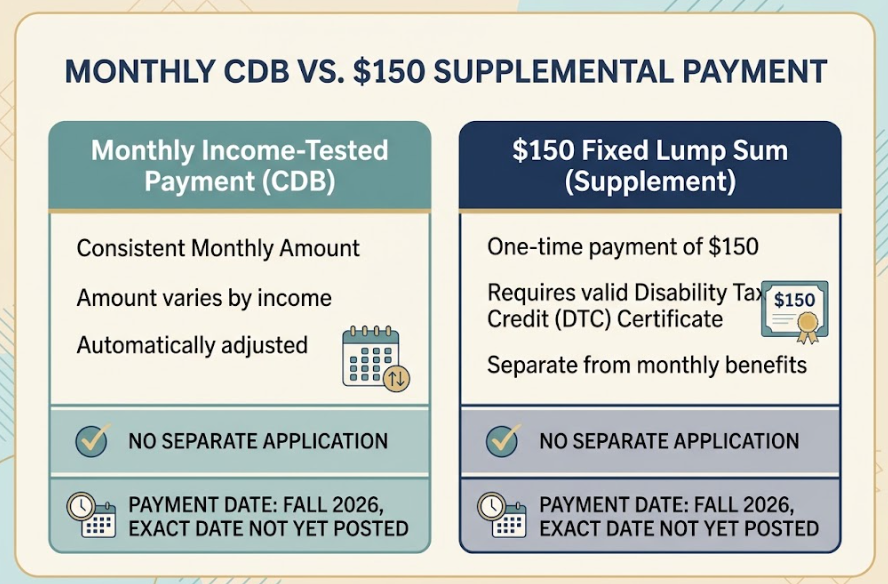
New Canada Disability Benefit regulations took effect on September 1, 2026, allowing the federal government to pay a $150 supplemental amount to eligible program recipients. It is a lump-sum payment, not a permanent $150 increase to the monthly benefit.
You do not need to apply separately for the supplemental payment. A person may qualify for each approved Disability Tax Credit certificate—or later recertification—that results in a Canada Disability Benefit payment. People who received a valid CDB payment before September 2026 remain eligible even if they no longer receive the monthly benefit.
September 1 was the legal effective date, not a promised deposit date. Canada.ca currently says payments will start in fall 2026 but does not publish a specific day on the pages reviewed for this article.
Reader Decision
First confirm whether you have actually received, or become entitled to receive, a Canada Disability Benefit payment based on an approved DTC certificate. Do not submit a separate $150 application or pay anyone to release the money. Keep your address and banking information current with Service Canada and CRA, then watch official Canada.ca information for the payment date.
What Changed on September 1
The government published amendments to the Canada Disability Benefit Regulations in the Canada Gazette on July 1. They came into force on September 1 and created a separate “supplemental amount” fixed at $150.
The ordinary CDB payment—called the allocation in the amended regulations—continues to be based on eligibility and adjusted family net income. For July 2026 through June 2027, the maximum regular benefit is $204.20 per month. The new $150 does not replace that amount, add $150 every month, or change the regular income calculation.
The supplemental payment is intended to help offset costs associated with obtaining the Disability Tax Credit, such as a medical practitioner’s fee or travel to an appointment. It is not a reimbursement claim: recipients do not have to submit a receipt showing that they spent exactly $150.
Who Is Eligible for the $150?
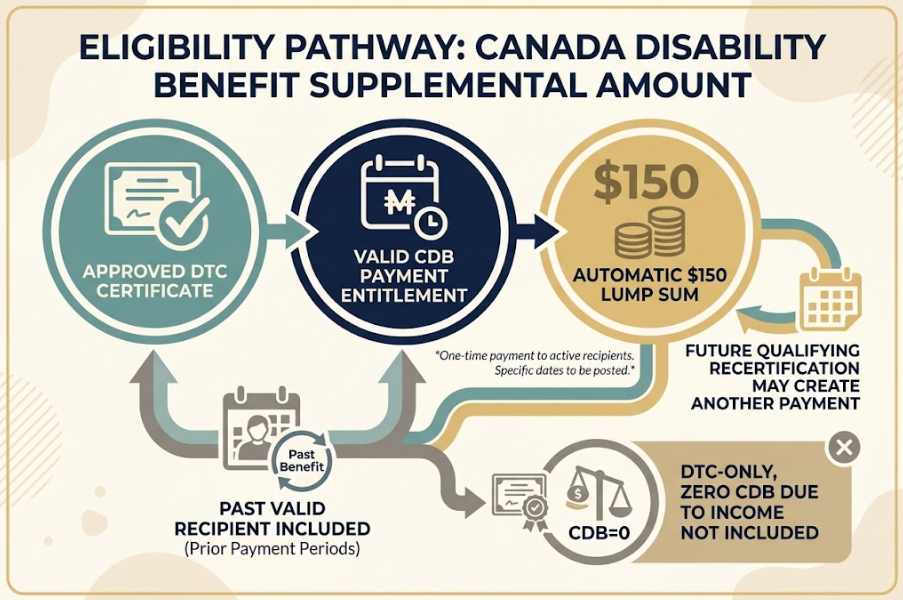
The simplest rule is that an approved DTC certificate must lead to an actual CDB entitlement and payment. Canada.ca says a person is eligible for a supplemental amount for each approved DTC certificate that entitles them to a monthly CDB payment. This includes people whose calculated monthly amount is $20 or less and is therefore paid as one lump sum for the payment period.
The transitional rule also reaches backward. Anyone who received a CDB payment before September 1, 2026, can receive the supplemental amount even if regular payments later stopped. The government gives the example of someone who received a single CDB payment in July 2025.
This makes three important groups:
- current recipients whose approved DTC certificate supports a CDB payment;
- past recipients who properly received a CDB payment before September 2026; and
- future recipients whose approved DTC certification or recertification results in a CDB payment.
The regulations can provide another $150 when a temporary DTC approval expires and a later recertification again produces CDB entitlement. It is therefore better described as one supplemental amount per qualifying certification event, not necessarily one payment for a person’s lifetime.
Who Is Not Included Merely Because They Have the DTC?
DTC approval is necessary for the CDB, but it does not by itself guarantee the supplemental payment. The regulatory explanation says people who meet general program requirements but receive no CDB allocation because their income is too high are not eligible for the $150.
Likewise, someone who has never applied for the CDB does not create a supplemental entitlement simply by holding a DTC certificate. The person must have a CDB payment linked to that certificate. Applying for the $150 is unnecessary, but applying for the underlying CDB may still be necessary for someone who has not entered the program.
Canada.ca also states that supplemental payments are not payable for individuals who died before September 2026. Estate questions involving a death after that point should be directed to Service Canada rather than inferred from the general webpage.
When Will It Be Paid?
The most precise current federal wording is “starting in Fall 2026.” The regulations give the government authority to pay as of September, but the public pages reviewed do not identify a specific deposit or cheque date.
Regular CDB payments normally arrive on the third Thursday of each month. That schedule should not be assumed to be the $150 date unless Service Canada says so. A legal effective date, an administrative payment window, and the day money appears in an account are different milestones.
Recipients can normally receive CDB payments by direct deposit or cheque. Confirm that Service Canada and CRA have the correct address and banking details, especially after a move, account closure, marital-status change, or interruption in regular benefits. Do not change banking information through a link in an unsolicited text or email.
Does the $150 Affect Taxes or Other Benefits?
Canada Disability Benefit payments are non-taxable. Canada.ca says they do not need to be reported as income on a federal income tax return and no CDB tax slip is issued. The amendments also align the regulations with Income Tax Act changes that exclude CDB payments from federal income calculations.
That does not establish how every provincial, territorial, municipal, private insurance, subsidized-housing, or social-assistance program will treat the supplemental amount. Provinces and territories control many of their own programs, and the interaction can differ by jurisdiction.
If another program reduces support based on income or benefit receipts, ask its administrator specifically how the Canada Disability Benefit supplemental amount is classified. Keep the CDB notice and bank record. Do not assume that the treatment of the regular monthly CDB automatically answers every question about a one-time payment.
What If You Do Not Receive It?
Because no exact payment date is currently published, a missing deposit cannot yet be judged simply from September 1. Wait for the announced payment window, then compare your history with the eligibility rule.
Gather:
- your CDB approval and payment letters;
- the date and amount of any earlier CDB payment;
- information about the DTC certificate supporting that payment;
- current direct-deposit or mailing details; and
- any notice explaining why regular payments stopped or changed.
Contact Service Canada through the contact information reached from Canada.ca if the official payment period passes and the amount is missing. A person who received no CDB because adjusted family net income was too high should not assume the missing $150 is an administrative delay.
Watch for Payment Scams
No separate application means no legitimate caller needs an application fee, gift card, cryptocurrency transfer, or “release charge” for this payment. Service Canada says it will not ask for personal information through an unsolicited phone call, text, or email.
Do not follow a sponsored search result or message link to “claim” the $150. Start at Canada.ca or contact the program through an official number. If someone contacts you claiming to be Service Canada, end the interaction and independently contact the program to verify it.
The Practical Takeaway
The new $150 is narrower than a monthly benefit increase but broader than a payment only to people receiving CDB in September. It is an automatic lump sum connected to a DTC certificate that produced a valid CDB payment, including qualifying past recipients and future qualifying certifications.
The regulations are now in force; the exact payment date is still an administrative detail to watch. Confirm your CDB payment history, maintain accurate contact and deposit information, and rely on Canada.ca rather than a message asking you to claim the money.
This newsletter provides general information about a Canadian federal benefit. It is not legal, tax, financial, or individualized eligibility advice. Program guidance, payment timing, and the treatment of this amount by other benefit programs may change. Verify current information with Service Canada, CRA, and any provincial or other program that affects you.
FAQ
Is the regular monthly Canada Disability Benefit increasing by $150?
No. The new amount is a fixed $150 lump-sum supplemental payment. The regular income-tested CDB continues separately.
Do current recipients need to apply for the $150?
No. Canada.ca says no separate application is required for the supplemental payment.
Can a former CDB recipient receive it?
Yes, if the person received a valid CDB payment before September 1, 2026. The government says eligibility can remain even after regular payments stop.
Does every person approved for the DTC receive $150?
No. The DTC certificate must result in entitlement to a CDB payment. A person receiving zero CDB because income is too high is not eligible merely because the DTC is approved.
Will the payment arrive on a regular CDB payment date?
The current official guidance says payments start in fall 2026 but does not identify an exact day. Do not infer the date from the regular third-Thursday schedule.
Is the $150 taxable?
Canada.ca says CDB payments are non-taxable, are not reported as income on the federal tax return, and do not generate a CDB tax slip. Ask other benefit programs how they treat the payment.
Sources
- Government of Canada — About the Canada Disability Benefit Program
- Government of Canada — How Much You Could Receive
- Government of Canada — Canada Disability Benefit Payments
- Canada Gazette — Regulations Amending the Canada Disability Benefit Regulations
- Service Canada — Scam and Fraud Prevention